

Intelligent operations means running the repeatable work of your company, such as intake, document review, reconciliation, follow-up and reporting, with AI agents that read context and make routine decisions, while people handle exceptions and strategy. For a growing company the payoff is simple: volume can rise without a matching rise in headcount. That only happens when the process is redesigned around the outcome, not when a tool is bolted onto an old workflow. We build custom AI agents and digital workforces for exactly this, and this guide explains how to decide where to start, what to expect and how to measure it.
TL;DR
- Intelligent operations combine automation, AI that reads context, and redesigned processes. The redesign is where most of the value sits.
- BCG attributes roughly 70% of the value in AI transformations to people, organization and processes, and only about 10% to algorithms.
- The best first candidates are high-volume, data-heavy, repetitive-but-nuanced processes: document validation, reconciliation, customer inquiries and reporting.
- Baseline your numbers before launch (cost per transaction, cycle time, error rate) and report time saved separately from realized dollars.
- Keep humans in the loop on exceptions and set clear decision authority from day one.
Table of Contents
- What intelligent operations actually are
- Why growth-oriented companies pay attention
- Which processes to start with
- Check readiness before you build
- Measure it like an operator
- Run it safely: data, reliability and oversight
- Where we come in
- Our perspective
- FAQ
- Sources
What intelligent operations actually are
Three layers are often confused, so it helps to separate them.
Traditional automation follows programmed rules. If an invoice arrives in this format, route it there. It is fast and cheap on stable processes, and it breaks the moment the input changes.
Robotic process automation (RPA) is software that imitates a person clicking through screens on rule-based tasks. It is still rule-driven.
Intelligent automation adds machine learning and language understanding on top, so the system can handle tasks that were never explicitly programmed, infer business context and improve with experience. SAP’s overview of intelligent automation draws the same line between rule-based bots and systems that learn.
Intelligent operations go one step further. The technology is only half of it: roles, measures and decisions are redesigned around an outcome (a loan funded, a claim paid, an order shipped), rather than around the steps people used to perform by hand. Automating a process and redesigning it are different jobs, and the second one is what changes your economics.
Academic work helps you place yourself. In a 2021 paper, Boute and Van Mieghem describe levels of digitization, automation and intelligence, and note that companies can either replace manual work with more automation or augment human work through smarter execution. The framework works as an audit: where are your processes today, and where could they be?
Why growth-oriented companies pay attention
A growing company hits a predictable wall. Every new client adds documents to read, records to reconcile, messages to answer and reports to build. Hiring keeps pace for a while, then margins thin. Intelligent operations target that wall.
The evidence points the same direction, with an important caveat about how it is done:
- BCG’s 2026 Applied AI Index found that companies it calls future-built for AI posted a 12% compound annual revenue increase and a 14% rise in EBITDA from 2022 to 2025.
- BCG’s September 2025 report found that future-built companies achieve five times the revenue increases and three times the cost reductions from AI compared with other companies.
- On smaller companies, Intuit’s survey of small and midsize businesses found that in the US, 78% of businesses using AI say it improved overall productivity, and in January 2026, 43% reported AI-driven revenue increases versus 2% reporting decreases.
- On where the gains come from, KPMG’s 2025 US guidance points to back-office work such as data entry, transaction processing, compliance checks, invoice management and fraud detection, plus personalized, predictive customer experiences in marketing and sales.
The most useful number for an owner or COO is the gap between two approaches. BCG estimates that dropping AI copilots into existing workflows saves individual workers 10% to 15% of task time, which rarely shows up in the P&L, while reshaping core functions around agentic AI can deliver 30% to 50% improvement in efficiency and effectiveness. The same piece cites US Census Bureau data showing almost 70% of US industrial AI adopters make no organizational, data or process changes. Those are the companies whose results stay flat.
For a sense of scale in a large enterprise, a Forrester Total Economic Impact study of an agentic AI deployment modeled a composite 10,000-employee company and found three-year risk-adjusted benefits that included a 1.3% top-line revenue increase and $16.2M in reduced external spend. Your numbers will differ with size and sector, which is why the measurement section below matters.
Which processes to start with
Not every task deserves an AI agent. Baker Tilly’s 2025 analysis identifies the best candidates for agentic AI as processes with complex decision trees, high data volumes and repetitive yet nuanced tasks: customer service inquiry handling, back-office data validation, reconciliation and reporting, and supply chain procurement, logistics and inventory decisions.
Translated into the businesses we serve, that looks like this:
| Business type | Strong first candidates |
|---|---|
| Fintech and lending | Reading and validating application documents, loan processing steps, portfolio monitoring |
| Healthcare practices | Intake paperwork, records validation, scheduling follow-up |
| Accounting firms | Document collection, reconciliation, recurring reporting |
| Agencies and consultancies | Reporting, project costing, client health tracking |
| E-commerce and Shopify brands | Order and inquiry handling, data synchronization across systems |
| Real estate and mortgage teams | Lead response, client follow-up, pipeline updates |
That last row is easy to picture in practice. An AI-powered mortgage CRM for lenders shows how automated lead response and client follow-up can sit inside a pipeline. Agencies can see a similar logic in how AI affects agency productivity and ROI.
A quick filter for any candidate process:
- Volume: does it happen dozens or thousands of times a month?
- Data: is the input mostly documents, messages or records a system can read?
- Variation: are there enough variations that fixed rules keep breaking?
- Cost of delay: does slowness cost you revenue, cash or client trust?
A process that scores yes on all four is where an agent earns its keep first. Our guides on back-office automation and automation examples with real ROI for service businesses walk through concrete cases.
Check readiness before you build
The most common mistake is starting with the tool. TDWI’s 2026 Agentic AI Readiness benchmark assesses five areas: organizational capability, data and context, technology and engineering, governance and control, and operationalization and learning. Among 161 respondents, median readiness was 69 out of 100, only 27% said their target processes were comprehensively documented, and just under one-third had agentic AI skills formally in place.
The lesson is practical: write down how the process really runs before anyone automates it. A short readiness pass looks like this.
- Document the process. Who touches it, what inputs arrive, what decisions get made, where it stalls. If nobody can describe it, an agent cannot be built around it.
- Check the data. Where do the documents and records live, in what formats, and how clean are they?
- Define decision authority. Decide what the agent may do alone, what needs approval and when it escalates to a person.
- Name an owner. One person accountable for the outcome, not just the tool.
- Pick one process. A narrow first deployment keeps complexity low and gives you a baseline to compare against.
Keeping scope tight is how you avoid unnecessary complexity. One process, one outcome, one measure, then expand. Our overview of AI-powered business operations covers how leaders sequence this.
Measure it like an operator
APQC’s guidance on AI value is a good template. Start with a measurable business problem and set a pre-implementation baseline: cost per transaction, hours per unit of work, cycle time, days sales outstanding and error rates. Then track results across five layers: investment, implementation, adoption, process impact and business value.
A few rules keep the numbers honest:
- Measure at the process level with a consistent unit of work, such as one processed application or one reconciled invoice.
- Pair speed with quality. Track accuracy, rework and exceptions alongside throughput.
- Separate time saved from realized value. Hours freed are not dollars until you redeploy them or avoid a hire.
- State the ROI formula and its scope. ROI is (gain minus cost) divided by cost, with the period and attribution written down.
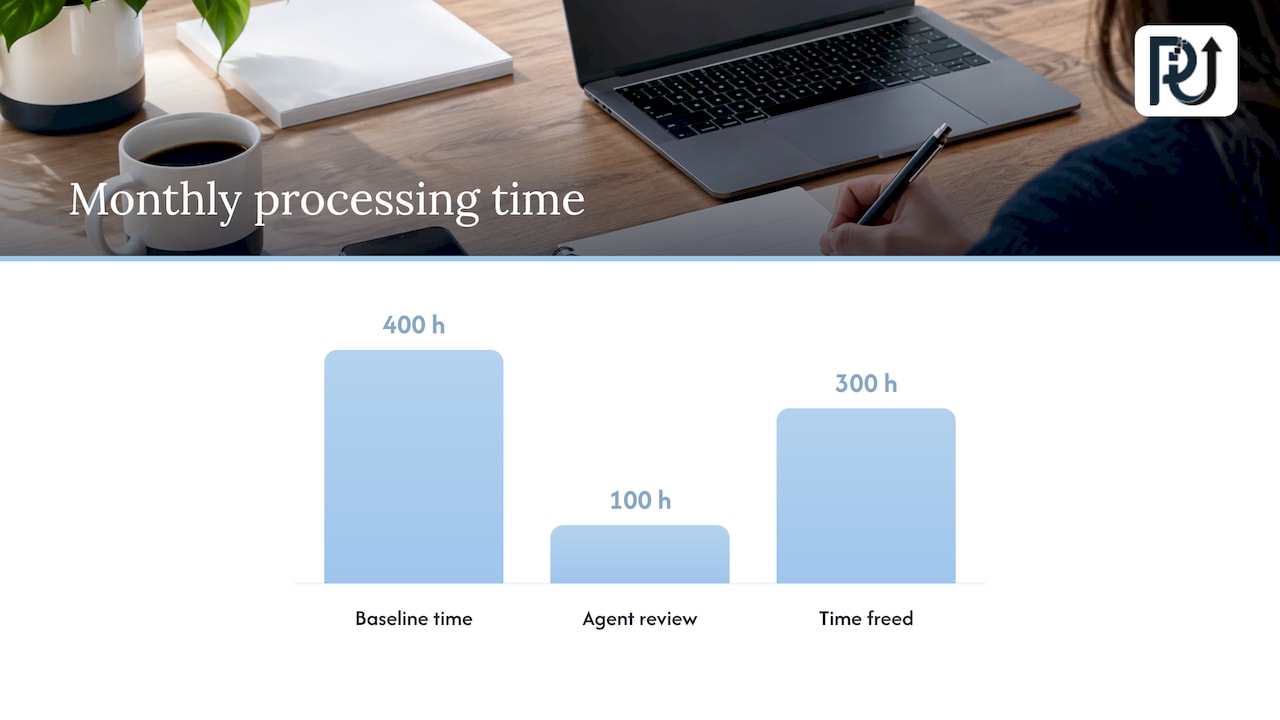
A worked example with illustrative numbers: suppose your team processes 2,000 documents a month at a baseline of 12 minutes each, which is 400 hours. If an agent cuts the human time to 3 minutes of review on average, that is 100 hours, so 300 hours freed. At a loaded cost of $40 an hour, that is $12,000 a month of capacity. Whether it becomes a realized saving depends on what you do with the hours: absorb growth without hiring, or shift people to higher-value work. Report both lines separately.
Run it safely: data, reliability and oversight
Good operators plan for risk at the start. OpenText’s survey of 113 US senior decision-makers at companies with 1,000 or more employees found that 83% cite data and security risks and 77% worry about output quality and reliability as top barriers to generative AI, and only 20% report complete trust in AI outputs on their own data. Most still want human oversight.
That translates into design choices you should make deliberately:
- Human review on exceptions. Route low-confidence or high-value items to a person.
- Access control. Give agents only the data and permissions the task needs, especially in healthcare and financial services, where regulated data is involved. Involve your compliance lead or counsel early.
- Logging. Keep a record of what the agent read, decided and did, so any outcome can be traced.
- Maintainable systems. Build so your team can understand and adjust the automation as the business changes.
Where we come in
POW IT UP designs, builds and deploys custom digital workforces: autonomous, context-aware AI agents that take on high-volume transactional work and hunt down the operational time leaks that slow a growing company. Our approach centers on custom, context-aware automation rather than generic scripts, with transparent processes and durable client ownership.
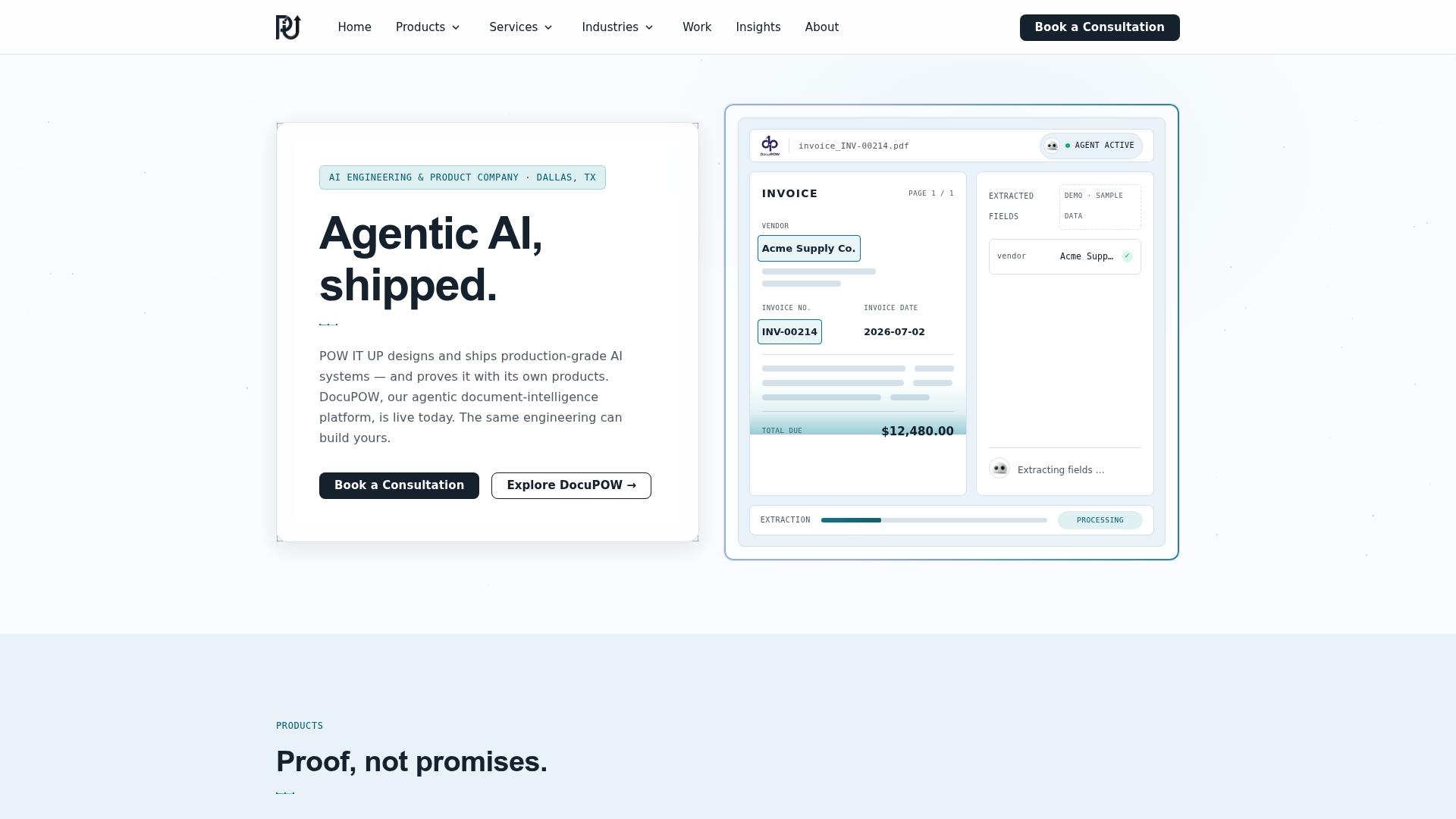
If your bottleneck is paperwork, DocuPOW is our product for document reading and validation, with live demos available. If you need portfolio monitoring and client health analytics, that is the role of AuraPOW. For everything else, our AI automation and AI integration services start from your process and your systems. You can see all our offerings, including cloud analytics, data analytics and project costing, on the services page, or start from powitup.com.
Our perspective
Most companies come to us asking for a tool. What they actually need is a process that no longer depends on someone remembering to do the next step.
We design digital workforces around outcomes. An agent that reads a document, checks it against your rules, flags what looks wrong and hands a clean file to a person is worth far more than a script that moves a file from one folder to another. That is why we focus on context-aware agents and on engineering that you can inspect, maintain and own.
The research agrees with what we see as the right order of work: redesign the process first, then automate it, then measure it against a baseline. Teams that skip the first step get tools. Teams that do it get capacity, and capacity is what lets a growing company take on volume without a matching rise in headcount.
Start with one high-volume process, define what success looks like in numbers, and build from there.
Syed Naveed Abbas
FAQ
What is the difference between intelligent operations and ordinary automation?
Ordinary automation follows fixed rules on predictable inputs. Intelligent operations use AI that can read documents and messages, infer context and handle variation, and they redesign the surrounding roles, measures and decisions. The second part is what turns time savings into results the P&L shows.
How long before a growing company sees results?
It depends on the process and the state of your data, so it is better to set a baseline and a target for one process than to expect a general timeline. Starting narrow, with a documented, high-volume workflow, gives you the quickest comparison between before and after.
Can a small business use intelligent operations, or is it only for enterprises?
Small and midsize companies are using it. In Intuit’s survey, 78% of US businesses using AI reported better overall productivity. Our guide to AI agents for small businesses explains where smaller teams usually begin.
Will AI agents replace my team?
The goal is to let volume grow without adding proportional headcount, and to move people from repetitive processing to exceptions, relationships and strategy. Humans stay in the loop on judgment calls and high-value decisions.
How do I know which process to automate first?
Pick the one with high volume, document- or data-heavy inputs, frequent variation and a visible cost when it runs slowly. Document the steps, record a baseline, and use that single process as your pilot.
Sources
- What is intelligent automation? | SAP
- Digital Operations: Autonomous Automation and the Smart Iron Age (Boute and Van Mieghem, 2021)
- How Industrial Companies Can Win with AI in 2026 | BCG
- Are You Generating Value from AI? The Widening Gap | BCG
- 2026 AI Impact Report | Intuit
- You can realize value with AI | KPMG
- The Total Economic Impact of Agentic AI Solutions | Forrester
- Harnessing agentic AI to transform business process optimization | Baker Tilly
- TDWI Benchmark Report: Agentic AI Readiness
- How Can AI Value, ROI, and Productivity Impact Be Measured? | APQC
- MarketPulse Survey for GenAI Adoption and Readiness | OpenText