

An autonomous system grows revenue by taking over the high-volume work that slows a company down: reading documents, chasing leads, routing requests, monitoring accounts. It does this continuously, within rules you set, and without adding headcount each time volume rises. The way to get there is not a single big-bang platform. It is a bounded, well-chosen process, a custom agent built around your data and software, and a clear measure of what changed. That is how we build at POW IT UP, and the rest of this guide shows the reasoning so you can judge it for your own business.
TL;DR
- Autonomous systems differ from standard automation because they observe, decide and adjust within defined limits instead of only following a fixed script.
- Revenue comes from speed and coverage: faster lead response, cleaner handoffs, fewer stalled deals and customers flagged before they leave.
- Start with one bounded, high-volume process with clear inputs and a measurable outcome, then widen.
- Choose the oversight model (approve, monitor or hands-off) per task, based on the cost of a mistake.
- Measure against a baseline you capture before launch: cycle time, throughput per person, conversion and retention.
Table of Contents
- What an autonomous system actually is
- How autonomy turns into revenue
- Operational growth and business performance
- Choosing the first process
- Deciding how much humans stay involved
- Measuring the effect on revenue and growth
- Our perspective
- See it working on your documents
- FAQ
- Sources
What an autonomous system actually is
The term is used loosely, so it helps to pin it down. Lenovo defines autonomous systems as technologies that perform tasks, make decisions and respond to changing conditions with little or no direct human intervention, working within defined conditions. The same source draws the line against conventional automation: a traditional workflow follows predefined steps, while an autonomous system uses observations, decisions and feedback to choose or adjust its actions as conditions change.
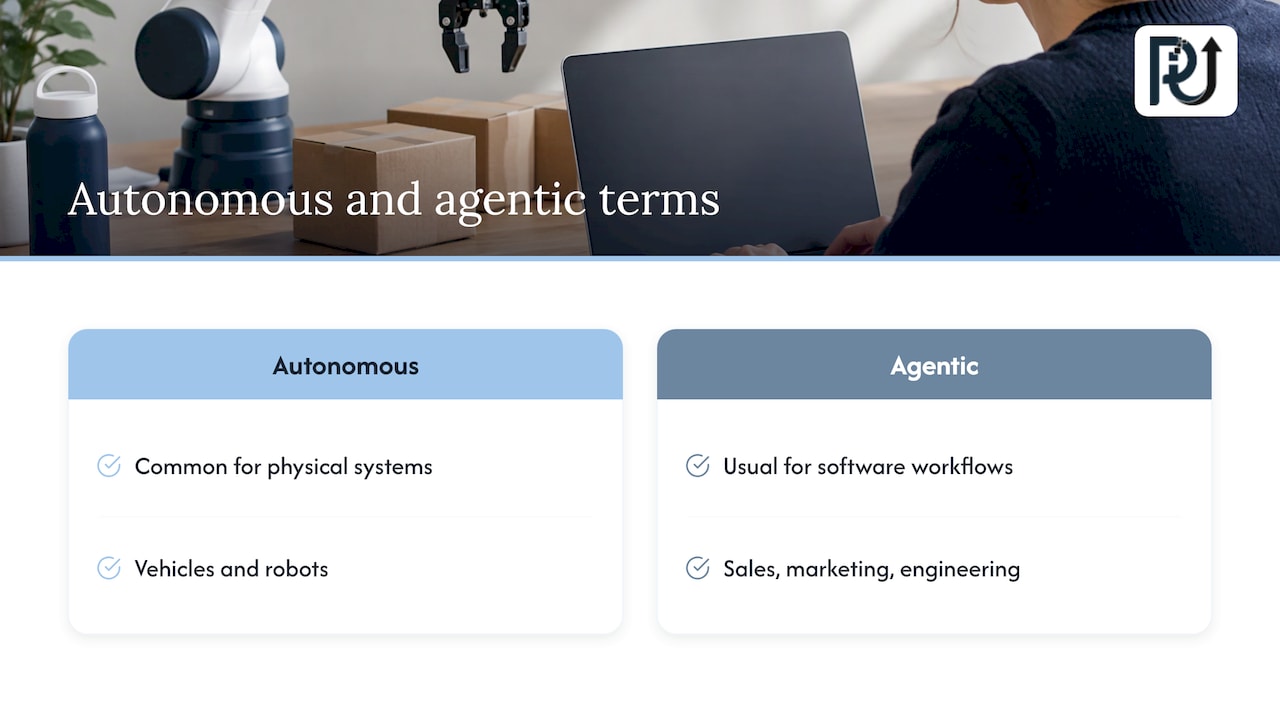
In a business setting, that usually means software agents. Everest Group’s Nishant Udupa, quoted by InformationWeek, describes an autonomous system as a self-governing entity that may be made up of several agents, with “agentic” typically meaning the individual agents coordinated to form it. He also notes that “autonomous” is the more common word for physical systems such as vehicles and robots, while “agentic” is the usual word for software workflows in sales, marketing and engineering. If you see both terms in vendor material, they are largely describing the same idea from two directions.
Teradata’s guide to autonomous AI breaks it into three traits: minimal supervision (finishing a task end to end without constant approvals), adaptability (adjusting to new data and performance signals) and context awareness (understanding business rules, risk thresholds, compliance requirements and what the system is authorized to do). Context awareness is the trait that matters most for revenue work, because a system that does not know your pricing rules, your customer history or your compliance limits cannot be trusted near a customer.
Where it sits next to what you already run
Most companies already have three layers: scripts and integrations that move data, rule-based tools that trigger on conditions, and AI assistants that answer when asked. An autonomous system adds a fourth: an agent that holds a goal (for example, get this application to a decision-ready state), pulls what it needs from several systems, handles exceptions it was designed for and escalates the rest to a person. AWS’s executive guide describes this as a spectrum, from language-model chains that follow a fixed sequence up to agents that set their own objectives and learn from outcomes, and points out that more autonomy brings more flexibility along with more to govern. That is why the design question is never “how autonomous can it be?” but “how much autonomy does this task deserve?”
How autonomy turns into revenue
Revenue growth from autonomous systems is rarely a mysterious AI effect. It comes from removing delay and loss from the path between a prospect, a sale and a renewal. Four mechanisms account for most of it.
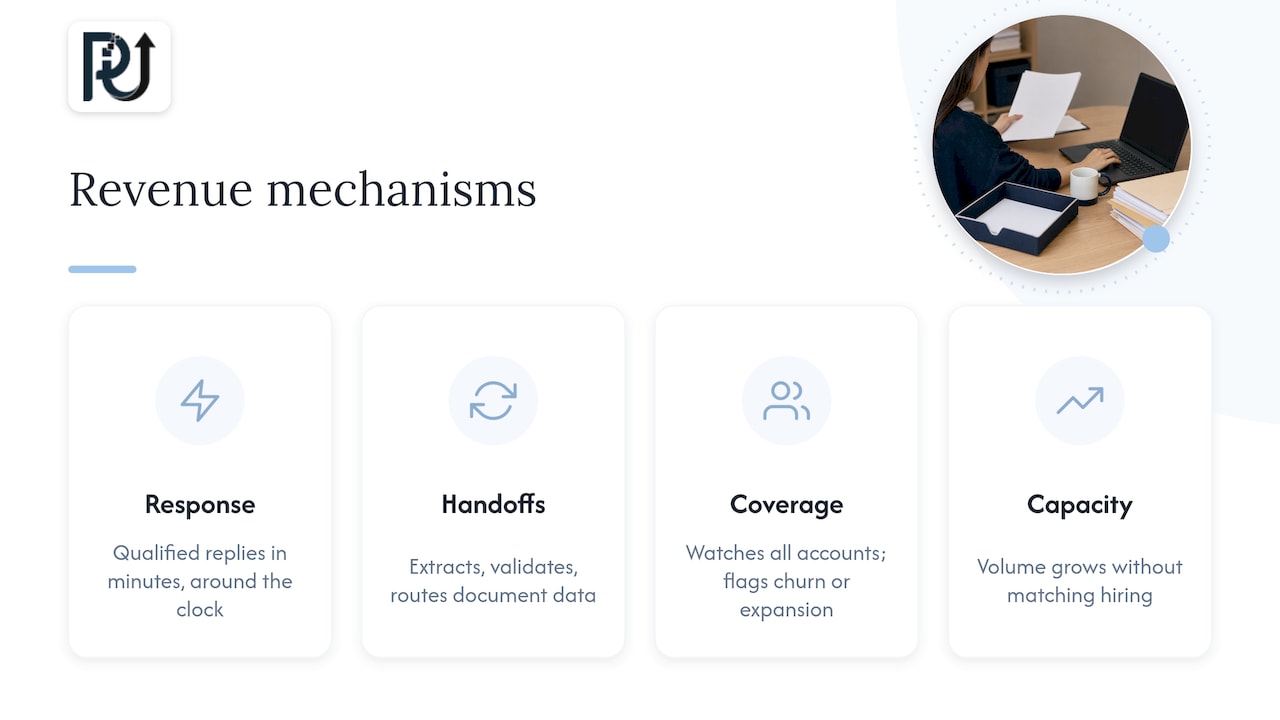
Speed to response. A lead that gets a qualified, personalized reply in minutes is worth more than the same lead answered the next day. An agent that reads the inquiry, checks it against your customer records and drafts or sends the first response keeps that window open around the clock.
Clean handoffs. Deals stall when information is stuck in an inbox, a PDF or someone’s head. Agents that extract data from documents, validate it and pass it into the right system keep work moving without a person re-keying it.
Coverage. A human team can personally watch only so many accounts. An agent can watch all of them, flag the ones showing signs of churn or expansion and put the right action in front of the right person.
Capacity. When a process no longer needs a person for every transaction, volume can grow without a matching hiring plan. That is the core of scaling without adding headcount: the people you have spend their time on judgment, relationships and closing.
Coordination across the customer lifecycle
The larger gains show up when agents share context instead of working in silos. SAP’s Autonomous CX course material describes five families of agents spanning marketing and engagement, sales and revenue, commerce, service, and finance and supply chain, designed so that an event in one area surfaces in every affected area: inventory signals inform commerce, and financial data informs deal pricing. You do not need an enterprise suite to apply the idea. A small firm can get the same effect by making sure the agent that handles intake, the one that handles quoting and the one that monitors accounts read from the same customer record. Marketing teams that want to see how shared context shapes media and campaign decisions can look at how direct response advertising and analytics tie spend to measured response.
Operational growth and business performance
The queries around this topic often swap “revenue” for “operational growth” or “business performance.” The mechanism is the same, and the evidence is in the back office as much as the front. Autonomous systems that handle document-heavy, repetitive, rules-bound work tend to show up first in cycle time and throughput, and revenue follows.
Examples of where this plays out for the industries we serve:
- Fintech and lending: intake, document checks and status updates take less time per file, so more applications reach a decision within the same staffing. Our guide to AI automation in loan processing walks through the steps.
- Healthcare practices: records, forms and scheduling-related paperwork move through validation before a person has to touch them.
- Accounting and consulting firms: engagement paperwork, client documents and project costing are captured and checked as they arrive.
- E-commerce and Shopify brands: order, inventory and customer signals feed marketing and service decisions without manual exports.
- Real estate and logistics: high-volume documents and status updates are read, validated and routed automatically.
Our leader’s guide to autonomous operations and our piece on autonomous workflows for operational excellence go deeper on how these gains compound as a company grows.
Choosing the first process
The fastest way to waste a budget is to automate something vague. A good first candidate has five traits:
- High volume. It happens dozens or hundreds of times a week, so small savings multiply.
- Clear inputs and outputs. You can say what comes in (an email, a PDF, a form) and what a finished job looks like.
- Rules a person already follows. If your best employee can explain how they decide, an agent can be designed around it.
- A measurable outcome. Turnaround time, error rate, leads contacted, files closed per week.
- A known cost of delay. You can put a dollar figure on a slow response or a stalled file.
Everest Group’s Udupa cautions in the same InformationWeek piece that fully autonomous business systems remain largely impractical today and that bounded, goal-driven agents performing discrete tasks are the more feasible route. That matches the way we scope work: pick a discrete task, give the agent a defined goal and clear limits, prove it, then connect the next one. Several bounded agents working from shared data add up to an autonomous system far more reliably than one agent asked to run everything.
What the build involves
Once a process is chosen, the work follows a consistent pattern.
- Map the process as it really runs. Include the exceptions, the workarounds and the places where work waits. The “time leaks” are almost always in the waiting.
- Inventory the data and software. List the systems the agent must read from and write to: CRM, accounting, e-commerce platform, document stores, email. Integration is where most projects succeed or stall, which is why our AI integration work sits alongside agent development.
- Define the goal, the limits and the escalation path. Decide what the agent may do alone, what needs approval and what goes to a person. This is where context awareness is written down: pricing rules, risk thresholds, compliance requirements.
- Build and test against real cases. Run historical examples, including the awkward ones, before the agent touches live work.
- Launch with a baseline in hand. Record current performance first so the improvement is a number, not an impression.
- Review and extend. Look at where the agent escalated and why, tighten the rules and add the next process.
Because our systems are custom and context-aware rather than generic scripts, the aim is a digital workforce shaped to how your business actually operates, with maintainable automation and client ownership of what is built. Our AI agents development service covers the build, and AI automation covers the workflows around it.
Deciding how much humans stay involved
Lenovo’s explainer names three oversight arrangements: human-in-the-loop, where a person approves actions; human-on-the-loop, where the system acts and a person monitors with the ability to step in; and human-out-of-the-loop, where the system completes a defined task without real-time supervision. The last does not mean the system is independent in every setting, only that for that task, within those limits, it does not wait for a person.
A practical way to assign them:
| Task type | Cost of a mistake | Suggested oversight |
|---|---|---|
| Drafting a first reply to a new lead | Low | On the loop: send, monitor samples |
| Extracting and validating fields from a document | Low to medium | Out of the loop for clean files, approval for flagged ones |
| Changing a price or issuing a credit | High | In the loop: a person approves |
| Flagging an at-risk account | Low | Out of the loop: alert the account owner |
Start tighter than you think you need and loosen as the escalation log shows the agent handling cases correctly. Teams that also rely on AI to summarize documents or reports can borrow a habit from these seven questions to ask before trusting an AI summary: know what the output is based on, and who reviews it. Reliable audit trails, defined escalation and clear authorization scopes are what let you move a task from approval to monitoring with confidence.
Measuring the effect on revenue and growth
An autonomous system earns its place only if the numbers move. Set the measures before launch and review them on a fixed schedule.
- Efficiency: cycle time per transaction, touches per file, hours of manual work removed.
- Throughput: transactions or cases handled per person per week. This is the scaling-without-headcount measure.
- Quality: error and rework rates, exceptions escalated and how they were resolved.
- Revenue: lead response time, lead-to-opportunity and opportunity-to-close rates, average time to cash, renewal and retention rates for accounts the system monitors.
- Cost: cost per transaction, including the system’s running cost, against the baseline.
Use a before-and-after comparison on the same process, and where you can, run the agent on part of the volume while the rest continues as before. Attribute only what the data supports. A faster response time and a higher conversion rate on the same lead source is a stronger case than a company-wide revenue number that moved for many reasons.
Our perspective
Most companies do not have a technology shortage. They have time leaks: the hours between a document arriving and someone acting on it, the accounts nobody had time to check, the leads that cooled while a person was busy elsewhere. Those leaks are where revenue quietly escapes.
We build digital workforces of autonomous, context-aware AI agents because a script cannot judge a situation and a generic tool does not know your business. The agent has to understand your rules, your risk thresholds and your customers, or it creates more work than it removes.
That is why we treat each engagement as engineering, not configuration. We design the system around your process, keep it maintainable and hand over something you own. DocuPOW, which reads and validates documents, and AuraPOW, which monitors portfolios and client health, are live examples of that approach, and DocuPOW can be seen in a demo.
Our advice is to begin with one high-volume process, give the agent clear limits, measure it against a baseline and extend from there. Volume can then grow without a matching rise in headcount, and your people spend their time where they create the most value.
Syed Naveed Abbas
See it working on your documents
If paperwork is where your time leaks, DocuPOW is the quickest place to see an autonomous system at work: it reads and validates documents so your team starts from verified data instead of raw files. Live demos are available, and subscription pricing applies for the product.
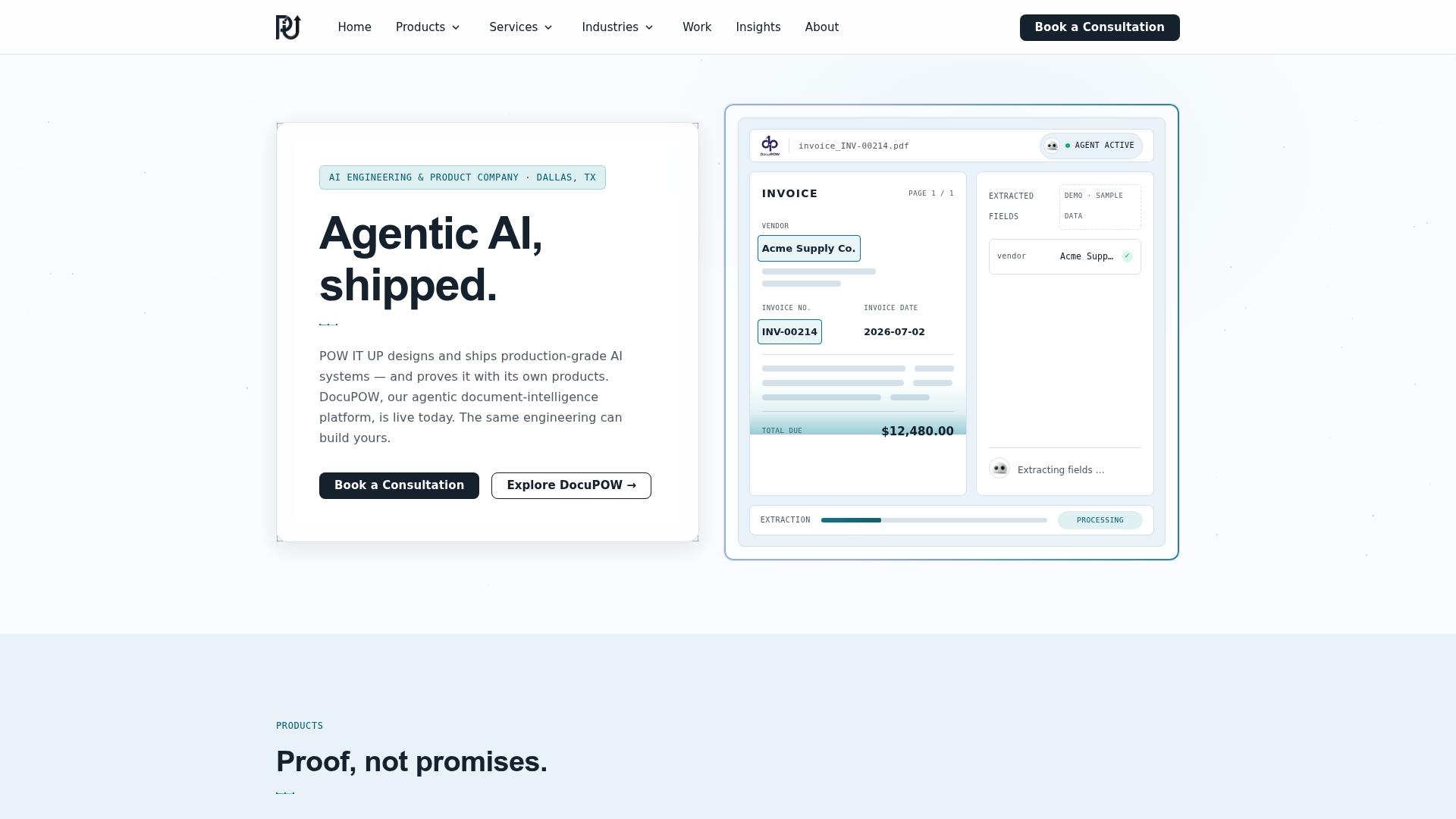
If your bottleneck is broader, such as intake, routing, account monitoring or connecting systems that do not talk to each other, our team designs and builds custom agents and integrations around your process. Explore DocuPOW, or talk to us about a custom build.
FAQ
Is an autonomous system the same as an AI agent?
Not exactly. An agent is a single piece of software pursuing a goal. An autonomous system is the larger arrangement, often several coordinated agents, that operates within defined conditions with little direct human intervention. In practice, most business deployments are built from a handful of bounded agents sharing data.
Which processes should a small business automate first?
Choose a repetitive, high-volume task with clear inputs and a measurable result, such as lead response, document intake or order status updates. Our guide to AI agents for small businesses covers where smaller teams typically start.
Do autonomous systems replace my team?
They take over repetitive transaction work so the same team can handle more volume. People set the rules, handle exceptions, approve high-stakes actions and manage relationships. The design goal is capacity growth without a matching rise in headcount.
How do I know it is working?
Capture a baseline for the process before launch, then track cycle time, throughput per person, error rate and the revenue measures tied to that process, such as response time and conversion. Compare against the baseline on a regular schedule.
Sources
- What are Autonomous Systems | Lenovo US
- Charting the path to the autonomous enterprise | InformationWeek
- What Is Autonomous AI? Examples and Use Cases | Teradata
- AI Agents vs. Automation | AWS Executive Insights
- Exploring the Autonomous CX Portfolio | SAP Learning
- Seven Questions to Ask Before You Trust an AI Summary
- Direct response advertising and analytics