
Operational Growth Systems are production-grade agentic AI platforms that read documents, route decisions, and execute multi-step workflows with limited human intervention. The outcome that matters: enterprises scale transaction volume without adding headcount in proportion. An example system illustrates the pattern, automating document reading and validation for high-volume back-office processing. Leaders should adopt these systems once manual queues start outpacing team capacity, not before.
TL;DR:
- Most enterprises are still developing autonomous automation, with only 10% having fully scaled deployments despite 76% working on it.
- Deployment success hinges on proper system integration, observability, and governance, not just building autonomous agents.
- Trust-building practices like real-time monitoring, explainability, and strict guardrails are crucial for safe, production-ready AI agents.
- A staged rollout—discovery, pilot, harden, and scale—prevents failures and allows early exit if KPIs are not met.
- Vendor evaluation should prioritize proven production experience, real-time observability, and clear data ownership policies over feature lists.
Table of Contents
- What Falls Under Operational Growth Systems?
- How Do You Architect for Different Levels of Autonomy?
- What Governance Controls Actually Keep Agents Safe in Production?
- How Should Leaders Roll Out Operational Growth Systems?
- In-House, SaaS, or Managed Engineering: Which Fits?
- What Leaders Consistently Get Wrong
- Ready to Build Yours With POW IT UP?
- Sources
- FAQ
What Falls Under Operational Growth Systems?
Operational Growth Systems combine four things: autonomous agents that make decisions, document intelligence that extracts and validates data, workflow orchestration that sequences the steps between systems, and analytics that tell you whether the whole thing is working. Leave out any one piece and you get either a smart chatbot with no reach into your systems, or a rigid pipeline with no judgment layer.
The enterprise use cases that pay back fastest tend to cluster around a few functions:
- Invoice processing and accounts payable matching against purchase orders
- Insurance claims intake, triage, and initial adjudication
- Customer support ticket deflection for tier-one questions
- Inventory and supply chain demand forecasting
- Employee and client onboarding workflows across HR, IT, and compliance
Executive appetite backs this up. IBM’s research found 76% of executives are already developing or scaling autonomous automation, though only 10% report a fully scaled deployment. Most organizations are still in the middle of that curve.
Statistic callout: Production deployments of autonomous agents show resolution rates of 70–85% within 90 days, with cost per resolution dropping 80–90% compared to manual processing, once workflows and integrations are properly defined.
Calculating your own ROI means adding three layers: direct labor cost avoided, cycle-time reduction converted to dollars, and softer gains like lower attrition among staff freed from repetitive queue work. That third layer is easy to skip and usually where the real number lives, since faster onboarding and better retention compound over quarters, not weeks.
How Do You Architect for Different Levels of Autonomy?
Not every process deserves a fully autonomous agent, and pretending otherwise is how pilots stall. Four architectural patterns cover almost every enterprise scenario:
- Rule-based automation and RPA. Fixed logic, no judgment. Good for stable, high-volume tasks with no exceptions worth handling intelligently.
- Workflow-driven systems. Orchestrated steps with conditional branches, still deterministic, but flexible enough to route around known exception paths.
- Partially autonomous agents. The agent makes bounded decisions inside a narrow domain (approve this invoice, flag this claim), with humans reviewing edge cases.
- Fully autonomous agents. The agent owns an entire process end to end, escalating only on defined exceptions.
Most organizations still sit at level one or two. As AWS notes, fully autonomous systems remain rare, with partially autonomous agents showing up mainly in narrow, well-bounded domains.
Wherever you land, the integration list is the same: an orchestration layer to sequence agent and human steps, agent identity so systems can log who (or what) took an action, API connectivity into your core systems, and clean data lineage. Regulated domains like fintech and healthcare claims need constraint enforcement and compliance gates built into the architecture itself, not bolted on afterward. Logistics and IT operations, by contrast, often benefit more from prioritizing agent-to-agent coordination and raw throughput. A partner infrastructure like Quikturn’s MCP server can handle the connective layer between agents and enterprise tools without custom point-to-point integration for every system.
What Governance Controls Actually Keep Agents Safe in Production?
Trust, not capability, is the real bottleneck. Camunda’s research found 71% of enterprises run AI agents only in sandboxes, and just 11% have a single agent live in production. The gap closes with three disciplines: test, see, explain.
- Test with statistical methods that measure variance across dozens of runs, not a single pass/fail check, since agent outputs vary run to run in ways traditional software tests were never built to catch.
- See through live observability that tracks what an agent is doing in real time, not a dashboard you check once a week.
- Explain with an auditable decision record for every action an agent takes, tying inputs, reasoning, and outcomes into one traceable chain.
Beyond those three pillars, you need operational guardrails: constraint gates that block an agent from acting outside defined boundaries, escalation thresholds that route uncertain cases to a human, agent identity and access controls comparable to what you’d require of an employee, and a full audit trail. Practitioner research surveying 22 business process management specialists lands on the same six priorities: define business goals, set guardrails, build human-agent collaboration, customize agent behavior, manage risk, and design safe fallbacks.
Pro Tip: Build the orchestration layer that records agent and human handoffs into one auditable log before you deploy anything, not after. Retrofitting explainability into a live system is close to impossible once logs are already fragmented across five different tools.

Watch escalation rate and behavior drift as your core KPIs. A rising escalation rate usually signals the process changed underneath the agent, not that the agent got worse.
How Should Leaders Roll Out Operational Growth Systems?
A staged rollout beats a big-bang launch every time, mainly because it gives you exit points before real damage happens.
- Stage 0: Discovery. Map the actual process end to end, audit data readiness, and set success metrics before writing a line of automation logic. Skipping this step is the single most common reason pilots fail later.
- Stage 1: Pilot. Pick one narrow process, run repeated stochastic tests against real production data patterns, and define acceptance thresholds in advance, not after you see the results.
- Stage 2: Harden. Introduce centralized orchestration across the pilot and any adjacent processes, and wire in the monitoring and audit trail you’ll need at scale.
- Stage 3: Scale. Expand autonomy gradually into new processes only where governance holds and KPIs stay inside acceptable bands.
Pro Tip: Treat each stage gate as a real decision point with authority to stop, not a formality. If escalation rates spike during the pilot, that’s data telling you the process itself was already broken before the agent touched it.
AWS’s guidance on this point is blunt: treat agents like teammates, which means investing in the skills and organizational roles needed to supervise them, not just the software license to run them.
In-House, SaaS, or Managed Engineering: Which Fits?
Three approach categories cover most enterprise decisions, and each fits a different risk and speed profile.
- In-house build makes sense when you have deep engineering capacity and a process so specific to your business that no off-the-shelf tool will fit it.
- Productized SaaS works well for narrow, well-defined problems, like document validation, where a purpose-built tool such as DocuPOW can go live faster than a custom build.
- Managed engineering fits complex, multi-system processes where you need custom agent logic but don’t have the internal team to build and maintain it safely.
Whichever path you choose, evaluate vendors against outcomes, not feature checklists. A useful discovery conversation covers: production experience with live (not sandboxed) agents, observability and testing tooling, breadth of integration into your existing systems, governance and audit support, service-level commitments, and who owns the data and models at contract end.
| Evaluation Area | Question to Ask |
|---|---|
| Production track record | Has this been run live, or only in a sandbox? |
| Observability | Can you see agent decisions in real time, not just after the fact? |
| Audit trail | Is there a single record tying human and agent actions together? |
| Rollback | What happens when an agent needs to be pulled from production fast? |
| Data ownership | Who keeps the data, models, and logic after the engagement ends? |
What Leaders Consistently Get Wrong
The most expensive mistake is automating a process that was already broken. Agents amplify whatever workflow they’re given, so a fragmented, undocumented process becomes a fragmented, undocumented process at higher speed. The second mistake is treating governance as a compliance afterthought rather than an architecture decision made on day one. The third is skipping change management: agents change what your staff actually do all day, and ignoring that guarantees quiet resistance later. Run an orchestration audit before you automate anything, and mandate KPIs from the first pilot.
— Syed Naveed Abbas
Ready to Build Yours With POW IT UP?
POW IT UP is the practical alternative to hiring a full in-house AI engineering team from scratch. Instead of a generic script or a black-box tool, you get custom agents built with the same test, see, explain discipline covered above, backed by a live product like DocuPOW you can actually evaluate before committing.
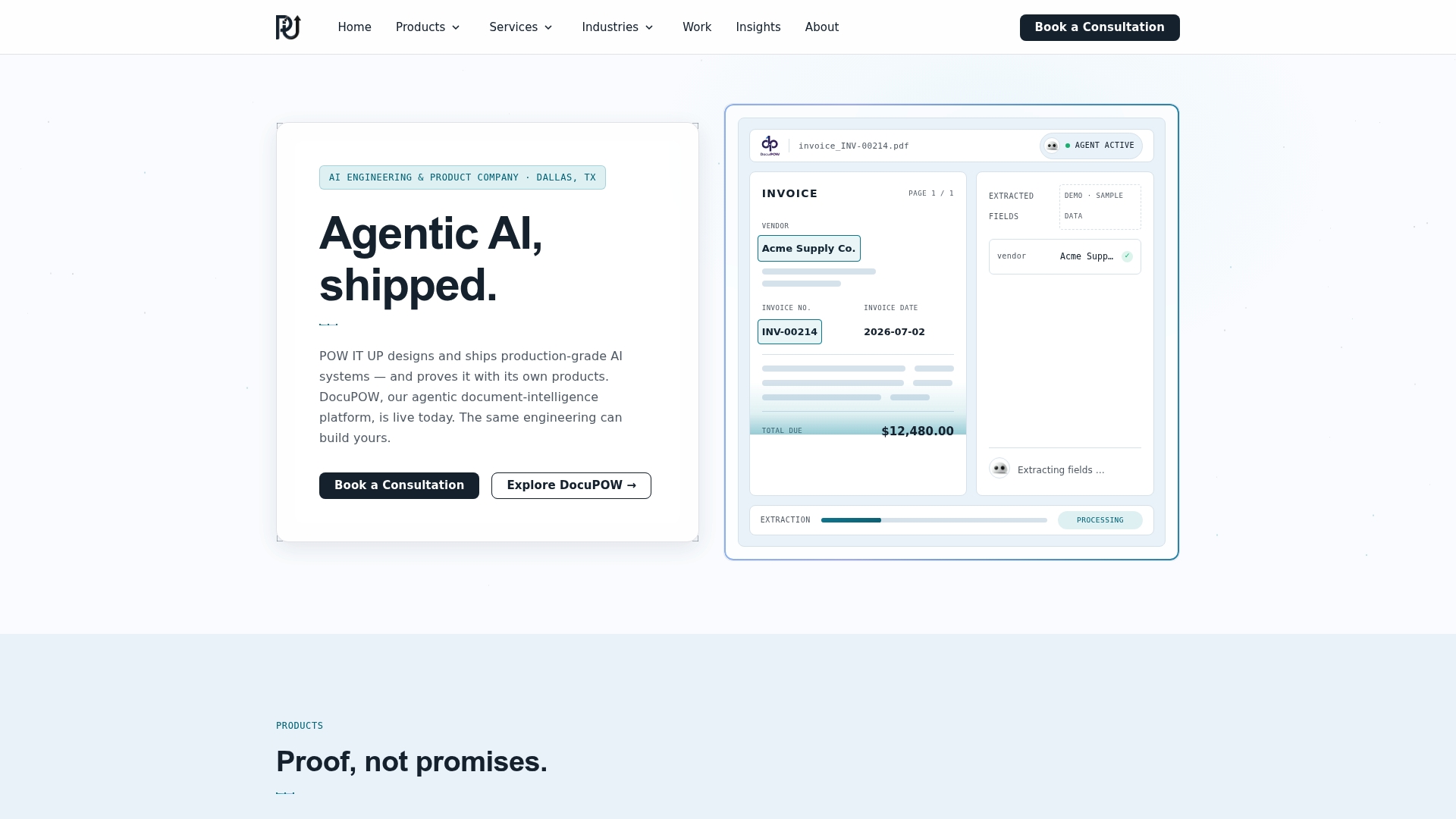
Our AI Agents Development team designs the orchestration layer and audit trail into the build from the first sprint, not after a pilot fails. If you’re integrating agents into systems you already run, AI Integration covers the connective work, and AI Automation covers the end-to-end workflow engineering. Book a discovery call or request a DocuPOW demo to see what an audit-ready agent looks like against your own documents before you scope a full engagement.
Sources
- Orchestrating agentic AI for intelligent business operations (IBM research brief)
- The rise of autonomous agents: What enterprise leaders need to know about the next wave of AI | AWS Insights
- Agentic Business Process Management: Practitioner Perspectives on Agent Governance in Business Processes
- Why AI agents fail in production: A trust problem | Camunda
- The Economics of AI Agents: Calculating Real Enterprise ROI · ActiveMotion Learn
FAQ
What Are Operational Growth Systems?
They’re production-grade agentic AI systems that combine autonomous agents, document intelligence, and workflow orchestration to scale transactional operations. The goal is handling more volume without a matching increase in headcount, as products like DocuPOW demonstrate for document processing.
How Long Does It Take to See ROI From Agentic Automation?
Production deployments often show autonomous resolution rates of 70–85% within 90 days once workflows and system integrations are properly defined. Timelines stretch when data quality or integration scope wasn’t assessed during discovery.
What Is the Difference Between Workflow Automation and Autonomous Agents?
Workflow automation follows fixed, deterministic steps with conditional branches. Autonomous agents make bounded judgment calls inside a defined domain, escalating only when they hit a case outside their guardrails.
Why Do Most AI Agent Pilots Never Reach Production?
Trust is the main barrier, not technical capability. Camunda’s research found 71% of enterprises keep agents in sandboxes because they lack the testing, observability, and audit trails needed to trust live decisions.
Does POW IT UP Offer a Pricing Plan for Custom Agent Development?
Pricing for custom AI Agents Development and AI Integration engagements is available on request based on project scope. Current details are listed on the POW IT UP site.