

Smart operations management combines real-time data, artificial intelligence, IT-OT integration, and formal governance to turn static processes into systems that keep improving on their own. Done well, it delivers faster decisions, higher throughput, and lower operating cost. The path there runs through four building blocks working together: clean data, applied AI, connected systems, and the oversight to keep all of it accountable.
TL;DR:
- Connect ERP, MES, sensors, and control systems before deploying models; unreliable data leaves even sophisticated AI models and agents underperforming.
- Prioritize predictive maintenance, forecasting, and document automation; use dynamic scheduling when demand or transit times vary, since stable operations can rely on static schedules.
- Give a center of excellence executive sponsorship, clear model and data responsibilities, operators trained for oversight, and an OT cybersecurity budget before pilots reach production.
- McKinsey’s 2025 survey found most organizations were piloting AI but only a minority had scaled it; workflow redesign and governance separate pilots from production.
- Set pilot success measures in advance, tracking data quality, model precision, and process cycle time before measuring uptime, labor productivity, or cost per unit.
Table of Contents
- Core components and architecture you need to get right
- High-impact AI and automation use cases you can prioritize
- Organizational enablers: governance, talent, and security
- A pragmatic implementation roadmap: assess, prioritize, pilot, scale
- How to measure impact: KPIs and realistic timelines
- What the research says and how practitioners apply it
- What matters most over the next 12 to 24 months
- How we help you build smart operations that scale
- FAQ
- Sources
Core components and architecture you need to get right
Before any algorithm adds value, operations teams need a foundation that connects information technology (IT) and operational technology (OT). IT handles business systems like ERP and analytics; OT runs the physical world: PLCs, sensors, and control systems on the plant floor. Smart operations management depends on a digital thread that links the two, so a demand signal in the ERP can inform a scheduling change on the line without someone re-entering data by hand. The MIT MIMO-McKinsey study on machine intelligence in manufacturing found that this kind of single source of truth is a precondition for scaling AI use cases: without it, models and agents underperform no matter how sophisticated they are.
Getting there requires attention to a few layers:
- Edge and PLC ingestion: sensors and controllers capture telemetry at a frequency fine enough to catch the events that matter, not just hourly averages.
- On-premises MES: manufacturing execution systems clean, label, and store that data so it is trustworthy before it reaches analytics.
- Cloud analytics and orchestration: this layer runs forecasting, anomaly detection, and reasoning models, then pushes decisions back down through APIs.
- AI roles: anomaly detection flags deviations early, reasoning models weigh trade-offs, and orchestration agents coordinate actions across systems.
Each layer depends on the one below it being reliable, which is why data quality work usually comes before any AI deployment, not after.
High-impact AI and automation use cases you can prioritize
Some use cases pay back faster than others, and prioritizing them correctly saves months of wasted pilot time.
- Predictive maintenance: vibration, temperature, and current sensors feed models that flag equipment likely to fail, cutting unplanned downtime rather than waiting for a breakdown.
- Demand forecasting and inventory optimization: combining point-of-sale data, ERP history, and external signals like weather or promotions improves forecast accuracy and reduces both stockouts and excess inventory.
- Real-time scheduling and dynamic routing: this pays off when variability is high, such as fluctuating order volumes or unpredictable transit times; static schedules still work fine in stable, low-variability environments.
- Document and back-office automation: automating invoice matching, claims intake, and supplier onboarding removes manual bottlenecks that otherwise cap how much volume a team can process. Our DocuPOW reads and validates documents for exactly this kind of throughput work.
- Agentic AI for orchestration: autonomous agents increasingly handle exception routing, deciding when a transaction needs human review versus straight-through processing.
The MIT MIMO-McKinsey research shows that AI leaders scale these use cases together rather than one at a time, treating forecasting, maintenance, and scheduling as parts of one connected system instead of isolated projects.
For teams building out their automation stack, this overview of service business automation tools maps common categories to specific operational tasks.
Organizational enablers: governance, talent, and security
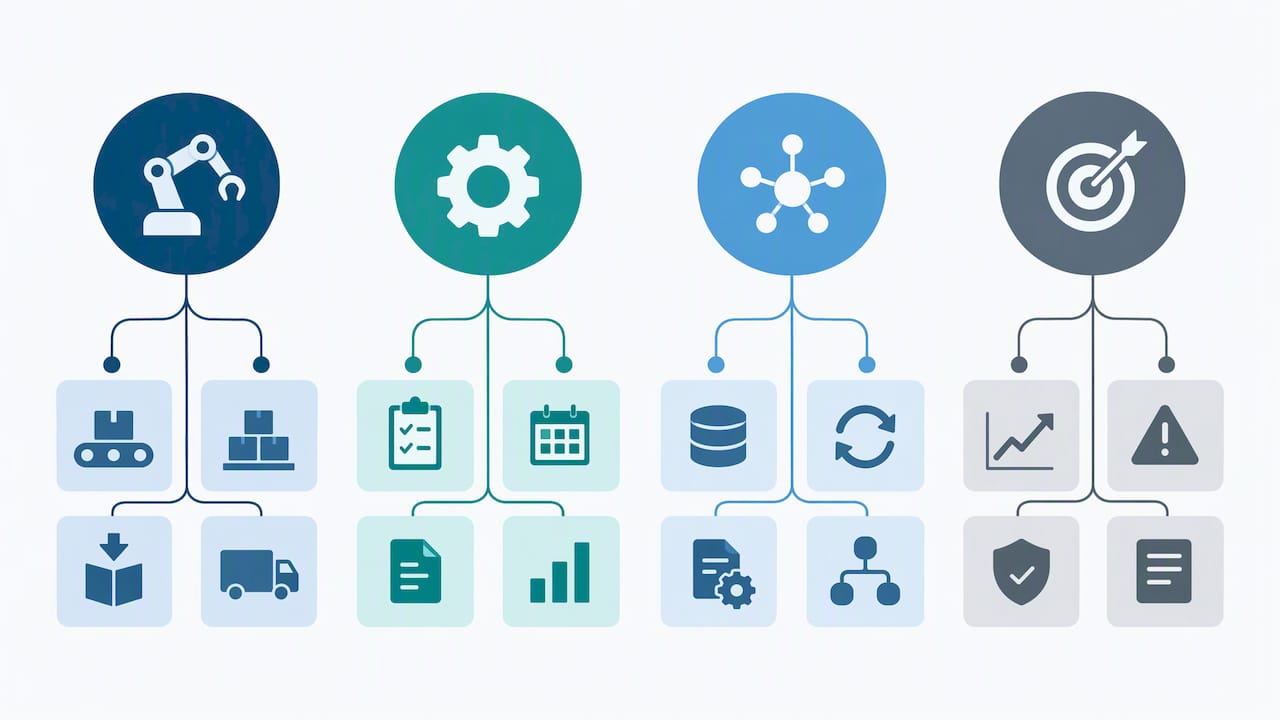
Technology alone does not produce results. McKinsey’s research on operations leaders found that the leaders pulling ahead share three traits: strong executive sponsorship, a dedicated center of excellence (COE), and disciplined data investment. Securing sponsorship usually means framing AI initiatives in terms the board already tracks: cost per unit, throughput, and capital efficiency, not technology for its own sake.
A few concrete steps make the difference between a pilot that stalls and one that scales:
- Define the COE’s remit clearly: does it build models, govern standards, or both?
- Staff it with a mix of data engineers, domain experts, and a single accountable executive sponsor.
- Set data governance rules before deployment: who owns a dataset, who can access it, and how changes get audited.
- Treat OT cybersecurity as a hard requirement, not a later add-on; for smaller operations, retrofitting older equipment for audit trails often forces capital decisions that should be budgeted early rather than discovered mid-project.
- Cross-train operators and supervisors so human oversight of AI recommendations is built into daily routines, not bolted on.
Pro Tip: Give the center of excellence a scorecard tied to one or two business KPIs from day one, so it reports progress in the same language finance uses.
A governance-first approach also shows up outside manufacturing: NEXTmsp’s analysis of AI adoption in professional services makes the same point about capturing value through structure rather than tools alone.
A pragmatic implementation roadmap: assess, prioritize, pilot, scale
Moving from interest to production works best as a sequence, not a leap.
- Assess: map existing processes, identify data gaps, and flag quick wins where a small fix removes a known bottleneck.
- Prioritize: score candidate use cases on value and feasibility together, favoring projects with clean data and a clear owner over ones that merely sound impressive.
- Pilot: narrow the scope to one process, define success metrics before starting, and confirm integration points with existing MES or ERP systems in advance.
- Integrate and scale: once a pilot proves out, productionalize the model with proper version control and monitoring, then hand it off to operations with a plan for continuous improvement.
This sequencing matters because McKinsey’s 2025 state of AI survey found that most organizations are piloting AI, but only a minority have deployed it at scale. The gap between the two comes down to whether workflows and governance were redesigned alongside the technology, not just bolted onto old processes. Our guide to AI-powered business operations walks through this sequencing in more detail.
How to measure impact: KPIs and realistic timelines
Pilots and production systems need different metrics tracked at different speeds.
- Leading indicators during a pilot: data quality scores, model precision against a held-out dataset, and cycle time for the specific process being automated.
- Lagging, business-level KPIs: equipment uptime, units processed per labor hour, cost per unit, and the change in full-time-equivalent (FTE) hours needed for a given volume.
- Financial framing for finance stakeholders: present ROI as a function of volume growth without headcount growth, since that is the metric most CFOs already track.
Workflow redesign alongside AI deployment correlates with higher reported financial impact, according to McKinsey’s 2025 research on organizational AI adoption, which found that a minority of organizations, only a minority have reached scale deployment. That gap is itself a useful benchmark: reaching production at all puts a team ahead of most peers.
What the research says and how practitioners apply it
Three bodies of research converge on the same conclusions. The MIT MIMO-McKinsey study ties scaling success to digital thread maturity. NIST’s 2026 roadmap on AI and machine learning for smart manufacturing highlights digital twins, trustworthy AI, and data-centric metrology as foundational, while flagging that agentic systems need rigorous testing before they handle real-time recovery decisions. McKinsey’s work on operations leaders ties executive sponsorship and COEs directly to outsized returns.
Leaders that combine executive sponsorship, a center of excellence, and disciplined data practices capture faster payback from AI pilots than those pursuing isolated projects.
On the practitioner side, our operational productivity work reports client outcomes including a 70% reduction in FTE hours on certain agentic AI deployments and 70 to 85% resolution rates within 90 days, figures we report as our own client results rather than industry averages.
What matters most over the next 12 to 24 months
Get the data foundation right and run one high-value pilot well before chasing a second. Treat OT integration and cybersecurity as gating requirements, not afterthoughts. Design every pilot around measurable KPIs you can repeat at scale.
— Syed Naveed Abbas
How we help you build smart operations that scale
We design and deploy custom AI agents that automate high-volume operational work without adding headcount. Our services include AI Agents Development, AI Integration, AI Automation, and document automation through DocuPOW.
If you are weighing where to start, schedule a pilot scoping conversation and see what a scoped pilot looks like for your operation.
FAQ
Will AI replace supply chain management roles?
AI is changing what supply chain roles focus on rather than eliminating the function itself. McKinsey’s research on supply chain risk notes that generative and agentic AI are emerging as high-potential tools for forecasting and orchestration, but they are not yet widely productionized, meaning human oversight remains central for the foreseeable future.
What are five examples of operations management in practice?
Common examples include inventory management, production scheduling, quality control, supply chain coordination, and facilities or equipment maintenance. Smart operations management applies AI and real-time data to each of these to improve speed and accuracy.
What are the four main types of operations management?
Operations management is typically grouped into manufacturing operations, service operations, supply chain operations, and quality management. Each type focuses on a different part of turning inputs into delivered value, though smart operations tools increasingly connect all four through shared data.
What does operations management actually do day to day?
Operations management plans, coordinates, and controls the processes that turn resources into finished goods or delivered services. In a smart operations context, that includes monitoring real-time data, managing automated workflows, and overseeing the AI systems that support scheduling, forecasting, and maintenance decisions.
How long does it take to see a return from smart operations initiatives?
Payback timelines vary by use case and data readiness, but McKinsey’s 2025 survey found that organizations pairing AI deployment with workflow redesign report stronger financial impact than those deploying AI on top of unchanged processes. Starting with a narrow, well-defined pilot is the fastest route to a measurable result.
Sources
- Bold accelerators: How operations leaders are pulling ahead using AI — McKinsey
- MIT MIMO – McKinsey study on machine intelligence in manufacturing and operations
- 2026 roadmap on artificial intelligence and machine learning for smart manufacturing — NIST