

AI-powered business operations integrate artificial intelligence directly into core workflows to transform how organizations execute, decide, and scale. The practical payoff is real: re-engineered processes that once took months can now complete in days, and manual ticket-to-technician workflows that previously took several hours to resolve can now respond in near real-time. This is not incremental improvement. It is a structural shift in how work gets done.
The core benefits business leaders are realizing in 2026 include:
- Faster execution across high-volume transactional processes without adding headcount
- Better decisions through real-time data routing and AI-assisted risk scoring
- Lower error rates by replacing manual handoffs with automated, governed workflows
- Continuous improvement via AI agents that monitor, test, and propose changes before deployment
- Scalability that grows with demand rather than with hiring cycles
Table of Contents
- What skills and tools do you need for AI-powered business operations?
- Where does AI create the most impact in your operations?
- What trends are reshaping AI operations in 2026?
- Domain-specific AI orchestration: the expert’s edge for scalable operations
- POWITUP builds the AI workforce your operations actually need
- FAQ
- Key Takeaways
What skills and tools do you need for AI-powered business operations?
Getting AI into your operations is not just a technology purchase. It requires a specific combination of human capability and the right platforms working together.
Critical skills for your team:
- AI literacy: Leaders and operators need to understand what AI agents can and cannot do, not at a coding level, but well enough to define outcomes and evaluate proposals.
- Data governance: AI is only as reliable as the data it runs on. Teams need clear ownership of data quality, access controls, and lineage.
- Change management: Deploying AI into live workflows disrupts established habits. Structured adoption programs reduce resistance and accelerate time to value.
- ROI measurement: Tracking cycle time, resolution rate, cost per case, and compliance rate gives you the weighted KPI scoring needed to evaluate whether AI changes are actually working.
Key tools that form the operational backbone:
- AI-powered CRM software: AI integration in CRM enables data-driven personalization and reduces manual customer management overhead.
- AI automation agents: Context-aware agents handle high-volume tasks, escalate edge cases, and execute defined workflows without constant human supervision.
- Process orchestration platforms: These coordinate people, systems, data, and AI across end-to-end workflows, replacing fragmented manual handoffs with a unified control layer.
- API integration layers: Connecting CRM, billing, compliance, and AI review systems into a single workflow removes the silos that cause errors and delays.
Pro Tip: Before selecting any tool, define your fitness function first. What KPIs matter most in your domain? Cycle time? Compliance rate? Cost per case? The answer shapes which platform configuration actually serves you.
Where does AI create the most impact in your operations?
AI delivers measurable results across several operational domains, but the highest-impact use cases share one trait: they replace not just manual effort, but the underlying process logic itself.

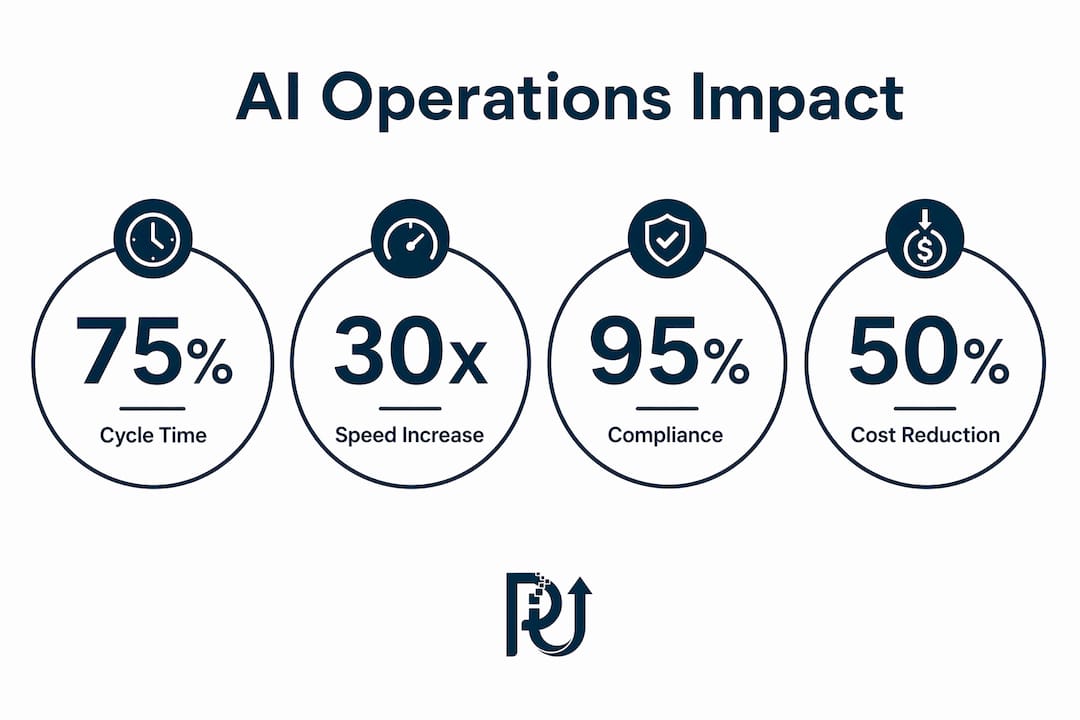
Business process modeling and automation is where most leaders start. Rather than speeding up a legacy process, AI-native re-engineering redesigns the workflow from the desired outcome backward. A single onboarding form that previously took significant time, slowed by manual steps and scattered systems, can be redesigned so the same task takes minutes.
Generative AI for product innovation is accelerating strategy work. Tools like ChatGPT and Microsoft Copilot now assist with product vision boards, PESTEL analysis, competitor profiling, and sprint planning, compressing weeks of research into hours. The Coursera AI-Powered Business Operations Specialization covers exactly this application for professionals building these skills.
| Use Case | Operational Gain | AI Capability Used |
|---|---|---|
| Customer onboarding | Months reduced to days | Process re-engineering agents |
| Ticket-to-technician routing | several hours reduced to near real-time | Autonomous workflow orchestration |
| CRM personalization | Reduced manual errors, higher engagement | AI-driven data routing |
| Supply chain planning | Faster demand forecasting | Predictive AI analytics |
| Compliance monitoring | Continuous audit trails | Automated governance agents |
Ethical and compliant operations are not an afterthought in this model. Automated audit trails capture every action, decision, and data input in real time, making regulatory reviews and internal troubleshooting dramatically simpler. AI-assisted risk scoring continuously evaluates potential compliance gaps before they become violations.
B2B marketing operations are also shifting fast. Automation in professional services now covers lead nurturing, content sequencing, and pipeline reporting that used to require dedicated analyst time.
What trends are reshaping AI operations in 2026?
The most consequential shift underway is the move from task automation to end-to-end AI orchestration. Automating individual steps is table stakes now. The organizations pulling ahead are re-engineering entire process architectures with AI as the native operating layer.
Trends worth tracking:
- AI-native process re-engineering: Designing workflows from scratch around AI capabilities rather than retrofitting automation onto legacy steps.
- Autonomous multi-agent systems: Agent-to-agent communication lets specialized AI agents collaborate, delegate tasks, and share context without human coordination at each handoff.
- Dynamic prioritization: AI analyzes deadlines, resource availability, and customer behavior signals to automatically shift team focus to the highest-impact work.
- Sustainable AI integration: Generative AI is now being applied to ESG reporting, supply chain decarbonization, and inclusive design, moving AI governance beyond data privacy into environmental accountability.
- Organizational memory models: Enterprise platforms now build private knowledge models from your systems, integration patterns, and operational decisions, stored in isolated repositories that never feed shared training data.
The governance dimension is growing in parallel with capability. As AI agents take on more autonomous decision-making, the organizations that build explainable, auditable governance frameworks now will have a structural advantage when regulatory scrutiny increases.
Domain-specific AI orchestration: the expert’s edge for scalable operations
Generic AI adoption and domain-specific AI orchestration are not the same thing, and the gap between them shows up in deployment timelines and operational outcomes.

Domain-specific orchestration means deploying AI agents pre-trained on the data, failure modes, and decision logic of your specific industry. SymphonyAI’s Industrial LLM, for example, powers 300+ pre-built agents trained on industrial ontologies, enabling customers to activate their first agent within days rather than months. Generic platforms require months of custom training before they understand your operation at all.
The architecture behind this matters. Enterprise AI operations platforms build organizational memory models isolated from shared datasets, preserving business context and decision history privately. Every process you build makes the next one faster because the system accumulates knowledge specific to your environment.
| Approach | Setup Time | Domain Fit | Governance |
|---|---|---|---|
| Generic AI platform | Months of custom training | Low out of the box | Manual configuration |
| Domain-specific agents | Days to first deployment | High from day one | Built-in governed autonomy |
| Custom in-house build | Months to production | Tailored but expensive | Owned entirely by your team |
AI agents in advanced orchestration systems operate across three autonomy modes: assistive (recommends, humans decide), augmented (acts on defined task classes, escalates edge cases), and fully autonomous (executes complete process loops with oversight available). IRIS Flows agents use exactly this model, escalating edge cases to human experts while independently handling routine operations.
Pro Tip: Start with augmented mode for your first deployment. It builds team confidence, surfaces edge cases you did not anticipate, and creates the evidence base you need to justify expanding to full autonomy.
The types of AI agents available for service teams have expanded considerably, and choosing the right architecture for your domain is now a core strategic decision, not a technical afterthought.
POWITUP builds the AI workforce your operations actually need
Most AI integration projects stall because the gap between a vendor’s platform and your actual operational reality is wider than anyone admitted upfront. POWITUP closes that gap by functioning as a technical architect, not just an implementation vendor.
POWITUP designs, builds, and deploys custom AI agent systems tailored to your specific workflows, volume patterns, and compliance requirements. The result is a digital workforce that handles high-volume transactional work, surfaces operational time leaks, and scales processing capacity without adding headcount. For leaders who have already evaluated off-the-shelf platforms and found them too generic, POWITUP’s approach starts from your outcomes and builds backward. Get a direct assessment of where AI can cut the most friction in your operations at powitup.com/ai-integration.
FAQ
What are AI-powered business operations?
AI-powered business operations integrate AI agents and orchestration platforms directly into core workflows to automate decisions, reduce manual coordination, and improve execution speed across the organization.
How do you measure ROI for AI in operations?
Track cycle time, resolution rate, cost per case, and compliance rate using weighted KPI scoring models. These metrics let you quantify process improvements objectively before and after AI deployment.
What is the difference between automation and AI orchestration?
Automation handles specific tasks within a process. AI orchestration manages how those tasks connect across systems, teams, and decision points, ensuring multi-step processes run end to end without manual handoffs.
How long does it take to deploy AI agents in operations?
Domain-specific agents pre-trained on relevant data can go live within days. Generic platforms that require custom training typically take months before they understand your operational context well enough to be useful.
How does POWITUP approach AI integration for business operations?
POWITUP acts as a technical architect, designing and deploying custom AI agent systems built around your specific workflows and scale requirements, rather than fitting your operations into a pre-built platform.
Key Takeaways
AI-powered business operations deliver transformative results when leaders combine domain-specific AI orchestration, governed autonomy, and organizational memory with clear KPI-based measurement frameworks.
| Point | Details |
|---|---|
| Re-engineer, don’t just automate | Redesigning workflows for AI-native outcomes reduces process time from months to days. |
| Measure with weighted KPIs | Track cycle time, resolution rate, cost per case, and compliance rate to evaluate AI impact objectively. |
| Domain-specific agents deploy faster | Pre-trained agents with industry ontologies go live in days versus months for generic platforms. |
| Governance is foundational | Automated audit trails and governed autonomy modes keep AI operations compliant and auditable at scale. |
| POWITUP builds custom AI workforces | POWITUP designs agent systems from your operational outcomes, not from a vendor’s default configuration. |