

An autonomous system that scales a business is a set of AI agents that take on a defined, high-volume process end to end, inside permissions you set, with humans stepping in only at the points you choose. You build it by picking one process, wrapping it in a deterministic workflow, adding agents only where judgment is needed, and governing it from day one. At POW IT UP we design and deploy custom digital workforces built on this pattern, so volume can grow without a matching rise in headcount.
This guide walks through what separates autonomy from ordinary automation, which processes to start with, how to architect the system, how to roll it out, and what U.S. rules to keep in view.
TL;DR
- Autonomous systems use agents that reason over changing inputs; conventional automation follows fixed rules. Most good systems combine both.
- Start with one process that is high-volume, spans several systems, or mixes data entry with judgment, such as claims, order-to-cash or document intake.
- Begin with a deterministic workflow and add agents only where the work is unstructured. Define inputs, outputs, escalation points and human touchpoints for every step.
- Set success measures before you build, and govern permissions, monitoring and kill-switches from the first deployment.
- Governance maturity is linked to fewer incidents and better task completion in recent research, so it is part of the scaling plan, not paperwork.
Table of Contents
- What makes a system autonomous, and how it differs from automation
- Which processes to automate first
- Architecting the system: deterministic first, agents where needed
- Set the measures before you build
- Roll out in stages, with controls
- Why governance belongs in the scaling plan
- U.S. rules to keep in view
- Our perspective
- Work with us on your first autonomous process
- FAQ
- Sources
What makes a system autonomous, and how it differs from automation
Traditional automation, including robotic process automation (RPA, software that mimics clicks and keystrokes), runs a predefined path. If the invoice layout changes or an exception appears, it stops or fails. An autonomous system sets its path from the situation in front of it.
TechTarget’s enterprise guide describes agentic process automation as agents that evaluate, plan, execute and optimize tasks with minimal human intervention. It is typically used in complex, nonlinear work such as supply chain management, fraud detection and personalized customer interactions, where RPA only follows strict predefined workflows.
Autonomy is a spectrum, not a switch. AWS frames it as a range from fixed LLM chains to fully autonomous agents that set their own objectives and learn from outcomes. Its guidance is to use the simplest solution that works, and to keep traditional automation for applications that need absolute predictability.
That last point shapes everything below. You do not build one giant agent. You build a system in which each step gets the least autonomy it needs.
| Rule-based automation | Autonomous agent | |
|---|---|---|
| Handles | Structured, predictable inputs | Unstructured, variable inputs |
| When something unexpected happens | Stops or errors out | Reasons about it and adapts, or escalates |
| Best for | Routing, approvals, fixed calculations | Reading documents, applying policy context, drafting content |
| Typical risk | Brittleness | Drift and over-broad permissions without governance |
Which processes to automate first
The fastest way to stall an autonomous program is to start with the most glamorous process. Start with the one that is expensive, repetitive and well documented.
CIO, citing an AArete data science leader, lists four patterns where agentic AI fits best:
- Processes that mix programmatic and manual work. Insurance claims are the example: automated validation plus manual document review.
- Workflows that span silos. Order-to-cash is the classic case, where an agent pulls data from sales, finance and logistics systems.
- Routine, repetitive actions such as data entry and report generation.
- Manual processes too expensive to staff, like customer support in a fast-growing business.
Here is how that maps to the industries we work with:
- Fintech and accounting firms: reading statements, invoices and onboarding documents, validating figures, flagging mismatches.
- Healthcare practices: intake forms, referrals and records that arrive in inconsistent formats.
- Logistics and e-commerce: order exceptions, carrier documents and inventory reconciliation across systems.
- Agencies and consultancies: reporting, client updates and time-and-cost tracking that eat billable hours.
A quick scoring test for your first use case
Score each candidate process from 1 to 5 on four questions:
- How many times a week does it run?
- How many systems or people does it touch?
- How often does a human have to interpret something that is not in a standard format?
- How bad is a wrong output, and can it be caught before it leaves the building?
The best first project scores high on the first three and has a recoverable answer on the fourth. A worked example: an accounting firm processes 600 client documents a month. Each one takes about eight minutes to read, key in and check. That is 80 hours a month of work that is high-volume, document-heavy, and reviewable, which makes it a strong first candidate. A one-off board report that happens twice a year is not.
If your first candidate is document-heavy, our DocuPOW product is built for document reading and validation, and live demos are available.
Architecting the system: deterministic first, agents where needed
Microsoft’s February 2026 white paper makes a point we agree with: successful solutions start with a deterministic workflow and add agents only where required. Agents suit interpreting unstructured inputs, applying judgment or policy context, and generating content. Deterministic logic handles routing, approvals and error handling.
For each step, define four things on paper before anyone writes code:
- Inputs and outputs. What data goes in, what must come out, in what format.
- Stop and escalation points. When does the system halt and hand off?
- Human touchpoints. Who reviews what, and how fast must they respond?
- Tool access. Which systems can the agent read, and which can it write to?
Wharton’s Summer 2026 research on architecting the agentic enterprise adds that models should be evaluated inside specific workflow scenarios against efficiency, accuracy, scalability and cost. Its key architecture choices are single-agent versus multi-agent design, workflow structure, and human-in-the-loop interactions. A single agent is easier to govern. Multiple specialized agents make sense when the process crosses distinct domains, such as finance and logistics. For a closer look at how an agent reads sources and returns cited answers, see what an AI research agent is.
Integration is where scale is won or lost
An agent that cannot reach your CRM, accounting system or document store is a demo. Most of the engineering effort goes into connecting the agent to your data and software safely, with narrow permissions. Our AI integration work covers this layer, and our AI agents development service builds the agents themselves, so the design and the connections are planned together rather than bolted on afterward.
You can read more on how we approach infrastructure planning in our guide to scalable AI infrastructure and on team structure in building autonomous AI teams.
Set the measures before you build
Microsoft’s paper argues that deciding evaluations up front anchors development in the right goals and prevents builders from bending the tests to fit the agent they already built. It recommends evaluating accuracy, reliability, latency and cost, and compliance, including edge cases and high-risk failures.
For return on investment, use before-and-after baselines on:
- time saved per task
- cycle time (request received to request completed)
- cost to serve
- quality or satisfaction scores
- customer adoption, where the system faces customers
Capture the baseline for the current manual process for at least a few weeks before launch. Without it, you cannot prove the headcount you did not have to add. If you want a model for tracking workflow results, this explanation of where to start with AI workflows shows how a process is scoped before it is automated.
Roll out in stages, with controls
The ONUG working group’s April 2026 requirements for scaling agentic AI recommend starting within a single trust domain, meaning one team, one data boundary, to validate governance and containment before expanding. It also calls for tool governance through explicit permissioning, rate limits and step-up authorizations, and continuous monitoring with real-time anomaly detection and kill-switches. In its poll, data guardrails were mandatory for 92% of respondents and secure orchestration for 71%.
A practical rollout looks like this:
- Shadow mode. The system produces outputs while people keep doing the work. Compare results.
- Assisted mode. The system acts; a person approves every output.
- Supervised autonomy. The system acts alone on routine cases and escalates exceptions. Humans sample a share of outputs.
- Expansion. Add volume, then a second process, then cross-team workflows.
Move from one stage to the next only when the accuracy and exception rates you defined are met. Microsoft’s paper also says to decide in advance how misbehavior is handled: blocking, escalating or quarantining an agent, and who may create or share agents and what data they can reach.
Why governance belongs in the scaling plan
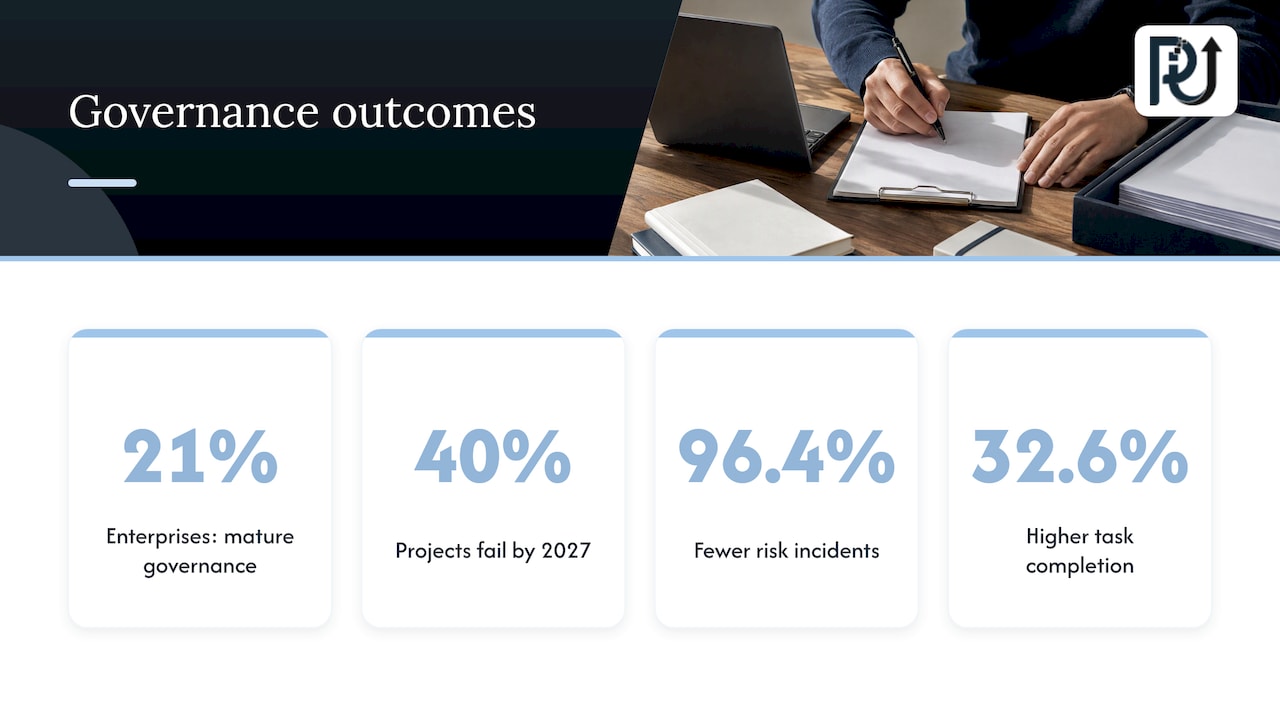
An arXiv paper from March 2026 reports surveys showing that only 21% of enterprises have mature governance models for autonomous agents, and that 40% of agentic AI projects are projected to fail by 2027 because of inadequate governance. In its simulations, organizations at the top maturity levels had 96.4% fewer risk incidents and 32.6% higher effective task completion than those at the lowest level. The paper also names the costs of agent sprawl: duplicate agents, shadow agents, orphaned agents and permission creep.
The lesson for an operations leader is simple. Keep an inventory of every agent, an owner for each one, and a review date. That is cheap to do at three agents and very expensive to reconstruct at thirty.
U.S. rules to keep in view
There is no single federal AI statute for businesses, and states are filling the gap. Baker Botts reports that more than 1,000 AI-related bills were introduced across states in 2025. Two examples from its update:
- Texas (TRAIGA, HB 149, signed June 22, 2025) applies to developers and deployers doing business in Texas, prohibits AI for certain restricted purposes, and offers an affirmative defense for compliance with the NIST AI Risk Management Framework. Penalties range from $10,000 to $12,000 for curable violations up to $80,000 to $200,000 for uncurable ones, plus $2,000 to $40,000 per day for continuing violations.
- Colorado’s AI Act (SB 24-205) is the first comprehensive U.S. statute on high-risk AI. It requires reasonable care against algorithmic discrimination, impact assessments and consumer disclosures.
If you operate in healthcare or financial services, add your sector’s privacy and security obligations. Build logging, access control and human review into the design so you can show how any decision was made. Confirm which laws apply to your states and your use case with your attorney; rules in this area change often.
Our perspective
We build digital workforces, not scripts. The difference shows up in month six, when a vendor changes an invoice layout, a new edge case appears, or volume doubles. A system built only on fixed rules breaks; a system with no guardrails drifts. We design for both: deterministic backbone, context-aware agents where judgment is needed, and clear escalation points.
Scaling without adding headcount does not mean removing people. It means your people stop retyping, chasing and reconciling, and spend their time on exceptions and clients. That is why we start with the process, not the model, and why we focus on maintainable systems you own, with transparent processes and engineering accountability.
Our products reflect that approach. DocuPOW reads and validates documents, and AuraPOW supports portfolio monitoring and client health analytics. Both come from the same belief: automation should hunt down the time leaks in your operation and earn its place with measurable results.
Syed Naveed Abbas
Work with us on your first autonomous process
If you have a process in mind, our AI automation service takes it from workflow design to deployment, and AI agents development covers custom agents. For document-heavy work, you can see DocuPOW in a live demo. Or start from the POW IT UP homepage and tell us the process that costs you the most time.
FAQ
What is the difference between an autonomous system and a chatbot?
A chatbot answers questions inside a conversation. An autonomous system acts: it reads inputs, decides, and takes steps across your software to finish a task. It works inside permissions you define and escalates when a case falls outside them.
How long does it take to build one?
It depends on the process and the systems involved. A single well-scoped process is the right size for a first project, because you can prove results and then expand. We scope timeline and cost per engagement.
Will autonomous systems replace my team?
The goal is to let the same team handle more volume. Agents take the repetitive reading, entry and reconciliation, while your people review exceptions and handle client relationships. Keep humans in the loop at the points where a wrong answer is costly.
How do I know the system is working?
Compare against the baseline you captured before launch: time saved, cycle time, cost to serve and quality. Review accuracy and exception rates on a set schedule, and keep monitoring running after launch.
Is a small business too small for this?
No. The test is volume and repetition, not company size. A small firm with a few hundred documents or orders a month can see clear savings from one focused agent. Our guide to AI agents for small businesses goes deeper.
Sources
- TechTarget: Agentic process automation, the enterprise guide
- AWS Executive Insights: AI agents vs. automation
- CIO: How to know a business process is ripe for agentic AI
- Wharton: Architecting the Agentic Enterprise
- Microsoft: How to Build Agents white paper, February 2026
- ONUG: Large Enterprise Requirements to Scale Agentic AI, Part B
- arXiv: Governing the Agentic Enterprise
- Baker Botts: U.S. Artificial Intelligence Law Update