

TL;DR:
- Revenue growth measures the increase in a company’s sales between two periods and is highly valued by investors. Effective strategies rely on accurate data, disciplined focus, and technology deployment, such as AI and automation, to scale operations sustainably. Leaders who focus on fixing core process constraints and measure key metrics like LTV:CAC see more profitable, long-term growth.
Revenue growth is the measurable percentage increase in a company’s total sales between two periods, and it is the single most watched metric by investors, boards, and operators alike. The standard formula is straightforward: (Current Revenue minus Previous Revenue) divided by Previous Revenue, multiplied by 100. A company moving from $800M to $920M in annual sales posts 15% year-over-year growth. That number tells you the rate of expansion, but it does not tell you whether that expansion is real. Organic revenue growth, which strips out revenue from acquisitions, reveals the true health of the core business. If $40M of that $920M came from a bolt-on acquisition, organic growth is 10%, not 15%. For multi-year analysis, the compound annual growth rate (CAGR) smooths out volatility. A company growing from $600M to $920M over three years posts a 15.3% CAGR. Investors and acquirers use CAGR to compare businesses across different time horizons, making it a critical number for any leader building a valuation case.
What tools and data prerequisites support effective revenue growth strategies?
The right tools do not create revenue growth on their own. They create the conditions where growth becomes repeatable and measurable. Without them, leaders are making decisions based on gut feel rather than evidence.
Data-driven buyer personas and lead quality sit at the foundation. A survey of 730 daily CRM users identified creating data-driven buyer personas and prioritizing lead quality over quantity as top strategies for increasing sales. Lead quality matters because a smaller pipeline of well-qualified prospects closes faster and at higher margins than a bloated list of poor fits.
A CRM platform gives your sales team pipeline visibility and a structured process. Without a CRM, deals fall through the cracks, follow-ups get missed, and managers cannot see where the bottleneck actually is. With one, you can track conversion rates at every stage and identify exactly where prospects stall.
Predictive analytics adds a second layer. Real-time data on customer behavior, purchase history, and engagement signals lets your team prioritize high-intent accounts rather than working the list alphabetically. Cloud analytics services that integrate internal sales data with external market benchmarks give leaders a clearer picture of where demand is building before competitors see it.
- CRM platform: Structures the sales process, tracks pipeline stages, and surfaces conversion data.
- Buyer persona database: Built from real customer interviews and behavioral data, not assumptions.
- Predictive analytics: Scores leads by purchase intent and flags accounts ready to buy.
- Automation layer: Handles scheduling, follow-up emails, and data entry so reps focus on selling.
Pro Tip: Audit your CRM data quality before adding new tools. Dirty data in a sophisticated analytics platform produces confident but wrong answers.
What practical steps can leaders take to increase revenue sustainably?
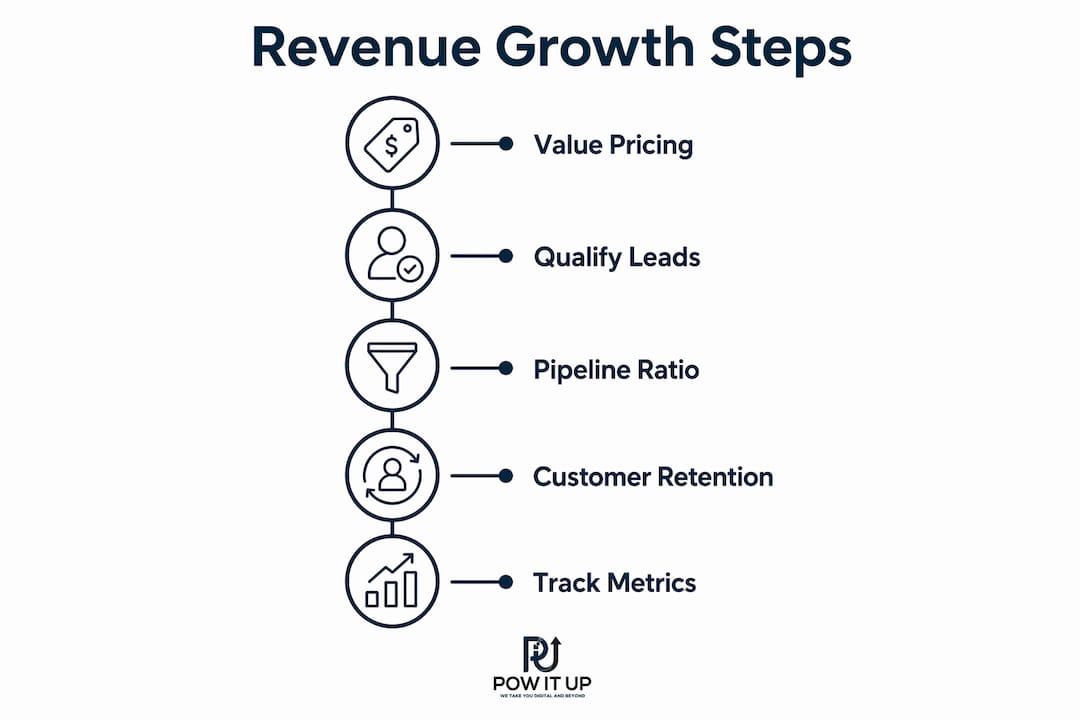
Sustainable revenue growth comes from fixing the system, not from pushing the team harder. The following steps address the four levers that move the number most reliably.
1. Shift to value-based pricing
Cost-plus pricing sets your price based on what it costs you to deliver. Competitor-based pricing sets it based on what others charge. Both leave money on the table. Value-based pricing sets price based on the outcome the customer receives. Pricing tiers aligned with customer outcomes can dramatically increase average revenue per user (ARPU). A software company that charges $50 per seat regardless of usage is leaving revenue behind. The same company charging $150 for a tier that includes advanced reporting, which saves the customer 10 hours a month, captures the value it actually delivers.
2. Qualify harder and shorten the sales cycle
Most sales teams lose time on deals that were never going to close. A formal qualification framework, such as MEDDIC (Metrics, Economic Buyer, Decision Criteria, Decision Process, Identify Pain, Champion), forces reps to confirm budget, authority, and urgency before investing significant time. Shorter sales cycles free up capacity for more deals and reduce the cost of acquisition.

3. Maintain a 3x pipeline-to-target ratio
A pipeline at least 3x your revenue target is the minimum buffer for consistent revenue generation. For a $100,000 quarterly target, that means $300,000 in qualified opportunities in the pipeline at all times. This ratio accounts for deals that stall, go dark, or close at lower values than expected. Leaders who let the pipeline shrink below this threshold almost always miss their number.
4. Invest in customer retention
Acquiring a new customer costs five to seven times more than retaining an existing one. Small improvements in retention compound quickly. A customer who renews for three years instead of one generates three times the lifetime value at a fraction of the acquisition cost. Retention tactics include proactive check-ins, usage reviews, and loyalty pricing for long-term contracts.
5. Track CAC, LTV, and the LTV:CAC ratio
These three metrics tell you whether your growth is profitable or just expensive.
| Metric | Definition | Healthy Benchmark |
|---|---|---|
| CAC (Customer Acquisition Cost) | Total sales and marketing spend divided by new customers acquired | Varies by industry |
| LTV (Lifetime Value) | Average revenue per customer multiplied by average customer lifespan | 3x CAC or higher |
| LTV:CAC Ratio | LTV divided by CAC | 3:1 or above |
| Payback Period | Months to recover CAC from gross margin | Under 12 months for SaaS |
An LTV:CAC ratio below 3:1 means you are spending too much to acquire customers relative to what they generate. Above 5:1 often signals underinvestment in growth.
Pro Tip: Review your LTV:CAC ratio quarterly, not annually. A ratio that looks healthy in January can deteriorate fast if churn spikes or acquisition costs rise mid-year.
How do you spot and fix revenue growth quality problems?
Rising revenue is not always good news. The quality of growth matters as much as the rate.
“Revenue growth must be evaluated alongside gross margin and free cash flow. Growth with margin compression or deteriorating cash flow signals a business that is scaling its problems, not its profits.”
The most common trap is chasing top-line growth while ignoring what it costs to deliver. A company that grows revenue 20% while gross margins fall from 60% to 45% is generating less profit per dollar of revenue. That pattern is unsustainable and often invisible until it becomes a crisis.
- Check gross margin alongside revenue. If revenue grows but gross margin shrinks, pricing or cost structure needs attention.
- Monitor free cash flow. Revenue growth without cash flow improvement often means the business is funding growth through working capital strain.
- Separate organic from inorganic growth. Acquisitions can mask a declining core business. If organic growth is flat or negative, the underlying model needs fixing before more capital goes in.
- Benchmark against sector averages. A 10% growth rate looks strong in a mature industry and weak in a high-growth sector. Context determines whether the number is good.
- Watch for revenue concentration risk. If one customer represents more than 20% of revenue, growth is fragile regardless of the rate.
The fix starts with building a dashboard that shows revenue, gross margin, free cash flow, and customer concentration side by side. Leaders who review all four together make better decisions than those who watch revenue alone.
How do emerging technologies support revenue growth and operational efficiency?
Technology does not replace a sound revenue strategy. It accelerates one that already works.
AI integration in CRM systems enables real-time analytics and smarter lead targeting. AI-driven CRM tools score leads by purchase intent, surface at-risk accounts before they churn, and recommend next-best actions for each deal. The result is a sales team that spends its time on the right accounts rather than the loudest ones.
Automation addresses one of the most persistent drains on sales productivity. Sales reps spend only 22% of their time actively selling. The rest goes to data entry, scheduling, reporting, and internal coordination. Automating those tasks through business process automation directly increases the hours available for revenue-generating activity.
| Approach | Primary benefit | Revenue impact |
|---|---|---|
| AI-enabled CRM | Smarter lead prioritization | Higher close rates on qualified deals |
| Sales process automation | More selling time per rep | Higher output without headcount increase |
| Predictive analytics | Demand forecasting accuracy | Better inventory and pricing decisions |
| Digital transformation culture | Consistent adoption of new tools | Compounding efficiency gains over time |
Selecting the right channels based on data rather than intuition is the final piece. Leaders who allocate budget to channels with the highest measured return on investment grow faster than those who spread spend evenly across all channels.
Pro Tip: Before deploying AI tools, map your current sales process in writing. AI amplifies what exists. A broken process with AI attached is a faster broken process.
Key Takeaways
Sustainable revenue growth requires measuring the right metrics, fixing the sales system, and using technology to multiply the output of a sound strategy.
| Point | Details |
|---|---|
| Measure organic growth separately | Strip out acquisition revenue to see whether the core business is actually growing. |
| Maintain a 3x pipeline ratio | Keep qualified pipeline at three times your revenue target to absorb deal losses. |
| Shift to value-based pricing | Price based on customer outcomes, not cost or competitor rates, to increase ARPU. |
| Track LTV:CAC ratio quarterly | A ratio below 3:1 signals that acquisition costs are eroding profitability. |
| Automate to increase selling time | Sales reps spend only 22% of their time selling; automation recovers the rest. |
Where most leaders go wrong with revenue growth
I have worked with enough leadership teams to see the same mistake repeat itself: the moment growth slows, the instinct is to launch five new initiatives simultaneously. New pricing model, new market segment, new sales methodology, new tech stack, all at once. The result is that nothing gets the attention it needs to actually work.
The research backs this up. Focused application of resources on the single largest bottleneck in the growth system produces far better results than scattering efforts across multiple tactics. The discipline is in the diagnosis. Before adding anything, identify the one constraint that, if removed, would unlock the most growth. Is it lead volume? Conversion rate? Average deal size? Churn? Each of those has a different fix, and fixing the wrong one wastes time and capital.
The leaders I have seen grow revenue consistently share one habit: they test one change at a time, measure it for 60–90 days, and then decide whether to scale or move on. That cadence feels slow in the moment. Over three years, it compounds into a fundamentally better business. Capital matters, but the intellectual discipline to stay focused on what actually moves the number is what separates companies that grow from companies that just get bigger.
— Sameer Abbas
How POWITUP helps leaders build scalable revenue growth
Business leaders who have the right strategy still need the right infrastructure to execute it at scale. POWITUP designs and deploys custom AI agents and automation systems that eliminate the manual work slowing your sales team down.
POWITUP’s AI integration services connect directly with CRM platforms and core business systems to surface real-time insights, automate lead follow-up, and reduce the administrative overhead that keeps reps off the phone. For leaders who want to scale revenue without scaling headcount, POWITUP builds the digital workforce that makes that possible. The result is a sales operation that runs faster, wastes less, and grows more predictably.
FAQ
What is the formula for calculating revenue growth?
Revenue growth is calculated as (Current Revenue minus Previous Revenue) divided by Previous Revenue, multiplied by 100. A company growing from $800M to $920M posts 15% year-over-year growth.
What is the difference between organic and inorganic revenue growth?
Organic growth reflects the performance of the core business, while inorganic growth includes revenue from acquisitions. Separating the two reveals whether the underlying business model is actually expanding.
What is a healthy LTV:CAC ratio for revenue growth?
A ratio of 3:1 or above is the standard benchmark. Below 3:1, acquisition costs are consuming too much of the value each customer generates.
How does automation support revenue growth?
Sales reps spend only 22% of their time actively selling. Automating data entry, scheduling, and reporting recovers that lost time and increases revenue output without adding headcount.
What is CAGR and why does it matter?
CAGR, or compound annual growth rate, measures the average annual growth rate over multiple years while smoothing out year-to-year volatility. It is the standard metric for comparing business performance across different time periods.