
An intelligent growth engine is a set of connected workflows in which AI agents handle the repeatable, high-volume work (reading documents, moving requests, checking conditions, preparing cases) so your people spend their hours on exceptions, judgment and customers. Revenue and volume can then rise without payroll rising at the same pace. The engine is built around outcomes you can measure, not around a tool. If you want one designed around your own operations, our AI automation service is where we start.
TL;DR
- A growth engine is end-to-end workflow redesign plus AI agents, not a chatbot bolted onto an old process.
- Good first candidates are frequent, repeatable tasks with clear completion criteria: document processing, finance operations, support, procurement, internal requests.
- A PYMNTS survey of 533 U.S. small and mid-sized businesses found 60% of AI users produce more work without adding staff.
- Start with a small, low-risk slice, measure it, then delegate more as it proves reliable.
- Track transactions per employee and cost per completed process, not hours saved in the abstract.
Table of Contents
- What an intelligent growth engine actually is
- Why leaders are building them now
- Which processes to build on first
- How to build the engine in stages
- Governance and data security
- Measuring the return honestly
- Where POW IT UP fits
- Our perspective
- FAQ
- Sources
What an intelligent growth engine actually is
Most businesses grow in a straight, expensive line: more customers mean more paperwork, more tickets, more reconciliations, more people. The line breaks when a company turns its repetitive operations into a system that absorbs volume by design.
Three parts make up that system:
- Workflows mapped from outcome to outcome. You trace a business result (an approved loan file, a paid invoice, a booked patient) from the first trigger to the last step and remove steps that add no value.
- Agents that do the routine work inside approved rules. An AI agent is software that can read inputs, decide the next step within limits you set, and act in your other systems. It collects information, routes requests, checks conditions and prepares the case.
- People who own exceptions and quality. Staff review what the agents cannot settle, improve the instructions, and spend freed capacity on revenue work.
This is different from a basic script that copies a field from one app to another. A script breaks when the input changes. A context-aware agent reads the document in front of it, understands what it is for and handles variation. That is the distinction behind the digital workforces we design and build: custom, autonomous agents that take on high-volume transactional work and hunt down the “time leaks” in daily operations.
Why leaders are building them now
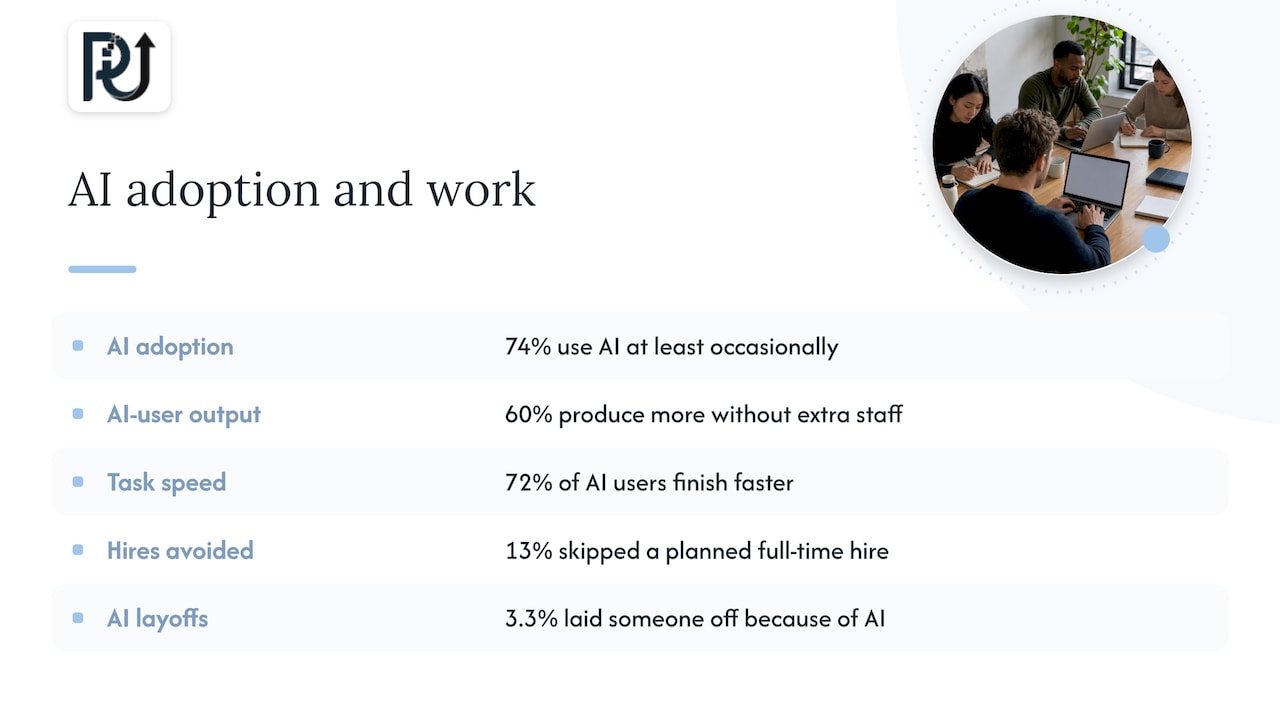
Adoption is no longer an experiment among small firms. The PYMNTS Intelligence report from October 2026, based on a survey of 533 U.S. small and mid-sized businesses, found that 74% use AI at least occasionally. Among users, 60% produce more work without adding staff and 72% finish tasks faster. Thirteen percent skipped a full-time hire they would otherwise have made, against 3.3% who laid someone off because of AI.
That pattern, growth through avoided hiring rather than cuts, shows up in larger firms too. Anthropic’s interviews with 58 enterprise customers, published November 23, 2026, found that interviewees more often described the value of AI as more output and better products or services than as cost cutting. Most said they were hiring less because of AI, and very few described domestic layoffs caused by automation.
One example from the same research: a fintech’s AI agents replaced offshore customer-service contracts, and managers moved to reviewing transcripts and improving the agents’ instructions and knowledge. The work did not vanish. The managers’ job changed from supervising people on the phone to improving a system.
That is the practical meaning of scaling “infinitely” without a matching headcount increase: processing volume stops being tied to the number of people touching each item.
Which processes to build on first
The best candidates share four traits:
- They happen often.
- They follow rules a new hire could learn from a checklist.
- They have a clear definition of “done.”
- A mistake is catchable before it causes harm.
In practice, that points to a short list by industry:
| Business type | Strong first candidates |
|---|---|
| Fintech and lending | Document intake and validation, loan file preparation, client onboarding checks |
| Accounting firms | Collecting client documents, categorizing and reconciling, preparing review packages |
| Healthcare practices | Referral and authorization paperwork, intake forms, follow-up on stalled requests |
| Agencies and consultancies | Reporting, project costing, status updates, lead handling |
| E-commerce and Shopify brands | Order exceptions, support triage, email and SMS flows |
| Logistics and real estate | Document packets, scheduling, status communication |
If you read documents all day, the highest-yield starting point is usually document intelligence. Our DocuPOW product is built for document reading and validation, and it comes with live demos, so you can see it on documents like yours. For portfolio-based businesses, AuraPOW covers portfolio monitoring and client health analytics, so account managers see which relationships need attention before a client leaves.
Run a quick readiness check
Before you build anything, answer these five questions for the candidate process:
- How many times a week does it run, and how long does each run take?
- Can you write down the rules a competent person follows?
- What does a correct result look like, and who decides?
- What data does it touch, and who is allowed to see it?
- What happens when the agent is unsure?
If you cannot answer the third and fifth, fix that first. Vague success criteria produce vague systems.
How to build the engine in stages
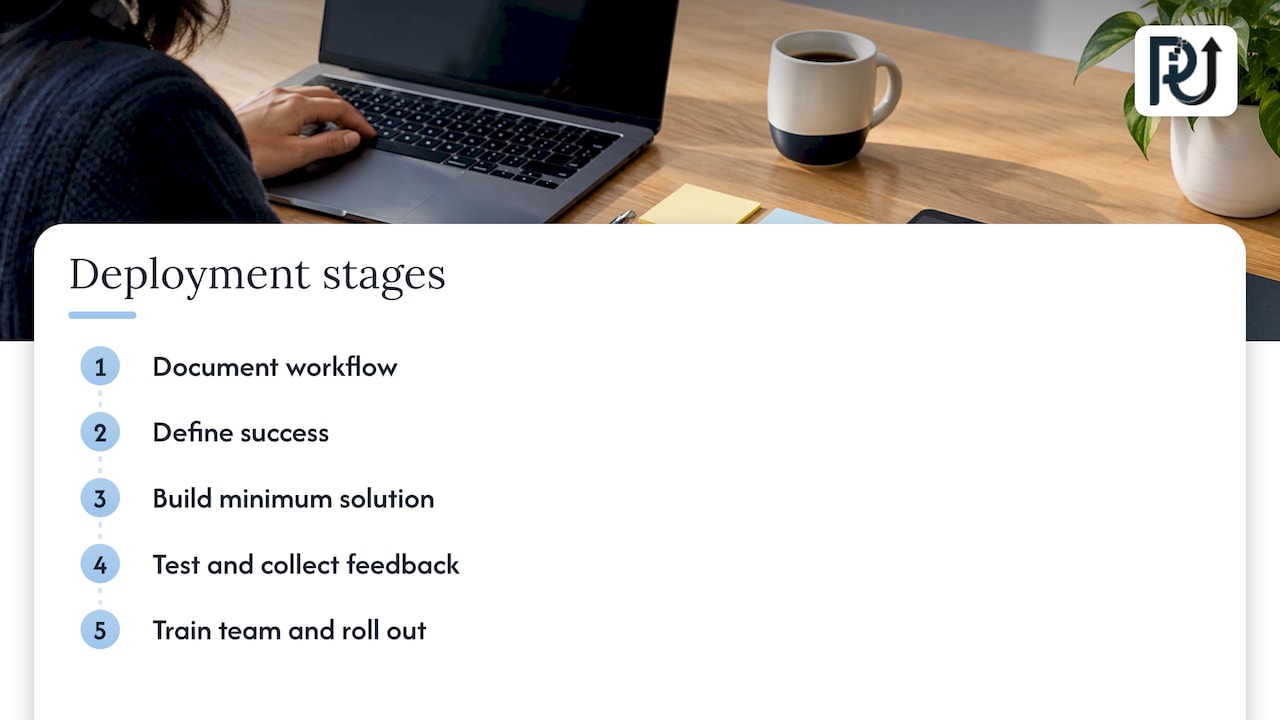
Bessemer Venture Partners’ operational playbook lays out a sequence that matches how reliable deployments tend to go: document the workflow, define success, build a realistic minimum solution, test and collect feedback, then train the team and roll it out. It also recommends beginning with small, low-risk slices of a process and delegating more as the solution proves reliable. The same guide makes the point that the playbook matters more than which tool you use.
Here is how that looks as a working routine.
1. Map one outcome end to end
Pick a single result and walk it from trigger to finish with the people who do it daily. Note every handoff, wait and rework loop. The common failure here is mapping the process as it is described in a manual rather than as it is actually done. Redesign the workflow before you add AI, because automating a broken process gives you a faster broken process.
2. Define success in numbers
Choose two or three measures before you start: transactions per employee, cost per completed process, turnaround time, error rate. Record the baseline. Without it, nobody can say later whether the system paid off.
3. Build the smallest useful slice
Automate the intake and first-pass check, not the whole process. Keep a person approving outputs at the start. This is the stage where custom engineering earns its keep: the agent has to connect to your real systems, handle your real documents and respect your approval rules. Our AI integration and AI agents development work covers that, with maintainable systems you own and understand rather than a black box.
4. Test with the people who will use it
The Anthropic interviews suggest adoption works best when workflow redesign is paired with employee participation. Top-down automation can provoke insecurity and resistance, while uncoordinated bottom-up use leaves adoption uneven and fragmented. Involve the team that runs the process from the mapping stage, and show them what the agent takes off their plate. For ideas on building that trust across a team, this piece on coordinating AI adoption across teams is worth your time.
5. Widen the delegation as reliability is proven
Once the first slice runs cleanly, hand the agent more: another document type, another decision, another system. Introducing AI agents incrementally keeps the risk of each step small and the learning fast.
6. Review, improve, repeat
Someone owns the agent’s instructions and reviews its exceptions weekly. In the fintech example above, this became the managers’ main job. It is also where the engine compounds: every corrected exception makes the next thousand runs better.
Governance and data security
An engine that touches client data needs written rules before launch. Cover who can access what, how actions are logged, where data is stored and for how long, and which decisions always go to a human.
If you are an accounting or tax preparation firm, this is not optional. The FTC Safeguards Rule (16 CFR Part 314) treats firms that prepare income tax returns as financial institutions, and requires a written information security program. Applied to AI, that means multi-factor authentication, access controls, logging, encryption, retention and disposal schedules, and oversight of vendors. Breach notification to the FTC is due within 30 days after discovery when unencrypted information on 500 or more consumers was acquired without authorization. Confirm your specific obligations with your compliance counsel or the FTC’s published guidance.
If you are a bank or lender, talk to your regulator and counsel about how your supervisory guidance treats agentic AI, since federal guidance in this area has been moving through 2026. Healthcare practices should involve their privacy officer before any patient data reaches an agent.
Build these controls into the design from day one. It is far cheaper than retrofitting them, and it is the reason we favor transparent processes and engineering accountability in every build.
Measuring the return honestly
Leaders are right to ask for proof. A U.S.-focused systematic review of 61 studies, posted in September 2026, reports that U.S. Census data show AI use in 18% of firms. Of AI-using firms, 66% reported augmentation-only use, and 2% reported AI-related employment decreases. The takeaway for your planning: the realistic gain is capacity, so measure what that capacity produces.
For each engine, track:
- Volume handled per employee before and after.
- Cost per completed process, including software, engineering and review time.
- Cycle time, from trigger to completion.
- Exception rate, the share of items a person must touch.
- What the freed time produced: faster outreach, follow-ups on stalled items, more client calls.
That last measure matters most. In one health system’s account, the leader described AI as a complement to labor and not a substitute: the value lies in what teams do with the capacity they get back.
For a deeper walkthrough of the arithmetic, see our guides to automation ROI and what AI automation costs, and service business automation examples if you run a services firm.
Where POW IT UP fits
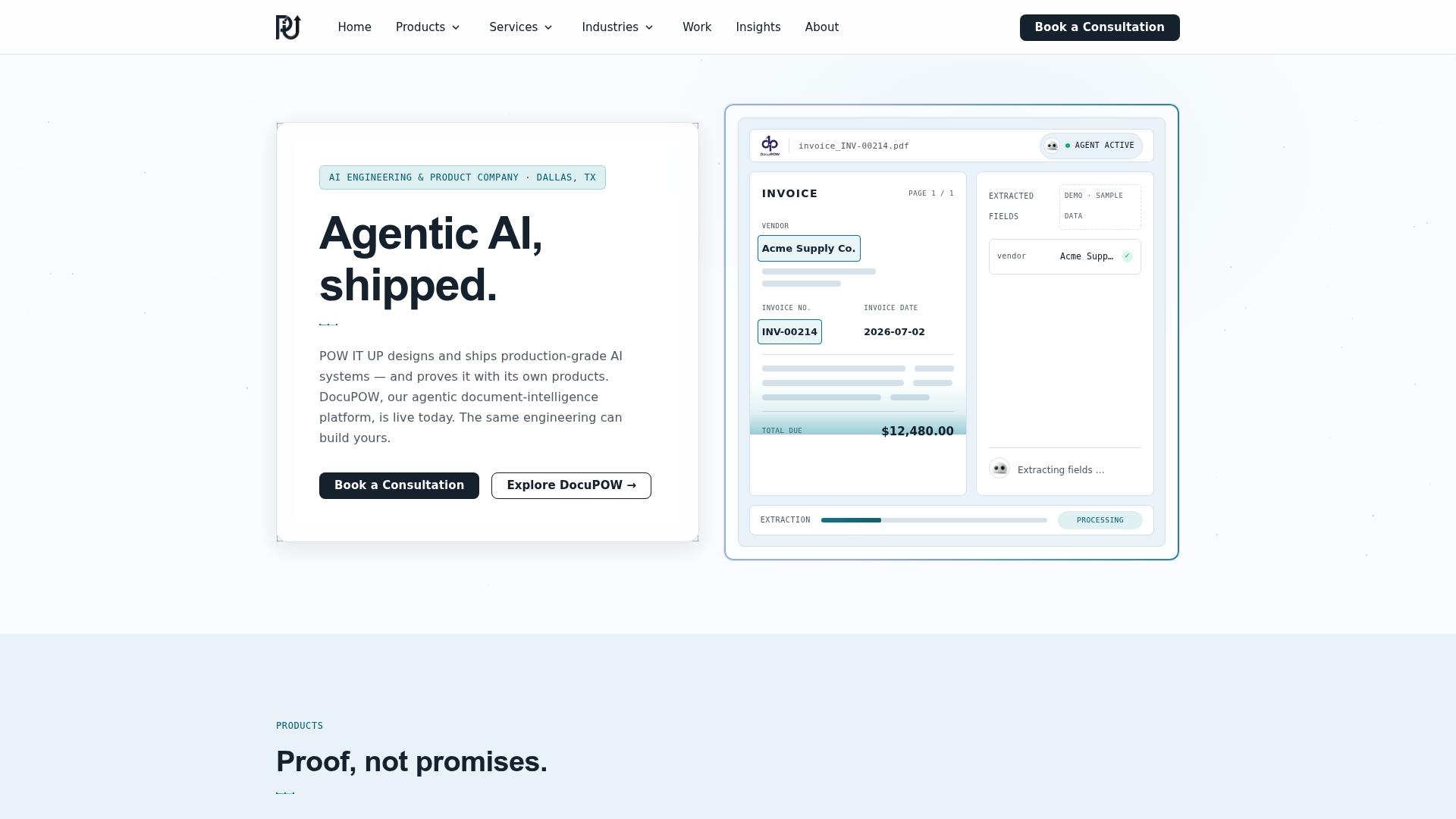
We design, build and deploy custom digital workforces: context-aware AI agents for document intelligence, workflow orchestration and autonomous transaction processing, along with cloud analytics, data analytics and project costing. Our work is built on documented, verifiable engineering, with live demo products like DocuPOW as proof of how we build. Clients keep durable ownership of what we create.
If your bottleneck is documents, start with DocuPOW. If your process is more specific to your business, talk to us about a custom build and we will begin with one workflow and one measurable outcome.
You can also browse our full list of services or read our guide to business automation through AI agents.
Our perspective
Most companies we talk with do not have a technology problem. They have a capacity problem that looks like a hiring problem. Every new customer adds work in the same places: documents, follow-ups, checks, status updates. Adding people to those places works until the margin disappears.
We build digital workforces because the better answer is to change where the work happens. A well-designed agent reads the document, checks it against your rules, moves it to the next step and flags the exception. Your best people then spend their day on the exception and the client.
That is why we insist on custom, context-aware systems instead of generic scripts, and on maintainable builds the client owns. An engine you cannot understand, adjust or extend is not an engine. It is a dependency.
Start small, measure plainly, and widen the scope as the system earns it. Done that way, volume can grow while headcount stays deliberate.
Syed Naveed Abbas
FAQ
What is the best AI to help me grow my business?
The process matters more than the tool. Pick a repeatable process with a clear return, start with a small slice and iterate. The right system is the one connected to your own documents, data and approval rules, which is why custom integration usually beats a generic assistant for operational work.
Will AI automation mean laying off staff?
The evidence so far points the other way. In the PYMNTS survey, 13% of small businesses skipped a planned hire, while 3.3% laid someone off because of AI. Anthropic’s enterprise interviews likewise found most firms hiring less, with very few reporting domestic layoffs. The common pattern is growth without proportional hiring.
How long before an automation engine pays back?
It depends on the volume and cost of the process you start with. High-frequency, document-heavy work tends to show results first, because the baseline is easy to measure. Record your cost per completed process before you start, then compare after the first slice has run for a full cycle.
Do I need clean data before I begin?
You need accessible data and clear rules, not perfect data. Mapping the workflow first shows what the agent will touch. Systems that read documents directly, rather than relying on tidy databases, can start from the files you already have.
Sources
- PYMNTS Intelligence: 60% of small business AI users do more without adding staff
- Anthropic: Working with AI
- Bessemer Venture Partners: From tasks to systems, a practical playbook for operationalizing AI
- Enterprise AI at the Decision Point: A U.S.-Focused Systematic Review
- AI agents for business: what they do and where to start
- Sales AI adoption: why most teams stall