

Intelligent business growth solutions are systems that read your data, make routine decisions inside rules you set, and carry out the work across sales, operations and service. They are not a dashboard and not a chatbot. Done well, they remove the manual handoffs that cap how much revenue your team can process. Done badly, they become one more pilot that never reaches production. This guide covers what these systems do, where they pay off, how to start, and what can go wrong.
TL;DR
- Intelligent growth means connecting data, workflows and AI agents so volume can rise without a matching rise in headcount.
- Most companies use AI, few capture real value: 88% of organizations use AI in at least one function, but only 5.5% are high performers.
- Start with one high-volume, measurable process, such as document intake, instead of a company-wide program.
- Governance is part of the build: inventory your models, test whether outputs fit their intended use, and keep humans in the loop on exceptions.
- Insight alone does not grow revenue. The gain comes when a system also acts on the insight.
Table of Contents
- What “intelligent” adds to a growth system
- Why revenue is an operations problem
- The adoption gap: lots of AI, little value
- Where intelligent systems pay off first
- A practical path from idea to production
- Governance is part of the build
- Our perspective
- Build or buy: choosing the right route
- How we can help
- Frequently asked questions
- Sources
What “intelligent” adds to a growth system
Most growth stacks already have a CRM, a billing tool, a help desk and a reporting layer. Each one works. The trouble sits between them: a person copies a figure from a PDF into a spreadsheet, another checks it, a third updates the CRM two days later. Those gaps are where revenue leaks.
An intelligent system adds three things on top of the stack you own:
- Understanding. It reads unstructured inputs such as invoices, applications, contracts and emails, and turns them into structured fields.
- Judgment inside limits. It applies your rules and learned patterns to decide: approve, flag, route, escalate.
- Action. It writes to the systems of record, triggers the next step and logs what it did.
The third part separates automation from analytics. A report that says a client account is at risk helps only if someone reads it in time. A system that notices the risk, drafts the outreach and assigns the owner changes the outcome.
This fits how BCG describes AI in revenue operations: predictive AI has long helped teams with segmentation, churn forecasting and similar tasks, and the next step is moving from prediction to execution across sales, marketing and customer success.
Why revenue is an operations problem
Leaders often treat growth as a demand problem: more leads, more campaigns, more reps. In practice, many companies hit a ceiling on the delivery side. Quotes wait for data entry. Onboarding stalls on missing documents. Renewals slip because nobody saw the warning signs.
Xactly’s definition of intelligent revenue makes a useful point: predictable, profitable, resilient revenue comes from breaking down silos between sales, marketing and customer success, and aligning planning, processes, systems and data into one repeatable engine. Buying a tool does not do that. Redesigning how work moves does.
Gartner expects the same shift in structure. Its RevOps guidance says 75% of the highest-growth companies will adopt a RevOps model by 2026. Whether or not you use that label, the principle is shared: one revenue process, one set of numbers, owned end to end.
The adoption gap: lots of AI, little value
The uncomfortable fact for anyone shopping for AI is how rarely it pays off at scale. Using the McKinsey 2025 survey, 88% of organizations report AI use in at least one function, while only 5.5% attribute more than 5% of EBIT to AI. The same summary shows the funnel narrowing from pilots to enterprise-wide scaling at roughly 7%.
Two lessons follow.
Pilots are cheap, scaling is hard. The gap is rarely the model. It is process redesign, data access, ownership and governance. A pilot that runs beside the real process, with someone copying results by hand, proves little.
Be wary of giant headline numbers. The widely quoted $4.4 trillion figure is a theoretical ceiling at full scale, not a forecast. Plan for incremental, compounding gains tied to specific processes, and measure them.
Where intelligent systems pay off first
The best first targets share four traits: high volume, repeated rules, expensive errors, and a clear before-and-after metric. These are the areas we see leaders prioritize.
| Area | What the system does | Metric to watch |
|---|---|---|
| Document intake | Reads, validates and routes invoices, applications, claims, statements | Minutes per document, error rate |
| Lead and client onboarding | Collects missing information, checks it, creates records | Days from signature to first value |
| Portfolio and account monitoring | Scores client health, flags churn or exposure | At-risk accounts caught before renewal |
| Reporting | Pulls figures from several systems into one trusted view | Hours spent on month-end reporting |
| Transaction processing | Handles routine, rule-bound transactions end to end | Throughput per person, exceptions per 1,000 |
Document-heavy operations
Fintech, insurance, healthcare practices, logistics and accounting firms all run on documents. If a person opens every file, volume is tied to headcount. DocuPOW is our product for reading and validating documents, with live demos available so you can test it on your own paperwork before committing.
Client health and portfolio monitoring
For service firms and lenders, revenue growth often depends on retention. AuraPOW, our portfolio monitoring and client health analytics product, exists for that reason: surface the accounts that need attention while there is still time to act.
Reporting people actually use
BI software is mature and inexpensive to start. Mainstream tools list entry prices around $14 to $15 per user per month, so licensing is rarely the obstacle. The obstacle is a clean, agreed definition of each metric. As an example of role-based reporting done concretely, dealership dashboards that split views by role and track speed-to-lead and inventory aging show how a small set of well-chosen metrics can guide daily decisions. Choose few numbers, tie each to an owner, and make each one trigger an action.
A practical path from idea to production
Here is the sequence we recommend to leaders who want results instead of a demo.
- Map the time leaks. Follow one process end to end and time each step. Note every place a person re-keys, waits or checks.
- Pick one process. Choose the one with the highest volume and the clearest metric. Resist adding a second.
- Write the rules and the exceptions. Decide what the system may do alone, what needs approval, and what must go to a person. This document is the real specification.
- Build against live systems. Connect to your CRM, ERP, core system or storage. A sandbox that never touches production hides the hardest problems.
- Run in parallel, then cut over. Compare system output with human output for a few weeks. Move volume across as accuracy holds.
- Measure and expand. Compare against the baseline from step 1. Only then pick the next process.
Our own guidance on starting with a pilot for SMBs and on proving consulting ROI within weeks goes deeper on scoping and measurement.
Governance is part of the build
AI systems carry risks that ordinary software does not. Testimony to the U.S. Senate banking subcommittee in 2025 listed IP infringement from training data, hallucinated outputs and a wider cyber attack surface, and described an AI model inventory and end-to-end audits as foundational steps before scaling. The same testimony points to NIST’s ARIA pilot, which emphasizes validity: whether output meets its intended use.
For a growth leader, that translates into simple habits:
- Keep a list of every AI model or agent in use, who owns it and what data it touches.
- Test on your own data and your own edge cases, not a vendor’s sample set.
- Log every automated decision so it can be reviewed.
- Keep a person on the exception path, especially in lending, claims and patient-related work.
The NIST AI Risk Management Framework is voluntary and designed for organizations of any size or sector, which makes it a workable reference for a small firm drafting its first policy. If you operate in a regulated field such as banking, insurance or healthcare, ask your compliance counsel or regulator-facing advisor which rules apply to automated decisions before you go live.
Our perspective
We build these systems for a living, and our view is plain: growth does not come from adding AI to a process, it comes from redesigning the process so AI has real work to do.
We treat a client’s operation as an architecture problem. Generic scripts break the first time an input looks unusual. Context-aware agents, built around your documents, rules and exceptions, hold up. That is why we focus on custom, maintainable systems, documented so your team understands them and owns them afterward, instead of renting a black box.
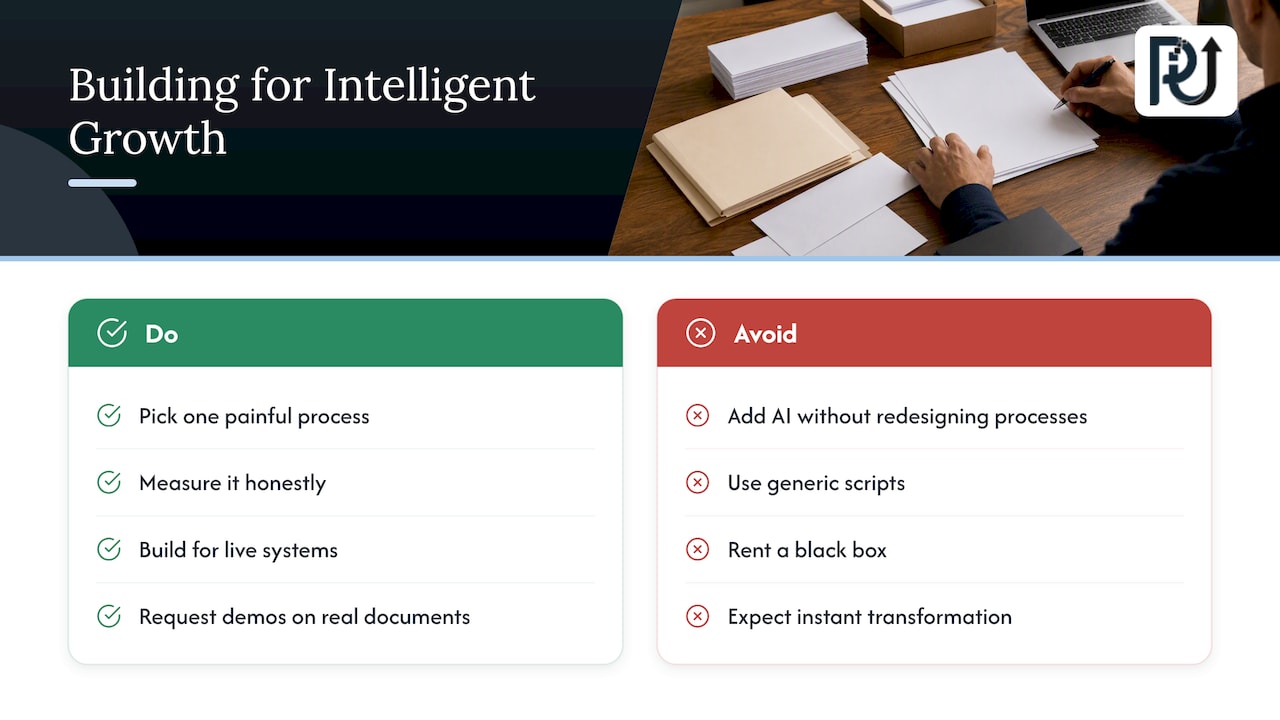
We also push back on the promise of instant transformation. The gains that last are incremental: a process that takes minutes instead of days, an account flagged a month earlier, a team that handles twice the volume with the same people. Stack enough of those and the business scales without a proportional increase in headcount. That is the reasonable meaning of “intelligent growth.”
Our advice to any leader: pick one painful process, measure it honestly, and insist on a build that touches your live systems. If a vendor cannot show a working demo on real documents, keep looking.
— Syed Naveed Abbas
Build or buy: choosing the right route
Leaders usually weigh three routes.
| Route | Best when | Watch for |
|---|---|---|
| Off-the-shelf SaaS | The process is standard and the tool fits it | Workarounds when your rules differ |
| Productized AI for a defined job | The task is common, such as document reading | Confirm it can be tuned to your formats |
| Custom-built agents and integrations | Your process is distinctive or spans several systems | Needs clear ownership and documentation |
Most companies end up with a mix. The test is simple: if people are working around the tool, the tool is the bottleneck. For multi-system work, see our overview of AI integration services for business leaders and our guide to what a business automation agency does.
How we can help
If you have a high-volume process and want to see it automated against your real systems, we design and deploy custom AI agents, integrations and automation, and we offer DocuPOW for document reading and validation. Start with a conversation about one process through our AI automation service, or explore AI agents development if your work needs autonomous decisions. We don’t publish prices for these services, so scope and cost come out of that first discussion.
Frequently asked questions
What does an intelligent business growth solution actually include?
Usually three layers: data connections to your existing systems, AI that interprets documents and signals, and automation that acts on them. Reporting sits on top. If a solution only produces dashboards, it informs growth but does not drive it.
How long before I see a return?
It depends on the process and the quality of your data, so be skeptical of fixed promises. A narrow pilot on one process can show a measurable change against your baseline within weeks, which is why we recommend starting there and not with a broad program.
Do I need a data team first?
Not necessarily. You need access to the data and someone who owns the process and can define correct output. A partner can build the connections and the first system. Data quality does matter, so a short audit of the inputs is worth doing first.
Is this only for large companies?
No. Small and mid-sized firms often benefit quickly because a handful of repetitive processes consume a large share of their staff time. Start small, measure, and expand. Our guide to AI agents for small businesses covers realistic first projects.
Sources
- Generative AI Adoption Statistics 2026, Morphed
- AI Was Made for RevOps: From Prediction to Execution, BCG
- What Is Intelligent Revenue, Xactly
- Revenue Operations, Gartner
- The $4.4 Trillion Number McKinsey Actually Published, Ali Safari
- Best Business Intelligence Tools in 2026, Toolradar
- Testimony before the U.S. Senate Banking Subcommittee, July 30, 2025
- NIST AI Risk Management Framework (AI RMF 1.0)