

Autonomous AI agents will change work less by replacing jobs than by moving people from doing tasks to supervising them. The agent handles the high-volume, rule-heavy steps. Your people verify, decide and handle exceptions. The businesses that benefit are the ones that pick the right workflow, build the agent around their own data and systems, and design the human oversight on purpose. That is the kind of system we build at POW IT UP: custom AI agents shaped around how your operation actually runs.
TL;DR
- An autonomous agent pursues a goal across several steps and tools. Classic automation follows a fixed script.
- Measured gains are real but task-specific: faster customer-service resolution, more completed coding tasks, and much shorter research cycles under human supervision.
- Work shifts toward supervising, verifying and handling exceptions. How you design that role decides whether the jobs get better or worse.
- Start with one high-volume workflow, define what the agent may do alone, and keep a person accountable for the outcome.
- Security, privacy and reliability are design requirements from day one, not a later add-on.
Table of Contents
- What an autonomous agent is, and what it is not
- How daily work changes
- What the evidence says about gains
- Where agents fit in your operation
- Jobs and skills: what changes for your team
- Risks to design for
- A practical path to your first agent
- Work with POW IT UP
- Our perspective
- FAQ
- Sources
What an autonomous agent is, and what it is not
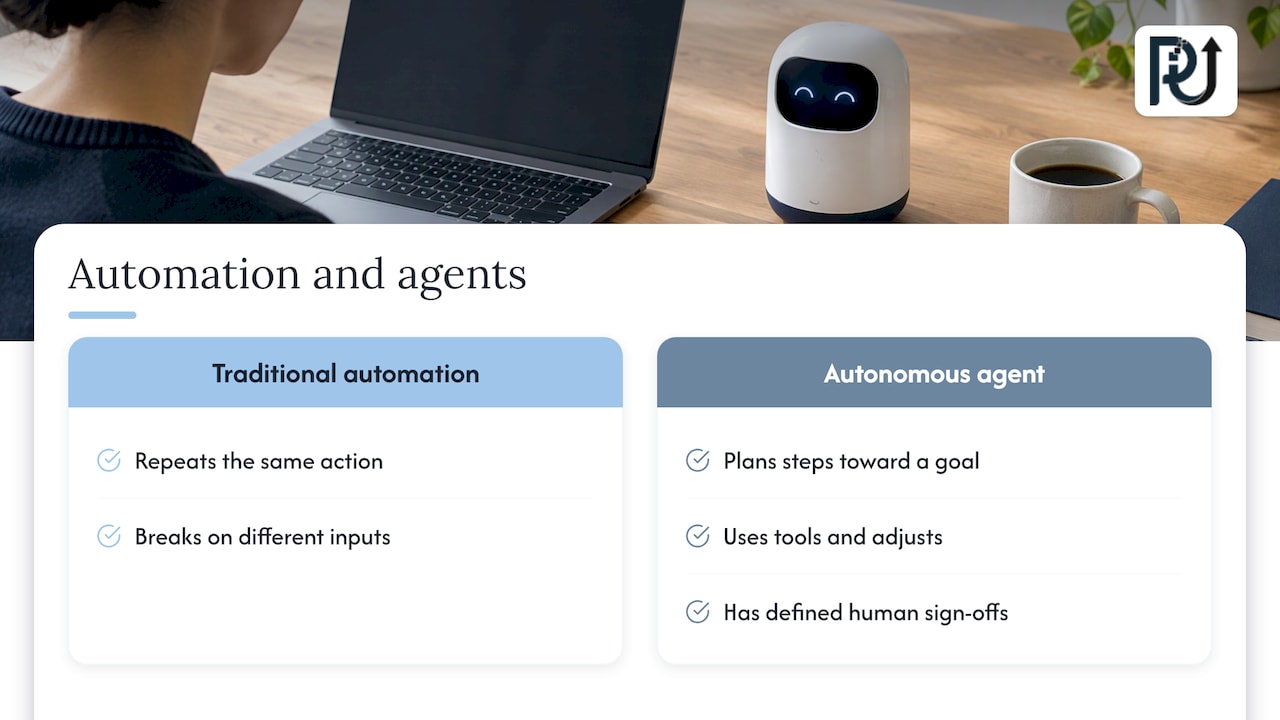
A chatbot answers a question. A traditional automation, such as a rule that copies a form field into a spreadsheet, does the same thing every time and breaks when the input looks different. An autonomous AI agent sits beyond both: you give it a goal, and it plans the steps, uses tools such as your CRM, email or a document store, checks its own progress and adjusts when something unexpected shows up.
The U.S. Government Accountability Office describes the current picture in its Science & Tech Spotlight on AI agents: agents are in use today in software development, customer service and autonomous vehicles, with operations management and routine workplace tasks such as data entry as emerging applications. Its example for operations is an agent that tracks inventory, staff schedules and equipment status, then schedules maintenance and repairs without being asked.
Think of it as a spectrum. At one end is a fixed sequence of AI calls. At the other is an agent that decides which steps to take. Most business value today sits in the middle: agents with a clear goal, a limited set of tools and defined places where a human signs off. If you want a deeper map of the categories, our guide to types of AI agents for service teams walks through them.
How daily work changes
The practical change is in who does what. Three shifts show up repeatedly.
From executing to supervising. An MIT study from April 2026 of more than twenty U.S. companies found that workers are increasingly asked to oversee and analyze processes rather than execute them. The same study found these supervisory jobs vary widely in quality and pay, and that management choices, including how interfaces for supervisory work are designed, make a large difference.
From narrow roles to wider ones. Harvard Business School’s AI Institute describes a pattern in which agents lower the barrier to work outside someone’s specialty: a manager prototyping a dashboard, a marketer running deeper financial analysis, a lawyer producing more polished client materials. In their analysis of agent use, users shifted from doing the work to verifying and extending it.
From headcount-driven volume to system-driven volume. When an agent processes invoices, intake forms or loan documents, volume stops being a staffing problem. That is the logic behind scaling without adding a proportional number of people, and it is where an operations leader should focus first.
What the evidence says about gains
Be specific about what is measured. Vague promises of transformation are easy to find. Numbers tied to a task are more useful.
- Research and knowledge work. In the HBS AI Institute report on 10,000 paired sessions from February to May 2026, a human-supervised agentic workflow cut average task completion time from 269 minutes to 36 minutes, an 87% reduction, with lower dissatisfaction on the next turn than conversational search.
- Customer service and coding. A U.S.-focused systematic review by Rah and Johnson (SSRN, September 2026) reports about 15% more customer-service issues resolved per hour and 26.08% more completed coding tasks in causal studies.
- Adoption is still partial. The same review, citing U.S. Census data, puts AI use at 18% of firms. Among firms using AI, 66% described their use as augmentation only, and 2% reported AI-related employment decreases.
Two lessons follow. First, gains concentrate in well-defined tasks, so the workflow you choose matters more than the model you buy. Second, the GAO notes that the best-performing agent in one software-development study completed only about 30 percent of tasks autonomously. Agents do the most when the task is bounded and a person reviews the result. We cover the same pattern from the operations side in AI efficiency for leaders.
Where agents fit in your operation
The workflows that suit agents share four traits: high volume, repeatable structure, messy inputs that rigid rules cannot handle, and a clear definition of a correct result.
| Function | What an agent can take on | Where a person stays involved |
|---|---|---|
| Finance and lending | Reading statements, pay stubs and applications, validating fields, flagging mismatches | Credit decisions, exceptions, customer disputes |
| Healthcare practices | Intake paperwork, scheduling, routine follow-ups | Clinical judgment, patient communication on sensitive matters |
| Accounting and consulting | Document collection, reconciliation, project costing inputs | Review, advice, client relationships |
| E-commerce | Order exceptions, support triage, catalog updates | Policy changes, escalations |
| Logistics | Status tracking, exception alerts, schedule updates | Carrier negotiation, disruption decisions |
| Real estate and service teams | Lead routing, document checks, task assignment | Client conversations, pricing, closing |
Document-heavy work is the clearest starting point, because the input is concrete and the output can be checked. Our DocuPOW product reads and validates documents, and the same approach appears in our guide to AI automation in loan processing. For firms that manage client portfolios, our AuraPOW product covers portfolio monitoring and client health analytics.
Jobs and skills: what changes for your team
The honest answer to the jobs question is that the evidence does not show a single outcome. In the Rah and Johnson review, no complete case demonstrated the full chain from AI cost to verified workforce replacement and realized return on investment. What the studies do show is changing job content.
The skills that gain value are:
- Process judgment. Knowing what a correct result looks like, so that you can spot a confident wrong answer.
- Exception handling. The cases the agent escalates are the hard ones, and they land on a person.
- Workflow design. Someone has to decide which steps the agent owns, which it only drafts, and which stay human.
- Data stewardship. Agents are only as reliable as the records and documents they read.
The MIT finding matters here for owners: job quality under AI is a management decision. If you design the supervising role well, with clear authority and decent tools, you keep your best people and give them better work.
Risks to design for
An agent that can act can also act wrongly. The risks are manageable when they are planned for in the build.
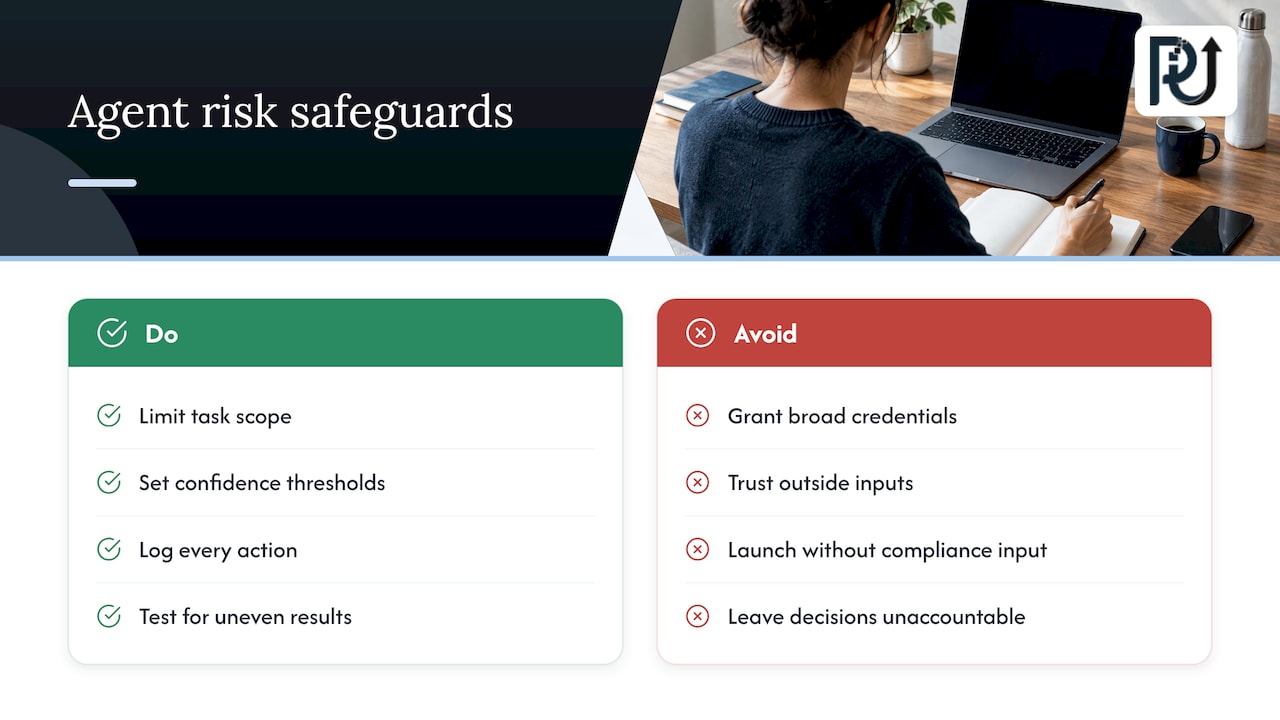
Reliability. Agents make mistakes, especially across long multi-step tasks. Limit the scope, set confidence thresholds, and route low-confidence cases to a person.
Security and access. An agent holding broad credentials is a bigger target than a script. Give each agent the narrowest permissions that let it do its job, log every action, and treat inputs from outside, such as inbound emails and uploaded documents, as untrusted. Security researchers now catalog agent-specific threats such as goal hijacking and tool misuse, which is why scoped access matters.
Privacy and regulated data. In fintech and healthcare, decide up front which data the agent may see and where it is processed, and involve your compliance lead or counsel before launch.
Bias and fairness. Where an agent influences decisions about people, such as lending, hiring or care, test its outputs for uneven results and keep a human accountable for the decision.
Oversight. NIST’s AI Risk Management Framework and its Generative AI Profile give U.S. organizations a common vocabulary for identifying and managing these risks. They are a sound basis for your own governance checklist.
Our view is that these are engineering questions, and the answers belong in the system itself: audit trails, approval steps, and clear ownership of each agent’s results. We go deeper on that in autonomous workflows for operational excellence.
A practical path to your first agent
You do not need an enterprise-wide program. You need one good workflow and a clear way to judge it.
- Find the time leaks. List the processes where staff spend hours on repetitive transactional work: re-keying data, chasing documents, reconciling records. Rank them by volume and by cost of errors.
- Pick a bounded workflow. Choose one with a clear definition of done and inputs you can collect. Avoid starting with a process that is already undocumented or politically contested.
- Check your data and systems. The agent needs access to clean records and to the tools your team already uses. Integration is often the larger share of the work, so plan it early. Our AI integration service exists for exactly this step.
- Define autonomy levels. Decide what the agent does alone, what it drafts for approval, and what it must escalate. Start tighter than you think you need to and loosen as results hold.
- Plan the compute and infrastructure. Some teams run models on their own hardware, and for them dedicated AI workstations and servers are part of the budget. Others use cloud services. Either way, budget for platform overhead, which we explain in our piece on scalable AI infrastructure.
- Measure against a baseline. Record cycle time, error rate and cost per transaction before launch. Compare after a set period, and share the results with the people supervising the agent.
- Scale deliberately. Once one workflow is stable, extend the pattern. Our six engineering steps past the pilot cover what changes at that point.
The reason to build with a specialist instead of assembling generic tools is fit. Generic scripts handle the standard case and fail on your exceptions. Our approach is custom, context-aware automation, with clear documentation and client ownership of what is built, so the system stays maintainable by your team.
Work with POW IT UP
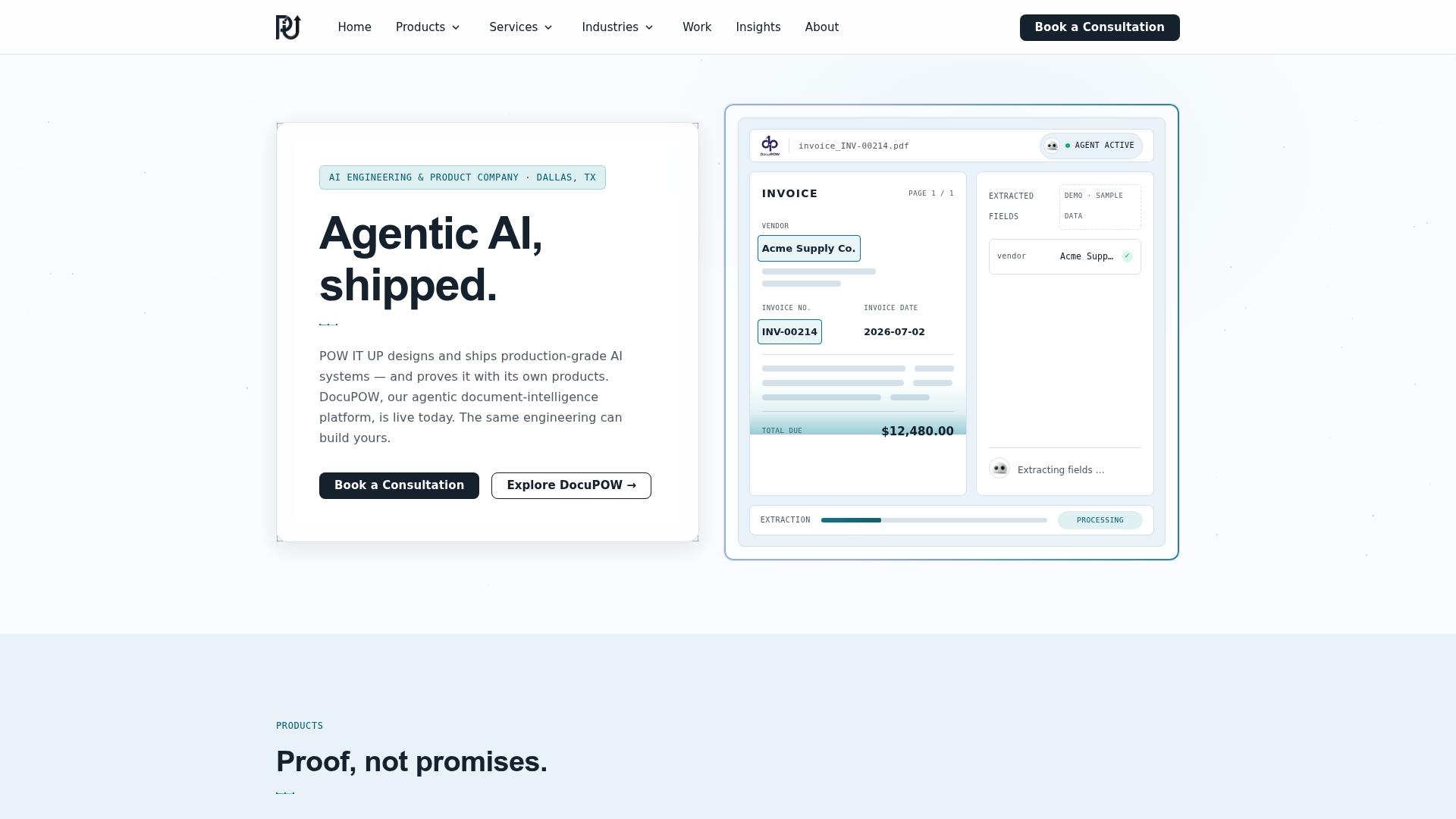
If you have a workflow in mind, AI Automation is where we begin: mapping the process, building the agent around your systems, and setting the oversight your team needs. If your bottleneck is documents, you can see DocuPOW in a live demo. For a broader look at what an engagement covers, see business automation through AI agents.
To discuss your operation, start at powitup.com.
Our perspective
Most of the talk about the future of work asks whether agents will replace people. We think the more useful question for an operator is which work you want people doing.
Every business we speak with has time leaks: hours spent moving information between systems, checking documents and chasing status. These are the first places an autonomous agent earns its keep, because the work is high-volume and the definition of correct is clear. Taking it off your team lets them spend time on judgment, relationships and exceptions.
We build digital workforces as engineered systems, not demos. That means agents with defined permissions, visible logs, and a human accountable for the result. It also means you own what we build and can maintain it. Companies that scale processing volume this way grow without adding headcount in step with every new transaction.
The research agrees on the shape of the shift: supervision, verification and exception handling become the core of many roles. Design that role well and the work improves for everyone in it.
Syed Naveed Abbas
FAQ
Will autonomous AI agents replace my employees?
The evidence so far points to changed roles more than eliminated ones. In a U.S. systematic review, most AI-using firms described their use as augmentation only. The more practical planning question is which tasks move to an agent and what your people do with the time.
How is an AI agent different from the automation I already have?
Existing automation follows fixed rules and fails when inputs change. An agent works toward a goal, chooses among tools and handles varied inputs such as unstructured documents. The trade-off is that it needs scoped permissions and human review points.
Which processes should a business automate first?
Choose a high-volume, repeatable workflow with a clear definition of a correct result, such as document intake, validation or routine scheduling. Document-heavy processes in lending, accounting and healthcare administration are common starting points.
How do we keep agents secure and compliant?
Give each agent the minimum access it needs, log its actions, treat outside inputs as untrusted and keep a person accountable for decisions. The NIST AI Risk Management Framework offers a structure for this, and your compliance lead or counsel should review any use involving regulated data.
Sources
- GAO Science & Tech Spotlight: AI Agents (GAO-25-108519)
- Enterprise AI at the Decision Point: A U.S.-Focused Systematic Review (SSRN)
- How AI Agents Are Changing the Way We Work (Harvard Business School AI Institute)
- Humans in the Loop (MIT)
- NIST AI Risk Management Framework
- AI Workstations & Servers