

Yes: when paired with the right integrations, orchestration, and governance, AI can scale operations without proportional headcount growth. The two levers that make this real are autonomous agents and automation paired with document intelligence that handles high-volume transactional work. The practical first move is simple: map one high-volume process and turn it into a pilot.
TL;DR:
- Deloitte found over two thirds of leaders expect 30% or fewer experiments to scale within three to six months; choose high volume, well defined workflows.
- Document heavy transactional workflows often make the strongest pilots because inputs can be validated and outcomes measured; invoice processing, claims intake, and contract review fit.
- Before deployment, define risk tiers, independent evaluations, red team testing, acceptable use limits, human escalation roles, and auditable logs; NIST recommends these safeguards for generative systems.
- A pilot without a measurable accuracy rate by week four should not advance; production systems need stable transaction costs for three months before expansion.
- Budget integration as an upfront cost tied to connected systems, then track recurring model, compute, storage, and governance expenses by transaction as volume grows.
Table of Contents
- Why operational scalability matters now
- Where AI delivers the biggest scalability gains
- Technical foundations for scalable AI operations
- Governance, risk management, and safety for scaling agentic AI
- Phased 6-step roadmap to scale AI without proportional headcount growth
- Cost considerations and budgeting for scaling AI-powered operations
- POW IT UP perspective: an engineering-first path to digital workforces
- How we help: book a demo or pilot
- FAQ
- Sources
Why operational scalability matters now
Executives are not wrong to be cautious about timelines. Deloitte’s State of Generative AI report found that more than two-thirds of respondents expect 30% or fewer of their current experiments to scale within the next three to six months. That gap between pilot enthusiasm and production reality is the single biggest reason operational AI projects stall.
More than two-thirds of surveyed leaders expect 30% or fewer AI experiments to reach production scale within three to six months, a reminder that scaling is a governance and engineering problem, not just a model selection one.
The same survey found that organizations centralizing governance and focusing pilots on high-volume, well-defined processes see faster value creation. That pattern holds across functions: when a process has clear inputs, clear outputs, and a measurable error rate, AI tends to reach production faster and the unit-cost improvements show up sooner. When a process is ambiguous or spans multiple approval layers, the same AI investment takes longer to pay back, regardless of how capable the underlying model is.
Where AI delivers the biggest scalability gains
Not every process deserves automation first. The processes that scale fastest share three traits: high volume, clear success criteria, and manageable compliance risk. Ranked by how reliably they produce throughput gains:
- Document intake and validation: invoice processing, claims intake, and contract review benefit from document intelligence systems (DocuPOW-style validation) that cut manual review time and reduce error rates on structured and semi-structured paperwork.
- Customer support ticket automation: routing, triage, and first-response drafting improve SLA adherence and resolution speed without adding support headcount.
- IT incident triage and runbooks: automated classification and runbook execution shrink ticket backlogs and improve mean time to resolution.
- Supply chain exception handling: automated demand signals and exception routing reduce stockouts and cut the volume of manual escalations.
- HR onboarding and employee requests: standardized intake and document checks shorten processing time and produce more consistent outcomes across locations.
Pro Tip: Score candidate processes on volume times outcome clarity times compliance risk; the highest-scoring process is almost always your best pilot.
Document-heavy transactional work tends to win the prioritization race because the inputs are structured enough to validate and the outcomes are easy to measure. For an example of how this plays out in practice, see how AI automates recurring operational deliverables that used to require a dedicated reviewer on every file.
Technical foundations for scalable AI operations
Scaling past a pilot requires infrastructure that most proof-of-concept projects skip. Five layers matter most:
- Connectors and integrations that pull data from the systems of record (ERP, CRM, document stores) without brittle point-to-point scripts.
- Document intelligence that extracts, validates, and reconciles structured and unstructured inputs before they reach a downstream workflow.
- Orchestration and agent frameworks that sequence tasks, hand off between automated and human steps, and recover gracefully from partial failures.
- Monitoring and observability that track accuracy, latency, and cost per transaction in near real time.
- Model lifecycle management that governs versioning, retraining triggers, and provider abstraction so a model swap does not require rebuilding the whole pipeline.
Underneath these layers, the data platform needs lineage tracking, automated quality checks, and access controls tight enough to satisfy an auditor. Peer-reviewed guidance on production AI validation emphasizes that continuous monitoring and reproducible evaluation pipelines are what separate durable automations from brittle pilots that quietly degrade after a few months in production.
Operationally, this means building modular services instead of monolithic scripts, abstracting the model provider so a vendor change does not force a rebuild, and setting explicit cost and latency budgets with service-level objectives attached to each workflow stage. Processes engineered this way scale horizontally; see the guidance on scaling AI process engineering for a deeper look at how these patterns fit together.
Governance, risk management, and safety for scaling agentic AI
Governance is not a compliance afterthought bolted on after launch; it is what lets a pilot become a production system without a costly rollback. The NIST Generative AI Profile outlines concrete actions for organizations deploying generative and agentic systems at scale:
- Establish risk tiers so high-stakes decisions get stricter review than low-stakes ones.
- Run independent evaluations, including red-teaming, before and after deployment.
- Write acceptable-use policies that define what the system may and may not decide autonomously.
- Maintain test, evaluation, validation, and verification (TEVV) logs that support audits and incident response.
NIST’s Generative AI profile treats scaling as a socio-technical program, prescribing independent assessments and defined human-AI configurations to reduce the chance of catastrophic errors reaching customers or regulators.
Practically, this means assigning clear role definitions (who approves an exception, who reviews flagged transactions), building an incident response plan before go-live, and keeping retention policies that make every automated decision traceable after the fact. Organizations that build this scaffolding early avoid the expensive pattern of shipping fast, discovering a failure mode in production, and rolling back the entire workflow. Trust, once established through visible governance, is what lets a pilot expand to the next business unit without re-litigating the same risk questions.
Phased 6-step roadmap to scale AI without proportional headcount growth
Scaling AI operations follows a predictable sequence. Skipping a step usually shows up later as rework.
- Pick the pilot. Choose a high-volume, low-regret process where errors are easy to catch and correct.
- Prepare data and telemetry. Connect the systems of record, define quality checks, and instrument logging before any automation runs live.
- Build and test the automation. Apply TEVV practices: validate accuracy, run adversarial tests, and document failure modes.
- Deploy with a defined human-AI configuration. Set clear escalation paths and service-level agreements for when a human reviewer steps in.
- Scale horizontally. Extend the same pattern to adjacent processes while layering in cost controls and governance checkpoints.
- Run continuous improvement. Monitor for drift, retrain on schedule, and measure outcomes including the headcount delta against baseline volume.
Pro Tip: Track the headcount delta from day one of the pilot, not after scaling; it is the single number that proves or disproves the business case.
Each phase has its own checkpoint. A pilot that cannot show a measurable accuracy rate by week four is not ready for step four. A production system that cannot show stable cost per transaction after three months of operation is not ready for step five. Treating the roadmap as a gate rather than a timeline keeps a leadership team from scaling a process that was never actually validated.
Cost considerations and budgeting for scaling AI-powered operations
Budgeting for AI-powered scaling has three cost centers that are easy to underestimate: integration work, ongoing model and infrastructure spend, and governance overhead. Integration work (connecting source systems, building validation layers, setting up orchestration) is usually the largest upfront line item, and it scales with the number of systems a workflow touches rather than with transaction volume.
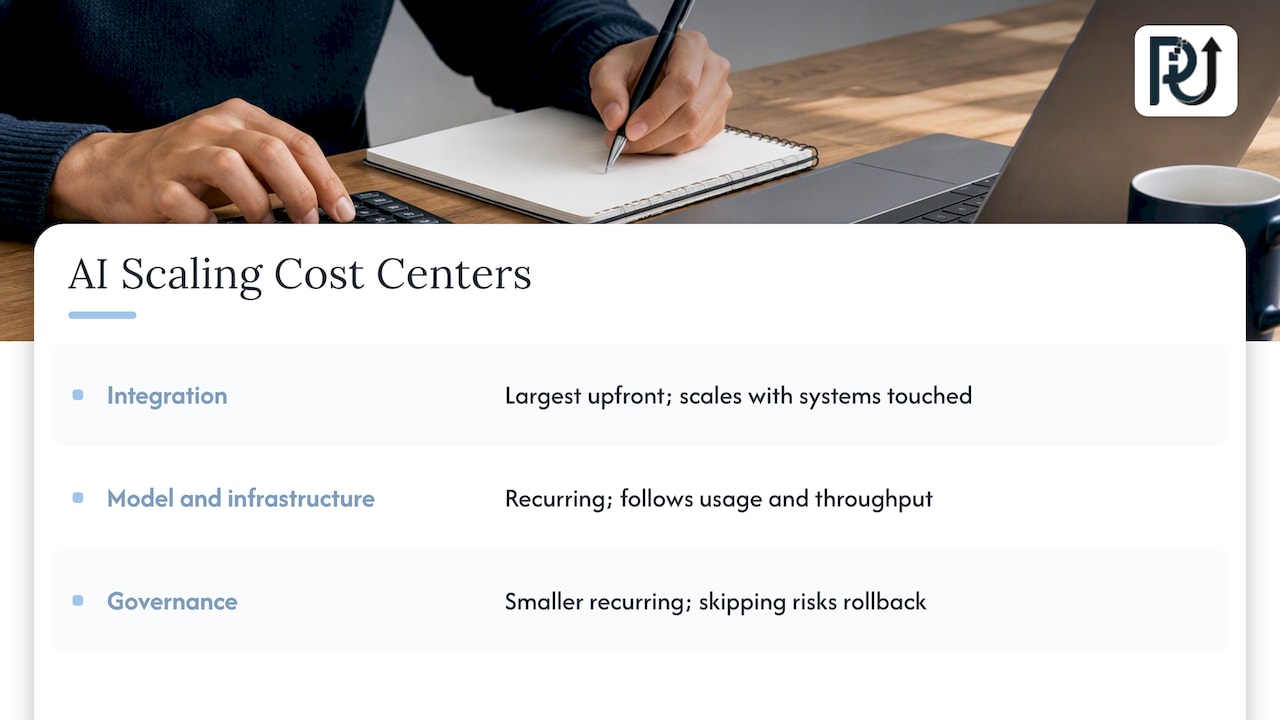
Ongoing costs follow usage: API calls, compute for document processing, and storage for audit logs grow with throughput, which is why cost-per-transaction tracking matters more than a flat monthly budget once a pilot moves to production. Governance overhead, including independent evaluation cycles and incident response readiness, is a smaller line item but a recurring one; organizations that skip it in the budget often pay for it later as an unplanned rollback.
A realistic budget separates one-time build costs from recurring operating costs and plans for a step increase in spend at each scaling phase, not a flat run rate. Leaders who set a single number for “the AI budget” without this breakdown tend to overspend on infrastructure they do not yet need and underspend on the evaluation work that keeps a scaled system trustworthy. The organizations Deloitte describes as centralizing governance while focusing pilots on high-volume use cases are, in practice, the ones budgeting this way by default.
POW IT UP perspective: an engineering-first path to digital workforces
We approach scalability as an engineering discipline first. Rather than scripting one-off integrations, we design and deploy context-aware AI agents that handle high-volume transactional work.
In practice, this means we build the connectors, orchestration, and TEVV-readiness a pilot needs before it reaches production, then hand over a system built for durable ownership rather than a prototype. A business with a well-defined, repeatable process and in-house engineering bandwidth can often build internally; a business facing multiple legacy systems, compliance requirements, or a tight timeline gets more leverage from an integration partner.
— Syed Naveed Abbas
How we help: book a demo or pilot
If the process you mapped in the opening section involves document-heavy intake, DocuPOW reads and validates transactional documents at volume without adding reviewers. If the work calls for a custom digital workforce, our AI Agents Development and AI Integration services cover the connectors, orchestration, and governance scaffolding this playbook walks through.
The next step is a fixed-scope pilot on the one process you identified earlier, not a broad platform rollout. Visit POW IT UP to see current engagement options and request a scoped conversation about your specific workflow.
FAQ
How long does it take to scale an AI pilot to production?
Timelines vary by process complexity, but Deloitte’s survey data shows most organizations expect only a minority of current experiments to reach production scale within three to six months. Centralizing governance and starting with a high-volume, well-defined process tends to shorten that window.
What metrics should we track to measure scalability success?
Track throughput per transaction, error or exception rate, cost per transaction, and the headcount delta against your pre-automation baseline. NIST’s Generative AI profile also recommends tracking evaluation and incident metrics as part of ongoing TEVV practice.
What is the minimum data quality needed before automating a process?
A process needs consistent, structured enough inputs to validate against clear success criteria before automation makes sense. Peer-reviewed guidance on production AI systems points to lineage tracking and automated quality checks as prerequisites, not optional extras, once a workflow moves past a one-off test.
What governance steps are essential before scaling an AI agent?
At minimum, define risk tiers for different decision types, run independent evaluations including red-teaming, and set an acceptable-use policy spelling out what the system may decide without human review. These steps come directly from NIST’s Generative AI risk management guidance and apply whether the system is built internally or with a partner.
Does automating HR processes change how HR teams operate day to day?
Automation tends to shift HR work from manual intake and data entry toward exception handling and policy decisions, rather than eliminating the function. Independent coverage of automation’s role in HR describes this shift as a change in task mix rather than a wholesale replacement of HR staff.
Sources
- Artificial Intelligence Risk Management Framework: Generative Artificial Intelligence Profile
- The State of Generative AI in the Enterprise (Wave 4) — Deloitte
- PMC article on operationalizing and validating AI systems (review)