

An intelligent organization is not one that bought the most AI tools. It is one where specific, repeatable work is handled by systems that understand context, people review the exceptions, and leadership can show the result in hours, dollars or customer outcomes. Getting there is mostly a sequencing problem: choose the right processes, give the effort an owner, prepare the data, pilot with oversight, then measure. This guide walks through each step for business owners and operations leaders. It also shows why custom, context-aware AI agents, the kind we build at POW IT UP, tend to outperform generic scripts and one-size-fits-all tools once you move past the first experiments.
TL;DR
- Start with tasks, not tools: break jobs into discrete tasks and automate the ones that are repeatable, high-volume and well understood.
- Make AI a business mandate with a named owner, not an IT side project, and tell employees why it is happening.
- Fix data quality and governance before deployment. Poor data is the most-cited adoption obstacle in a 2025 TDWI survey.
- Design for escalation: let AI handle the routine work and route exceptions to people.
- Measure growth and quality as well as hours saved, because teams that track both report better returns.
Table of Contents
- Where most organizations actually stand
- Start with a business goal, not a model
- Find the processes worth automating
- Give AI an owner and bring people along
- Prepare data, systems and policies first
- Pilot, then scale with humans in the loop
- Measure what matters
- Our perspective
- Turn the first process into a working system
- FAQ
- Sources
Where most organizations actually stand
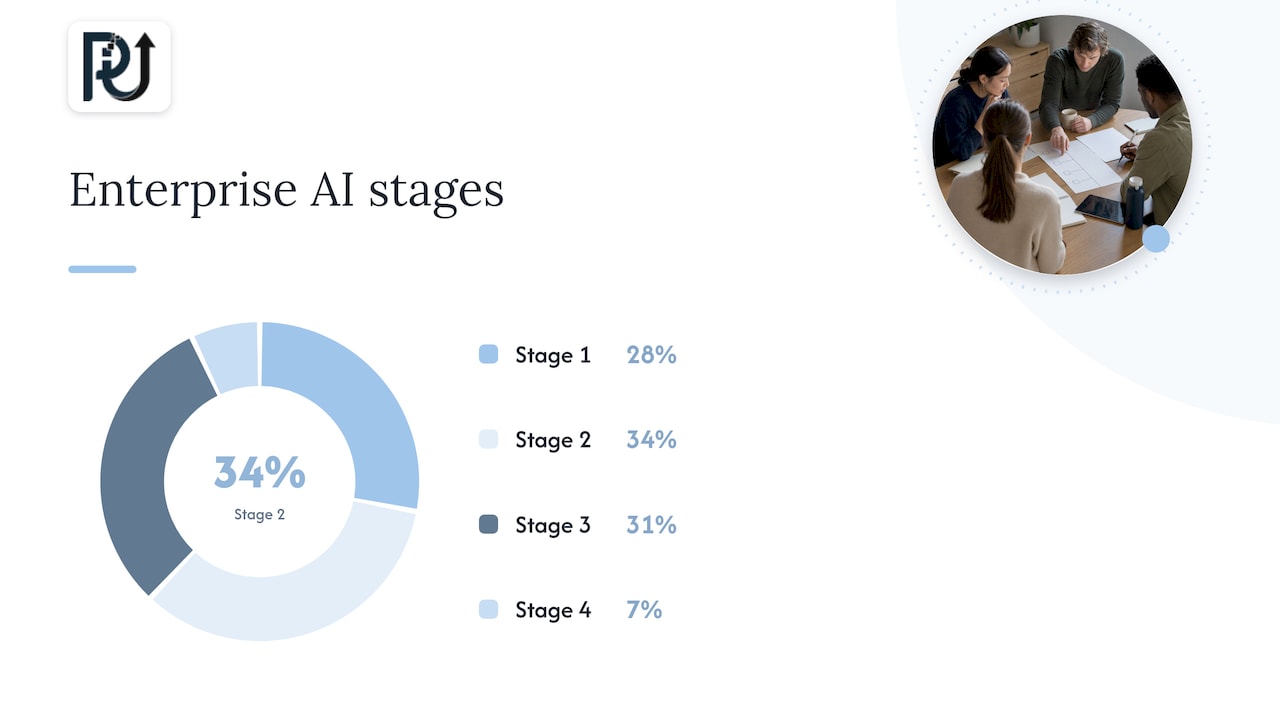
Most companies are earlier on the path than their press releases suggest. MIT’s Center for Information Systems Research placed 28% of surveyed enterprises in Stage 1 (experiment and prepare), 34% in Stage 2 (build pilots), 31% in Stage 3 (develop AI ways of working) and only 7% in Stage 4 (AI future ready). Gartner reports that just 38% of CIOs and technology leaders rate their progress toward creating value with AI as excellent or good.
The same MIT model describes what moves a company from Stage 2 to Stage 3: defining metrics, simplifying and automating processes, and consolidating data silos through APIs. That is the unglamorous plumbing this article is about. An API is simply a standard way for two software systems to exchange data, and connecting your systems that way is what lets an AI agent act on real information instead of a pasted snippet.
Harvard Business School Online separates three ideas that get blurred. AI readiness is the ability to adopt and scale AI in ways that strengthen performance and advance strategy; maturity is how advanced your current use is; governance is responsible oversight. You need all three, but readiness comes first, and it starts with a business goal.
Start with a business goal, not a model
MIT Sloan Executive Education describes an AI strategy as a coordinated, enterprise-wide effort in which every initiative is tied to measurable goals such as customer experience, operational efficiency or innovation. If you cannot finish the sentence “this project will move X by Y”, it is not ready.
Gartner suggests weighing three kinds of business case: defend (quick wins), extend (custom applications with a financial return) and upend (new AI-powered products). For most owner-led and mid-sized companies the best first move sits in the “extend” category: take a costly, high-volume process and automate it with a system built around your own data and rules.
The same Gartner guidance asks leaders to decide how they will deploy: public off-the-shelf models, public models adapted to your data, or custom in-house algorithms. Off-the-shelf tools are quick for drafting and summarizing. When the work touches your documents, your customers and your approval rules, a custom build that understands your context is the stronger foundation, and it is the work our AI agents development practice exists to do.
Find the processes worth automating
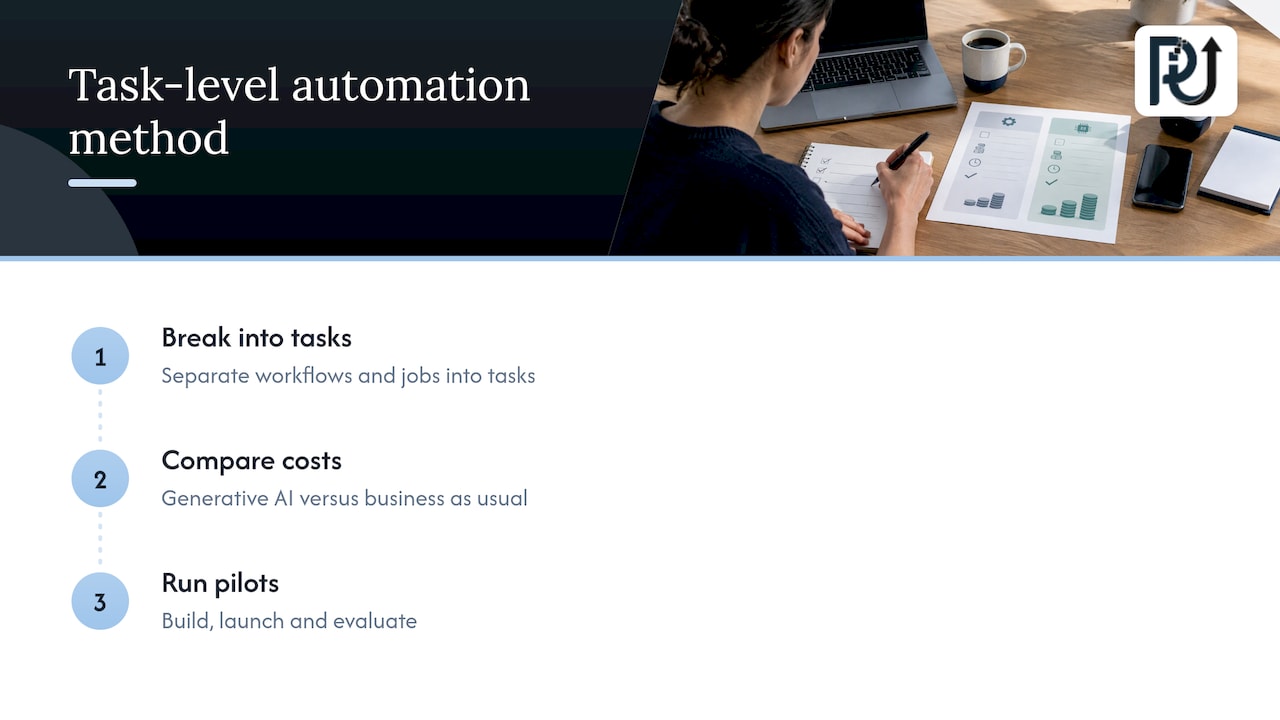
The most reliable method we have seen cited is task-level. MIT Sloan’s three steps: break workflows and jobs into tasks, assess each task by comparing the cost of using generative AI with business-as-usual costs, then build, launch and evaluate pilots. The point is that jobs rarely automate as a whole. Some tasks inside a job do, and others should not.
Bessemer Venture Partners adds a useful filter: a good process-automation use case has clear ROI, a precisely defined and repeatable process the team has already mastered, and a reasonable expectation that an AI can execute it.
A simple scoring pass
List every recurring task in one department, then score each from 1 to 5 on four questions:
- Volume: how many times a week does it happen?
- Clarity: could you write the steps and the exceptions on one page?
- Data access: does the information live in systems an agent can reach?
- Cost of error: what happens if the output is wrong, and who would catch it?
High volume, high clarity, reachable data and a catchable error is your first target. Typical candidates in our audience’s industries:
| Industry | Strong first candidates |
|---|---|
| Fintech and lending | Reading and validating application documents, portfolio monitoring |
| Healthcare practices | Intake forms, document routing, scheduling follow-ups |
| Accounting firms | Collecting and checking client documents, recurring reconciliations |
| Agencies and consulting | Reporting, project costing, client health tracking |
| E-commerce | Order exceptions, customer messaging, catalog updates |
| Logistics | Shipment documents, status exceptions |
Document-heavy work is often the cleanest starting point because the inputs are structured enough to check. This is why we built DocuPOW, our product for document reading and validation, and why we offer live demos so you can see it on documents like yours. For portfolio monitoring and client health analytics, AuraPOW covers the same need on the analytics side.
Give AI an owner and bring people along
Projects without an owner stall. One white paper on AI leadership argues that AI should be a business mandate owned by the CEO, with the board setting goals, the AI leader holding written decision rights, business-unit leaders owning results, and HR involved in role design, training and communication. In a smaller company the structure is lighter, but the principle holds: one named executive accountable for outcomes, and process owners who answer for their own area.
Communication is where many rollouts quietly fail. Bessemer’s upskilling guide reports that only 42% of enterprises that launched AI initiatives in early 2024 had regular internal communication about the value created, and just 19% had a compelling change story. Its advice is practical: leaders who share their own experiments, including the ones that failed, open two-way conversation, while mandating tools without explaining why tends to backfire.
A short, honest message works better than a program: what we are automating, which tasks it removes, what people will do with the freed time, and who to talk to with concerns. Skills matter too. Judgment and critical thinking become more valuable as routine work moves to software, a theme explored in this look at cognitive skills in AI-era hiring.
Prepare data, systems and policies first
Poor data quality is the most-cited obstacle in TDWI’s 2025 research: 28% name data quality, 25% lack of AI skills and 24% insufficient AI literacy. The same report describes effective AI data governance as data that is trustworthy (complete, accurate, timely, relevant), transparent about who is accountable, fair, and secure, with authorized access, encryption and protection against leakage.
Translate that into a pre-deployment checklist:
- Data: identify the source of truth for each field the AI will use, and fix duplicates and gaps in that slice only. You do not need to clean the whole company.
- Access: decide which systems an agent may read and which it may write to. Start read-only where you can.
- Privacy and security: review any new tool for security, privacy and compliance before it touches customer or patient data. Healthcare and financial firms should involve their compliance lead or counsel at this point.
- Policy: write one page on approved uses, prohibited uses and who approves exceptions.
- Process: document the current workflow, including the exceptions people handle from memory. An agent can only follow rules that exist on paper.
MIT Sloan’s report on leading with AI adds a step many skip: deconstruct each business challenge into subproblems and match an AI technique to each, confirming datasets are complete and governed before deployment. That is also how we scope integration work. Connecting AI to your existing systems is a design job first, which is what our AI integration service is built around.
Pilot, then scale with humans in the loop
The MIT Sloan researchers quoted in that same report recommend a two-speed approach: fast experiments and proofs of concept feeding a slower, longer-term strategy, with expectations set realistically from the start. A good pilot has one process, one owner, a baseline measurement and a defined end date.
The design of human oversight matters more than most leaders expect. The Stanford Enterprise AI Playbook found that escalation-based models, where AI handles 80% or more of the work autonomously and humans review exceptions, delivered median productivity gains of 71%, compared with 30% for approval models, in which a person signs off on each item. Oversight is still essential: an Intuit-commissioned survey of 2,000 US senior leaders found 91% agree human oversight remains essential, and 92% are redesigning processes around AI.
In practice that means:
- Define what the agent may do alone, what it must flag, and what it must never do.
- Set confidence thresholds so uncertain items route to a person automatically.
- Log every decision so exceptions can be audited and the rules improved.
- Teach staff to question outputs. A short list such as these questions to ask before trusting an AI summary is a good habit for any AI-generated text.
This is where context-aware agents earn their keep. A generic script follows a fixed path and breaks on the first unusual input. A custom agent built around your documents and rules can recognize that an item is unusual and hand it to the right person with the relevant context attached, so the exception queue stays small and useful. Our approach is to design these systems so they are maintainable and owned by the client, with transparent processes and engineering accountability. Our AI automation work follows that pattern.
Measure what matters
Hours saved is the easiest number and the least complete one. The Wharton Human-AI Research report on enterprise AI found 40% of departments judge AI investment by hours saved, yet departments tracking at least one growth measure report strongly positive returns at 35%, versus 13% for those tracking efficiency alone.
Build a small scorecard per process, with a baseline taken before the pilot:
| Dimension | Example measure |
|---|---|
| Speed | Average time from request to completion |
| Productivity | Items handled per person per week |
| Quality | Error and rework rate, exceptions per 100 items |
| Customer experience | Response time, satisfaction score |
| Cost | Cost per transaction, overtime and contractor spend |
| Growth | Volume handled without added headcount, revenue from faster turnaround |
TDWI likewise recommends metrics tied to business goals, such as time from order placement to shipment, process efficiency and cost savings, because measurable criteria create accountability. Review monthly for the first quarter, then quarterly. If you are weighing budgets, our breakdown of AI automation costs and ROI shows how to frame the investment.
Our perspective
Leaders ask us where to begin, and our answer is always the same: begin with the work that is eating your people’s time and has clear rules, and build a system that fits that work exactly.
We design and deploy digital workforces: autonomous, context-aware AI agents that process high-volume transactional work, hunt down the operational time leaks most teams have stopped noticing, and let a company grow its processing volume without a matching rise in headcount. That is a different job from stitching together basic integrations. It takes architecture, data discipline and accountability for how the system behaves in production.
The organizations that become genuinely intelligent are the ones that treat AI as an operating capability. They pick processes with care, keep humans on the exceptions, measure results honestly and own what they build. We believe clients should understand and own their systems, which is why we favor transparent, maintainable engineering over black boxes.
If you want a starting point for the strategy side, our guides on AI strategy for CEOs and AI workflow optimization and governance lay out how we think about it.
Syed Naveed Abbas
Turn the first process into a working system
If you have scored your tasks and one stands out, the next step is scoping it with people who build these systems. POW IT UP designs custom AI agents, AI integrations and automation for fintech, healthcare, service businesses, agencies, logistics, e-commerce and other operations-heavy companies. If documents are your bottleneck, DocuPOW is available with a live demo, so you can see document reading and validation working before you commit to anything.
To discuss a process you want to automate, start at powitup.com, or review our AI integration services for business leaders.
FAQ
What is the first step in building an AI-enabled organization?
Start by listing the recurring tasks in one department and scoring them on volume, clarity, data access and cost of error. Pick one that is high-volume and well defined, set a baseline, and tie it to a measurable goal. A narrow first win teaches you more than a broad strategy document.
Who should be responsible for AI in a mid-sized company?
One named executive should be accountable for results, with the CEO or owner setting the mandate. Process owners in each department answer for outcomes in their own area, and HR or people leads help with role changes and communication. Written decision rights prevent the stalls that come from shared, vague ownership.
How much human oversight does an AI agent need?
Enough that exceptions and high-risk decisions always reach a person. Research from Stanford found that systems handling most routine work autonomously and escalating exceptions outperformed approval-for-everything models. Define what the agent may do alone, and log every action for audit.
How do I know if AI is actually paying off?
Compare against a baseline you took before the pilot, and track more than hours saved. Add quality, customer experience, cost per transaction and growth measures such as volume handled without added staff. Wharton’s research links tracking growth measures to stronger reported returns.
Sources
- Building Enterprise AI Maturity, MIT CISR
- Get AI Ready: What IT Leaders Need to Know and Do, Gartner
- How to Know If Your Company Is AI-Ready, Harvard Business School Online
- Developing an Effective AI Strategy, MIT Sloan Executive Education
- How to find the right business use cases for generative AI, MIT Sloan
- From tasks to systems: A practical playbook for operationalizing AI, Bessemer Venture Partners
- Where AI Leadership Sits, Octant Advisory
- The AI upskilling guide for executives, Bessemer Venture Partners
- Creating an AI-Ready Organization, TDWI Best Practices Report
- Leading with AI: Insights for Success in AI-Driven Organizations, MIT Sloan
- Enterprise AI Playbook, Stanford
- Enterprise Technology Benchmark Report, Intuit
- The Adaptive Advantage: Who’s Winning With AI and How, Wharton
- AI Hiring 2026: Why Cognitive Skills Win
- Seven Questions to Ask Before You Trust an AI Summary