

TL;DR:
- Building repeatable, measurable capabilities is essential for successful business innovation, focusing on continuous improvement and AI-driven growth. Leaders should pilot projects with clear KPIs, implement disciplined innovation practices, and prioritize maintainable automation through trusted partners for scalable results. Operational responsiveness and well-documented systems are critical competitive differentiators in today’s autonomous business environment.
Business innovation succeeds when leaders build repeatable, measurable capabilities that combine incremental efficiency with AI-driven growth, not when they treat creativity as a one-time event. The immediate next step: scope a pilot with a specialized integration partner taking several weeks, define three to five KPIs before you start, and measure against them ruthlessly. MIT Sloan research identifies eight core practices that distinguish firms treating innovation as a permanent institutional capability from those chasing ad-hoc wins. Harvard Business School’s growth frameworks reinforce that discipline: align resources, operations, and profit formulas before scaling. And Salesforce data shows 80% of business buyers rate the experience a company provides as critical as its products, which means operational responsiveness is now a competitive differentiator, not a back-office concern.
Table of Contents
- What does business innovation actually mean for enterprise leaders?
- How do AI and automation accelerate business innovation?
- Should you buy, build, or partner for AI automation?
- What does a practical AI innovation playbook look like?
- How do you choose the right AI integration partner?
- What results can a digital workforce actually deliver?
- Key Takeaways
- Why maintainable automation is the only kind worth building
- POW IT UP builds the digital workforce your operations need
- Useful sources
- FAQ
What does business innovation actually mean for enterprise leaders?
Business innovation is the institutional capability to introduce new ideas, methods, or systems that create measurable value, not a quarterly brainstorm or a skunkworks project. The distinction matters because capability scales; episodes don’t.
MIT Sloan’s strategic innovation research frames this clearly: leading firms maintain a permanent innovation architecture that balances two distinct tracks.
- Incremental innovation: process efficiency, SOP refinement, cycle-time reduction, cost-to-serve improvement
- Strategic innovation: new products, new revenue models, portfolio expansion, disruptive business models that open new markets
Most organizations over-invest in incremental work and under-govern strategic bets. The fix is a portfolio mindset: separate governance, separate budgets, and separate success metrics for each track.
Cost and timeline follow the same split. Incremental automation projects typically run 6–12 weeks and carry lower risk. Strategic initiatives, such as building a new AI-powered product line or deploying autonomous transaction processing, require longer horizons, more stakeholder alignment, and explicit technical debt budgets from day one.
How do AI and automation accelerate business innovation?
AI and automation are accelerants because they let you scale processing volume without scaling headcount linearly. That single shift changes the economics of almost every innovation initiative.
80% of business buyers say the experience a company provides is as critical as its products and services. For operations leaders, that means automation is no longer optional infrastructure, it’s a direct driver of competitive position.
Source: Salesforce
Three mechanisms explain where the value actually lands:
Operational scale. Automated document intake, validation, and routing can process thousands of transactions per day with consistent accuracy. Manual teams hit a ceiling; automation transforms processes by removing that ceiling entirely.

Customer experience. Faster response times, fewer errors, and proactive status updates are direct outputs of well-designed automation. The Salesforce figure above isn’t abstract; 80% of business buyers now rate experience as critical, mapping directly to churn risk when your operational responsiveness lags a competitor’s.
New business model enablement. AI agents that monitor portfolio health, flag anomalies, or generate real-time client analytics create capabilities that simply didn’t exist before. Those capabilities can become new roles and revenue streams in their own right.
Should you buy, build, or partner for AI automation?
The rule of thumb: if the capability is core to your competitive differentiation or requires custom data handling, build or partner. If it’s commodity infrastructure, buy a proven tool.
| Initiative archetype | Recommended route | Primary driver |
|---|---|---|
| Process automation (standard workflows) | Buy | Time-to-value, low customization need |
| Document intelligence (custom validation logic) | Partner | Regulatory risk, maintainability |
| Autonomous transaction processing | Partner or build | Scale, proprietary data, technical debt risk |
| Productized SaaS analytics | Partner | Speed, specialized AI engineering |
| Off-the-shelf CRM or billing integration | Buy | Cost, vendor support |
Buy: fast deployment, predictable cost, limited customization. Risk: vendor lock-in and feature gaps at scale.
Build: maximum control and IP ownership. Risk: high engineering cost, long timelines, and technical debt that compounds if SOPs aren’t documented first.
Partner: access to specialized AI architects, faster deployment, and maintainability built into the engagement. High-performing firms consistently choose this route when speed and regulatory compliance both matter.
Pro Tip: Add maintainability and technical debt remediation as explicit scoring criteria in any build-vs-partner evaluation. A system that works on day one but can’t be updated without the original developer is a liability, not an asset.
What does a practical AI innovation playbook look like?
A four-phase playbook, assess, pilot, measure, scale, keeps risk contained and gives leadership clear decision points at each gate.
- Assess (weeks 1–2): Map current processes, identify “time leaks,” document SOPs before touching automation, and confirm data readiness.
- Scope the pilot (weeks 3–4): Define one bounded use case, set three to five KPIs, assign owners, and complete a security and compliance review.
- Measure (weeks 5–8): Run the pilot, track KPIs weekly, and hold a mid-point review against pre-defined success thresholds.
- Scale (weeks 9–12+): Promote successful pilots to production, hand over runbooks, and expand scope incrementally.
| Phase | Timeline | Owner | Key deliverable |
|---|---|---|---|
| Discovery & SOP documentation | Weeks 1–2 | Operations lead | Process map, data audit |
| Pilot build & integration | Weeks 3–5 | AI engineering team | Working prototype |
| Testing & KPI measurement | Weeks 6–8 | Cross-functional team | KPI dashboard, error log |
| Handover & scale decision | Weeks 9–12 | Executive sponsor | Runbook, go/no-go decision |
KPIs worth tracking, drawn from IMD’s innovation strategy guidance, include:
- Throughput: transactions processed per hour vs. baseline
- Error rate: defects per 1,000 transactions
- Cycle time: end-to-end processing time reduction
- Customer experience delta: response time or satisfaction score change
- ROI horizon: projected payback period at current volume
Thryv’s research on scaling SMBs is direct: document SOPs before automating. Automating a flawed process compounds errors at scale. Budget for technical debt remediation from the start, not as an afterthought.
On cost: pilot engagements for bounded automation use cases typically fall in the low-to-mid five figures. Strategic, multi-system deployments run higher. The variable that drives cost most is data readiness, not engineering complexity.
How do you choose the right AI integration partner?
The single most important filter: can this partner deliver maintainable automation and manage technical debt proactively? Everything else is secondary.
| Question to ask | Why it matters |
|---|---|
| Can you show a working pilot within 6–8 weeks? | Filters out vendors who over-promise and under-deliver |
| How do you handle model drift and retraining? | Ensures the system stays accurate after deployment |
| Who owns the IP and data after engagement ends? | Protects your organization’s assets |
| What does your SOP and runbook handover look like? | Confirms maintainability without vendor dependency |
| What SLAs cover uptime and error thresholds? | Sets accountability for production performance |
| How do you manage regulatory and data compliance? | Critical for fintech, healthcare, and insurance use cases |
Red flags to walk away from:
- No testable pilot offered before full contract commitment
- No documented SOPs or runbooks in the deliverables
- Proprietary data formats that prevent migration
- No clear ownership of model drift or retraining cycles
- Vague change-control terms in the contract
Watch these contract terms closely: SLA definitions and remedies, change-control procedures, IP and data ownership clauses, and exit or transition support obligations.
Pro Tip: Include an operational acceptance test in any pilot contract. It should specify minimum throughput, maximum error rate, rollback criteria, and confirmation that SOPs and runbooks are in place before you sign off on handover.
What results can a digital workforce actually deliver?
A mid-size financial services firm processing loan application documents manually faced a familiar problem: high error rates, slow cycle times, and a team that couldn’t scale without hiring. The challenge was volume, not complexity.
The solution was a phased deployment starting with automated document intake and AI-powered validation using DocuPOW, POW IT UP’s document intelligence product. The pilot ran several weeks. SOPs were documented first. The system was tested against a defined error-rate threshold before go-live.
Results after full deployment: document processing throughput increased by more than 3x, error rates dropped significantly, and average cycle time fell from days to hours.
Key lessons from the engagement:
- SOPs written before automation prevented the team from encoding broken processes into the new system
- AuraPOW’s portfolio monitoring flagged anomalies in real time, giving leadership visibility they previously lacked
- The handover runbook meant the internal team could manage the system without ongoing vendor dependency
The automation ROI examples that hold up consistently share one trait: the organization treated the pilot as a learning exercise, not a deployment event.
Key Takeaways
Business innovation at scale requires institutionalized capability, not episodic creativity, and AI automation is the fastest path to that capability when paired with disciplined pilots and measurable KPIs.
| Point | Details |
|---|---|
| Capability over creativity | Treat innovation as a permanent institutional function with separate governance for incremental and strategic tracks. |
| SOP-first automation | Document processes before automating; flawed SOPs encoded into automation compound errors at scale. |
| Pilot with KPIs | Run a 6–8 week scoped pilot with defined throughput, error rate, and cycle-time targets before committing to full deployment. |
| Partner for maintainability | Choose integration partners who deliver runbooks, manage technical debt, and don’t lock you into proprietary formats. |
| POW IT UP as next step | POW IT UP designs and deploys custom digital workforces, including DocuPOW and AuraPOW, for leaders ready to scale. |
Customer experience as a priority: 80% of business buyers rate the experience a company provides as critical as its products or services, making operational responsiveness a competitive requirement.
Why maintainable automation is the only kind worth building
Most organizations underestimate the gap between a working demo and a production system their team can actually own. A pilot that runs beautifully in a controlled environment but requires the original vendor to make any change is not an asset. It’s a dependency.
The firms that get the most from AI automation treat it the way good engineering teams treat software: with version control, documented runbooks, observable model behavior, and a retraining plan built in from the start. That discipline is what separates a digital workforce that compounds value over time from one that quietly degrades until someone notices the error rate climbing.
POW IT UP’s focus on SOP-first practice and technical handover isn’t a differentiator for its own sake. It reflects a straightforward operational reality: the client’s team has to live with the system long after the engagement ends. Governance, security review, and measurable KPIs aren’t add-ons; they’re the conditions under which automation actually delivers on its promise.
POW IT UP builds the digital workforce your operations need
Scaling operations without scaling headcount is the core problem POW IT UP solves. As a custom AI integration partner, POW IT UP designs, builds, and deploys autonomous AI agents and automation systems that handle high-volume transactional work with measurable accuracy and full operational handover.
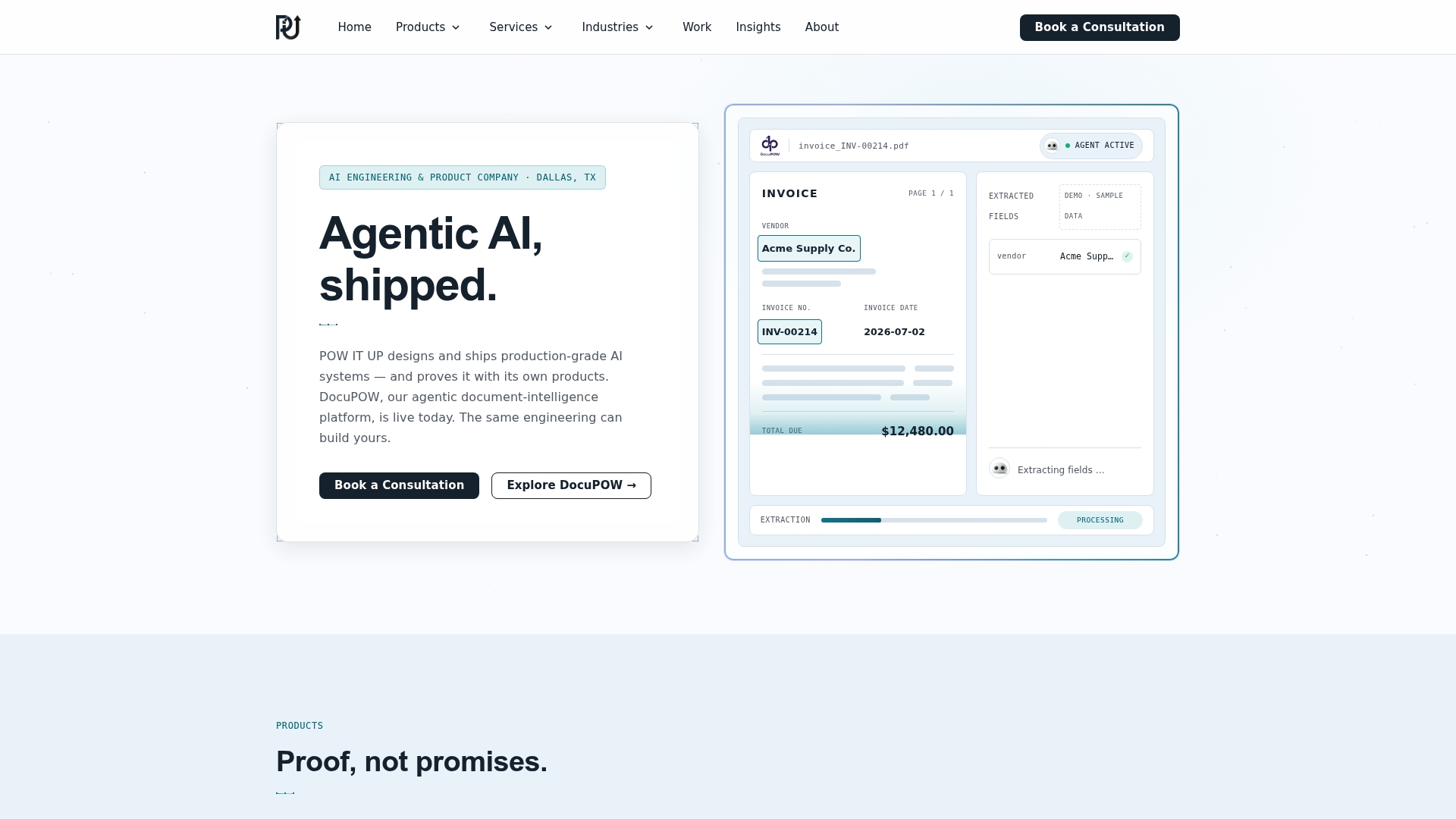
Services include AI integration, custom AI agent development, DocuPOW for document intelligence, AuraPOW for portfolio monitoring and client health analytics, pilot engineering, and governance and handover support. The engagement model is straightforward: discovery, scoped pilot, iteration, and scale, with defined deliverables at each stage.
Leaders ready to move can request an AI automation consultation or review the full business automation agency overview to understand exactly how POW IT UP engages and what to expect at each phase.
Useful sources
The claims in this article draw on research from MIT Sloan (innovation as institutional capability), HBS Online (growth strategy frameworks and KPI discipline), Salesforce (80% of business buyers rate experience as critical), IMD (innovation KPIs and pilot metrics), WeWork Ideas (buy/build/partner frameworks), and Thryv (SOP-first automation and technical debt management).
For POW IT UP services and next steps: AI integration services, automation tool categories, and the AI architects explainer. To start a conversation, visit powitup.com and request a discovery call.
FAQ
What is business innovation in practical terms?
Business innovation is the ongoing capability to introduce new processes, products, or systems that create measurable value. It’s an institutional discipline, not a one-time creative event.
How long does an AI automation pilot typically take?
A well-scoped pilot runs 6–8 weeks, covering discovery, build, testing, and KPI measurement, before a go/no-go decision on full deployment.
What KPIs should leaders track for automation initiatives?
Track throughput, error rate, cycle time, customer experience delta, and projected ROI horizon, as recommended by IMD’s innovation strategy framework.
When should a company partner rather than build AI automation in-house?
Partner when the initiative requires custom data handling, regulatory compliance, or specialized AI engineering that your internal team can’t maintain long-term without significant technical debt.
How does POW IT UP support business innovation for scaling operations?
POW IT UP designs and deploys custom AI agents and automation systems, including DocuPOW and AuraPOW, with full SOP documentation and operational handover so client teams own the system after deployment.