

TL;DR:
- Competitive advantage through AI relies on proprietary data and workflows, not just model access.
- Firms that focus on embedding AI into unique processes and designs build lasting market moats.
Real competitive advantage through AI is not about which models you run. It comes from combining AI with proprietary data, embedded workflows, a compounding learning architecture, and distribution or switching costs that competitors cannot replicate overnight. The single highest-leverage action you can take right now: identify one customer-facing or mission-critical workflow, assign an accountable executive to it, and start building a learning loop around your firm’s unique data. POW IT UP helps organizations do exactly that, from architecture design through production deployment.
The evidence is unambiguous. MIT Sloan warns that when model access is ubiquitous, AI tends to homogenize rather than differentiate firms. Bain & Company frames the window for advantage as opening on Day 1, with hesitation compounding a performance gap that becomes progressively harder to close. And a California Management Review study found that companies building advantages across six complementary areas delivered a total return to shareholders (TRS) premium over firms that did not, demonstrating a measurable market benefit.
The pattern is consistent: model access is a commodity. Proprietary intelligence is the moat.
What separates leaders from laggards, according to Bain:
- Build proprietary intelligence through data, encoded workflows, and learning architectures
- Make seven deliberate choices: posture, domain focus, data, technology architecture, operating model, learning system, and governance
- Concentrate bets on 3–5 high-impact domains rather than running dozens of unfocused pilots
- Assign CEO-level sponsorship to AI posture — it cannot be delegated
Table of Contents
- Why AI alone is not a moat — and where real advantage lives
- How the “situated AI” framework helps you screen initiatives
- The 6-step playbook for building and scaling AI advantage
- What must change inside your organization to make advantage durable
- What risks will derail your AI strategy — and how to avoid them
- How to measure whether your AI advantage is actually compounding
- What the research actually says about durable AI advantage
- Key Takeaways
- The mistakes leaders keep making — and what to do instead
- POW IT UP turns your AI playbook into a working system
- Further reading and primary sources
- FAQ
Why AI alone is not a moat — and where real advantage lives
The most common executive mistake right now is conflating AI access with AI advantage. Every firm in your industry can call the same APIs, run the same foundation models, and deploy the same off-the-shelf copilots. When that is true, the tool itself cannot be the source of differentiation.
What changes the equation is what you wrap around the model. AI&Scale identifies the conditions that convert AI from productivity layer to structural moat: proprietary data, process integration, learning speed, domain expertise, distribution reach, switching costs, and workflow redesign. None of those are things a competitor can acquire by signing up for the same SaaS platform.
The four primary value zones where AI creates measurable business impact:
- Predictive analytics: demand forecasting, churn prediction, credit risk scoring, and supply chain optimization where proprietary historical data creates a feedback loop competitors cannot access
- Operational efficiency: automating high-volume transactional work (document processing, claims handling, order management) to reduce cost per transaction without headcount growth
- Customer personalization: recommendation engines, dynamic pricing, and next-best-action systems that improve with every interaction — and degrade for any competitor starting from scratch
- New business models: AI-native products and services (autonomous monitoring, real-time advisory, usage-based pricing) that are structurally impossible without the underlying data and learning system
The practical implication: separate your AI portfolio into three buckets. Commodity use cases (productivity, drafting, summarization) belong in the first bucket — they matter for efficiency but create no moat. Capability use cases (proprietary analytics, workflow automation) belong in the second. Moat use cases (learning architectures tied to unique data and encoded workflows) belong in the third, and that is where CEO attention and capital should concentrate.
Companies building advantages across six complementary areas delivered a 10.7 percentage point TRS premium in 2023, per California Management Review — a signal that breadth of integration, not depth in a single tool, is what the market rewards.
How the “situated AI” framework helps you screen initiatives
Academic strategy research offers a useful screening tool called situated AI, which asks whether an AI initiative is genuinely grounded in the firm’s specific context or whether it could be lifted out and deployed identically by a competitor. The framework has three moves.
Grounding means connecting the AI system to assets the firm uniquely owns: proprietary transaction histories, customer relationship data, institutional process knowledge, or domain expertise that took years to accumulate. An AI system that trains on your data and only your data is grounded. One that runs on generic public data is not.
Bounding means scoping the initiative for defensibility. A narrowly scoped AI system that solves a specific, high-value problem in your industry is harder to replicate than a broad, horizontal deployment. Bounding forces the question: what, exactly, would a competitor have to copy to match this? If the answer is “just the tool,” the initiative is not bounded.
Recasting is the hardest move and the most valuable. It means rewiring workflows and roles around the AI system so that the way work gets done changes fundamentally, not just the speed at which it happens. Workflow redesign forces competitors to copy an operating model, not only a tool. That is a much higher bar.
This maps directly to Bain’s seven decisions and CMR’s six sources of advantage. Grounding corresponds to data and domain focus. Bounding corresponds to posture and technology architecture. Recasting corresponds to operating model and learning system. When you evaluate a proposed AI initiative against all three moves and it fails one, you have identified exactly where to invest before scaling.
Pro Tip: When a pilot shows early promise, do not treat it as a standalone deployment. Ask: what data does this system generate, and how does that data feed back into improving the model? If there is no answer, you have built a tool, not a learning architecture. Redesign the feedback loop before you scale.
The 6-step playbook for building and scaling AI advantage
Building durable AI advantage follows a sequence. Skipping steps — especially the assess and govern phases — is the most common reason pilots never convert into structural capability.
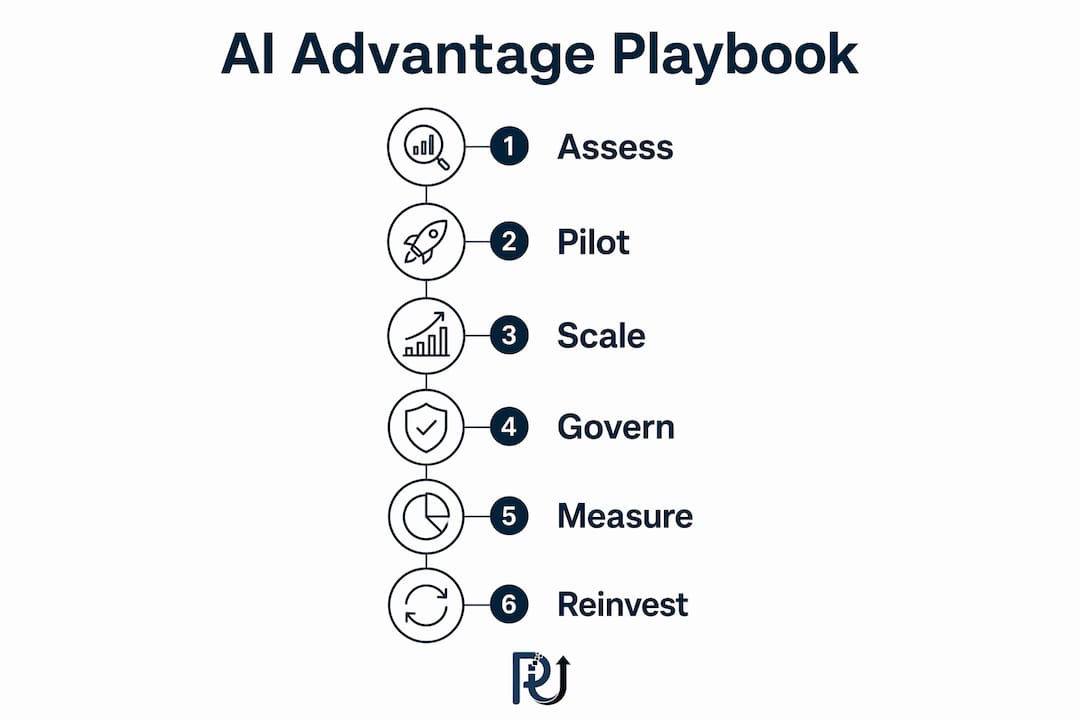
Step 1: Assess
Map your candidate workflows against three criteria: data richness (do you own proprietary data that would train a better model than a generic one?), learning loop potential (does the workflow generate feedback that improves the system over time?), and strategic centrality (is this workflow close to how you win with customers?). Shortlist 3–5 candidates. Assign a named executive owner to each.

Step 2: Pilot
Run focused, time-boxed experiments — 60–90 days maximum — with pre-defined success metrics. Governance matters here: every pilot needs a clear hypothesis, a measurement plan, and a go/no-go threshold. Pilots without these become zombie projects that consume budget without producing learning.
Step 3: Scale
Convert successful pilots into composable primitives: reusable AI components that other workflows can call. This is the architectural move that separates firms building proprietary intelligence from firms running isolated tools. Composable primitives feed a shared learning architecture where each deployment improves the whole system.
Step 4: Govern
Dual governance is required. One track governs risk: model validation, audit trails, bias monitoring, regulatory compliance. The other governs transformation: initiative health, adoption rates, and learning velocity. Both tracks need an accountable executive, and neither can be delegated to IT alone.
Step 5: Measure
Leading indicators tell you whether the system is learning. Lagging indicators tell you whether it is winning. Both matter, and the measurement cadence should match the decision gate (see the KPI table in the measurement section below).
Step 6: Reinvest
Early wins generate two things: credibility with the board and cash flow. Use both to fund the next layer of the stack: data engineering, digital core infrastructure, and encoded workflows. The compounding effect only kicks in when reinvestment is systematic, not opportunistic.
Sample 12–24 month timeline and cost shape:
- Months 1–3: Assess and select priority workflows; stand up data governance; appoint executive owners
- Months 4–6: Run 2–3 focused pilots with clear hypotheses and measurement plans
- Months 7–12: Scale 1–2 winners into production; build composable primitives; establish shared learning architecture
- Months 13–18: Extend to second-tier workflows; deepen data assets; begin workflow redesign (recasting)
- Months 19–24: Govern at scale; measure compounding learning effects; reinvest in digital core
Cost drivers at each phase: data engineering and labeling (typically the largest line item in months 1–6), model hosting and inference (grows with scale), integration and change management (underestimated in most budgets), and ongoing model validation.
| Role | Owner | Responsibility | Phase |
|---|---|---|---|
| Executive Sponsor | CEO / COO | AI posture, domain prioritization, board narrative | All phases |
| AI Program Lead | Chief AI Officer / VP Technology | Pilot governance, architecture decisions, vendor management | All phases |
| Domain Lead | Business Unit Head | Workflow selection, success metrics, adoption | Assess, Pilot, Scale |
| Data Engineer | Head of Data / Data Platform Team | Data pipelines, labeling, governance, freshness | Assess through Scale |
| ML / AI Engineer | Engineering Lead | Model development, integration, composable primitives | Pilot through Scale |
| Change Manager | HR / Transformation Lead | Role redesign, reskilling, incentive alignment | Scale, Govern |
| Risk & Compliance Lead | General Counsel / Chief Risk Officer | Regulatory exposure, audit trails, bias monitoring | Govern, Measure |
What must change inside your organization to make advantage durable
A playbook without organizational change produces pilots, not moats. Four structural areas require CEO-sponsored investment.
Data architecture
Build a semantic layer that connects your AI systems to proprietary datasets with clear ownership, freshness standards, and rights management. The firms that win are not necessarily those with the most data — they are the ones whose data is clean, labeled, and continuously updated. Prioritize datasets that are hard for competitors to replicate: customer interaction histories, proprietary transaction records, domain-specific labeled datasets, and real-time operational signals.
Technology architecture
You need an orchestration layer that ties foundation models to your proprietary data and decisioning logic. This is not a single tool — it is an in-house stack that includes APIs for model access, a vector database or knowledge graph for proprietary context, and an execution layer that routes decisions back into workflows. Firms that rely entirely on a single vendor’s closed stack are building on rented land. The AI architecture decisions you make in the first 12 months tend to constrain or enable everything that follows.
Talent and roles
Four new role types matter most: AI product managers (who translate business problems into model requirements), ML engineers (who build and maintain the learning architecture), domain translators (who bridge subject-matter expertise and model behavior), and learning engineers (who design the feedback loops that make systems improve). Reskilling existing staff is faster and cheaper than external hiring for the domain translator role — your best candidates already understand the workflows.
Operating model
Encoded workflows are the organizational equivalent of grounding. When a workflow is redesigned around an AI system, the AI becomes load-bearing infrastructure rather than an optional tool. That creates switching costs. Cross-functional squads with clear AI ownership, incentives tied to learning velocity rather than just output volume, and CEO-level visibility into initiative health are the operating model changes that make advantage compound over time. Standardizing workflows with AI before scaling is what separates firms that build moats from those that accumulate technical debt.
| Organizational Area | Key Change | Owner | Success Signal |
|---|---|---|---|
| Data | Semantic layer + proprietary dataset prioritization | Head of Data | Data freshness SLAs met; labeled datasets growing |
| Technology | Orchestration layer connecting models to proprietary data | CTO / Engineering Lead | Composable primitives deployed; no single-vendor lock-in |
| Talent | AI PM, ML engineer, domain translator, learning engineer roles defined | CHRO / Talent Lead | Roles filled or reskilling plans active within 90 days |
| Operating Model | Encoded workflows; cross-functional AI squads | COO / Transformation Lead | At least one workflow redesigned (not just automated) |
| Governance | Dual-track governance (risk + transformation) | CEO / Chief Risk Officer | Audit trails active; learning velocity tracked quarterly |
What risks will derail your AI strategy — and how to avoid them
Most AI initiatives fail not because the technology does not work, but because of strategic and organizational errors that were predictable from the start.
The six most common failure modes:
- Commoditization trap: deploying AI on generic workflows using off-the-shelf tools, producing efficiency gains any competitor can match within months
- Shallow deployments: running AI as a bolt-on layer without workflow redesign, so the system adds speed but not switching costs
- Vendor lock-in: building the entire AI stack on a single closed platform, surrendering architectural control and creating cost exposure at renewal
- Data poisoning and drift: failing to monitor data quality and model behavior in production, leading to degraded outputs that erode trust without visible warning
- Regulatory exposure: deploying AI in regulated workflows (credit, hiring, healthcare, insurance) without audit trails, explainability, or bias monitoring — a growing liability under emerging U.S. AI governance frameworks
- Loss of institutional knowledge: when employees use private or ad-hoc AI tools without shared standards, the organization loses the ability to learn at the system level, per AI&Scale
Governance checklist for leaders:
- Dual governance tracks: one for risk (validation, audit, compliance), one for transformation (adoption, learning velocity, initiative health)
- Named accountable executive for each AI initiative — not a committee
- Model validation and audit trails active before production deployment
- Transparent ROI and learning metrics required for every pilot to receive continued funding
- Responsible AI practices documented and reviewed quarterly, tied to adoption and customer confidence metrics
The firms most exposed to AI risk are not the ones moving too fast — they are the ones running dozens of ungoverned pilots with no shared standards, no audit trails, and no learning architecture connecting the deployments.
How to measure whether your AI advantage is actually compounding
Measurement is where most AI programs lose credibility with boards. The problem is usually one of two things: measuring only lagging indicators (which show up too late to course-correct) or measuring only activity metrics (number of pilots, number of users) that say nothing about learning or value creation.
Leading indicators tell you whether the system is getting smarter:
- Learning rate: is model accuracy or recommendation quality improving with each new data batch?
- Adoption rate: are the people closest to the workflow using the system, or routing around it?
- Time-to-decision: is the AI system reducing the time from signal to action in the target workflow?
- Recommendation accuracy: are AI-generated outputs being accepted, overridden, or ignored — and why?
Lagging indicators tell you whether advantage is accumulating:
- Cost per transaction in the automated workflow (vs. pre-AI baseline)
- Margin uplift attributable to AI-driven decisions
- Revenue retention in customer segments where personalization is active
- Switching cost proxy: how long would it take a competitor to replicate this workflow from scratch?
| KPI | Owner | Frequency | Decision Gate |
|---|---|---|---|
| Model accuracy / recommendation quality | ML Engineer | Weekly | 90-day: go/no-go on scale funding |
| Adoption rate in target workflow | Domain Lead | Bi-weekly | 90-day: below 60% triggers redesign |
| Time-to-decision reduction | Domain Lead | Monthly | — |
| Cost per transaction | Finance / Operations | Monthly | — |
| Margin uplift | CFO | Quarterly | — |
| Learning velocity (model improvement rate) | AI Program Lead | Quarterly | — |
| Regulatory / audit trail compliance | Risk & Compliance Lead | Monthly | Ongoing: zero-tolerance threshold |
For automating recurring operational workflows, the 90-day gate is the most important. If adoption is low and learning rate is flat at 90 days, the problem is almost never the model — it is workflow design or change management. Fix those before spending more on compute.
What the research actually says about durable AI advantage
The academic and industry evidence converges on a small number of conditions that separate transient AI gains from structural advantage. Here is the synthesis.
Bain & Company frames the core thesis as proprietary intelligence: advantage comes not from model access but from seven deliberate choices that build a learning system competitors cannot easily replicate. The CEO must personally own these choices — they are not delegable. Bain also finds that most organizations run portfolios of isolated pilots rather than integrated AI transformations, which is why most fail to convert early gains into structural capability.
MIT Sloan offers the clearest caution: AI’s ubiquity erodes its ability to be a unique, sustained advantage. Differentiation must come from creativity and firm-specific assets, not from the model itself. This is not a pessimistic view — it is a precise one. It tells you exactly where to invest.
AI&Scale identifies seven conditions for durable advantage: proprietary data, process integration, learning speed, domain expertise, distribution, switching costs, and workflow redesign. The last condition is the most underestimated. Workflow redesign forces competitors to copy an operating model, not just a tool.
California Management Review provides the empirical anchor: the 10.7 percentage point TRS premium for firms building multiple complementary sources of advantage in 2023 is the clearest market signal that breadth of integration matters.
“AI’s ubiquity erodes its ability to be a unique, sustained advantage; competitive differentiation must come from creativity and firm-specific assets.” — MIT Sloan Management Review
The five-question durability test for any AI initiative:
- Does this system train on data that competitors cannot access or replicate?
- Does the workflow change fundamentally (not just get faster) when AI is embedded?
- Does each deployment feed a shared learning architecture that improves the whole system?
- Would a competitor need to copy our operating model — not just our tool — to match this?
- Does the system create switching costs for customers or internal users over time?
If the answer to three or more questions is no, the initiative belongs in the commodity bucket, not the moat bucket. Redirect capital accordingly.
Pro Tip: When presenting AI progress to the board, replace “number of pilots launched” with “learning velocity on our top-priority workflow.” Show the improvement curve — accuracy, adoption, cost per transaction — over time. A compounding curve is the most persuasive evidence that advantage is accumulating, not just activity.
Key Takeaways
Durable competitive advantage through AI requires proprietary data, embedded workflows, a compounding learning architecture, and CEO-level sponsorship — model access alone produces efficiency, not a moat.
| Point | Details |
|---|---|
| Model access is not a moat | When AI tools are ubiquitous, advantage shifts to firm-specific data, workflows, and learning systems. |
| Multi-source advantage pays off | Firms building advantages across six complementary areas delivered a 10.7 percentage point TRS premium in 2023. |
| Concentrate bets, not pilots | Focus on 3–5 high-impact domain bets; scattered pilots rarely convert into structural capability. |
| Workflow redesign is the hardest move | Recasting workflows forces competitors to copy an operating model, not just a tool, raising the imitation bar. |
| POW IT UP accelerates the playbook | POW IT UP designs and deploys custom AI agents, integration layers, and encoded workflows that convert pilots into proprietary intelligence systems. |
The mistakes leaders keep making — and what to do instead
The pattern I see most often is what Bain calls pilotitis: a portfolio of 20 or 30 AI experiments, each with its own vendor, its own data silo, and its own success metric, none of which connect to a shared learning architecture. The CEO gets a quarterly update showing impressive pilot counts. The board approves more budget. And two years later, the firm has spent significantly on AI and built nothing that a competitor cannot replicate in six months.
The second mistake is chasing tools. A new model drops, a vendor demo impresses, and the organization pivots to the shiny object before the previous deployment has been properly embedded. Tool-chasing is expensive not just in direct cost but in the organizational attention it consumes. Every pivot resets the learning clock.
The third mistake is misallocating capital away from data and workflows and toward compute and licensing. Compute is cheap and getting cheaper. Data engineering, workflow redesign, and change management are the hard, expensive, slow parts — and they are exactly where the moat gets built. Firms that underinvest in data infrastructure and over-invest in model access end up with sophisticated tools running on mediocre inputs.
The reframe that works in board conversations: stop reporting the number of pilots and start reporting the learning velocity on your single most value-critical workflow. One workflow with a compounding improvement curve is worth more strategically than 30 pilots with flat metrics. That shift in framing also forces the organizational discipline to actually finish something before starting the next experiment.
POW IT UP turns your AI playbook into a working system
Most firms have the strategy. What they lack is the technical architecture to execute it without accumulating debt, vendor dependency, or ungoverned sprawl.
POW IT UP is built for exactly this gap. As a strategic AI integration and automation firm, POW IT UP designs, builds, and deploys custom digital workforces: autonomous, context-aware AI agents that embed directly into your highest-value workflows. The work goes well beyond scripting basic integrations. POW IT UP engineers the orchestration layer that ties your proprietary data to your decisioning logic, builds composable primitives that scale across workflows, and deploys products like DocuPOW (document intelligence and validation) and AuraPOW (portfolio monitoring and client health analytics) where they fit the use case.
How POW IT UP maps to the playbook:
- Assess: workflow and data asset mapping to identify your highest-leverage AI bets
- Pilot: focused agent deployments with clear success metrics and governance built in
- Build: custom AI agent development, intelligent automation, and integration into your existing stack
- Operate: production-grade systems that scale transaction volume without headcount growth
- Govern: audit-ready transparency, model validation, and dual-track governance support
If you are ready to move from pilot to proprietary intelligence, explore POW IT UP’s AI integration services or book a scoping call to map your priority workflow.
Further reading and primary sources
These are the sources worth assigning to your team before a board-level AI strategy conversation.
- Bain & Company — Proprietary Intelligence: The clearest executive framework for the seven decisions that separate AI leaders from laggards. Assign to the CEO and Chief AI Officer.
- MIT Sloan Management Review — Why AI Will Not Provide Sustainable Competitive Advantage: The essential caution against tool-first thinking. Assign to strategy leads and board members who conflate AI access with AI advantage.
- California Management Review — Competitive Advantage in the Age of AI: The empirical evidence base, including the TRS premium finding. Assign to the CFO and board for the investment case.
- AI&Scale — Where Does AI Create Competitive Advantage?: The most practical conditions-based framework. Assign to CTOs, operations leads, and anyone designing the technology architecture.
- POW IT UP — AI Integration Services: For leaders ready to move from framework to execution, POW IT UP’s service pages map directly to the playbook steps above.
- AI Workflow Design — Moderate Murmurations: Practical perspectives on workflow design and change management for teams working through the recasting phase.
For board materials, lead with Bain and CMR (strategy and evidence). For the CTO and engineering team, lead with AI&Scale and the POW IT UP architecture resources. For HR and change management, the operating model sections of Bain and the digital transformation culture resources at POW IT UP are the most relevant starting points.
FAQ
What does “competitive advantage through AI” actually mean?
It means combining AI with proprietary data, embedded workflows, and a compounding learning architecture that competitors cannot easily replicate — not simply using AI tools that are available to everyone.
Why isn’t access to AI models enough to create a moat?
When model access is ubiquitous, AI tends to homogenize rather than differentiate firms, per MIT Sloan. The moat comes from what surrounds the model: unique data, redesigned workflows, and switching costs.
How many AI pilots should a company run at once?
Bain recommends concentrating on 3–5 high-impact domain bets rather than running dozens of unfocused pilots, which rarely convert into structural capability.
What is the most important KPI for measuring AI advantage?
Learning velocity on your top-priority workflow — the rate at which model accuracy, adoption, and cost-per-transaction improve over time — is a stronger signal of compounding advantage than the number of pilots launched.
How does POW IT UP help leaders build defensible AI advantage?
POW IT UP designs and deploys custom AI agents, orchestration layers, and encoded workflows that convert isolated pilots into proprietary intelligence systems, with governance and audit-ready transparency built in from the start.