
AI-enabled organizational scaling means growing the volume of work your company handles without growing headcount at the same rate. It happens when AI takes over high-volume, rule-heavy steps inside redesigned processes, and people move to judgment, exceptions and relationships. It does not happen when you hand out chatbot licenses and hope. This guide covers what changes, where the effort goes, how to sequence the work, and how to tell progress from theater.
TL;DR
- Scaling with AI is a process and people project first, a technology project second. The widely cited 10/20/70 rule puts 70% of effort on people and processes.
- Start with one high-volume workflow, measure it, then replicate. Stop projects that miss their outcome early.
- Individual AI use is common, but company-wide financial impact is not. In McKinsey’s 2026 survey, 37% of respondents report a positive EBIT contribution.
- Autonomous agents work best on transactional, document-heavy work with clear escalation rules and a human in the loop.
- Own your systems: insist on documented, maintainable builds, not black boxes you cannot change.
Table of Contents
- What AI-enabled scaling actually means
- Why most scaling attempts stall
- The 10/20/70 rule, applied
- Where to start: pick the right first workflow
- A 90-day sequence that works for SMBs
- Roles and capabilities you need as you scale
- Governance without bureaucracy
- Our perspective
- Where POW IT UP fits
- Measuring whether you are really scaling
- FAQ
- Sources
What AI-enabled scaling actually means
Traditional scaling is linear. More invoices, claims, onboarding packets or client reports mean more people to process them, more managers to coordinate those people, and more rework when handoffs break. Each added layer slows the whole.
AI changes the shape of that curve in three ways.
- Processing capacity. Software agents read documents, validate fields, route requests and draft responses at a volume that does not need a matching hire for each increment.
- Coordination. Work that used to move through email and status meetings can be orchestrated by a system that knows where every item sits.
- Replication. Once a workflow is proven in one team or location, the same pattern can be deployed to the next with far less training and drift.
Research is starting to name the structural result. A 2026 paper in Electronic Markets describes three emerging organizational forms: cognitive meshworks, where AI synthesizes distributed human expertise; algorithmic ecosystems, where autonomous agents are the primary coordinators; and hybrid intelligence collectives, where human and AI cognition fuse deeply. The authors treat these as distinct archetypes, not stages on one ladder. For most US small and mid-sized firms, the practical takeaway is simpler: decide where agents coordinate, where people do, and write that down.
A separate working paper from EPINOVA argues that one or a few humans supported by AI can perform at scales that once required much larger organizations. That is a thesis, not a guarantee, but it explains why operators ask whether growth must mean hiring.
Why most scaling attempts stall
The gap between “we use AI” and “AI moved our numbers” is wide. McKinsey’s 2026 survey reports that 37% of respondents say AI has contributed positively to EBIT, essentially unchanged from the prior year, even as individual workers get gains from their own use. The same survey finds 40% of respondents at large organizations (over $1 billion in revenue) scaling AI agents, while smaller organizations stayed flat at 22%.
Two readings follow. First, individual productivity does not automatically become company productivity. Second, smaller firms are not behind because the technology is out of reach. They are behind because they have not had a sequenced, owned plan.
The common failure patterns:
- Pilot sprawl. Ten experiments, none tied to a metric, none with an owner.
- Tool-first buying. A platform is licensed before anyone has mapped the process it should change.
- No exception path. The agent handles 80% of cases, and nobody has defined who handles the other 20%, so people route around it.
- Unowned builds. A vendor delivers something that works until the vendor leaves.
We go deeper on the engineering side of getting past the pilot in our guide to scaling AI operations, and on the hidden budget lines in the costs pilots miss.
The 10/20/70 rule, applied
BCG’s guidance, as reported by Forbes, is to put 10% of resources into algorithms, 20% into technology and data, and 70% into people and processes. The article notes that many organizations get this backwards. It also says success takes a redesign of end-to-end processes, overseen by leadership willing to manage change.
What does the 70% look like in a 60-person service firm? Concretely:
| Bucket | Share | Examples |
|---|---|---|
| Algorithms | 10% | Model selection, prompt and agent logic, evaluation sets |
| Technology and data | 20% | Integrations with your CRM, accounting or practice system; data cleanup; hosting |
| People and process | 70% | Rewriting the workflow, defining exceptions, training, role changes, KPI changes, trust-building |
If your plan has a large software line and a blank space where “process redesign” should be, the plan is upside down.
Where to start: pick the right first workflow
The World Economic Forum’s 2026 report on organizational transformation argues for disciplined experimentation tied to business outcomes, with standardized criteria for prioritizing use cases so failing projects stop quickly and high-value ones scale. You can apply that with a simple scorecard.
Score each candidate workflow from 1 to 5 on:
- Volume. How many items per week or month?
- Rule clarity. Can a trained new hire follow written steps?
- Data access. Are inputs digital or at least scannable?
- Cost of error. Can mistakes be caught before they reach a client or regulator?
- Measurability. Do you already know the cycle time and cost per item?
The best first targets usually score high on volume and rule clarity: intake and document review, invoice and statement processing, loan or claims file assembly, client reporting, scheduling and follow-up. Strategy, negotiation and sensitive client conversations score low and should stay with people.
Hunt the time leaks
Before automating, shadow the work for a week. Count the minutes spent re-keying data, hunting for the latest file version, chasing missing documents, and answering “where is this?” These time leaks rarely appear on an org chart, but they are where scaled capacity comes from. Fix the leak, then automate what remains.
A 90-day sequence that works for SMBs
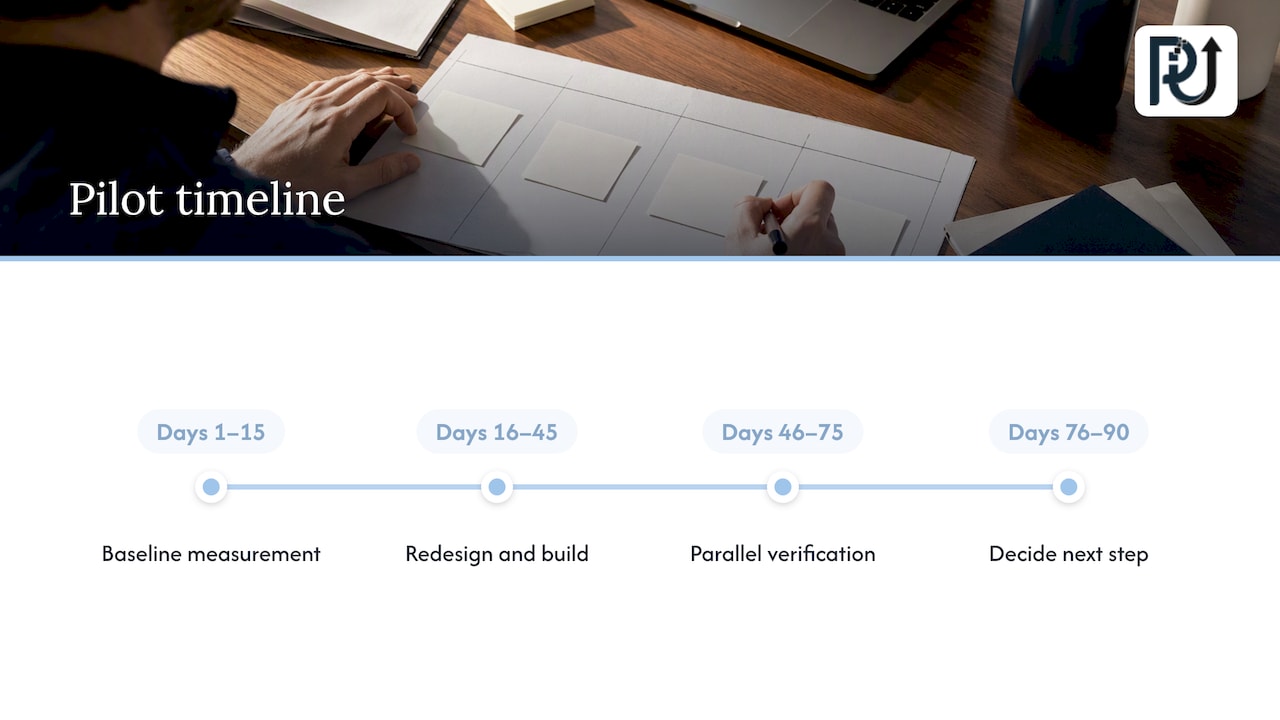
Days 1 to 15: Baseline. Pick one workflow. Record volume, cycle time, error rate, and fully loaded cost per item. Name one business owner, not an IT owner.
Days 16 to 45: Redesign and build. Rewrite the process on paper as if the agent existed. Define inputs, validation rules, confidence thresholds, and the human escalation path. Build against real documents, not clean samples.
Days 46 to 75: Run in parallel. The agent processes live work while staff verify. Track accuracy and override reasons. Every override is either a bug or a missing rule.
Days 76 to 90: Decide. Compare against the baseline. If the target is met, move to supervised production and pick the second workflow. If not, fix or stop. The WEF framing of stopping failing projects quickly is a feature of the method, not a failure of it.
For a pilot-first approach written for smaller firms, see our plan for small and mid-sized businesses, and for how to judge payback, proving AI consulting ROI in 4 to 8 weeks.
Roles and capabilities you need as you scale
AI at scale needs more than a developer. You need someone who owns the process, someone who owns data access and security, someone who evaluates output quality, and a leader who decides what the humans do now. For a view of how the broader workplace is shifting, the state of AI at work study offers useful context on the capabilities organizations are building.
On cost, be realistic and avoid headline myths. The “$900,000 AI job” people ask about is not a standard role. The Bureau of Labor Statistics lists median pay for software developers at $135,980, and your own constraint is likely finding and keeping scarce talent at all. That is one reason many SMBs bring in an outside engineering team for the build and keep a small internal group for ownership and oversight.
Governance without bureaucracy
Scaling raises the stakes of errors, so lightweight rules matter early:
- Human in the loop where it counts. Define which decisions an agent may take alone and which need approval. Make the agent show its reasoning so reviewers can override it.
- Audit trail. Log inputs, outputs and overrides for every item.
- Data boundaries. Decide what client data models may touch, and where it is stored.
- Regulated work. In fintech and healthcare, involve your compliance lead and counsel before production, and confirm your obligations under the rules that apply to your state and sector.
- Change log. Version the agent logic like software.
Our perspective
We build digital workforces, and the pattern we see is consistent: companies do not fail to scale because the models are weak. They fail because nobody redesigned the work around the model. A document-reading agent dropped into a broken intake process just produces wrong answers faster.
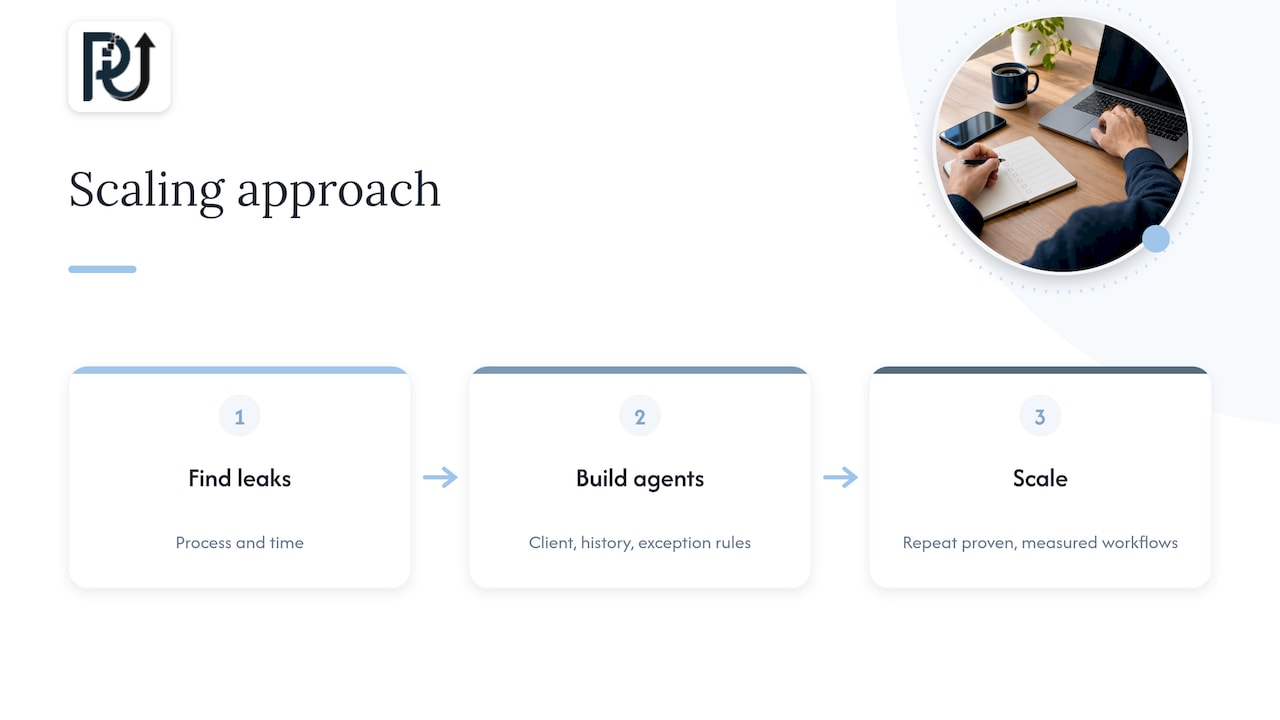
So we start with the process and the time leaks, then build agents that are context-aware rather than generic scripts. Context-aware means the agent knows the client, the account history and the exception rules, not only the text on the page. We favor documented, maintainable systems that you own, because a system only you can’t change is a dependency, not an asset.
We also think leaders should be skeptical of any plan that promises infinite scale on day one. Scale comes from repeating a proven workflow, with measurement at each step. Our live products, such as DocuPOW for document reading and validation, exist partly so you can see the behavior before you commit to a build.
— Syed Naveed Abbas
Where POW IT UP fits
If your first workflow is document-heavy, DocuPOW reads and validates documents, and a live demo is available. If your process needs something built around your systems, our AI agents development and AI integration services design autonomous agents and connect them to the tools you already run. For fintech teams, our guides on AI integration in core banking systems and loan processing automation show what the work looks like in practice. Not sure where to begin? Talk to us and we will help you pick the first workflow.
Measuring whether you are really scaling
Track a short list and review it monthly:
- Volume per full-time equivalent. The core scaling number.
- Cycle time per item. From receipt to completion.
- Exception rate. The share of items the agent hands to a person. It should fall as rules improve.
- Error and rework rate. Measured after human review, not before.
- Capacity redeployed. Hours moved from processing to client-facing or revenue work. If freed hours vanish into nothing, you saved time but did not scale.
Be wary of vanity metrics such as number of prompts or active users. They tell you about adoption, not about operations.
FAQ
What does AI scaling mean?
It means expanding AI from a single successful project to many parts of the organization, with the structures to sustain it. In operational terms, it is the ability to handle more volume without a proportional rise in headcount.
What is the 10/20/70 rule in AI?
It is a BCG principle that puts 10% of resources into algorithms, 20% into technology and data, and 70% into people and processes, as reported by Forbes. It is a guide to where change management effort belongs, not an exact budget formula.
What are the three new organizational forms enabled by AI?
Researchers propose cognitive meshworks, algorithmic ecosystems and hybrid intelligence collectives. They differ by who holds agency, how autonomous the AI is, and how deeply human and AI thinking are integrated, according to the Electronic Markets paper.
How long before AI scaling shows results?
A single well-chosen workflow can be baselined, built and tested in about 90 days, as in the sequence above. Company-wide results take longer, because each new workflow needs its own redesign and measurement.
Sources
- Beyond markets and hierarchies: How GenAI enables unbounded cognitive fusion, Electronic Markets
- Single-/Few-Human–AI Firms: New Archetypes under the MMC Framework, EPINOVA
- The state of AI in 2026: On the road to ROI, McKinsey
- Why AI’s 10-20-70 Principle Should Matter To CEOs, Forbes
- Organizational Transformation in the Age of AI, World Economic Forum
- Most New Jobs, Occupational Outlook Handbook, U.S. Bureau of Labor Statistics