

AI-led business transformation is an organization-wide program that rearchitects processes, data, governance, and operating models, not a single tool rollout. Leaders who move fastest secure three things up front: executive sponsorship, three to five high-impact processes to target, and a governance and run budget that outlasts the pilot. Expect pilots in weeks, production in months, and most of the real investment to land on process, data, and people rather than the model itself.
TL;DR:
- Name a business owner before building, and scale only when a narrow pilot meets accuracy and cost thresholds and a permanent team can sustain it.
- Fund monitoring, retraining, audits, and governance as recurring costs from the start; pilot infrastructure may not withstand production volume or operating demands.
- Start with efficiency tasks such as document intake or ticket triage when data readiness or sponsorship is uncertain; prioritize revenue projects after operating foundations hold.
- Organizations that plan a one to two year path from pilot to scale are 65% more likely to scale than those proceeding without a plan.
- Keep people reviewing flagged exceptions, and track business outcomes alongside accuracy, drift, and exception rates before increasing automated volume in production.
Table of Contents
- A phase-based framework for running an AI transformation program
- Four pillars that decide whether a pilot survives production
- Where AI delivers revenue growth versus operational efficiency
- What a realistic implementation timeline and budget actually look like
- Applying GOVERN, MAP, MEASURE, and MANAGE to an AI program
- How we help leaders execute the transformation framework
- What separates leaders who scale from leaders who stall
- Ready to move from pilot to production?
- FAQ
- Sources
A phase-based framework for running an AI transformation program
Most enterprise AI efforts fail from unclear ownership, not from weak models. A four-phase structure gives leaders a shared map for resources, owners, and timelines, and it mirrors the approach our AI transformation strategies for business leaders work walks through.
- Discover: pick use cases and build an ROI hypothesis for each, scoring them on revenue potential, process volume, and data readiness.
- Design: map the target workflow, define the data and integration points, and assign a business owner before any build starts.
- Deploy: ship a working pilot against a narrow, measurable slice of the process, with a human reviewing exceptions from day one.
- Run and scale: move from pilot to production once the pilot clears agreed accuracy and cost thresholds, then fund a permanent run team.
Governance and measurement are not a late-stage checkpoint. They belong inside Design and Deploy, where policies, access controls, and success metrics get defined before volume ramps up. The decision to scale should rest on hard numbers: error rate, exception volume, and whether the run team can sustain the process without the project team propping it up.
Four pillars that decide whether a pilot survives production
A pilot usually works in a demo. What determines whether it survives contact with real volume is the foundation underneath it, which is why our guide on scaling businesses with AI treats these four areas as a single budget line, not an afterthought.
- Data: build data products with clear ownership, a catalog that tracks lineage, defined quality targets, and APIs that let the AI system read and write without manual handoffs.
- Operating model: assign a business owner for each automated process, and staff a run team with SRE or ML-Ops expectations for uptime, retraining, and incident response.
- Talent and change: run reskilling programs tied to the specific roles affected, create redeployment paths for displaced tasks, and align incentives so managers do not quietly resist automation that changes their headcount math.
- Platform: invest in observability, scalability testing, and a realistic run-cost forecast, since infrastructure built for a pilot rarely holds at production volume, a point we expand on in our scalable AI infrastructure guide.
Pro Tip: Budget run-phase costs, governance, monitoring, retraining, and auditing as a recurring line item from day one, not as a surprise after the pilot succeeds.
Where AI delivers revenue growth versus operational efficiency
Not every use case produces the same kind of value, and conflating them leads to the wrong budget and the wrong metric.
- Revenue examples: personalization engines that lift conversion on existing traffic, and AI-enabled product features that let a company win deals it previously lost on speed or customization, a shift we unpack in AI-driven growth strategies for business leaders.
- Efficiency examples: document intake automation that reads and validates incoming paperwork, intelligent triage that routes support tickets by urgency, and claims automation that processes routine claims without manual entry.
- Escalation model: AI handles the bulk of standard volume while people review flagged exceptions, an approach that produced median productivity gains near 71% in sampled enterprise cases on high-volume, recoverable tasks.
Mortgage and lending teams apply a similar pattern with AI-driven referral and pipeline workflows, where automated lead response and database mining extend a sales team’s reach without adding headcount. The pattern holds across industries: efficiency use cases are usually faster to prove and fund the program, while revenue use cases justify the bigger platform investment once the organization has data discipline.
What a realistic implementation timeline and budget actually look like
Timelines compress when leaders commit to a schedule instead of treating AI as an open-ended experiment. Pilots typically run weeks to a few months, production rollout takes several months after that, and full scale across a business unit takes months to a couple of years.
- Discovery and use-case selection: weeks, mostly people-time spent scoring candidate processes.
- Engineering and licensing: the largest near-term cost, covering integration work and platform fees.
- Governance and run-phase funding: ongoing, covering monitoring, retraining, and audit trails.
- Change management: parallel to every phase above, covering training and incentive redesign.
Organizations that set intentional one-to-two-year timelines from pilot to scale are 65% more likely to reach scale than those moving pilot by pilot without a plan, according to the Stanford enterprise AI playbook. The most common friction points are a weak or absent executive sponsor, data that is not yet in usable shape, and end users who were never trained on the new workflow, which is why our AI business consulting approach fixes scope and timeline before engineering starts.
Applying GOVERN, MAP, MEASURE, and MANAGE to an AI program
The NIST AI Risk Management Framework organizes AI governance into four functions, and translating them into plain program actions keeps the framework usable for business leaders rather than only for technical teams.
- GOVERN: set written policies for who can approve a new AI use case, who owns the risk, and what counts as an acceptable error rate.
- MAP: document the context each AI system operates in, including what data it touches and what decisions it influences.
- MEASURE: track both business outcomes (cost per transaction, revenue lift) and model metrics (accuracy, drift, exception rate) on the same dashboard.
- MANAGE: build human oversight into the workflow, keep an audit trail for every automated decision, and review it on a fixed schedule.
Smaller organizations can apply the same four functions at a lighter scale, a path we cover in AI transformation for SMBs, and larger enterprises evaluating sovereign or air-gapped deployments will find the NIST-aligned change management approach from Forge AI a useful companion for high-security environments.
How we help leaders execute the transformation framework
We build the systems that turn this framework into working production software. Our AI agents development practice designs autonomous, context-aware agents for high-volume transactional work, and our AI integration and AI automation services connect those agents into existing systems rather than bolting on scripts.
- DocuPOW: a document intelligence product that reads and validates incoming documents, representing an efficiency use case that reduces manual entry.
- Autonomous transaction processing: design of digital workforces intended to scale processing volume without a corresponding increase in headcount.
- Engineering accountability: systems designed to enable durable client ownership, ensuring continued clean operation after initial development.
What separates leaders who scale from leaders who stall
Efficiency projects are the right starting point when data is messy or sponsorship is untested, since they prove the operating model cheaply. Revenue projects deserve priority once that foundation holds, because they open deals and features a company could not win before, not just lower costs. The leaders who scale tie AI adoption to concrete OKRs and build a safe-to-fail culture where a stalled pilot gets fixed, not punished.
Align your sponsor, pick three use cases, and secure the run budget before you build anything.
— Syed Naveed Abbas
Ready to move from pilot to production?
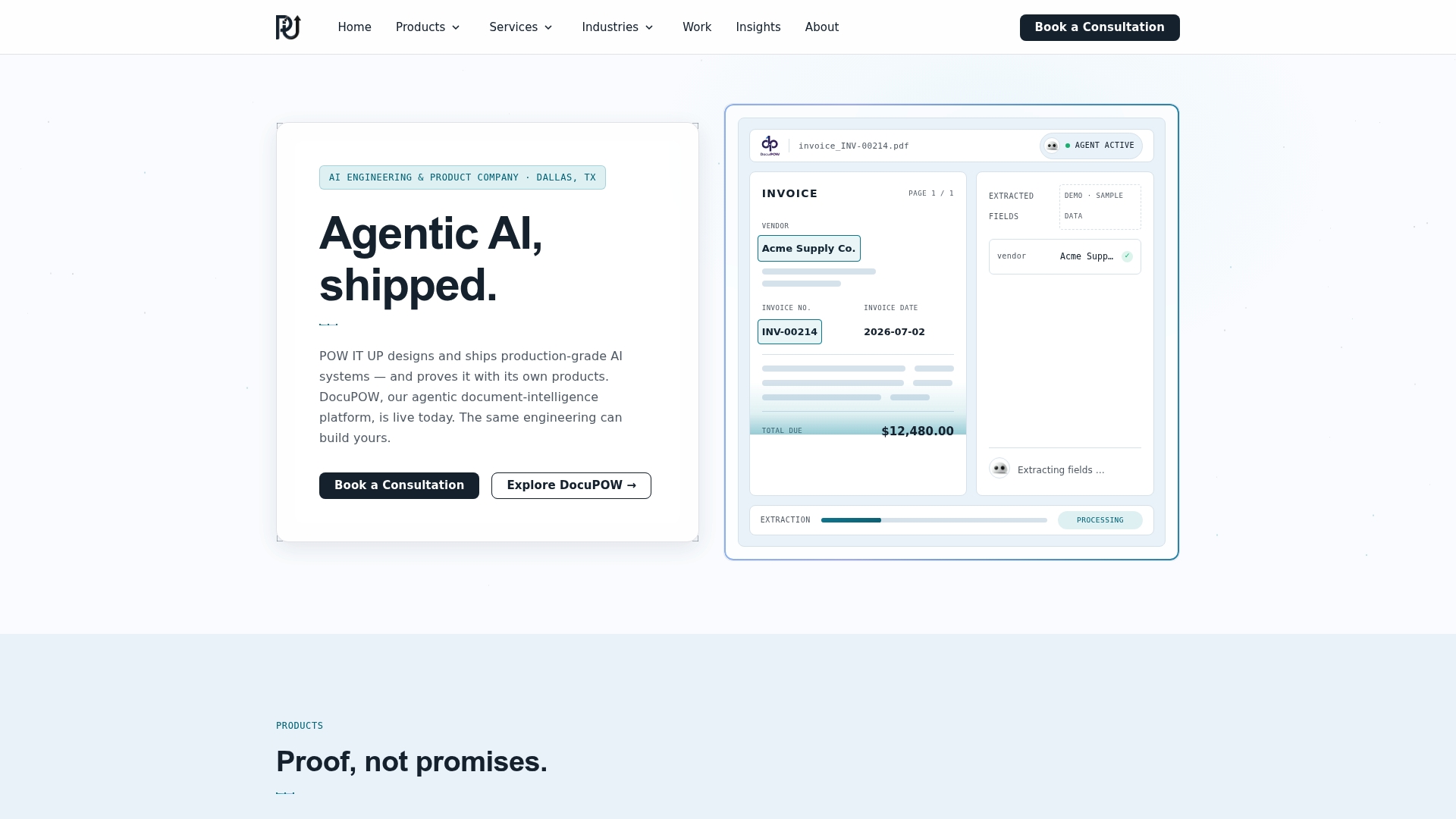
If you have the use cases picked but not the engineering team to build them, that is where we come in. We design custom AI agents, integrate them into your existing systems, and stand behind the result with transparent process and durable ownership, so the system is still yours to run long after launch. Explore DocuPOW for document intake and validation, or book a scoping call through our AI integration page to get a fixed-scope plan and timeline for your first production use case.
FAQ
What is AI business transformation?
AI business transformation is an organization-wide program that redesigns processes, data, governance, and operating models around AI capabilities, rather than adding AI as a feature to existing workflows. It typically spans leadership sponsorship, a phased rollout from pilot to scale, and ongoing governance and run-phase investment.
What is the 30% rule for AI?
If you encounter a term, treat it as informal shorthand rather than an established standard, and rely on documented frameworks like the phased Discover-Design-Deploy-Run model instead.
Which jobs are most resistant to AI automation?
Roles built around complex judgment, relationship management, and physical or creative work that resists codification tend to be the most resistant to automation, though the degree varies by task mix within each role. The Stanford enterprise AI playbook finds that organizational readiness, not the technology itself, usually determines which tasks within a role actually get automated.
What is the 10/20/70 rule for AI?
Definitions of a “10/20/70 rule” vary and it is not a standard defined by a major research body or government framework in our sourcing. A commonly cited informal version splits effort as roughly 10% on algorithms, 20% on data and technology, and 70% on process and people, which lines up with the heavier non-model investment leaders see once pilots move toward production.
How long does it take to see ROI from AI transformation?
Pilots can show results in weeks to a few months, but production rollout across a full process typically takes several months, and scaling across a business unit takes one to two years. Organizations that set an intentional one-to-two-year scaling timeline are 65% more likely to reach scale than those without a defined timeline.