
Future-ready AI infrastructure is the combination of data foundations, compute, integration, security and governance that lets you add AI workloads without rebuilding every time a model, vendor or regulation changes. For most operators outside the hyperscalers, it has little to do with owning GPUs. It means clean data, well-defined interfaces, controlled access, cost visibility and a team that owns the result.
The pressure is real. Adoption has moved from pilots to daily operations, and the physical and financial costs underneath are shifting fast. This guide covers what to build, what to rent, what to govern and in what order.
TL;DR
- Most businesses should treat AI infrastructure as a data, integration and governance problem first, and a hardware problem a distant second.
- 78% of organizations reported using AI in 2024, up from 55% a year earlier, so “wait and see” is now the riskier position.
- Costs fall quickly for model inference but rise for power, data movement and oversight. Budget for both.
- Build security in from the start and audit AI risk plans more often than traditional security plans.
- Start with one high-volume workflow, measure it, then reuse the same foundation for the next.
Table of Contents
- What “future-ready” actually means
- Why the physical layer matters even if you never touch it
- The cost curve is on your side, with a catch
- A practical architecture for mid-sized organizations
- Security and governance from day one
- Break down the silos
- Our perspective
- A sequence you can follow
- Where POW IT UP fits
- Common mistakes to avoid
- FAQ
- Sources
What “future-ready” actually means
The phrase gets used for everything from liquid-cooled data halls to a new SaaS contract. For a business leader, a more useful definition is operational: can you swap a model, add a use case or pass an audit without a rewrite?
Five layers decide that:
- Data. Documents, records and events are accessible, labeled, and owned by someone.
- Compute. You can reach the processing you need, usually through cloud capacity, without paying for idle machines.
- Integration. Agents and models connect to your systems of record through documented interfaces, not screen-scraping or one-off scripts.
- Security and governance. Every AI action has an identity, a permission boundary and a log.
- Operations. Someone monitors accuracy, cost per completed task and drift, and fixes problems.
A company with strong layers 1, 3 and 4 and rented compute is more future-ready than one with a rack of accelerators and no way to trace what an agent did.
Why the physical layer matters even if you never touch it
You may never rent a rack, but the economics of the AI supply chain reach your invoices and your vendors’ roadmaps.
The U.S. Department of Energy reports that data centers used 192 TWh in 2024, about 4.7% of U.S. electricity, with projections of 521 to 843 TWh by 2030, driven in part by dense AI servers. A 2026 update from the national lab says data centers could reach 11.8% of total U.S. electricity by 2030. Deloitte estimates that power demand from U.S. AI data centers could grow more than thirtyfold by 2035, to 123 gigawatts, up from 4 gigawatts in 2024.
What this means for a non-hyperscaler:
- Capacity and pricing can tighten regionally. Avoid designs that depend on one region or one provider’s scarce instance type.
- Efficiency becomes a selection criterion. Smaller, task-specific models often do the job at a fraction of the resource use.
- Portability is insurance. If your workflows are tied to one model’s quirks, you inherit its supply risk.
The cost curve is on your side, with a catch
The Stanford AI Index found that querying a model at GPT-3.5 level fell from $20.00 per million tokens in November 2022 to $0.07 by October 2024, a drop of more than 280 times. That is why automating transactional work such as document reading, routing and reconciliation now pencils out for mid-sized companies.
The catch is that cheap tokens do not make a cheap system. Total cost also includes:
- Data preparation and cleanup
- Integration with legacy platforms
- Evaluation, monitoring and human review
- Security assessment and audit work
- Volume growth: lower unit prices invite more usage
Track cost per completed task, not cost per token. It is the number that tells you whether a workflow is paying for itself. Our own planning guidance on scalable AI infrastructure and platform overhead goes deeper on budgeting that overhead.
A practical architecture for mid-sized organizations
Start with the data you already have
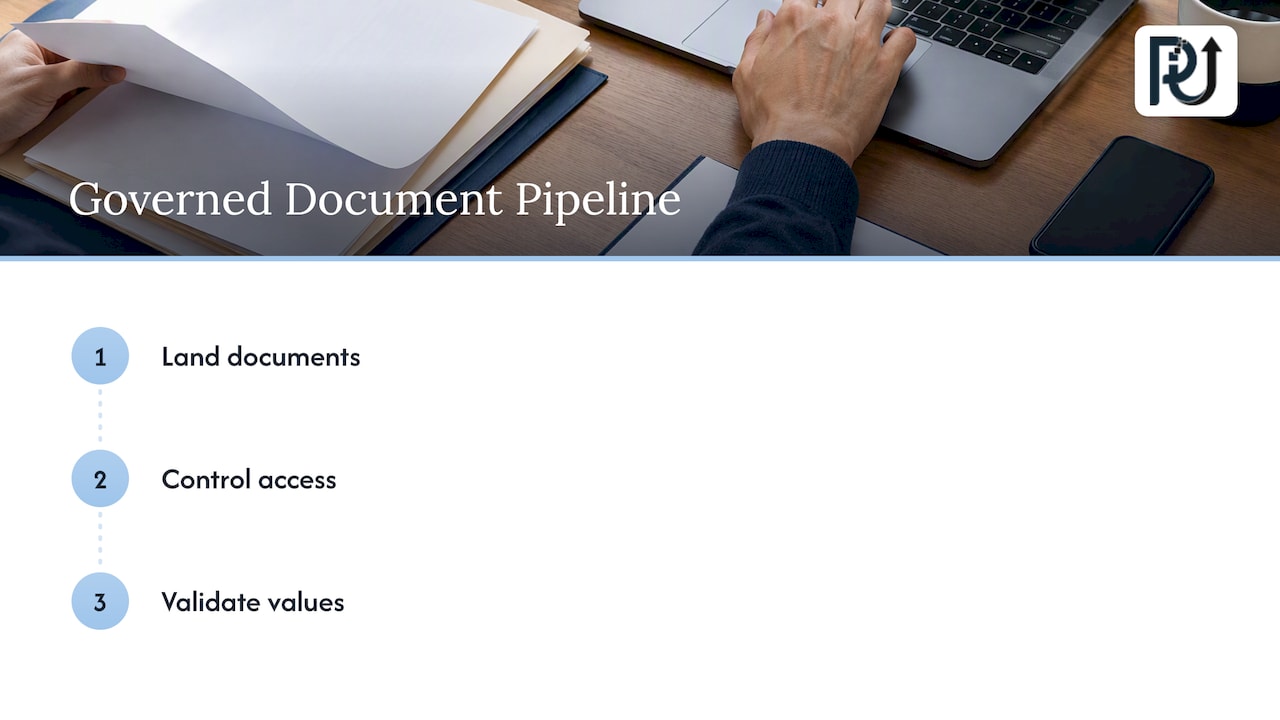
Most operational value sits in invoices, claims, contracts, intake forms, emails and spreadsheets. Before choosing a model, decide where those documents land, who can see them, and how extracted values are validated. A single, governed document pipeline beats five departmental tools that each read PDFs differently.
Keep the integration layer thin and documented
Agents should talk to your CRM, ERP, core system or practice-management software through stable APIs, with a clear contract for what they can read and write. This is what lets you replace the model later without touching the business logic. If you are weighing how to connect AI to existing platforms, see our overview of AI integration services for business leaders.
Rent compute, own the logic
For nearly all service businesses, fintech teams and clinics, cloud inference is the sensible default. What you should own is the workflow logic, the prompts and evaluation sets, and the data. That keeps you free to move between providers as prices and capabilities change.
Design for a hybrid of agents and humans
Autonomous agents are strongest on high-volume, rules-bound work. Exceptions, judgment calls and anything with legal consequences should route to a person with the context attached. Our note on AI-ready hybrid digital infrastructure covers how that split works in practice.
Security and governance from day one
Federal guidance is consistent on this point. CISA’s principles for secure integration of AI in operational technology note that AI can raise efficiency and cut costs but also introduces new risks in the environments it touches. The HHS 405(d) program warns, in its July 2024 newsletter, that excitement about AI can cause risks around data security and ethical decision-making to be overlooked, particularly where patient information is involved.
Turn that into concrete requirements:
- Treat AI features as new systems. When a vendor adds an AI feature to software you already run, do not assume it inherits the host platform’s security posture. Ask for a security risk analysis specific to that feature.
- Give agents their own identities and least-privilege access. Log every action so you can reconstruct a decision.
- Create a cross-functional group. Legal, IT, security and the operational owner should sign off together, not in sequence. Governance built in at the start is cheaper than retrofitting it, a theme we explore in our piece on AI workflow optimization and governance.
- Review AI risk plans on a faster cycle. Capabilities change continuously, so a once-a-year review is too slow. Treat oversight as a living process.
If you are in financial services
Regulators are paying attention. The SEC’s Division of Examinations listed AI-related risks among its 2025 examination priorities, and an SEC order from January 2025 describes two registered investment advisers that failed to exercise reasonable care in addressing known vulnerabilities in their algorithmic models. The lesson is plain: documented testing, vulnerability handling and supervision are part of the infrastructure. Check your own obligations with counsel or your compliance officer.
If you are in healthcare
Any AI that touches protected health information needs a documented risk analysis under your existing HIPAA program, and your security officer should be in the room before deployment. The 405(d) guidance above is a good starting reference for your team.
Break down the silos
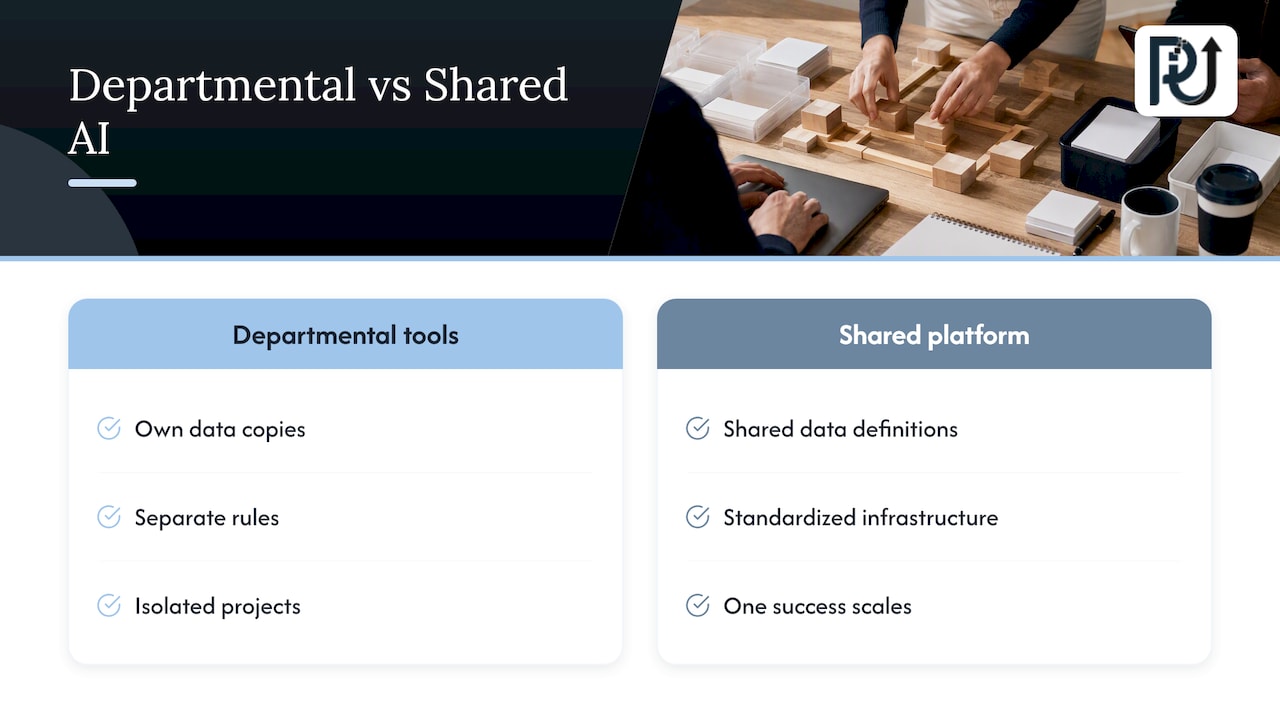
The most common failure we see is not technical. Each department buys its own AI tool, each with its own data copy and its own rules. Government agencies have reached the same conclusion: HHS strategy materials describe a unified, “OneHHS” approach that standardizes data management and infrastructure across the organization rather than running isolated projects. Shared platforms and shared data definitions are what let one success become ten. The same logic applies to functions like marketing and procurement, as this look at integrating marketing and procurement on a shared platform shows.
Our perspective
We build digital workforces for a living, and the pattern is consistent: the projects that last are the ones where the foundation was boring and well documented. Generic scripts break when a vendor changes a field. Context-aware agents, running on a documented integration layer with logging and clear ownership, keep working and can be maintained by your team after we leave.
So we push clients to answer four questions before any build. Which single workflow has the highest volume and the clearest rules? Where does its data live, and who owns it? What does a correct outcome look like, in numbers? Who reviews exceptions? If those have answers, the infrastructure decisions get simple. If they do not, buying more technology will not help.
We also believe you should own what we build. That means transparent processes, engineering accountability and systems your team can run without us.
— Syed Naveed Abbas
A sequence you can follow
- Pick one workflow. Choose high volume, rules-based and measurable: invoice intake, claims document review, client onboarding, portfolio monitoring.
- Map the data and the systems. List sources, owners, access rules and the systems the agent must read from or write to.
- Set the baseline. Record current handling time, error rate and cost per transaction.
- Run a governed pilot. Include security review, logging and a human exception path from the start.
- Measure cost per completed task. Compare against the baseline, including oversight time.
- Reuse the foundation. Extend the same data pipeline, identity model and monitoring to the next workflow.
Stanford’s AI Index notes that organizations using AI in service operations most often report cost savings, which is a reasonable place to look for your first workflow. For a broader view, see our practical playbook for scaling businesses with AI.
Where POW IT UP fits
If your first workflow involves reading and validating documents, DocuPOW is our productized option, with live demos available. If you need something built around your own systems, our AI agents development and AI integration teams design the agents, connect them to your platforms and hand over maintainable systems. Pricing is scoped to the engagement, so get in touch through our site to talk through your workflow.
Common mistakes to avoid
- Buying compute before defining the use case. Idle capacity is the most expensive kind.
- Locking into one model. Keep prompts, evaluations and logic portable.
- Skipping the exception path. Agents without a human fallback create quiet errors.
- Treating governance as paperwork. It is how you prove, to auditors and to yourself, that the system does what you think.
- Measuring activity instead of outcomes. Documents processed means little without accuracy and cost per task.
FAQ
Do I need my own GPUs to be AI-ready?
Usually not. Most small and mid-sized organizations are better served by cloud inference and managed services, keeping ownership of their data, workflow logic and evaluation sets. On-premises hardware makes sense mainly for strict data-residency needs or very steady, heavy workloads.
How much should I budget for AI infrastructure?
It depends on the workflow, so we do not give a blanket figure. Budget for data preparation, integration, security review and ongoing monitoring, not just model usage. Measuring cost per completed task against your current baseline tells you whether the numbers work.
What is the first step for a regulated business?
Assign an accountable owner and form a cross-functional review group with legal, IT and security. Then run a documented risk analysis on the specific AI use case before deployment. Healthcare teams should involve their security officer, and financial firms their compliance officer.
How often should we revisit our AI risk plan?
More often than a traditional security plan, because model capabilities and vendor features change continuously. Many teams move to a regular, scheduled review and an extra review whenever a vendor adds an AI feature.
Sources
- Stanford HAI, AI Index Report 2025
- Stanford HAI, 2025 AI Index: Economy
- U.S. Department of Energy, 2024 Report on U.S. Data Center Energy Use
- U.S. Department of Energy, Data Center Energy Usage Report 2025 update
- Deloitte, Can US infrastructure keep up with the AI economy?
- CISA, Principles for the Secure Integration of AI in Operational Technology
- HHS 405(d) Post, July 2024
- SEC, 2025 Examination Priorities
- SEC order, January 16, 2025