
Scalable digital infrastructure is technology built to absorb growth in traffic, data, and workload without breaking or requiring a full rebuild. The single most important move for 2026 is designing hybrid-by-design from the start: pairing platform engineering, automation, and a deliberate data strategy so systems handle both today’s transactions and tomorrow’s AI workloads. Businesses that delay this shift usually pay for it twice, once in outages and again in the rebuild.
TL;DR:
- Rapid provisioning, automation, and real-time cost visibility are essential for avoiding outages and supporting AI workloads without costly rebuilds.
- Modular systems with clear boundaries, observability, resilience, and a strong data strategy prevent bottlenecks caused by data gravity or manual processes.
- Hybrid infrastructure strategies like cloud, colocation, and edge deployment help manage unpredictable GPU demands and data sensitivity for AI projects.
- Addressing the most critical gap, such as automation or data visibility, first accelerates scaling, reduces staff workload, and improves system reliability.
- Prioritize fixing visibility and automation before hardware or compute expansion to build a resilient, scalable digital infrastructure.
Table of Contents
- Why Scalable Digital Infrastructure Matters for Growth
- Five Core Principles for Building Scalable Systems
- Cloud Migration, Hybrid Design, and AI Workload Readiness
- Checklist: Assess Your Infrastructure Maturity
- POW IT UP’s Perspective on Turning the Checklist Into Action
- What the Data Actually Supports, and What Gets Overhyped
- Getting From Checklist to Working System
- Sources
- FAQ
Why Scalable Digital Infrastructure Matters for Growth
Every business leader who has watched a product launch stall under traffic they didn’t plan for already knows the cost of guessing wrong on capacity. Scalable infrastructure changes three outcomes directly: how fast you ship, how predictable your costs are, and how well you survive a bad week.
Companies with flexible infrastructure, meaning self-service provisioning, infrastructure as code, and rapid elasticity, consistently show stronger software delivery performance, according to DORA’s research on flexible infrastructure. Teams that can spin up an environment in minutes ship features faster than teams waiting days for a ticket to clear.
The downside risk is just as concrete. Skip the planning and you accumulate technical debt that shows up later as slower releases, brittle deployments, and outages during your highest traffic moments, exactly when the outage costs the most.
Energy is now part of this calculus too. The Department of Energy has documented rising electricity demand from data centers, a trend that pushes capacity planning and sustainability into the same conversation as uptime and cost.
What growth actually looks like when infrastructure works:
- Faster time-to-market because environments provision themselves instead of waiting on a ticket queue
- Predictable, usage-aligned costs instead of surprise overages during traffic spikes
- Resilience that keeps revenue flowing during a regional outage or a demand surge
- Room to onboard AI workloads without a parallel infrastructure project
Five Core Principles for Building Scalable Systems
Good architecture isn’t a single decision; it’s five decisions made consistently across every system you build.
- Modularity and bounded contexts. Break systems into services with clear boundaries, each owning its own data and logic. Microservices patterns work because they let one team scale checkout independently of inventory, instead of scaling the entire monolith to fix one bottleneck.
- Observability across logs, metrics, and traces. You cannot scale what you cannot see. Distributed tracing tells you which service is choking under load before your customers do.
- Automation and infrastructure as code. Manual provisioning is the single biggest bottleneck in most organizations. Codifying infrastructure means a new environment takes minutes, not a change request and a week of waiting.
- Resilience by design. Multi-availability-zone and multi-region deployments, graceful degradation, and circuit breakers turn a single point of failure into a contained, recoverable event.
- A deliberate data strategy. Large datasets create data gravity: the bigger the dataset, the harder it is to move, and the more it pulls compute toward it. Colocating processing near your data, rather than shipping data to compute, cuts latency and cost. PlatformDIGITAL’s interconnection approach is one example of infrastructure built specifically to address that gravity for AI-scale data collaboration.
Pro Tip: Audit your data gravity before you audit your compute. Most scaling bottlenecks trace back to data sitting in the wrong place, not to underpowered servers.
These five principles interact. Modularity without observability just hides the same problems in more places. Automation without resilience just breaks things faster. Treat them as a set, not a menu.
Cloud Migration, Hybrid Design, and AI Workload Readiness
Cloud migration isn’t one technique with one right answer. Distinct migration strategies carry different trade-offs, and picking the wrong one for your situation is one of the most expensive mistakes a growing company makes.
Lift-and-shift moves existing workloads to cloud infrastructure with minimal changes. Choose it when speed matters more than optimization, typically for a data center lease expiring in three months or a compliance deadline forcing a quick exit. Refactoring or re-architecting rebuilds applications to use cloud-native services, containers, and managed data stores. Choose it when the workload will live for years and needs to scale elastically, not just run somewhere else.
Neither approach alone solves the hybrid question most enterprises actually face. A consistent control plane across on-premises systems, colocation facilities, edge nodes, and public cloud lets you place workloads where they perform best instead of where your last contract happened to land. HPE GreenLake is one model for this: a unified hybrid platform with pay-per-use economics and reference architectures for workloads that legally or technically can’t move to public cloud.
AI workloads add their own demands: GPU capacity that spikes unpredictably, storage fast enough to feed training jobs without starving the GPUs, data locality that keeps sensitive datasets near compute, and deployment pipelines that push models to production without a manual handoff. Flexible infrastructure, DORA notes, is a prerequisite for scaling AI initiatives specifically because it lets teams spin up ephemeral environments to validate models safely, without provisioning delays throttling every experiment.
None of this runs itself and often requires expert AI development services to implement effectively. It needs:
- Platform engineering teams building the paved paths developers actually use
- Site reliability engineering owning uptime and incident response as a discipline, not an afterthought
- FinOps practices tying cloud spend to business value instead of letting it drift
- Self-service developer platforms that turn infrastructure requests into a few clicks
Checklist: Assess Your Infrastructure Maturity
Before you invest in a rebuild, find out where you actually stand. Five checks tell you almost everything:
- Provisioning lead time. Minutes signals platform maturity. Days or weeks signals a bottleneck that’s quietly taxing every team.
- Self-service adoption. What percentage of infrastructure requests bypass a ticket entirely?
- Observability coverage. Can you trace a request end to end across every service it touches, or only within one team’s slice?
- Disaster recovery readiness. Have you actually tested failover in the last quarter, or does the runbook just exist on paper?
- Cost visibility. Can any engineering leader see what a feature costs to run, in near real time, without a finance request?
These map roughly onto three maturity levels. Basic means manual provisioning, siloed monitoring, and cost data that arrives a month late. Developing means some automation exists but inconsistently, and self-service covers a handful of common requests. Platform-enabled means infrastructure is a product: self-service by default, observability standardized across teams, and costs visible to whoever is spending them.
Sequence investments around your riskiest gap first. If disaster recovery has never been tested, that’s your pilot project, not a nice-to-have you’ll get to eventually.
POW IT UP’s Perspective on Turning the Checklist Into Action
Most organizations that run the maturity checklist honestly land somewhere between basic and developing, with one gap that’s costing them more than the rest combined. POW IT UP treats that gap as the starting point, not a generic rebuild.
The pattern that shows up in engagements: design the target architecture around the highest-volume manual process first, build the automation and integration layer to support it, then deploy it as a monitored, self-service system rather than a one-off script. That sequence mirrors the checklist directly, provisioning speed, observability, and cost visibility all improve together rather than in isolation.
Outcomes worth targeting from this kind of work:
- Closing the “time leaks” where staff manually shepherd data between systems that should talk to each other
- Scaling transaction processing volume without a matching headcount increase
- Live analytics on cloud spend and system performance instead of a monthly report
Pro Tip: If your team can already build and maintain automation internally, upskilling in-house is often the better long-term investment. Bring in a specialist partner when the gap is speed to production or when the workload (AI agents, document intelligence) sits outside your team’s current expertise.
Related reading: Why Service Businesses Need AI Architects in 2026.
What the Data Actually Supports, and What Gets Overhyped
Most infrastructure advice treats “scalability” as a purely technical problem, buy more compute, add more nodes, and call it solved. That framing misses the actual bottleneck in most organizations, which is process, not hardware. A company can have unlimited elastic capacity and still be stuck, because the process feeding data into that capacity is still manual, still siloed, and still slow.

The conventional wisdom also underrates data gravity. Teams plan compute scaling in detail and treat data placement as an afterthought, then discover their AI initiative is bottlenecked on data transfer costs and latency, not model performance. Address data placement before you address compute, not after.
If you take one thing from this playbook, prioritize observability and automation before you touch anything else. A resilient, modular architecture with no visibility into its own behavior is just an expensive black box. Fix visibility first, then resilience becomes something you can actually verify instead of assume. That order matters more than most architecture diagrams suggest, and it’s the order that determines whether the next twelve months feel like scaling or firefighting.
— Syed Naveed Abbas
Getting From Checklist to Working System
Running the maturity checklist tells you where the gaps are. Closing them, especially the automation and integration gaps that eat the most staff hours, is where most internal teams stall out, not from lack of skill but from lack of bandwidth to build it alongside daily operations.
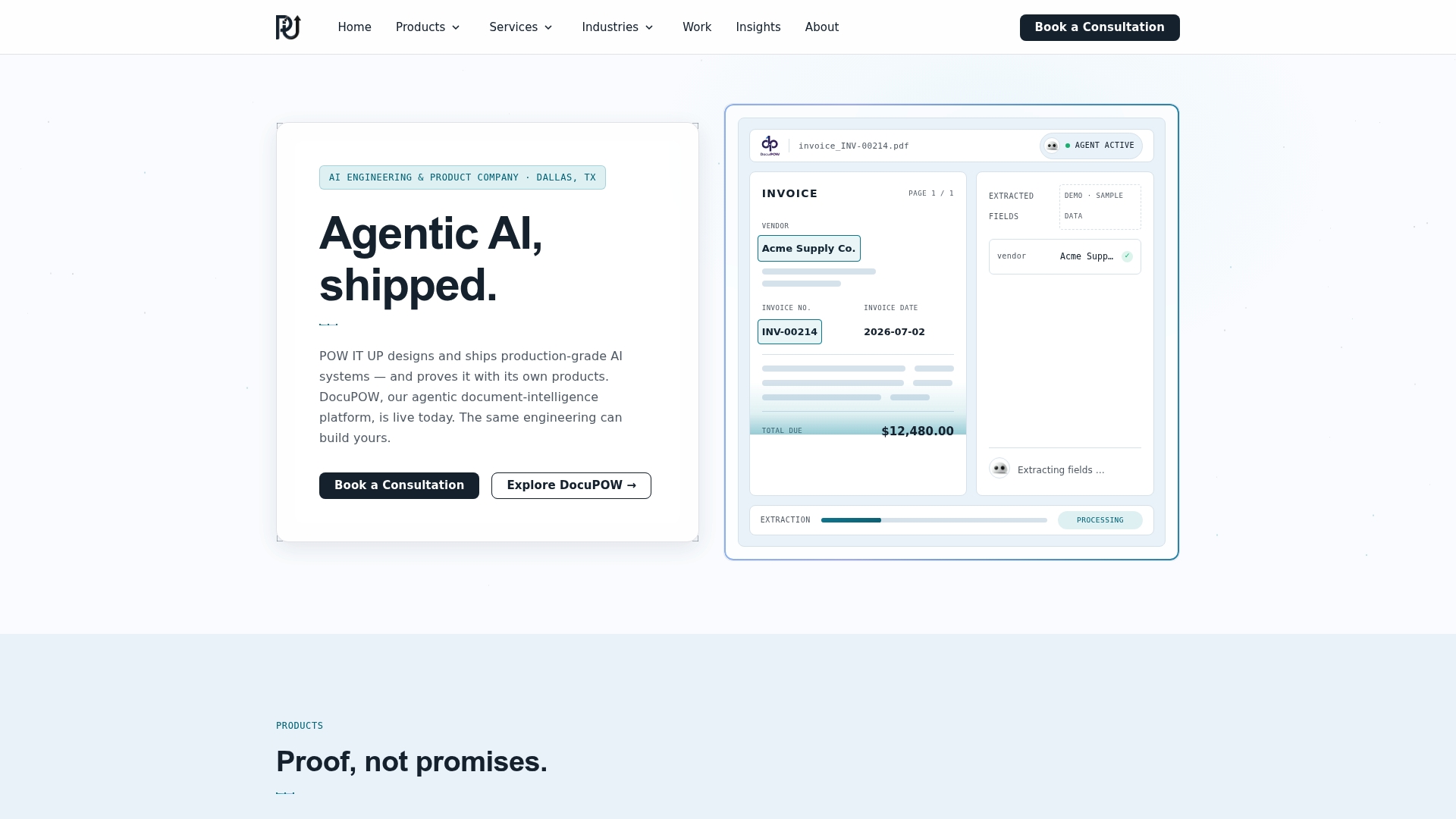
The automation layer that sits underneath scalable infrastructure includes custom AI agents that handle document intelligence, transaction processing, and workflow orchestration at volumes a manual team can’t match without adding headcount. That’s the concrete difference versus hiring internally from scratch or stitching together generic automation tools: a working system deployed against your specific process, not a template.
Engagements typically start with a discovery phase mapping highest-cost manual processes, followed by a scoped build and deployment against measurable targets like processing volume or turnaround time. If your infrastructure checklist flagged automation or data visibility as the weak point, that’s exactly where AI integration and AI agent development fit. Get a scoped assessment of where automation would move the needle fastest and what a build would look like for your systems.
Sources
- DORA | Capabilities: Flexible infrastructure
- PlatformDIGITAL | Digital Realty
- GreenLake | HPE
- DOE report on increasing electricity demand from data centers
FAQ
What Is Scalable Infrastructure?
Scalable infrastructure is technology, compute, storage, and networking, built to grow with demand without a redesign, typically through modular services, automation, and elastic cloud resources.
What Is an Example of Digital Infrastructure?
Cloud computing platforms, data center networks, content delivery systems, and hybrid setups like HPE GreenLake that combine on-premises and cloud resources under one control plane all count as digital infrastructure.
What Are the Top AI Infrastructure Providers?
There’s no single fixed list, but the category includes hyperscale cloud providers, colocation and interconnection platforms such as PlatformDIGITAL, hybrid platform providers like HPE GreenLake, and specialized AI integration firms like POW IT UP that build the automation layer on top of that infrastructure.
What Are the Four Types of Infrastructure?
Digital infrastructure is generally grouped into compute, storage, networking, and security, with modern stacks adding a platform or automation layer that ties the other four together.
How Do I Know if My Infrastructure Is AI Ready?
Check provisioning lead time, data locality relative to your compute, and whether your deployment pipeline can push a model to production without manual steps. Slow provisioning or scattered data are the two most common blockers.