

Yes, small and midsize businesses should pursue AI transformation, but the smart path starts small: tightly scoped, measurable pilots aimed at frequent, high-volume tasks. Two-thirds of U.S. small businesses already use AI, and the SBA recommends testing low-cost tools first. The roadmap below shows exactly how to start.
TL;DR:
- Small businesses can achieve quick AI wins by automating common tasks like invoice validation, scheduling, and routine customer replies.
- Pilot projects should focus on narrow, high-volume tasks with clear metrics such as hours saved or error reduction, and scale only after proven value.
- Data quality, accessibility, and proper governance are crucial for AI success, requiring simple readiness checks before implementation.
- Starting with off-the-shelf, low-cost tools for high-frequency, simple tasks minimizes risk and ensures measurable ROI within a few months.
- Transitioning to custom AI solutions is advisable only after pilots demonstrate clear KPIs and task complexity exceeds what standard tools can handle.
Table of Contents
- Concrete benefits and evidence for SMBs adopting AI
- Step-by-step, pilot-first implementation roadmap
- How to prioritize high-impact AI use cases
- Data readiness and managing AI risk the practical way
- Pilot measurement, ROI tracking, and scaling criteria
- Change management: training, policy, and adoption tactics
- Publisher’s perspective: pilot-first lessons
- How we can help: pilot services and DocuPOW for SMBs
- FAQ
- Sources
Concrete benefits and evidence for SMBs adopting AI
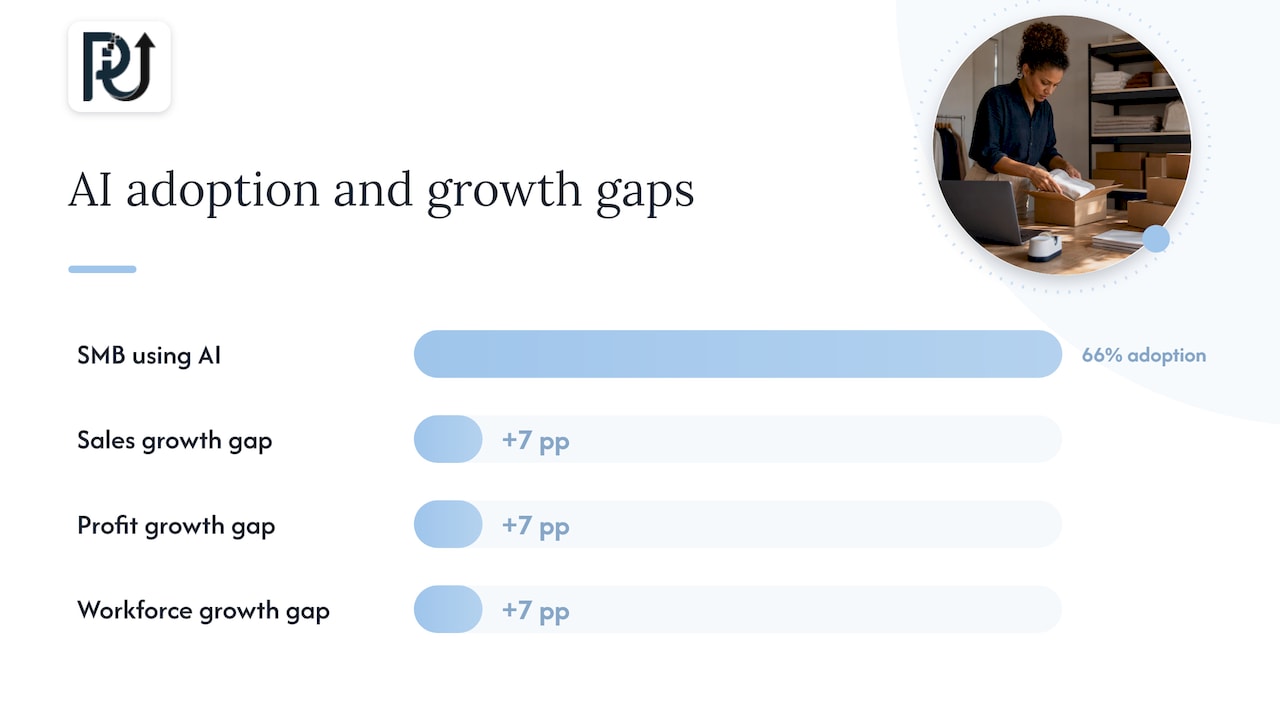
The payoff is no longer theoretical. Two-thirds (66%) of U.S. small businesses now use AI, and those businesses report sales, profit, and workforce growth at rates at least 7 percentage points higher than non-AI peers, according to the U.S. Chamber of Commerce. That gap shows up across industries, not just tech-forward ones.
Transaction data from the JPMorgan Chase Institute tells a related story: small businesses are buying a wider variety of AI services and integrating them more deeply, even as average monthly spend per business has fallen since 2019. In plain terms, AI is getting cheaper and more embedded at the same time.
The benefit areas worth targeting first are consistent across sectors:
- Operational cost reduction: automating repetitive document and data-entry work cuts hours spent on tasks that produce no real value.
- Revenue lift: faster response times and better follow-up on leads convert more of the business you already have.
- Faster decision-making: real-time dashboards replace end-of-month reporting with daily visibility.
Three high-impact applications show up again and again: automated invoice and document validation, intelligent scheduling and reconciliation, and AI-assisted customer replies for routine inquiries. None of these require a large engineering team to start.
Step-by-step, pilot-first implementation roadmap
Before touching any tool, define the business objective and the metric that proves it worked: hours saved, error rate reduced, cycle time shortened. Without that, you can’t tell a win from a distraction.
- Crawl (weeks 1-4): run one or two low-risk pilots using off-the-shelf AI features already inside tools you own, like email drafting assistants or basic document scanners. Keep scope narrow: one task, one team, one metric.
- Walk (months 2-4): once a pilot proves value, integrate AI into the core workflow it touches. This is where data readiness matters: confirm the data feeding the tool is accurate, accessible, and properly permissioned.
- Run (months 5+): scale proven pilots with custom agents and orchestration across multiple workflows, once KPIs are validated and the team has adapted its processes around the tool.
Each phase needs different people. The crawl phase works with a single process owner and an IT generalist. The walk phase needs someone who understands the underlying data and at least one frontline user testing daily. The run phase typically needs outside engineering support to build and maintain custom automation, since most SMB teams don’t have in-house AI developers.
Pro Tip: Run your first pilot on a task your team already complains about weekly, not on the task that sounds most impressive in a board meeting.
How to prioritize high-impact AI use cases
Not every automation idea deserves a pilot slot. A simple scoring approach keeps the list honest: rate each candidate task on expected return on investment, how frequently it occurs, the quality of the data behind it, how complex the workflow is, and any regulatory exposure. Tasks that score high on frequency and data quality but low on complexity are the fastest wins.
Quick-win categories worth shortlisting first:
- Document intake and validation: invoices, receipts, contracts, and forms that currently require manual review.
- Scheduling and reconciliation: appointment booking, order matching, and calendar coordination.
- Routine customer communication: answering common questions, confirming orders, sending reminders.
For the simplest wins, an off-the-shelf SaaS feature is usually enough. Once a task touches multiple systems, requires custom logic, or needs to scale past a few hundred transactions a month, custom engineering tends to pay off faster than stretching a generic tool past its design.
Data readiness and managing AI risk the practical way
Most SMB AI pilots fail quietly, not because the model is wrong but because the data feeding it is incomplete, duplicated, or locked behind inconsistent access rules. A short readiness audit catches this early:
- Availability: is the data you need actually captured somewhere, or does it live in someone’s inbox?
- Quality: are records consistent, deduplicated, and reasonably current?
- Access controls: who can see or edit the data, and is that list accurate today?
Governance doesn’t need to be heavy to be real. The minimum worth putting in writing: an acceptable-use policy for AI tools, basic activity logging, a human-in-the-loop checkpoint for consequential decisions, and a quick risk check on any vendor touching customer data. The NIST AI Risk Management Framework lays out concrete actions here, including documenting training data provenance, assigning oversight proportional to risk, and running supplier risk assessments, all scalable to a small team.
The SBA echoes this with practical guidance: test free or low-cost tools first, and draft a simple transparency statement so customers know when they’re interacting with an AI system. SBA and NIST both recommend voluntary adoption of AI RMF principles rather than waiting for formal regulation to catch up.
Pilot measurement, ROI tracking, and scaling criteria
A pilot without a measurement plan is just an experiment with no ending. Set KPIs before launch, tied directly to outcomes: hours saved per week, cost per transaction processed, or conversion lift on a specific workflow.
The most reliable measurement methods are simple: compare before-and-after performance on the same process, run an A/B test where one team uses the tool and a comparable team doesn’t, or hold a control group steady while the pilot team adopts the change. Any of these beats guessing based on anecdotal feedback.
On economics, a few rules keep pilots honest:
- Estimate payback in months, not years, since a pilot that can’t show value within two or three quarters rarely justifies scaling.
- Watch recurring costs closely, since subscription and usage fees often grow faster than expected once adoption spreads.
- Factor in vendor lock-in risk before committing to a platform that’s hard to migrate away from later.
Our ROI breakdown on AI automation costs walks through how to estimate payback periods when budgeting a pilot.
Change management: training, policy, and adoption tactics
The team that touches the workflow daily should get trained first, not the executives approving the budget. Low-cost upskilling options work fine here: short internal walkthroughs, vendor-provided tutorials, and a single point person who fields questions.
Keep policy simple: a one-page AI conduct guideline covering what tools are approved, what data can be entered into them, and when customers need to be told AI was involved in a response.
- Integrate into tools staff already use rather than asking them to learn a new system.
- Name a champion on each team who tests new features first and answers peer questions.
- Track adoption, not just output, since a tool nobody opens isn’t delivering value no matter how good the pilot numbers looked.
Pro Tip: Ask your champion to share one specific time the tool saved them an hour. That story spreads faster than any mandate.
Publisher’s perspective: pilot-first lessons
Across the automation work we do, the pattern repeats: the biggest wins rarely come from the flashiest AI feature. They come from finding the operational “time leak,” the task eating hours every week without anyone noticing, and automating that first. Invoice validation, document intake, and routine customer replies show up constantly as the highest-return starting points. A narrow, well-measured pilot beats an ambitious rollout almost every time, because it proves value fast enough to earn the budget for the next step.
— Syed Naveed Abbas
How we can help: pilot services and DocuPOW for SMBs
Once a pilot proves its case, scaling it without adding headcount is where most SMBs get stuck. We design and build custom AI agents, integrate them into your existing systems, and automate transactional work that pilots usually uncover.
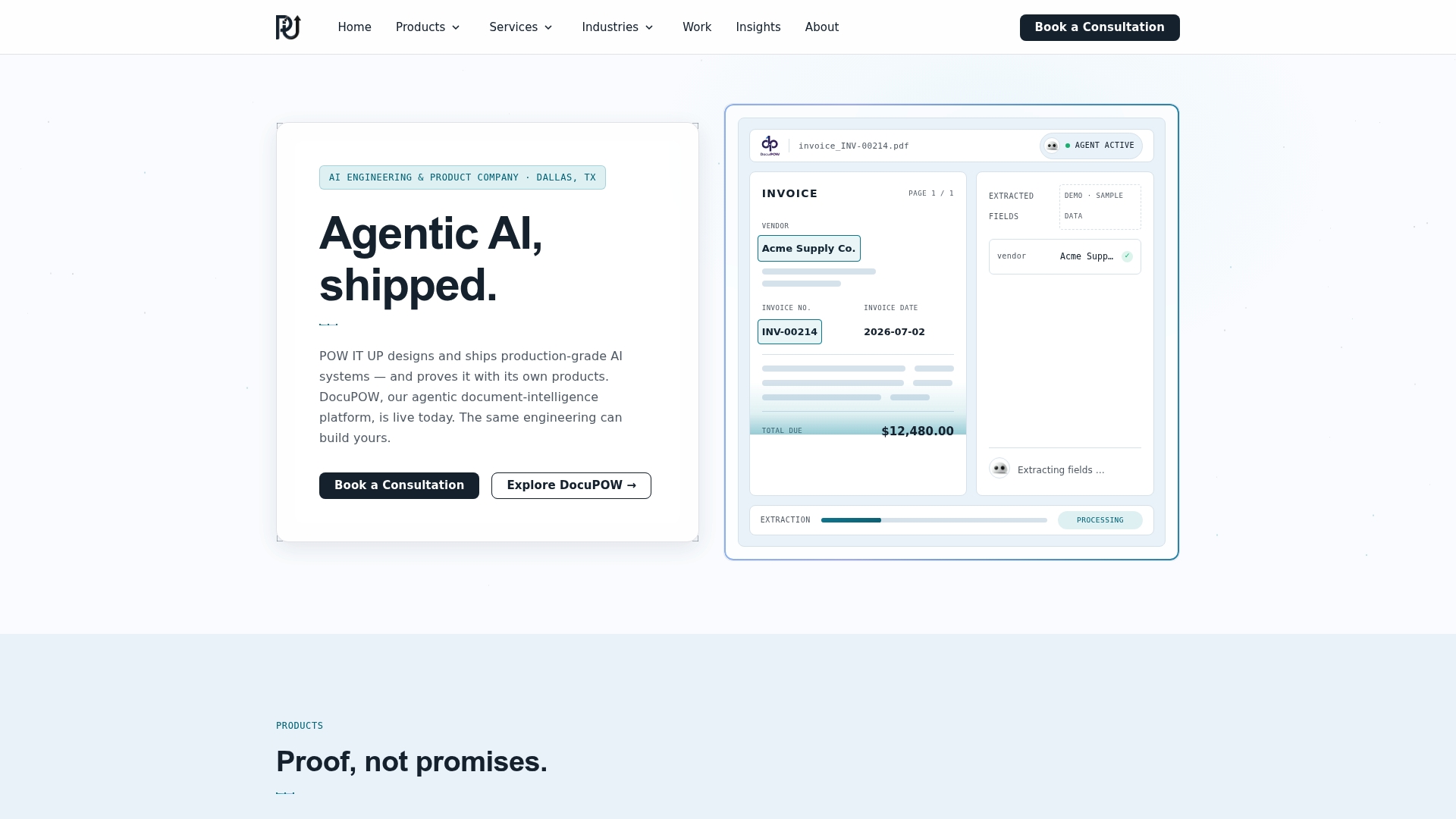
DocuPOW is a document intelligence product that handles document reading and validation for teams dealing with invoices, forms, and contracts. For businesses ready to move past off-the-shelf tools, AI Agents Development services can build autonomous agents sized to actual workflows, not generic templates. Request a demo or talk to our team about scoping your next pilot.
FAQ
What does “AI transformation” mean for a small business?
For most SMBs, AI transformation means replacing manual, repetitive tasks (document review, scheduling, routine replies) with automated systems, starting small and expanding only after a pilot proves its value. It’s less about adopting every new model and more about applying AI where it measurably saves time or money.
What’s the safest way for an SMB to start an AI pilot?
Start with a single, high-frequency task and a free or low-cost tool, exactly as the SBA recommends. Define the success metric before launch and keep the pilot’s scope narrow enough to measure cleanly within one quarter.
How should an SMB think about AI risk and governance?
Even without a dedicated compliance team, a business can apply the NIST AI Risk Management Framework at a basic level: document training data provenance, assign a human to review consequential decisions, and perform supplier risk assessments before signing on. These steps scale down to a team of any size.
When should an SMB move from a pilot to a custom-built solution?
Once a pilot’s KPIs are proven and the task volume or complexity outgrows what an off-the-shelf feature can handle, custom engineering, like the agent development we offer through AI Agents Development, typically delivers a faster return than stretching a generic SaaS tool further.
Sources
- Empowering Small Business: The Impact of Technology on U.S. Small Business | U.S. Chamber of Commerce
- AI for small businesses | U.S. Small Business Administration
- AI RMF profile for Generative AI | NIST
- Understanding AI use by small businesses | JPMorgan Chase Institute