
The future of AI-powered operations is not a smarter assistant for each employee. It is whole workflows, such as invoice intake, claims handling, onboarding and client monitoring, run by AI agents while people supervise, handle exceptions and keep improving the system. The companies that get there first will not be the ones with the most pilots. They will be the ones that redesigned how work flows, measured it, and governed it from day one.
TL;DR
- The unit of automation is shifting from the single task to the end-to-end workflow, with people moving into supervision, governance and exception handling.
- Adoption is wide but shallow: most departments use agents, yet few let them finish work without step-by-step human approval, and that supervised middle is where returns are weakest.
- Practical wins today sit in document-heavy, rules-heavy, high-volume work: claims, invoices, onboarding, procurement, service queues and forecasting.
- Scaling without proportional headcount depends on redesigned processes, reliable data and continuous governance, not on adding more tools.
- Treat AI operations as a standing management function: measure against baselines, review risk regularly, and keep human ownership of outcomes.
Table of Contents
- From automating tasks to redesigning workflows
- What the adoption data actually says
- Where AI-powered operations already pay off
- Scaling volume without scaling headcount
- Building operational resilience, not just speed
- Redesigning the operating model
- Governing AI operations as a continuous function
- Measuring whether it works
- Our perspective: build a digital workforce you can inspect
- Where POW IT UP fits
- FAQ
- Sources
From automating tasks to redesigning workflows
For a decade, operations automation meant scripts and bots that copied data from one screen to another. Generative AI first added a layer of assistants: draft this email, summarize that call. Both approaches share a limit. They speed up a task inside a process that was designed for people.
Agentic AI changes the picture. MIT Sloan’s October 2026 analysis argues that the unit of analysis moves from the individual task to the workflow. Agents can carry out substantial segments of a workflow on their own, while people supervise the systems, govern what agents are allowed to do, manage exceptions and improve performance. The same piece urges leaders to stop debating automation versus augmentation and to redesign complete workflows instead.
That has a practical meaning. If an agent reads an incoming invoice, validates it against a purchase order, flags the mismatch and routes only the odd cases to a person, nobody is “augmented” or “replaced” in the old sense. The job itself has changed: the accounts payable specialist now tunes rules, reviews exceptions and watches error patterns.
Three shifts follow from this:
- Process design comes before tooling. An agent dropped into a broken process automates the breakage faster.
- Roles are rewritten. Supervisory, governance and improvement duties become real job content, with training and performance measures to match.
- Context matters more than scripts. Work that depends on reading documents, interpreting intent and checking several systems needs context-aware agents, not fixed rules that fail on the first unusual input.
What the adoption data actually says
The loudest claims about AI productivity often come from vendors. The better evidence comes from controlled studies and large surveys, and it is more nuanced.
On productivity, a February 2025 MIT working paper combined randomized field experiments at Microsoft, Accenture and a Fortune 100 company. It found a 26.08% increase in completed software-development tasks among 4,867 developers using an AI coding assistant. That is a strong result, but note its scope: one profession, one kind of tool, individual tasks.
On organizational returns, the picture is less comfortable. Knowledge at Wharton’s 2026 AI Adoption Report says two-thirds of departments report using AI agents, but only 17% let an agent complete a task without a person approving each step. Most organizations sit in a supervised middle, paying for AI while keeping the full human review burden, which is where returns are weakest.
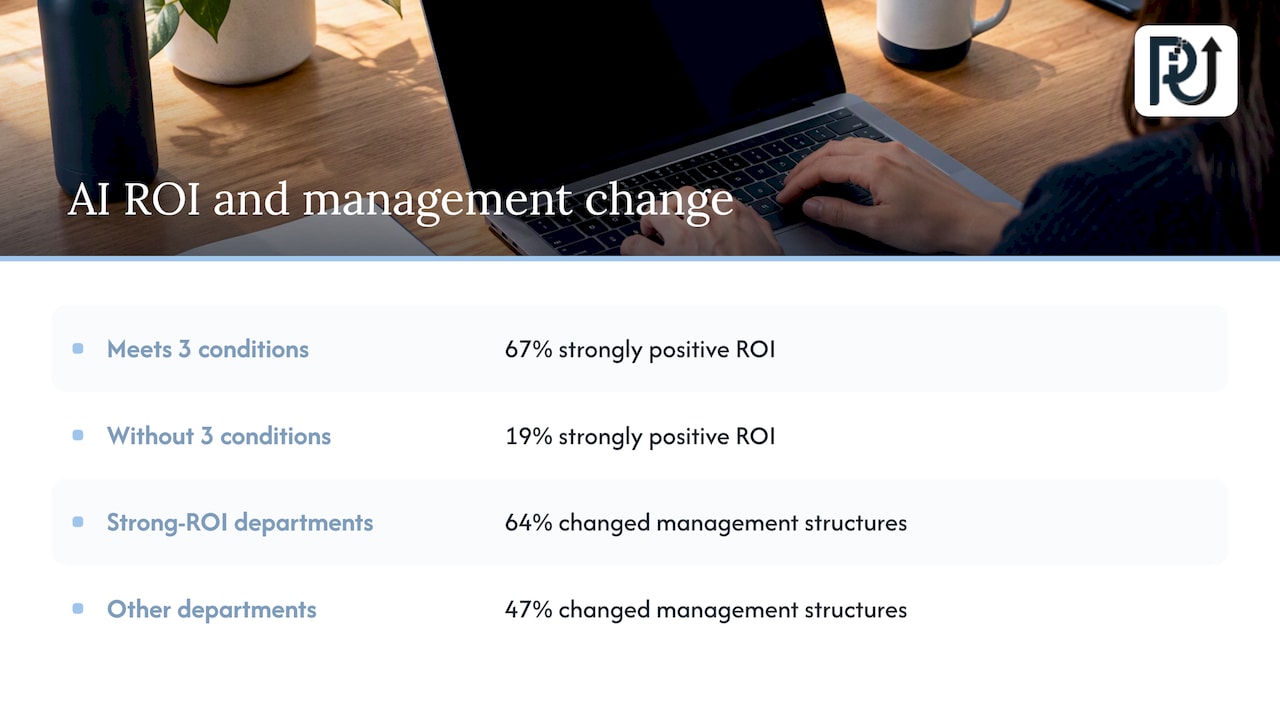
The same report points to what separates winners. Among enterprise leaders whose departments meet three transformation conditions, 67% report strongly positive ROI, against 19% of those that do not. And 64% of departments with strongly positive ROI changed management structures because of AI, compared with 47% of the others.
The lesson is blunt. Buying AI does not produce returns. Changing how work is organized around it does.
Where AI-powered operations already pay off
The most dependable use cases share a profile: high volume, structured outcomes, lots of documents, and clear rules for what “correct” looks like. A 2026 North Dakota Legislative Council memorandum drawing on U.S. sources lists practical business uses that include customer-service chatbots and agent assist, personalization, OCR combined with generative AI for contracts, invoices and claims, procurement and onboarding workflow automation, cybersecurity detection, supply-chain forecasting and coding assistants.
The same memorandum gives sector examples: finance uses AI for trading, credit and service; insurance for claims, underwriting and fraud; manufacturing and logistics for robotics, inspection, autonomous movement, predictive maintenance and digital twins.
Here is how that maps to the kinds of operations most mid-sized U.S. businesses run:
| Operational area | What the AI does | What people keep |
|---|---|---|
| Accounts payable and invoicing | Reads documents, extracts fields, matches against orders | Approving exceptions, vendor disputes |
| Claims and intake (insurance, healthcare) | Classifies, validates completeness, routes | Judgment calls, member or patient communication |
| Client onboarding | Collects and checks documents, triggers account setup | Relationship, risk decisions |
| Service queues | Answers routine requests, assists agents with context | Complex or sensitive cases |
| Portfolio and client monitoring | Watches signals, flags accounts at risk | Deciding the response |
| Supply chain and logistics | Forecasts demand, flags delays | Supplier negotiation, trade-offs |
Notice the right-hand column. Each row still has people, but doing different work from before.
Scaling volume without scaling headcount
This is the question most operations leaders actually ask: can we handle twice the volume without hiring twice the staff? Sometimes yes, and the mechanism is specific.
Headcount grows with volume when every transaction needs a person to touch it. An agent that handles the routine majority end to end breaks that link. Volume can double while the human workload grows only by the share of cases that become exceptions. So the numbers that matter are the straight-through rate (the share of transactions completed without human touch) and the exception rate (how many need review and why).
A few conditions make this real rather than aspirational:
- A stable, documented process. If three people do the same task three ways, standardize first. Our guide on why service firms standardize with AI covers that step.
- Reliable data. Agents inherit every flaw in the systems they read from. Clean, accessible data is a prerequisite, not a follow-up project.
- Modular integration. Agents must connect to your core systems through maintainable interfaces, so you can swap a model or a step without rebuilding everything.
- A plan for the exceptions. Capacity you save on routine work should be redirected to the cases that need judgment, not quietly cut before you know what the exception load looks like.
We lay out the engineering path from pilot to production in six engineering steps past the pilot.
Building operational resilience, not just speed
Efficiency gets the headlines, but resilience is the stronger argument in an uncertain market. An operation is resilient when a surge in volume, a staff shortage or a supplier disruption does not break service.
AI contributes in three ways. Agents absorb volume spikes because they do not need to be hired and trained. Monitoring agents surface problems earlier: a client account trending toward churn, a payment pattern that looks off, a machine drifting out of tolerance. And codified processes reduce dependence on the tacit knowledge of one long-tenured employee.
Resilience also has a downside risk. An operation that depends on an agent nobody understands is fragile in a new way. Build in fallbacks: a documented manual path for critical processes, logging of every agent action, and clear owners who can pause an agent. Resilience means you can still run when the automation fails, not that it never fails.
Redesigning the operating model
The organizations pulling ahead treat AI as an operating model change. Gartner’s guidance on operating model alignment says to redesign the operating model as an interconnected system: align workflows, cross-functional structure, talent, outcome-based performance measures, shared technology and reliable data, and governance. It also says AI transformation should be reassessed continuously rather than treated as a one-time project.
MIT Sloan’s account of enterprise AI research gives a complementary view. It names four requirements for moving from pilots to scale: align strategy to measurable value, build modular and interoperable systems and data ecosystems, synchronize people and redesigned roles with AI capabilities, and embed compliant, human-centered stewardship.
Put together, a workable sequence looks like this:
- Pick value streams, not departments. Choose two or three workflows where redesign could move a number the business already tracks: cycle time, cost per transaction, error rate, days to cash.
- Map the current process honestly. Include the workarounds and the “time leaks”: waiting, re-keying, chasing missing documents.
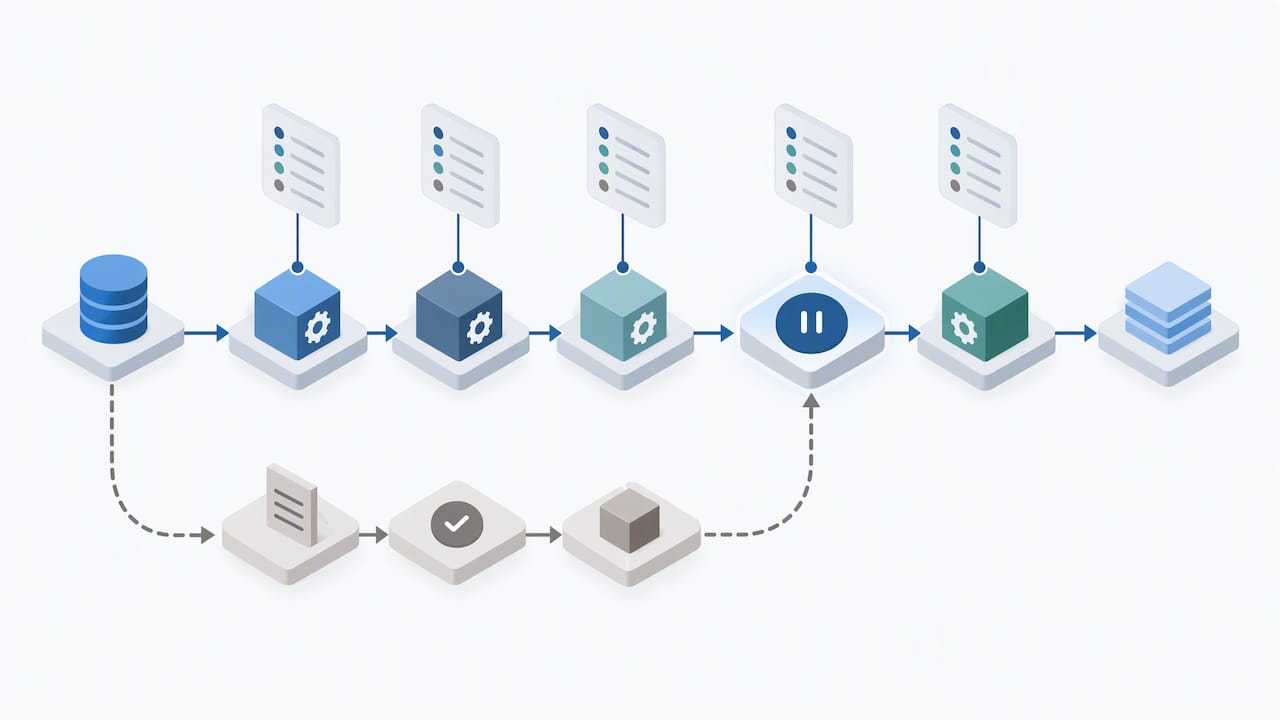
- Redesign the flow with the agent in it. Decide what the agent does, what a person reviews and what triggers escalation.
- Integrate with existing systems. Our AI integration approach focuses on connecting agents to the systems you already run.
- Run in production with measurement. Compare against the baseline you captured in step 2.
- Reassess on a schedule. Models, rules and business priorities change.
Governing AI operations as a continuous function
The more autonomy you give agents, the more governance matters. The U.S. National Institute of Standards and Technology publishes a voluntary AI Risk Management Framework. It calls for governance across all stages of organizational AI risk management and stresses accountability, along with consideration of legal and third-party risks. The implication is that governance is an ongoing management function, not a one-time technical sign-off.
In practice, that means:
- Named accountability. Every agent has a business owner, not just an engineer.
- Action boundaries. Define what an agent may read, write, approve and spend.
- Logging and review. Keep an auditable record of what agents did and why, and sample it regularly.
- Third-party exposure. Know which model providers and data processors touch your information, especially in healthcare and financial services.
- Sector rules. Regulated industries have their own obligations; the risks of AI in regulated document work, for example, are covered in this guide to AI risks in regulated industries.
NIST also offers a practical way to find your starting point. AI RMF Profiles let an organization compare its current and target AI-risk profiles, identify gaps, create action plans, prioritize mitigation and estimate staffing and funding needs. For a mid-sized company, a simple version of that exercise, run once a year, is a sound governance habit.
Measuring whether it works
Before any build, write down the baseline. Without one, every later claim is a story. Useful operational measures include:
- Cycle time per transaction, from receipt to completion
- Cost per transaction, fully loaded
- Straight-through processing rate
- Exception rate and top exception causes
- Error or rework rate
- Hours of human time spent on supervision versus exception handling
Set a short evaluation window. A useful reference point is this piece on proving AI value within 90 days, which shows how to frame evidence for a skeptical audience, even though it is written about people development. Our own view is similar: a well-scoped project should show movement on its baseline measures within weeks, and if it does not, you want to know early. We discuss this in proving AI consulting ROI in 4 to 8 weeks.
Also track the Wharton warning sign: if your agents always need a person to approve every step, you may have built an expensive assistant rather than an autonomous workflow. Decide deliberately which steps need approval and why, then widen autonomy as the error data earns it.
Our perspective: build a digital workforce you can inspect
We build custom AI agents and automation for fintech, healthcare, service firms, logistics, insurance and other operations-heavy businesses, and our view is simple. The future belongs to companies that treat agents as a workforce to be designed, supervised and improved, not as software to be installed.
That shapes how we work. We favor context-aware agents over generic scripts, because real operations are full of documents and edge cases that scripts cannot interpret. We insist on transparent processes and engineering accountability, so you can see what an agent does and why. And we aim for durable client ownership: the system we hand over should be maintainable by you, not a black box you rent forever.
We also think the “supervised middle” is the real risk of the next few years. Many firms will spend on agents and see little, because they never redesigned the workflow or never decided where autonomy is safe. Start with one process where you can measure the result, prove it, then widen it.
— Syed Naveed Abbas
Where POW IT UP fits
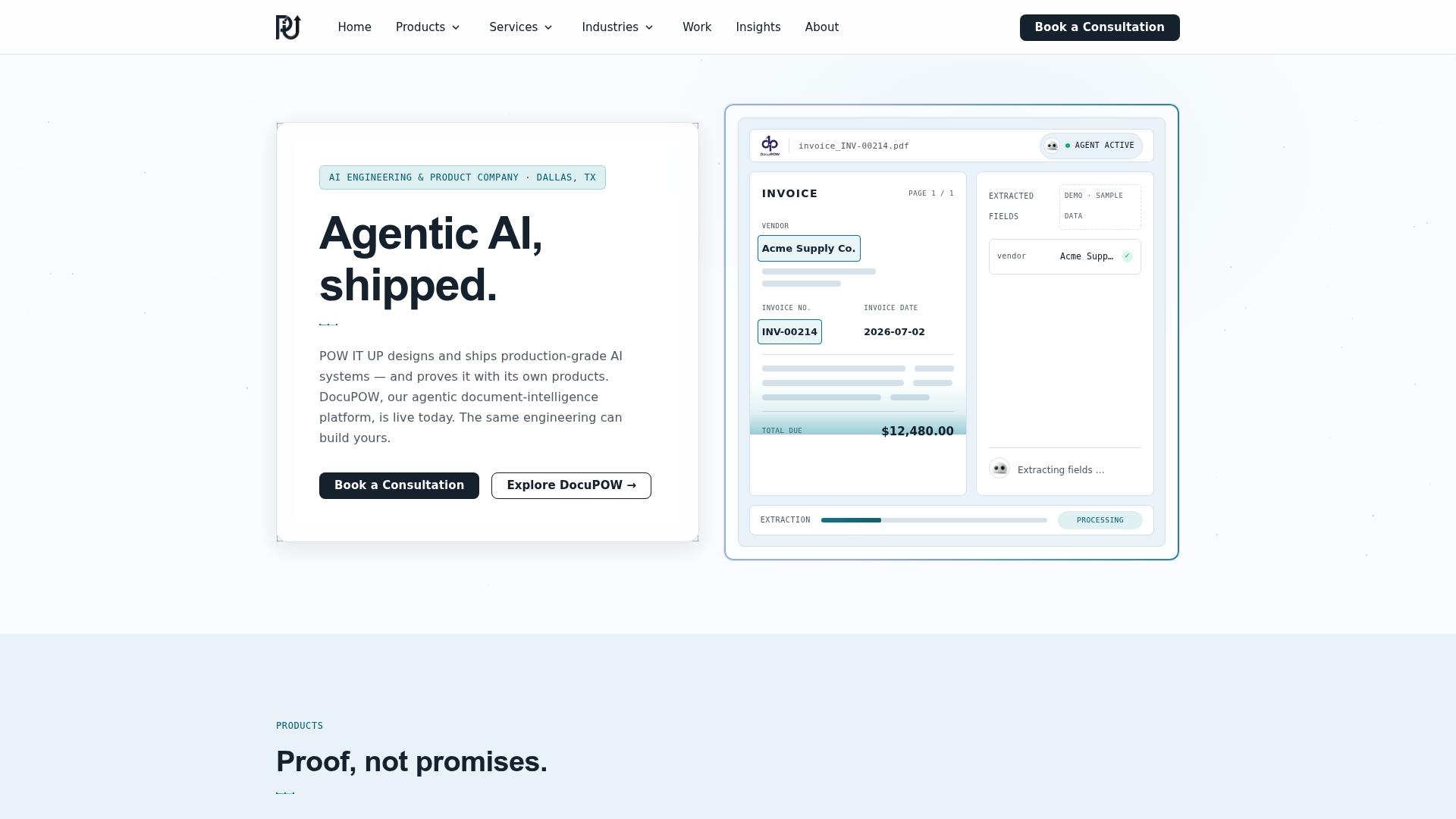
If you are ready to move one workflow from pilot to production, we design, build and deploy custom agents and integrate them with the systems you already run. Our AI agents development service covers bespoke digital workforces, and DocuPOW reads and validates documents, with live demos available.
For a broader view of how we scope and deliver this work, see our AI automation service.
FAQ
What does the future of AI-powered operations look like?
It looks like agents running substantial segments of workflows on their own, while people supervise, set boundaries, handle exceptions and improve the process. The change is from automating individual tasks to redesigning entire workflows. Governance and measurement become standing management duties.
Can AI really let a company scale without adding headcount?
It can for high-volume, rules-based work where agents complete most transactions without human touch. Headcount then grows only with the exception load, not total volume. This requires a standardized process, clean data and good integration, and you should measure the straight-through rate to confirm it.
Which parts of operations should we automate first?
Start with document-heavy, repetitive workflows with clear success criteria, such as invoice processing, claims intake, onboarding and routine service requests. Choose one where you already track cost or cycle time, so you can compare results against a baseline.
What are the main risks of AI in operations?
The biggest are unclear accountability, agents acting outside intended limits, poor data quality, and third-party or legal exposure. NIST’s framework treats governance as continuous, so assign owners, log agent actions and review risk on a regular schedule. In regulated sectors, involve your compliance or legal counsel before launch.
How do we know our organization is ready?
Check whether you have a documented process, reliable data, a business owner and a measurable target. Then compare your current and target risk profiles, as NIST’s profile approach suggests, to find gaps in governance, staffing and funding.
Sources
- Stop debating automation vs. augmentation, MIT Sloan
- The Effects of Generative AI on High-Skilled Work, MIT working paper
- 2026 AI Adoption Report, Knowledge at Wharton
- Artificial Intelligence Uses and Commercialization, North Dakota Legislative Council
- Operating Model Alignment Is the Key to Driving AI Value, Gartner
- How to boost your organization’s AI maturity level, MIT Sloan
- Artificial Intelligence Risk Management Framework 1.0, NIST
- AI RMF Profiles, NIST AI Resource Center
- AI risks in regulated industries
- Proving AI value within 90 days