
An end-to-end AI workforce is a set of AI agents that carries a business process from the first input to the finished result, with people stepping in only on exceptions. For most operations leaders at fintech firms, healthcare practices, agencies and service businesses, the best fit is a custom-built digital workforce designed around your own documents, systems and approval rules. That is what POW IT UP builds, and the comparison below shows why it holds up against the other four ways of buying this capability.
TL;DR
- An end-to-end AI workforce completes whole processes, such as reading a document, validating it, updating your systems and routing exceptions. A chatbot or a single-step automation does not.
- There are five routes: a vendor suite, a workflow automation platform, a governance platform, an engineering framework your team codes, or a custom-built digital workforce.
- A custom build suits you when your process crosses several systems and you want to own the result. POW IT UP designs and deploys these, and DocuPOW shows the approach in a live demo.
- Cost models differ widely: per action, per conversation, per user, or by quote. Compare them on your real monthly volume.
- Healthcare and fintech buyers should verify access controls, audit trails, data handling and signed agreements before any pilot.
Table of Contents
- What end-to-end actually means
- The five ways to buy an AI workforce
- What it costs in the United States
- Security and compliance checks for healthcare and fintech
- What results to expect, and what they depend on
- How to choose for your business
- Our perspective
- Talk to us about your workflow
- FAQ
- Sources
What end-to-end actually means
The phrase gets stretched. A useful definition is this: the agent owns an outcome, not a task. A task-level tool drafts an email or summarizes a call. An end-to-end workforce takes an incoming loan packet, an insurance claim or a patient intake form and moves it through reading, checking, decision support, system updates and hand-off.
Three traits separate it from what you may already run:
- It handles ambiguity. Rule-based automation follows a fixed path and stalls when an input does not match. DataRobot’s analysis of agent workforces describes this contrast: legacy automation is deterministic and high-upkeep, while an agentic workforce is built to work toward outcomes and cope with edge cases.
- It crosses systems. The work rarely lives in one application. Documents arrive by email, data sits in a CRM or core system, and approvals happen elsewhere. The agents must connect all of it.
- It runs against a measure. A digital worker needs a defined role, an owner and a target, the same way a new hire does.
Many products labeled agents are really chatbots that answer questions and trigger a few API calls. If a human must still carry the work between steps, you have bought an assistant, not a workforce. That is a fine purchase for some needs, but it will not let you scale volume without adding headcount.
The five ways to buy an AI workforce
Independent comparisons of this market, such as a June 2026 enterprise platform comparison, sort the options into groups that behave very differently. Here is how they compare on what matters to an owner or operations leader.
| Route | What it is | Best for | Typical pricing model | Ownership and lock-in |
|---|---|---|---|---|
| Custom-built digital workforce (POW IT UP) | Agents engineered around your documents, systems and rules | Multi-system processes with real volume | Project-based engagement, subscription for productized tools such as DocuPOW | Built for durable client ownership |
| Vendor agent suite | Agents inside one software ecosystem (CRM, IT service or office suite) | Companies already standardized on that ecosystem | Per action, per conversation or per user | High tie to that ecosystem |
| Workflow automation platform | Visual builders for deterministic paths with AI steps added | Predictable, repeatable processes | Subscription or usage tiers | Medium |
| Governance platform | Manages agents as entities with identity, access, budget and audit trail | Companies that already have many agents | Quote | Medium |
| Engineering framework | Open code libraries for multi-agent logic | Firms with in-house AI engineers | Free code, plus engineering time and hosting | Low, but you carry all upkeep |
Custom-built digital workforce
POW IT UP designs, builds and deploys custom digital workforces made of autonomous, context-aware AI agents. The aim is to automate high-volume transactional work, find the operational time leaks where hours disappear, and let processing volume grow without a matching rise in headcount. The work is engineered to be maintainable, with transparent processes and client ownership of what is built.
This route fits when your process is specific to you. A lender with its own document set, a healthcare practice with its own intake rules, or an accounting firm with its own review steps rarely matches a generic template. Custom engineering starts from your process and your systems rather than asking you to reshape them.
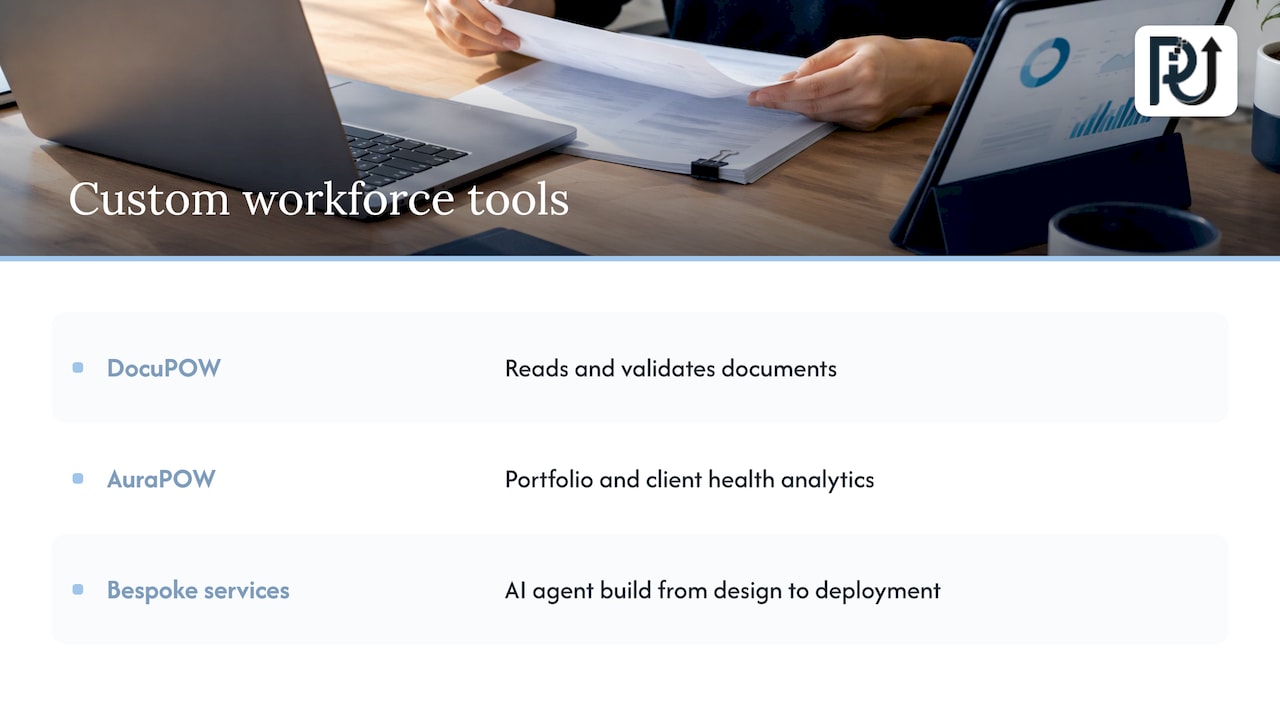
Two productized tools show the approach. DocuPOW reads and validates documents, and live demos are available. AuraPOW covers portfolio monitoring and client health analytics. For bespoke work, the AI agents development, AI integration and AI automation services cover the build from design to deployment.
Vendor agent suites
The large software ecosystems now ship agents of their own. Some are customer-facing and tied to a CRM. Others are employee-facing for IT and HR requests. Others sit inside an office productivity suite. They are quick to switch on if you already live in that ecosystem, because the data and permissions are in place.
The trade-off is scope. These agents work best on processes inside the vendor’s own platform, and the comparison above rates the tie to the ecosystem as high for several of them. If your process begins with a PDF from a client and ends in three different systems, a suite covers only part of the path. The model choices and deployment options also follow the vendor’s roadmap, not yours.
Workflow automation platforms
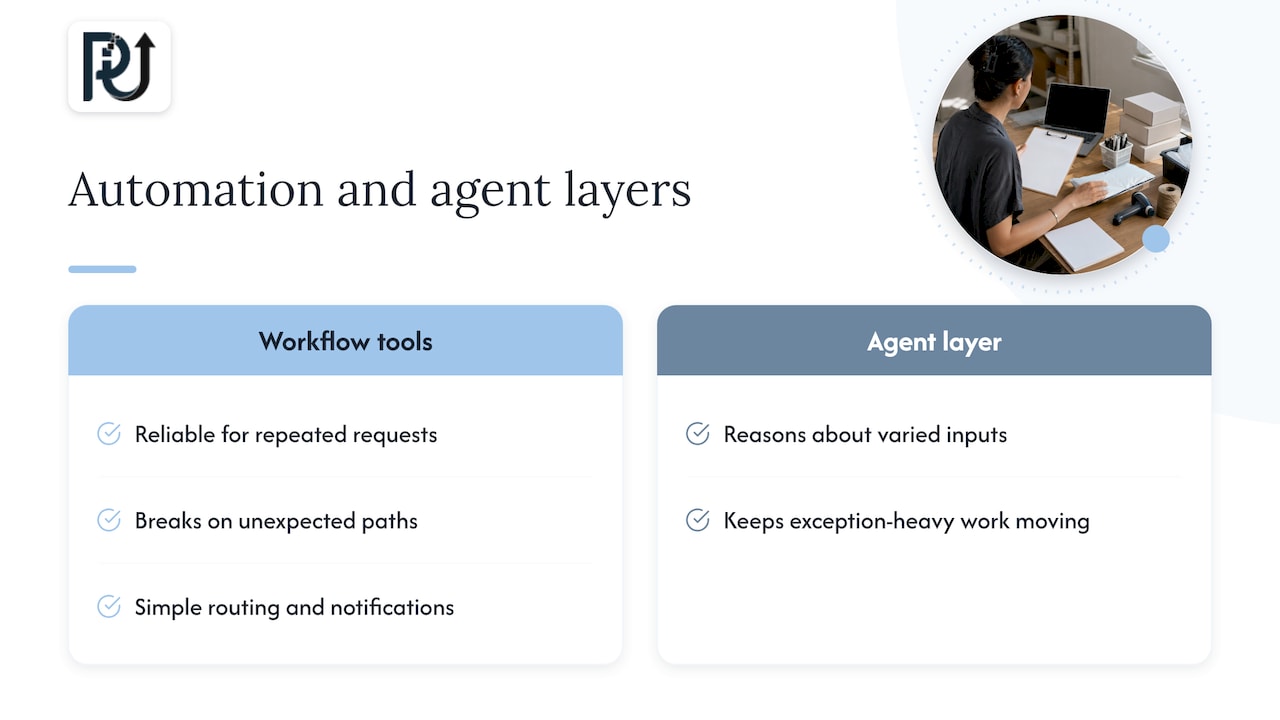
These tools excel at deterministic work: if X happens, do Y, then Z. They are reliable when requests look the same each time. Their limit is the same determinism, which breaks when a request does not match the assumed path, as one 2026 platform overview points out. They are a solid base for simple routing and notifications. Where documents vary in format and exceptions are common, an agent layer that reasons about the input is what keeps the process moving.
Governance platforms
Governance platforms treat each agent as a durable entity with an identity, access rights, a budget and an audit trail. That discipline matters once you run many agents. But governance describes how you supervise agents. It does not build the agents or prove they produce value. Most small and mid-sized firms need working agents first and a governance layer second.
Engineering frameworks
Open frameworks let engineers write multi-agent logic from scratch. They give maximum flexibility and demand a team that can build, host, monitor and maintain the system. For a business whose core is not software, the real cost is the people and time needed to keep the system running after launch. A specialist firm carries that load so your staff stay on your actual business.
What it costs in the United States
Pricing is where these routes diverge most, and the units are not comparable at a glance. Published US models include these:
- Per action. One suite meters agent work in credits, with an action priced at $0.10 in a June 2026 comparison, and a separate $2 rate per customer conversation.
- Per user. The same comparison lists per-user add-ons at $125 to $150 per user per month, and a top edition from $550 per user per month.
- Credit packs. An office-suite agent builder is sold in packs of 25,000 credits at $200 per month, plus a pay-as-you-go meter.
- By quote. IT-service, data-science and enterprise AI platforms generally require a custom quote.
To compare fairly, take one process and count its monthly volume. A document workflow that touches 20,000 items a month, with several agent actions per item, can reach six-figure action counts quickly under per-action metering. Per-user pricing, meanwhile, rewards you for adding people, which is the opposite of the goal if you want to scale without headcount.
POW IT UP does not publish prices. Custom builds are scoped as engagements, and DocuPOW is a subscription product. The practical way to compare is to bring your volume and process to a scoping conversation and ask every provider to price the same workload.
Security and compliance checks for healthcare and fintech
If you handle patient data, financial records or client identity documents, verify these before you approve a pilot. The June 2026 comparison shows how much the answers differ by provider: certifications, data retention terms, whether customer data trains models, and whether government cloud environments are supported all vary.
- Access control. Each agent should have its own identity and the minimum permissions its job requires. Role-based access keeps one agent from reading what it does not need.
- Audit trail. Every action and decision should be logged so a reviewer can reconstruct what happened. Regulated processes depend on this.
- Data handling. Ask where data is stored, how long it is retained, and whether it is used to train models.
- Agreements and certifications. Healthcare data requires a signed business associate agreement under HIPAA. Fintech buyers typically ask for SOC 2 reports and the controls that map to their regulator’s expectations.
- Guardrails and human review. Define which decisions an agent can make alone and which route to a person, such as payments above a threshold or clinical judgment.
A practical AI data governance playbook can help your leadership team set these policies before vendors enter the room. With a custom build, these requirements go into the design from day one, rather than being fitted around a product that was designed for a different buyer. Your compliance officer or counsel should review any healthcare or lending deployment before launch.
What results to expect, and what they depend on
Be wary of inflated promises. The evidence that exists is encouraging but conditional.
- A St. Louis Fed analysis summarized by SmartBrief found that among recent generative AI users, average time savings reached 5.4% of work hours, with 20.5% saving four or more hours a week.
- A study by Oxford Economics for Zebra surveyed 1,000 senior leaders across retail, manufacturing, transportation and logistics. It found workflow automation linked to a 20% productivity increase.
The same SmartBrief piece adds the condition that matters most: gains appear only when organizations redesign workflows so freed hours go to higher-value work, and 60% of leaders in one survey said their organization lacks a clear AI plan. In practice, that means the best outcomes come from mapping the process first, automating the highest-volume steps, and assigning a human owner to the result. Individual tools used ad hoc spread the time savings thinly. A designed workforce concentrates them on a measurable process.
How to choose for your business
Work through these questions in order.
- Where does the work start and end? Draw the path from first input to final record. If it crosses three or more systems, a single-ecosystem suite will cover only a slice.
- How varied are the inputs? Uniform inputs suit simple automation. Varied documents, free-text requests and frequent exceptions call for agents that reason.
- What is your monthly volume? High volume makes per-action and per-user pricing hard to forecast. Price a defined workload.
- Who will maintain it? If you have no AI engineers, choose a route where someone else carries the upkeep.
- What must you own? If the process is a competitive asset, favor a build you own and can maintain.
- What does your regulator expect? Apply the checks above and write them into the scope.
By industry: lenders and fintech teams usually start with document intake and validation. Healthcare practices begin with intake and scheduling paperwork. Agencies and consulting firms often start with reporting and client onboarding. E-commerce brands tend to start with order and support operations. For a first project, pick one process with high volume and a clear success measure, then expand. Our guides on business automation through AI agents and enterprise automation services go deeper on scoping. For a broader view of how agencies approach this, see this overview of AI integration agency trends.
Our perspective
We build digital workforces for a living, and the pattern we see in how people frame this decision is a product question when it is really a process question. Buying a platform first and then hunting for processes to fit it is how pilots stall.
Our view is that the process comes first. We map where hours leak out of a workflow, then engineer agents that are context-aware enough to handle the messy reality of your documents and systems, not only the clean cases. Scripts that follow fixed rules are cheap to write and expensive to keep alive. Agents designed around your context are built to keep working when inputs change.
We also believe you should own what we build for you. Our process is transparent, our systems are designed to be maintainable, and we hold ourselves accountable for engineering quality. DocuPOW exists so you can watch document reading and validation work on a live demo before you decide anything.
The goal is simple: let your volume grow while your headcount does not have to. A custom digital workforce is the most direct way we know to get there.
Syed Naveed Abbas
Talk to us about your workflow
If your process spans several systems and you want a digital workforce you own, POW IT UP can scope it with you. We design, build and deploy custom AI agents, and for document-heavy work you can see DocuPOW in a live demo.
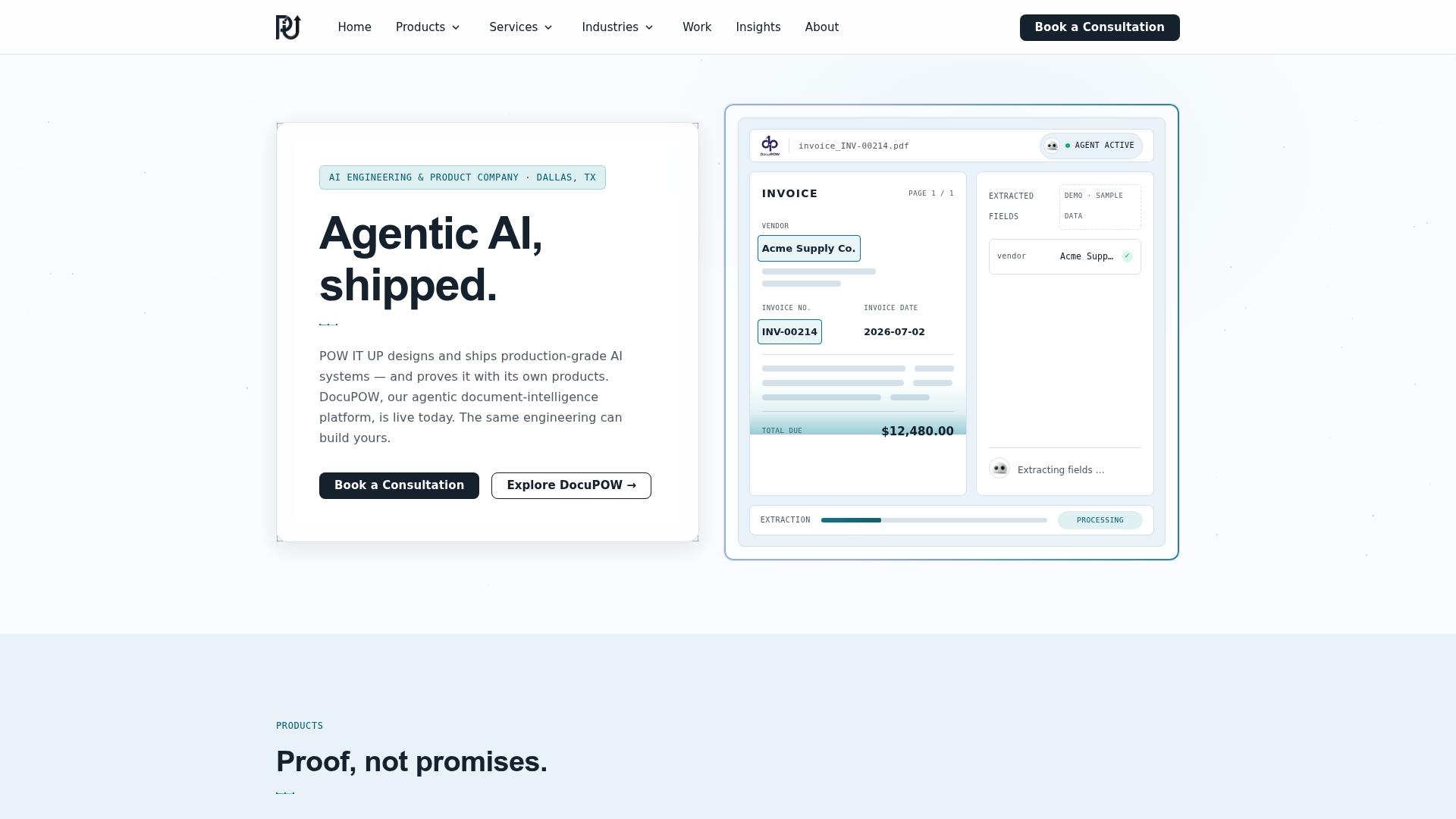
Start with AI agents development to see how we build, or visit POW IT UP to book a conversation about your highest-volume process.
FAQ
What is the difference between an AI workforce and a chatbot?
A chatbot answers questions and may trigger a few actions. An AI workforce owns a whole process: it reads inputs, makes decisions within set limits, updates your systems and escalates exceptions. If a person must still move the work between steps, it is closer to an assistant.
How long does it take to see results?
It depends on the process and its complexity, so no honest figure fits every business. The fastest starts come from one high-volume process with a clear measure. Scoping that process with a provider gives you a realistic timeline for your case.
Can a small business use an end-to-end AI workforce?
Yes, if it has a repeatable, high-volume process such as document intake, onboarding or order handling. The deciding factor is volume and repetition, not company size. Our guide to AI agents for small businesses explains where to begin.
Is an AI workforce safe for healthcare and financial data?
It can be, when it is designed with role-based access, audit logging, controlled data handling and human review for sensitive decisions. Healthcare data also requires a signed business associate agreement under HIPAA. Have your compliance officer or counsel review the design before launch.
Sources
- The agent workforce: Redefining how work gets done
- Enterprise agent platforms comparison, June 2026
- What Is an AI Workforce Platform?
- AI’s productivity is finally hitting the real economy
- Zebra study with Oxford Economics on workflow automation