

TL;DR:
- Effective cost reduction involves analyzing expenses to distinguish growth-enabling costs from waste.
- Implementing strategic cuts ensures long-term savings without harming revenue or operational capabilities.
Cost reduction is the strategic process of permanently lowering business expenses without sacrificing quality or growth potential. Unlike one-time budget cuts, true cost reduction embeds lower spending into how a company operates every day. Business leaders who treat it as a discipline, not a crisis response, consistently outperform peers on profit margin and resilience. This guide covers the prerequisites, proven cost saving strategies, common pitfalls, and measurement frameworks that separate sustainable savings from short-term fixes that backfire.
What does effective cost reduction actually require?
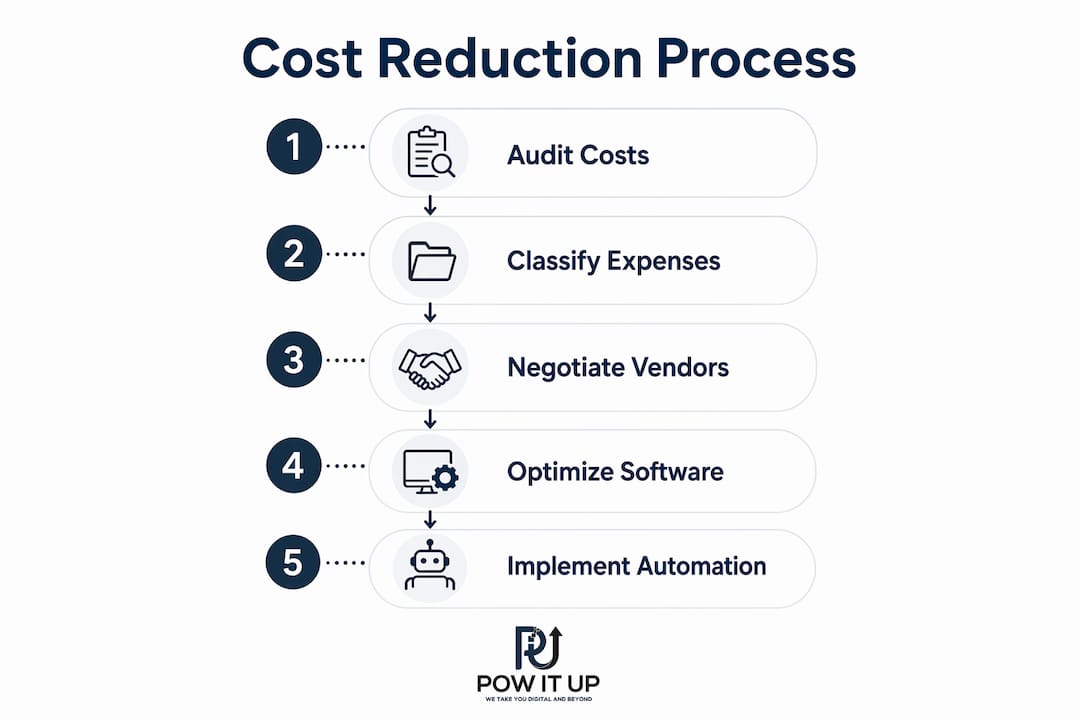
Effective cost reduction starts with a complete picture of where money goes. Before cutting anything, leaders need a full expense audit drawn from profit and loss statements, vendor contracts, and operational metrics. Without this baseline, reductions are guesses, and guesses tend to hit the wrong targets.
The most important step in that audit is classifying every cost as either growth-enabling or waste. Growth-enabling costs include R&D, customer-facing staff, and marketing that drives revenue. Waste costs include redundant software licenses, unused office space, and duplicated vendor contracts. Classifying costs strategically before cutting protects the capabilities that generate future revenue.
Pro Tip: Run your expense audit quarterly, not annually. Costs drift upward between reviews, and a 90-day cycle catches waste before it compounds.
The table below maps the key cost categories leaders should audit, along with the tools that make each review practical.
| Cost category | What to examine | Useful tool |
|---|---|---|
| Software licenses | Active vs. assigned users | SaaS management platform |
| Vendor contracts | Renewal dates, volume discounts | Contract database or CLM software |
| Facilities | Occupancy rates, lease terms | Space utilization tracker |
| Headcount | Roles vs. output, overtime patterns | HR analytics dashboard |
| Utilities and services | Consumption vs. benchmarks | Expense management software |
SMBs that complete a software audit typically find they pay for 40% more licenses than their teams actually use. That single finding alone often yields 15–25% immediate savings on software spend, before any other change is made.
How can businesses implement cost reduction strategies that deliver results?

The most effective expense management techniques fall into five categories: vendor negotiation, software optimization, automation, supplier consolidation, and workforce management. Each carries a different effort level and risk profile.
Vendor negotiation
Vendor contracts are the fastest place to find savings. Companies that negotiate actively save an average of 9.2% on total contract value. That figure compounds across a portfolio of suppliers. The negotiation does not require adversarial tactics. Presenting competitive quotes, committing to longer terms, or consolidating volume with fewer vendors gives procurement teams real leverage.
Software license optimization
Software is the most overlooked cost line in most operating budgets. Businesses can reduce software spend by up to 30% by auditing configurations, removing duplicate tools, and recycling licenses from departed employees. A SaaS management platform automates this process and flags unused seats in real time.
Automation
Automation delivers the highest ROI of any cost reduction method when applied to high-volume, repetitive processes. Accounting automation alone can yield up to 200% ROI within the first year. That return comes from eliminating manual entry errors, accelerating close cycles, and freeing finance staff for analysis rather than data entry. POWITUP builds custom AI agents that handle exactly these workflows, scaling transaction volume without adding headcount. Leaders can review automation ROI examples to see how these gains translate across service industries.
Supplier consolidation and Just-in-Time inventory
Reducing the number of active suppliers lowers administrative overhead and increases volume leverage with the suppliers that remain. Just-in-Time inventory management cuts carrying costs by aligning stock levels with actual demand rather than forecasts. Both methods reduce operational costs without touching headcount or customer experience.
Workforce strategies with minimal morale impact
The following approaches lower labor costs without triggering the morale damage that comes from layoffs:
- Implement a hiring freeze on non-critical roles while cross-training existing staff.
- Shift eligible roles to remote work. Remote employees show 24% higher productivity, and a smaller office footprint cuts facility costs directly.
- Offer voluntary reduced hours before considering involuntary reductions.
- Redesign workflows to eliminate low-value tasks before assigning them to new hires.
Pro Tip: Pair any workforce cost initiative with a clear communication plan. Employees who understand the “why” behind changes maintain engagement and flag additional waste you have not yet found.
The table below compares the five core methods by impact, effort, and risk level.
| Method | Cost impact | Effort to implement | Risk level |
|---|---|---|---|
| Vendor negotiation | Medium | Low | Low |
| Software optimization | Medium to high | Low | Low |
| Automation | High | Medium | Low to medium |
| Supplier consolidation | Medium | Medium | Low |
| Workforce restructuring | High | High | High |
SMBs that focus on non-headcount operating costs first can reduce expenses by 10–20% within 90 days, improving profit margins by 2–5 percentage points without touching a single employment contract.
What mistakes do businesses make when cutting costs?
The most common failure in cost reduction is speed without classification. Leaders under pressure cut broadly and quickly, hitting growth-enabling costs alongside waste. Blunt, indiscriminate cuts damage morale and strip out the capabilities a business needs to recover and grow.
The following mistakes appear repeatedly across failed cost reduction efforts:
- Cutting R&D or product development to hit a short-term target, then losing competitive position within 18 months.
- Reducing customer service headcount without automating support workflows, causing churn that costs more than the savings.
- Eliminating training budgets, which raises error rates and slows onboarding for future hires.
- Treating all vendor relationships as interchangeable and damaging key supplier partnerships that took years to build.
- Failing to communicate the rationale for cuts, which drives voluntary departures among high performers who have options.
“The difference between cost reduction that builds a company and cost reduction that breaks one is classification. Cut waste aggressively. Protect what grows revenue. Never confuse the two.”
Protecting customer-facing functions is non-negotiable. Customer acquisition costs far exceed retention costs in most industries. A reduction that saves $200,000 in support staff but drives a 5% increase in churn will destroy more value than it creates. Leaders should model the downstream revenue impact of every proposed cut before approving it. For a practical framework on setting realistic savings targets without damaging operations, the approach used in high-accountability finance environments applies directly.
How do you measure and sustain cost reduction success?
Measurement turns a one-time initiative into a permanent capability. The key performance indicators that track cost efficiency gains over time include:
- Operating cost as a percentage of revenue: the primary signal of whether the business is getting more output per dollar spent.
- Gross margin: reflects direct cost discipline in production or service delivery.
- EBITDA margin: captures the full operating efficiency picture before financing and tax effects.
- Revenue per employee: measures workforce productivity and flags when headcount is outpacing output.
- Customer churn rate: the early warning signal that cost cuts have damaged service quality.
Governance frameworks like Gartner’s TIME model (Tolerate, Invest, Migrate, Eliminate) give IT and operations leaders a structured way to categorize spending and make consistent decisions over time. Embedding cost reviews into the annual budgeting cycle, rather than treating them as a separate project, is what separates companies that sustain savings from those that see costs drift back up within two years.
Accounting automation shifts finance teams from manual reporting to real-time analysis, which means cost variances surface faster and leaders can respond before small overruns become structural problems.
Pro Tip: Track employee engagement scores and Net Promoter Score monthly during any cost reduction program. A drop in either metric before financial results deteriorate is your earliest signal that a cut has gone too far.
The uncomfortable truth about cost reduction programs
I have worked with business leaders across manufacturing, professional services, and technology, and the pattern is consistent. The companies that fail at cost reduction do not fail because they lacked the right spreadsheet. They fail because leadership treats it as a finance project rather than an operational discipline.
The most durable savings I have seen come from organizations where frontline employees actively identify waste. That only happens when leadership communicates openly about financial targets and creates a culture where flagging inefficiency is rewarded, not ignored. When employees understand that finding waste protects jobs and funds growth, they become the most effective cost reduction tool a company has.
The other lesson is that quick wins matter more than most leaders admit. Capturing 10–20% in non-headcount savings within the first 90 days builds the organizational confidence to tackle harder, longer-term changes like process redesign and automation deployment. Start with software audits and vendor renegotiations. Bank those wins. Then use the credibility to drive deeper change.
Cost reduction and growth are not opposites. The best-run companies treat every dollar saved as a dollar available for investment. That reframe changes how teams approach the work and produces better decisions at every level.
— Sameer Abbas
How POWITUP accelerates your cost reduction goals
Business leaders who have completed their expense audit and identified automation as a priority need a partner who builds, not just advises.
POWITUP designs and deploys custom AI agents that automate high-volume transactional workflows in finance, procurement, and operations. These agents eliminate manual entry, reduce processing errors, and free your team for work that drives revenue. Accounting automation delivers up to 200% ROI in year one. POWITUP’s AI automation services are built for leaders who want measurable results, not pilot programs that stall. If you are ready to reduce operational costs at scale, POWITUP builds the digital workforce to make it permanent.
FAQ
What is the difference between cost reduction and cost cutting?
Cost reduction is a permanent, strategic lowering of expenses that preserves quality and growth capacity. Cost cutting is typically a short-term, reactive measure that may damage operations if applied without classification.
How quickly can a business see results from cost reduction?
SMBs focused on non-headcount costs can reduce operating expenses by 10–20% within 90 days. Software audits and vendor renegotiations typically produce the fastest returns.
What is the biggest risk in a cost reduction program?
The biggest risk is cutting growth-enabling costs alongside waste. Indiscriminate reductions in R&D, customer service, or training destroy future revenue and are difficult to reverse.
How do I know if my cost reduction efforts are working?
Track operating cost as a percentage of revenue, gross margin, EBITDA margin, and customer churn monthly. A drop in churn or margin signals that cuts have gone too far.
Can automation genuinely reduce operational costs?
Automating repetitive processes like accounting and procurement can yield up to 200% ROI in the first year by eliminating errors, accelerating cycle times, and redirecting staff to higher-value work.
Key takeaways
Effective cost reduction requires classifying every expense as growth-enabling or waste before making any cuts, because protecting revenue-driving capabilities is what separates sustainable savings from damaging ones.
| Point | Details |
|---|---|
| Audit before cutting | Map all expenses from P&L statements and operational data before reducing anything. |
| Classify costs first | Label each cost as growth-enabling or waste to protect capabilities that drive revenue. |
| Software and vendors first | Audits yield 15–25% software savings; vendor negotiation saves an average of 9.2% on contracts. |
| Automation delivers the highest ROI | Accounting automation can return up to 200% ROI in year one with low operational risk. |
| Measure churn and margin together | Rising churn alongside falling costs signals that cuts have damaged customer-facing functions. |