

TL;DR:
- Process optimization involves systematically redesigning workflows to reduce waste, costs, and errors. It incorporates methods like Lean, Six Sigma, and AI tools to deliver measurable improvements in efficiency, quality, and customer experience.
Process optimization is defined as the systematic analysis and redesign of business workflows to reduce waste, lower costs, and improve output quality without sacrificing customer experience. The discipline draws on proven frameworks like Lean Six Sigma and the DMAIC methodology (Define, Measure, Analyze, Improve, Control) to deliver measurable gains across financial performance, product quality, and service delivery. Effective process optimization removes errors, delays, and redundant steps that quietly drain revenue. For business leaders, it is not a one-time project. It is the operating discipline that separates companies that scale from those that stall.
What are the primary methods and tools used in process optimization?
The four most established frameworks are Lean, Six Sigma, Kaizen, and PDCA (Plan, Do, Check, Act). Each targets a different type of operational problem, and choosing the wrong one wastes time and credibility.

Lean Six Sigma is the most proven combined method. Lean removes waste and speeds up flow. Six Sigma reduces variation and defects using the DMAIC framework. Together, they address both speed and quality in the same program. Kaizen focuses on small, daily improvements driven by frontline workers rather than top-down redesigns. PDCA provides a simple four-step cycle for testing changes before committing to them at scale.
On the technology side, the tools that matter most are process mining, process mapping, Business Process Management (BPM) suites, Robotic Process Automation (RPA), and AI. Process mining uses event log data from systems like SAP or Oracle to reveal how processes actually run versus how they were designed. Process mapping creates visual diagrams that expose handoff failures and redundant approvals. BPM suites orchestrate workflows across departments. RPA handles high-volume, rule-based tasks like data entry and invoice matching without human intervention.
Pro Tip: Apply Lean when your core problem is speed or waste. Apply Six Sigma when your core problem is defects or inconsistency. Use Kaizen when you need cultural buy-in for continuous change. Mixing all three without a clear diagnosis produces activity, not results.
The table below summarizes when to apply each method:
| Method | Core Problem It Solves | Best Use Case |
|---|---|---|
| Lean | Waste and slow cycle times | Manufacturing, logistics, service delivery |
| Six Sigma / DMAIC | Defects and process variation | Healthcare, finance, quality-critical operations |
| Kaizen | Lack of continuous improvement culture | Any industry needing incremental daily gains |
| PDCA | Testing changes before scaling | Pilot projects and iterative redesigns |
| RPA | High-volume, rule-based task execution | Back-office operations, data processing |
| AI agents | Unstructured data and multi-step workflows | Customer service, procurement, compliance |
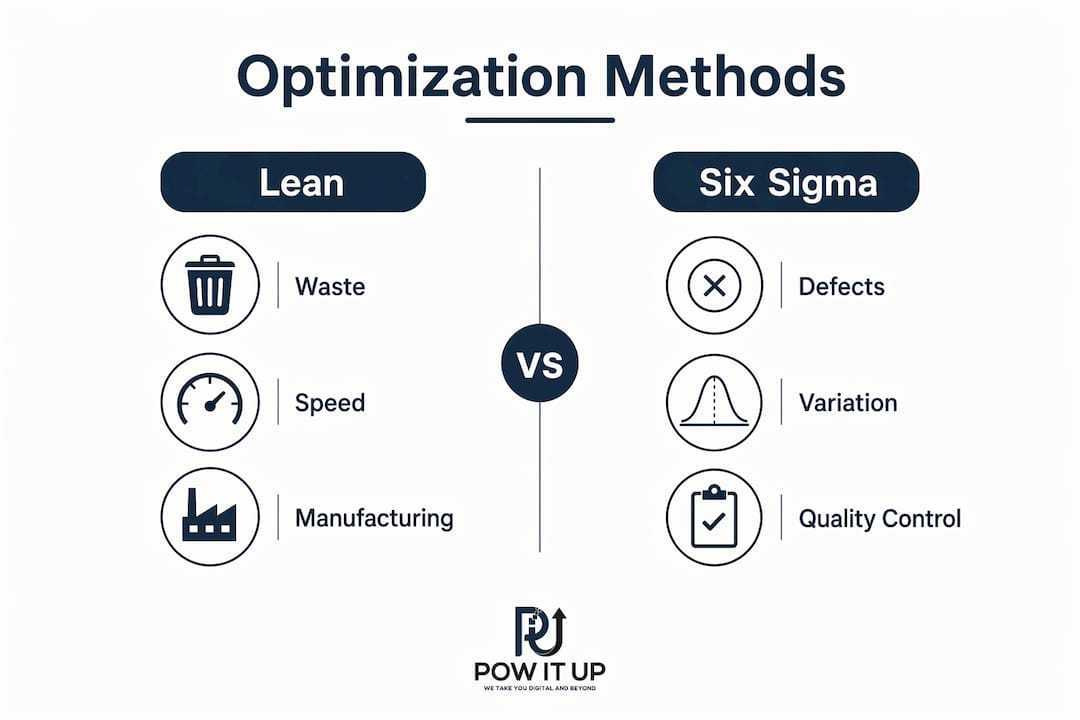
No single method fits all contexts. Leaders must match the tool to the problem type before committing resources.
How does process optimization drive measurable business value?
The financial case for process improvement is direct. Eliminating waste cuts operating costs. Reducing rework avoids the double labor cost of fixing errors after the fact. Faster cycle times free up capacity without adding headcount.
AI-optimized processes can reduce operating expenses by 15–35%, cut cycle times by 30–50%, and achieve near-zero human error rates. Those are not theoretical projections. They reflect documented outcomes across industries where AI has been integrated into core workflows. The quality gains compound over time because fewer errors mean fewer customer complaints, fewer compliance violations, and lower rework costs.
A real-world example from energy production illustrates the scale of gains possible. A hydropower operation applying a specific energy-based optimization strategy improved daily output from 2.73 to 18.4 MWh, totaling 177.39 MWh in monthly gains. The process did not change the physical infrastructure. It changed the operational logic governing how the infrastructure was used.
“Process optimization does not require bigger machines or more people. It requires better decisions about how existing resources are deployed. The gains come from logic, not capital.”
The table below shows representative improvements across key performance indicators when optimization programs are applied consistently:
| KPI | Baseline (pre-optimization) | Post-optimization result |
|---|---|---|
| Operating cost | High, with significant waste | Reduced by 15–35% with AI integration |
| Cycle time | Slow, with manual handoffs | Cut by 30–50% |
| Error / defect rate | Measurable and recurring | Near-zero with automated quality checks |
| Customer response time | Variable and unpredictable | Consistent and faster |
| Employee time on manual tasks | High percentage of total hours | Significantly reduced through automation |
Customer experience gains follow directly from operational improvements. Faster, more reliable service delivery raises satisfaction scores. Fewer errors reduce complaint volume. Consistent process performance builds the kind of reliability that retains customers without additional marketing spend.
What are the best practices to implement process optimization programs?
Successful programs follow a disciplined sequence. Leaders who skip steps in the name of speed typically spend more time recovering from failed rollouts than they saved.
-
Define the business-critical pain point. Start with a specific, measurable problem. “We want to be more efficient” is not a target. “We want to reduce invoice processing time from 14 days to 3 days” is. Clear objectives make it possible to measure success and justify continued investment.
-
Map the current state before redesigning anything. Process mapping reveals where time, money, and quality actually leak. Many leaders discover that the biggest bottlenecks are not where they assumed. Skipping this step means redesigning the wrong thing.
-
Run a small-scale pilot project. Pilot projects deliver faster, visible ROI and build organizational credibility for larger deployments. A well-run pilot typically demonstrates 4x to 5x ROI within months. That result funds the next phase and reduces executive skepticism.
-
Build governance into the program from day one. The Control phase of DMAIC exists for a reason. Most programs fail without governance structures and ongoing measurement. Assign ownership, set review cadences, and track KPIs continuously.
-
Address human factors directly. Employee resistance is the most common reason process redesigns stall. Change management, training, and clear communication about why the change is happening reduce friction before it becomes obstruction.
Pro Tip: Never automate a broken process. Fix the workflow logic first, then apply RPA or AI. Automation applied to a flawed process scales the flaw, not the fix.
How can AI and automation enhance process optimization?
Automation and optimization are related but distinct. Automation executes a defined process without human intervention. Optimization improves the process logic itself. The most powerful programs do both, in the right order.
AI agents move beyond rule-based automation by handling unstructured data and automating multi-step tasks across systems. A traditional RPA bot can process a structured invoice. An AI agent can read an unstructured email from a vendor, extract the relevant data, cross-reference it against a purchase order in an ERP system, flag discrepancies, and route exceptions for human review. That is a qualitatively different capability.
The specific advantages AI brings to workflow optimization include:
- Predictive bottleneck detection: Machine learning models identify where delays are likely to occur before they happen, based on historical patterns.
- Prescriptive scenario simulation: AI can model the downstream impact of a proposed process change before it is implemented, reducing the risk of unintended consequences.
- Unstructured data processing: AI reads emails, PDFs, contracts, and voice transcripts and converts them into structured workflow inputs.
- Cross-system integration: AI agents connect CRM, ERP, and supply chain platforms to create a unified data layer for analysis and decision-making.
- Continuous learning: Unlike static RPA scripts, AI models improve as they process more data, making the optimization gains compound over time.
The transition from simple automation to AI agents enables deeper integration of unstructured data and dynamic multi-step workflows. This is the frontier where the largest efficiency gains now live. Engineering applications confirm the pattern. Applying advanced multi-objective algorithms to a gear transmission system raised high-efficiency operational coverage from 68.5% to 78.6% and overall system efficiency from 92.8% to 95.6%. The principle applies across industries: better optimization logic produces better system performance.
Pro Tip: Before deploying AI agents, audit your data quality. AI amplifies what it finds in your systems. Clean, structured data produces accurate predictions. Dirty data produces confident wrong answers.
Key Takeaways
Process optimization delivers the largest and most durable gains when leaders combine proven methodologies, disciplined governance, and AI-enabled tools in the right sequence.
| Point | Details |
|---|---|
| Match method to problem | Use Lean for waste, Six Sigma for defects, Kaizen for culture, and AI agents for complex multi-step workflows. |
| Pilot before scaling | Small pilots deliver 4x to 5x ROI in months and build credibility for larger programs. |
| Fix before automating | Redesign broken workflows before applying RPA or AI to avoid scaling inefficiencies. |
| Govern continuously | Assign ownership, track KPIs, and review performance on a set cadence to sustain gains. |
| AI compounds returns | AI-optimized processes reduce operating costs by 15–35% and cut cycle times by 30–50%. |
Why most optimization programs stall before they pay off
Most leaders I work with understand the theory of process improvement. They have read about Lean, attended a Six Sigma briefing, and approved a pilot project. The programs still stall. The reason is almost always the same: the organization treats optimization as a project with a finish line rather than a discipline with a governance structure.
The uncomfortable truth is that the Control phase of DMAIC is where most programs die. The Analyze and Improve phases get attention because they produce visible deliverables. Control is unglamorous. It means assigning ongoing ownership, reviewing dashboards that show regression, and holding people accountable for metrics that were exciting six months ago and are now routine. Organizations that skip this phase watch their gains erode within a year.
The second pattern I see consistently is leaders who want to automate their way to efficiency without first fixing the underlying process. Deploying RPA or AI agents on a flawed workflow does not fix the flaw. It executes the flaw faster and at greater scale. The discipline of mapping and redesigning the process before touching the technology is not optional. It is the work that makes the technology investment pay off.
The third factor that separates successful programs from failed ones is how leaders handle the human side. Employees who do not understand why a process is changing will find ways to work around the new system. Training and communication are not soft add-ons. They are the mechanism by which the redesigned process actually gets used.
The leaders who get this right treat process optimization as an operating discipline, not a transformation initiative. They build it into how the organization runs, not how it occasionally improves.
— Sameer Abbas
POWITUP’s AI integration services for process efficiency
Business leaders who have mapped their processes and identified the gaps often reach the same conclusion: the next constraint is execution speed, not strategy. Deploying AI agents that handle high-volume transactional work, detect bottlenecks before they surface, and integrate across CRM and ERP systems is where the largest remaining gains live.
POWITUP designs and deploys custom AI agent systems built around your specific workflow logic, not generic templates. The firm’s AI integration services cover everything from initial process audit to full deployment and performance monitoring. For leaders ready to move from optimization planning to execution, POWITUP’s intelligent automation consulting provides the technical architecture and implementation support to make it happen at scale.
FAQ
What is process optimization in business?
Process optimization is the systematic analysis and improvement of business workflows to reduce waste, lower costs, and increase output quality. It applies frameworks like Lean, Six Sigma, and DMAIC to deliver measurable gains in financial performance and customer experience.
What is the difference between process optimization and automation?
Automation executes a defined process without human intervention. Optimization improves the process logic itself. The most effective programs redesign the workflow first, then apply automation to the improved version.
How long does a process optimization program take?
A focused pilot project typically delivers measurable results within 90–180 days. Full-scale programs with governance structures run continuously, as sustained gains require ongoing measurement and adjustment rather than a fixed endpoint.
When should a business use AI agents for process improvement?
AI agents are the right tool when the process involves unstructured data, multi-step decisions across systems, or high-volume tasks that exceed what rule-based RPA can handle. They are most effective after the underlying workflow has been mapped and redesigned.
What causes process optimization programs to fail?
The most common causes are skipping the Control phase of DMAIC, automating broken processes before fixing them, and failing to address employee resistance through change management and training.