

Nine forces will define competitive advantage through 2026: agentic and generative AI, hybrid AI infrastructure, zero trust cybersecurity, data clean rooms and provenance, intelligent operations, IoT and edge robotics, quantum computing, green tech, and workforce redesign. Some demand action inside the next 12 months; others are longer bets worth watching now.
Act within 12 months:
-
Agentic and generative AI in core workflows
-
AI infrastructure and hybrid compute decisions
-
Cybersecurity and zero trust controls
-
Data governance and clean rooms
Strategic, longer horizon:
-
Intelligent operations and digital twins
-
IoT, robotics, and edge compute
-
Quantum computing partnerships
-
Green tech procurement
-
Workforce and operating-model redesign
Gartner’s 2026 trend report groups its priorities around AI-native platforms, multiagent systems, and preemptive security. The single move that matters most right now: pick one mission-critical, high-volume workflow, make its data AI-ready, and run a small production pilot before you commit budget to anything bigger.
Key Takeaways
Business technology trends in 2026 reward leaders who scope one high-value workflow, secure its data, and measure results before scaling further investment.
| Point | Details |
|---|---|
| Prioritize by urgency | Act on agentic AI, hybrid infrastructure, cybersecurity, and data governance within 12 months. |
| Start narrow | Pick one high-volume workflow for your first AI pilot instead of a broad rollout. |
| Secure before scaling | Apply zero trust controls and model inventories before expanding any AI system’s scope. |
| Measure before committing | Set KPIs and a go/no-go threshold before a pilot starts, not after results come in. |
| Partner for speed | POW IT UP designs and deploys custom AI agents for document intelligence and workflow automation, built for a scoped 90-day pilot approach. |
Table of Contents
-
Agentic and Generative AI: What Leaders Must Do to Capture Value
-
IoT, Robotics, and Edge Compute: Where Physical and Digital Converge
-
Quantum Computing and Digital Twins: Strategic R&D Investments
Agentic and Generative AI: What Leaders Must Do to Capture Value
Generative AI produces content, code, and analysis on demand. Agentic AI goes further: it plans multi-step tasks and executes them with limited supervision, chaining decisions rather than just answering a prompt. Deloitte’s Tech Trends 2026 frames this year as the shift from experimentation to measurable impact, and that shift shows up in three places.
-
Copilots embedded in existing software (support, sales, finance) that draft, summarize, and recommend.
-
Automated workflows where an agent reads a document, validates it, and routes it without a human touching every step.
-
Content and code generation that compresses production time for marketing, engineering, and reporting teams.
The gap between a flashy pilot and a working production system usually comes down to inference cost and governance, not model quality.
Pro Tip: Before scaling any AI pilot, price out inference cost at your real transaction volume. A demo that looks cheap at 100 requests a day can get expensive fast at 100,000.
Start small: pick one domain, lock down the data feeding the model, define who reviews outputs, and set two or three KPIs before you build anything.
AI Infrastructure and the Hybrid Compute Strategy
Cloud, on-premises, and edge each play a different role in an AI stack, and getting the mix wrong is the fastest way to blow a budget. Cloud handles elastic training and bursty workloads. On-premises and sovereign infrastructure suit regulated data or steady, predictable inference. Edge compute handles anything that needs a near-instant response or can’t leave the device. Capgemini’s Top Tech Trends 2026 report describes this shift as “Cloud 3.0,” where hybrid and sovereign options are replacing single-cloud defaults as AI workloads scale.
Watch for three warning signs before costs spiral:
-
Inference bills growing faster than usage volume, a sign your model or hosting choice is mismatched to the workload.
-
Latency complaints from users in regions far from your primary data center.
-
Data residency requirements colliding with where your models actually run.
Build your architecture checklist around data locality, clear model hosting decisions, and genuine multi-cloud portability so you’re not locked into one vendor’s pricing.
How Should You Prioritize AI-Specific Cybersecurity Risks?
AI systems widen the attack surface in ways traditional security tools weren’t built to catch. Beyond phishing and ransomware, you’re now defending against data poisoning (corrupting training data), model theft (extracting proprietary weights), and adversarial inputs designed to fool a model into a bad decision. Gartner’s 2026 trends list preemptive cybersecurity and confidential computing as core themes for exactly this reason.
Near-term defensive priorities:
-
Inventory every model in production, including ones business units deployed without IT’s knowledge.
-
Apply access controls to model endpoints the same way you would to a production database.
-
Isolate high-risk models from core systems until they’ve passed adversarial testing.
-
Run red-team exercises against your own agents before attackers do.
CISA’s guidance on cyber threats recommends zero trust architecture as the baseline for critical systems, and that recommendation applies directly to AI infrastructure, not just traditional networks.
Data Strategy: Clean Rooms, Provenance, and Governance
Data clean rooms let two or more parties analyze combined data without either side seeing the other’s raw records. Retailers and advertisers use them to measure campaign performance while staying compliant with privacy laws. The trade-off is real: industry analysis on emerging technologies notes that clean rooms preserve privacy but can reduce the precision of the resulting analysis compared to unrestricted data access.
Provenance matters just as much. If you can’t trace where a data point came from or how it was transformed, you can’t trust what an AI model built on it. A shared semantic layer, a consistent vocabulary across systems, keeps that lineage intact as data moves between teams.
Before your next AI project starts, confirm you have:
-
A data lineage map showing origin and transformations
-
Consent mapping tied to how data can legally be used
-
A current data catalog accessible to the teams building models
-
Measurement guardrails that flag when clean room accuracy trade-offs affect a decision
Intelligent Operations, Digital Twins, and Hyperautomation
Basic robotic process automation handles a single repetitive task. Intelligent operations connect dozens of those tasks into a closed loop where agents monitor outcomes, adjust, and escalate only when a human judgment call is genuinely needed. That’s the practical difference hyperautomation promises over simple scripting.
Digital twins, virtual models of a physical process or system, let you test changes to a supply chain or production line before touching the real thing. Common use cases include supply chain optimization, automated finance close processes, and service operations where an agent handles routine tickets end to end.
The pieces that make this work in practice:
-
Real-time monitoring dashboards that surface exceptions, not just averages
-
Feedback loops so the system improves from outcomes, not just rules
-
Defined human checkpoints for decisions above a set risk threshold
-
Metrics tied to cycle time and error rate, not just volume processed
Pro Tip: Instrument your pilot from day one. If you can’t measure cycle time and error rate before and after, you won’t be able to prove the pilot worked, and you’ll struggle to get budget for phase two.
IoT, Robotics, and Edge Compute: Where Physical and Digital Converge
Logistics, manufacturing, and field service businesses are the biggest beneficiaries of connected sensors and robotics right now. A warehouse using IoT sensors to track inventory in real time, or a field technician’s device running diagnostics locally, both depend on edge compute to work at the speed the business actually needs.

Edge computing matters because sending every data point to the cloud for processing introduces latency you can’t afford in safety-critical or time-sensitive operations. Keeping computation close to where data is generated also limits exposure for privacy-sensitive information.
Before scaling past a pilot, look for these signals:
-
Latency requirements the cloud alone can’t meet
-
A clear cost offset from reduced downtime or labor
-
Data volume that would be expensive or slow to centralize
-
A defined owner accountable for the pilot’s ROI numbers
Quantum Computing and Digital Twins: Strategic R&D Investments
Quantum computing isn’t ready for daily business operations, but it’s already showing promise in narrow areas: complex simulation, optimization problems, and materials modeling that classical computers struggle with. Treat it as a multi-year R&D bet, not a 2026 line item.
Digital twins deliver value today. Manufacturers use them to simulate a production change before committing capital. Logistics firms model network disruptions before they happen. Both applications de-risk decisions that used to rely on guesswork or costly trial runs.
If you’re exploring quantum, keep the experiment cheap and the partner selective:
-
Fund a small proof-of-concept tied to one optimization problem you already understand well
-
Partner with an academic lab or established quantum vendor rather than building in-house
-
Set a hard budget ceiling and a clear “no-go” criteria before you start
Green Tech and Sustainability-Driven Technology Investments
Sustainability tech now carries commercial upside beyond compliance. Renewable energy storage, precision agriculture sensors, and carbon accounting software all reduce cost while satisfying investor and regulatory pressure that isn’t going away.
When evaluating a green tech vendor, don’t accept vague sustainability language. Require measurable emissions data and proof the vendor can meet whatever reporting standard your regulator applies.
Put these items in every green tech RFP:
-
Verified emissions reduction data, not marketing estimates
-
Reporting compatible with your jurisdiction’s disclosure requirements
-
Total cost of ownership including maintenance and replacement cycles
-
References from customers of comparable size and industry
Building the Workforce for an AI-Native Enterprise
Becoming AI-native isn’t a technology purchase. It’s an operating-model change, and IBM’s 2026 business trends report points out that employees increasingly expect their employers to provide the AI tools and training to keep pace, not the other way around.
-
Prioritize new roles first: AI operations leads, prompt and workflow designers, and data governance owners matter more right now than pure model builders.
-
Run a short reskilling playbook: identify the 20% of your workforce whose roles change most, train them first, and let peer teaching cascade the knowledge outward, a version of the 20/200/2,000 model where a small trained group teaches the next tier, which teaches the rest.
-
Assign clear governance ownership: one executive should own AI risk and adoption decisions, not a committee.
-
Decide hire versus partner deliberately: building an internal team makes sense for core differentiators; partnering makes sense for speed on everything else.
-
Measure adoption, not just deployment. Track how often employees actually use the tools you’ve rolled out.
Turning These Trends Into a 90-Day Roadmap
Trend lists are easy to read and hard to act on. The practical fix is a simple prioritization framework: score candidate workflows on value (time saved, error reduced, revenue protected) against feasibility (data readiness, system access, stakeholder buy-in), and start with whichever scores highest on both.
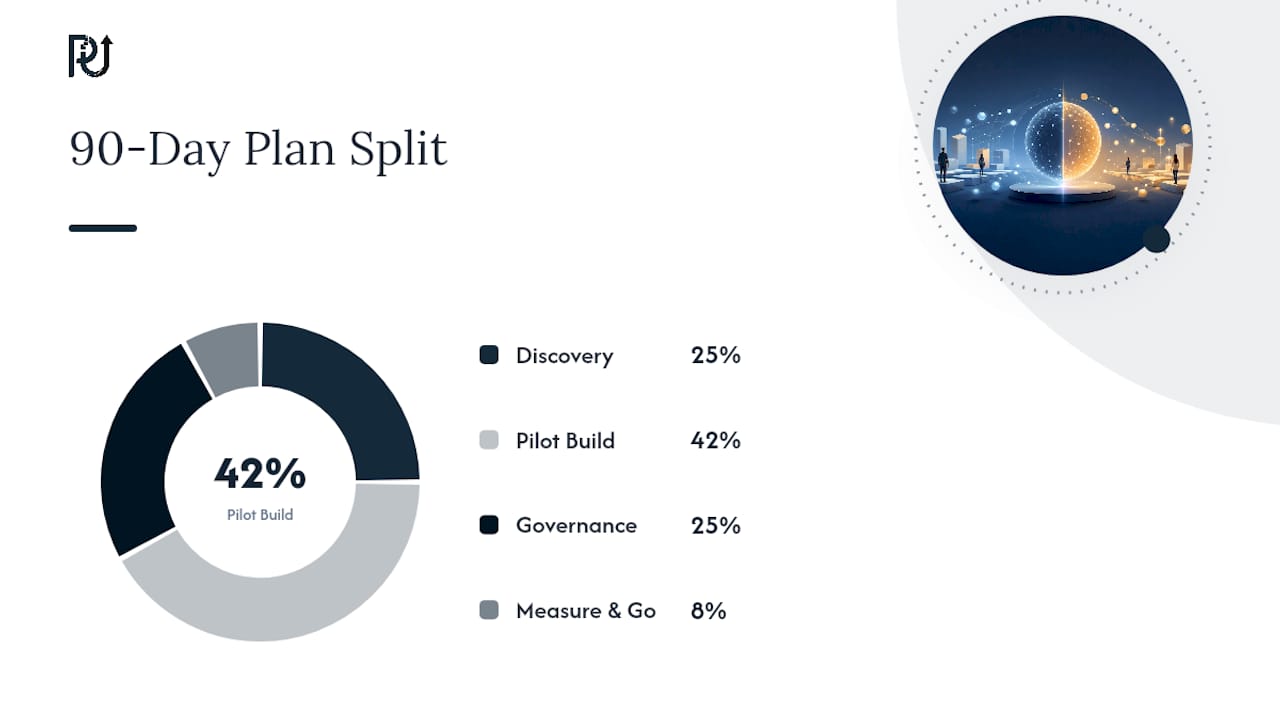
A realistic 90-day plan looks like this:
-
Weeks 1 to 3, discovery: map the target workflow end to end, identify data gaps, and define the KPIs that will prove success.
-
Weeks 4 to 8, pilot build: build a narrow-scope version of the automation or agent, with human review on every output.
-
Weeks 9 to 11, governance guardrails: define access controls, escalation paths, and audit logging before expanding scope.
-
Week 12, measurement and go/no-go: compare pilot KPIs against baseline and decide whether to scale, adjust, or stop.
Pro Tip: Set your go/no-go threshold before the pilot starts, not after you see the results. It’s the only way to keep a mediocre pilot from getting scaled just because everyone’s already invested time in it.
POW IT UP typically engages this way: discovery to understand the workflow and data reality, a scoped build focused on one transactional process, deployment with monitoring built in from day one, and a measurement checkpoint before any expansion conversation happens. The goal at each checkpoint is the same: prove the workflow works at production volume before adding a second one.
Why Leaders Can’t Treat These as Someday Projects
Enterprise automation and AI integration work has a pattern worth naming: the companies that win aren’t the ones with the most ambitious AI vision. They’re the ones who picked one workflow, instrumented it properly, and let the results argue for the next investment.
One early integration project I reviewed replaced a manual document review process with an AI validation step. The team didn’t rebuild the whole department. They automated one queue, measured error rate and turnaround time for 60 days, and used those numbers to justify expanding scope. That discipline, not the sophistication of the model, is what separated it from pilots that stalled.
Leaders who wait for a perfect strategy before acting on agentic AI will lose the year to competitors who just started.
Where POW IT UP Fits in Your 2026 Technology Plan
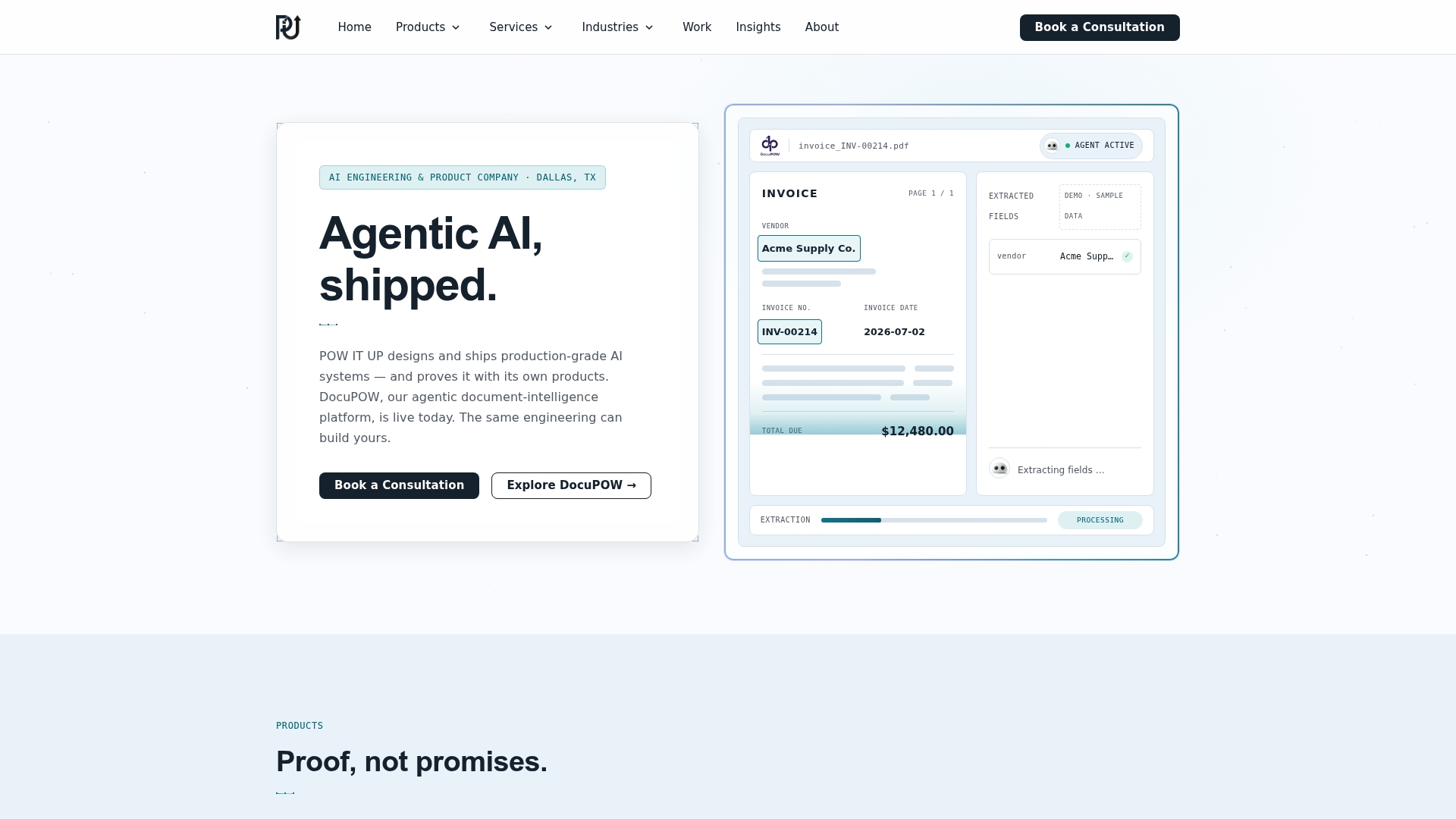
POW IT UP builds the digital workforce most of this article describes: custom AI agents that handle document validation, workflow orchestration, and transaction processing at volumes your current headcount can’t match without hiring. Where a traditional software vendor sells you a fixed tool, POW IT UP designs the system around your actual workflow, then deploys it with the monitoring and human oversight this article’s 90-day roadmap calls for.
If you’ve already identified the workflow worth automating, the next step is a discovery conversation, not another trend report. Explore POW IT UP’s AI integration services to see how a scoped engagement gets structured, or review the AI integration guide for business leaders for a closer look at what a first pilot typically involves. Book a discovery call and bring one workflow you’d want automated first.
Sources
FAQ
What are the top technology trends for 2026?
The trends drawing the most executive attention are agentic and generative AI, hybrid AI infrastructure, zero trust cybersecurity, data clean rooms and provenance, intelligent operations with digital twins, IoT and edge robotics, quantum computing, green tech, and workforce redesign for AI-native operations.
What are some current tech trends businesses should watch?
Beyond generative AI, businesses are watching hybrid cloud and edge compute strategies, AI-specific cybersecurity defenses, and data governance tools like clean rooms that let companies analyze shared data without exposing raw records.
What are the top trends in the business industry right now?
Scaling AI from pilot to production, modernizing data infrastructure to support that scale, and redesigning operating models around new skills top most 2026 industry conversations, according to Deloitte’s Tech Trends 2026.
How is AI changing business operations day to day?
AI is moving from answering questions to executing multi-step tasks through agentic systems, handling document review, workflow routing, and transaction processing with limited human supervision. Firms like POW IT UP build these custom agents for high-volume operational workflows.
How should a company start adopting these trends without overspending?
Pick one high-value, high-feasibility workflow, secure its underlying data, run a small production pilot with clear KPIs, and decide whether to scale only after measuring real results against a baseline.