
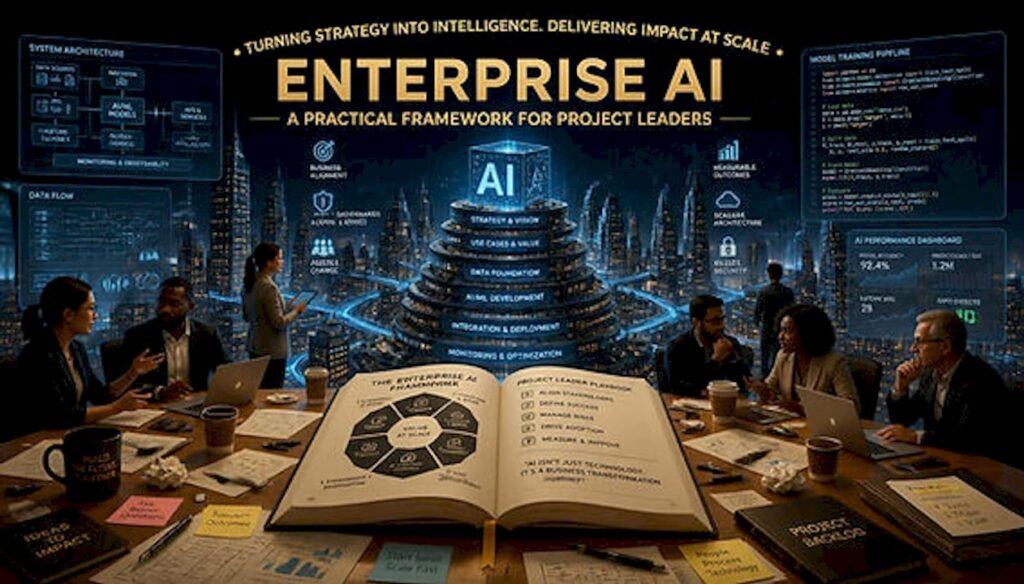
AI-powered decision making automates and scales repeatable operational choices, cutting decision cycle times from days to seconds while holding accuracy steady under volume that would bury a manual team. The strongest deployments pair predictive models with retrieval-augmented generation (RAG), knowledge graphs, and a human-in-the-loop review layer, and firms like POWITUP build these as governed systems rather than black boxes. The right stance for any leader evaluating this shift is narrow and disciplined: pick one measurable pilot, demand traceability from day one, and expand only after the model proves itself against real business KPIs.
Where this shows up first:
-
Fraud and credit risk scoring that flags exceptions instead of reviewing every case
-
Order routing and approval workflows that used to wait on a human queue
-
Inventory allocation and supply-chain rebalancing
-
Next-best-action recommendations in customer service and sales
Key Takeaways
AI-powered decision making succeeds when predictive models, business rules, and human oversight combine inside a decision engine backed by decision-ready data.
| Point | Details |
|---|---|
| Start with one pilot | Choose a high-volume, low-risk decision like document validation or approval routing to prove ROI fast. |
| Fix data before models | Unified, decision-ready data pipelines matter more to outcomes than model sophistication. |
| Ground LLMs with retrieval | Pair large language models with RAG and knowledge graphs to reduce hallucinations and improve traceability. |
| Build governance in from day one | Explainability, audit trails, and human-in-the-loop thresholds prevent the trust gap that kills rollouts. |
| Work with a practitioner partner | POWITUP designs custom decision engines and digital workforces with monitoring and retraining built in. |
Table of Contents
How AI-Powered Decision Making Actually Works
An AI decision system is not one model making a call. It is a pipeline: raw data goes in, a recommendation or action comes out, and several layers do the translating in between.
-
Data ingestion and feature engineering. Transaction logs, CRM records, sensor feeds, and support tickets get cleaned, joined, and converted into “decision-ready” features, the numeric or categorical signals a model can actually score against. Skip this step and every layer above it inherits the mess.
-
Predictive models and optimization layers. A model predicts something (default risk, churn probability, delivery delay) and an optimization layer turns that prediction into a ranked choice, given constraints like budget or inventory.
-
Business rules and policy constraints. Pure machine learning output rarely ships as-is. A rules layer enforces regulatory limits, credit policy, or brand guardrails on top of the model’s score, which is what makes the system hybrid rather than purely statistical.
-
The decision engine. This is the orchestration layer that combines model output, rules, and context into a single action, then logs why it made that call. Teradata’s guide to decision engines describes this as the piece that turns scattered model outputs into consistent, auditable actions at production scale.
-
LLMs and RAG for unstructured input. When a decision depends on a contract clause, a claims narrative, or a support transcript, a large language model grounded with RAG retrieves the relevant passage before generating a summary or recommendation. Left unconstrained, an LLM will confidently invent details; grounded in retrieval and a knowledge graph, it cites the source it pulled from. Constrain LLM use to retrieval and summarization tasks, and keep the actual decision logic in the rules and scoring layers where you can audit it.
What Makes a Decision Engine Production-Ready
The architecture choices below separate a demo from something finance or ops will actually trust.
-
Real-time versus batch. Fraud scoring needs millisecond response; inventory rebalancing can run nightly. Mixing the two into one pipeline usually slows both down.
-
Feature stores. A centralized feature store materializes the same signals for both model training and live scoring, so the number a model was trained on matches the number it sees in production.
-
Explainability and audit trails. Every automated decision needs a record of which inputs, model version, and rule fired. This is what turns an audit conversation from a scramble into a five-minute lookup.
-
Drift detection and retraining loops. Model accuracy decays as customer behavior shifts. Automated monitoring for drift, tied to a retraining cadence, is what keeps a model from quietly getting worse for months, which the HBS AI Institute flags as one of the more common causes of failed deployments.
-
Integration points. APIs for synchronous calls, event streams for continuous data, and containerized deployment for portability across cloud environments.
Pro Tip: Build the audit trail before you build the model. Retrofitting explainability onto a system that’s already in production is far more expensive than designing it in from the first sprint.
Where AI Decisioning Is Already Paying Off
The clearest wins show up wherever a company processes the same type of decision thousands of times a month.
-
Fraud and risk scoring. Financial institutions use scoring models to route only the ambiguous cases to human reviewers, cutting manual review volume while catching more true positives than static rule sets alone.
-
Approval and routing workflows. Loan applications, insurance claims, and purchase orders that once sat in a queue for days now get auto-approved, auto-escalated, or auto-denied based on scored risk, shortening cycle time from days to hours.
-
Inventory and supply-chain allocation. Retailers use optimization layers to rebalance stock across warehouses in response to demand signals, reducing both stockouts and excess inventory carrying costs.
-
Next-best-action in customer experience. A support or sales system scores which offer, article, or agent response is likeliest to resolve a customer’s issue, personalizing the interaction without a human manually deciding each time.
-
Quick-win pilots. The fastest path to a working system, and the one that needs the least integration, is usually document intake validation: a model plus a rules layer flags mismatched invoices, missing fields, or out-of-policy claims before a human ever touches the file.
Each of these examples shares a trait worth noting: none of them require a company to hand over judgment calls. They automate the repetitive, well-defined portion of a decision and leave exceptions to people.
How Much Faster and More Accurate Does AI Decisioning Get?
Organizations that build a culture around data tend to report measurably better decision-making, according to HBS Online’s research on data-driven decision-making, though the payoff depends entirely on whether the underlying data is clean and unified before automation begins.
The gains cluster around three things: speed (decisions that took days now take minutes), consistency (the same inputs produce the same output every time, unlike a tired analyst on a Friday afternoon), and lower cost per decision at volume. But AI has real edges.
-
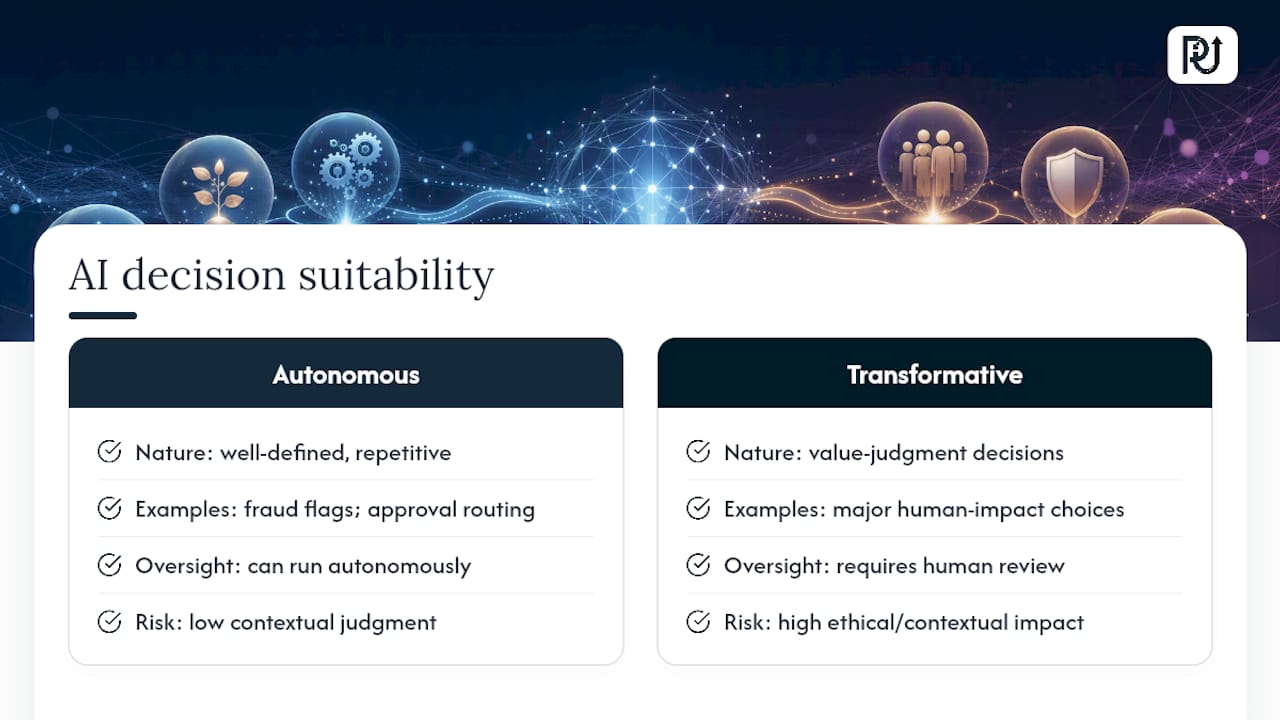
It excels at easy choices, the straightforward optimization problems with a clear objective function.
-
It can assist with hard choices by surfacing options or tradeoffs a human hadn’t weighed, without making the final call.
-
It cannot substitute for transformative choices, the ones where the outcome reshapes the values or identity of the people involved. HBS’s research on algorithms and human expertise draws this line clearly: AI supports judgment, it does not replace it for decisions that redefine what an organization values.
The most common misconception is treating every decision as automatable. It is not. Sort decisions by that taxonomy first, and automate only the easy tier initially.
Building a Pilot That Actually Proves ROI
Most AI decisioning projects fail not because the model is bad, but because the rollout skipped a step. Here’s the sequence that holds up in practice.
-
Pick one measurable, low-risk pilot. Transaction validation, document intake, or approval routing all work because the volume is high, the decision is repetitive, and a wrong call is cheap to catch and fix.
-
Define the business KPIs before you write a line of code. Cycle time, error rate, manual review volume, and cost per decision. If you can’t measure the baseline, you can’t prove the improvement.
-
Assemble a cross-functional team and name a decision owner. Someone in the business, not just IT, has to own what “correct” means for that decision. Without an owner, governance decisions get made by default instead of on purpose.
-
Unify and prepare the data. This is the step everyone wants to skip and the one that determines everything else. Build the pipelines that turn raw records into the features your models will actually score against, and lean toward a feature store from the start rather than retrofitting one later, a pattern Cambridge Judge Business School’s research on decision-ready architectures ties directly to deployment success.
-
Design governance before deployment, not after. Set explicit human-in-the-loop thresholds: which score ranges auto-approve, which get flagged for review, and who reviews them. Define what an explainability output needs to include for an auditor versus an executive.
-
Operationalize deployment with proper monitoring. Treat model updates like software releases with version control and staged rollouts. Set a retraining cadence tied to drift metrics, not a calendar guess.
-
Vet vendors against a short, hard checklist. Can the system integrate with your existing stack without a rebuild? Does it produce an audit trail by default? Does it include drift monitoring, or is that an add-on you’ll have to build yourself?
Pro Tip: Run your first pilot on a decision you already track manually. If you can’t state today’s error rate and average handling time, you have no baseline to prove the AI system improved anything.
Most companies that get stuck at the pilot stage got stuck at step four. Ambitious model architecture on top of siloed, dirty data just automates the mess faster. A practical automation framework built around your actual data readiness tends to outperform a more sophisticated model bolted onto broken pipelines.
What Governance Actually Looks Like in Practice
Stakeholder trust is the real adoption barrier, not model accuracy. The HBS research on AI and human judgment points to explainability and governance as the dominant blockers to enterprise rollout, ahead of raw performance concerns.
What holds up under audit:
-
Multi-level explainability. An executive needs a plain-language reason for a decision; an engineer needs the feature weights and model version behind it. Build both outputs, not one.
-
Escalation rules with teeth. Define exactly which confidence scores route to a human, and make sure that threshold is documented, not tribal knowledge held by one engineer.
-
Version control and audit logs on every model change. If a decision gets challenged six months later, you need to reconstruct exactly what logic produced it.
-
Metrics tied to outcomes, not vanity numbers. Track drift, precision and recall, and fairness metrics against actual business KPIs like approval rate parity or cost per decision, not just model accuracy in isolation.
-
Board-level visibility on high-stakes categories. Credit decisions, hiring-adjacent scoring, and healthcare triage deserve executive sign-off on the governance framework, not just IT sign-off on the code.
Frameworks like ISO 42001 give a structured starting point for formalizing AI governance and compliance if your organization needs a recognized standard to build policy around, and firms specializing in AI strategy and security can help stress-test that governance layer before regulators or auditors do it for you.
A Practitioner’s View: Building Decision Engines for Real Operations
POWITUP builds custom AI agents and decision systems for companies that need to process high transaction volumes without adding headcount, functioning less like a software vendor and more like a technical architecture partner embedded in the client’s actual workflow.
The pattern that shows up across almost every engagement: the biggest win isn’t a smarter model, it’s finding the “time leak,” the specific manual step where a person is re-keying data or manually checking something a rules layer could flag automatically. Fix that one leak with a decision-ready pipeline, and the ROI conversation writes itself.
The operational lessons that repeat across deployments:
-
Time leaks hide in the handoffs between systems, not inside any single application.
-
A decision-ready data architecture has to exist before agent autonomy scales safely.
-
Monitoring and retraining aren’t optional add-ons. They’re what keeps a working pilot from quietly degrading a year later.
Tools like DocuPOW for document validation and AuraPOW for portfolio monitoring are built around exactly this pattern: score the routine cases automatically, route the ambiguous ones to a human, and log every step for audit.
The Gap Between AI Decision Hype and What Actually Works
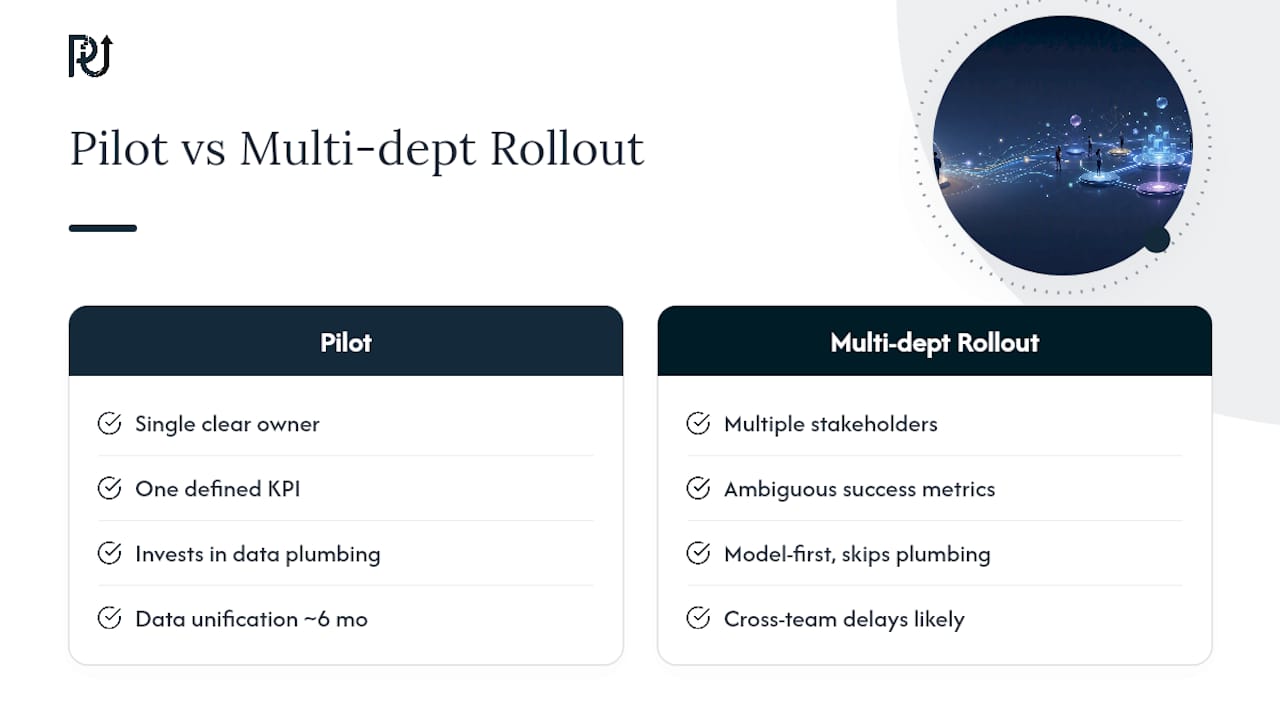
The conventional pitch on AI decisioning oversells autonomy and undersells plumbing. Vendors love to talk about the model. Almost nobody wants to talk about the six months of unifying data across three legacy systems that has to happen before that model produces a trustworthy number.
Start small, and mean it. A single pilot with a clear owner and a defined KPI beats an ambitious multi-department rollout every time, because incentives get misaligned the moment more than one team has to agree on what “success” looks like. Invest in the boring data plumbing before you invest in the model. It’s not glamorous, but it’s the difference between a demo that impresses a room and a system that survives contact with real transaction volume.
Pro Tip: Watch for the first month where your decision engine’s accuracy quietly starts drifting. That’s the moment that tells you whether your monitoring actually works, not the launch day demo.
Getting Started With POWITUP
Most companies evaluating AI decisioning already have the data. What they lack is the architecture to turn it into governed, auditable action, and that’s the gap POWITUP fills. Rather than selling a generic model, POWITUP designs custom AI agents and decision systems built around your actual transaction volume, with explainability and human-in-the-loop review built in from the start, not bolted on after an audit forces the question.
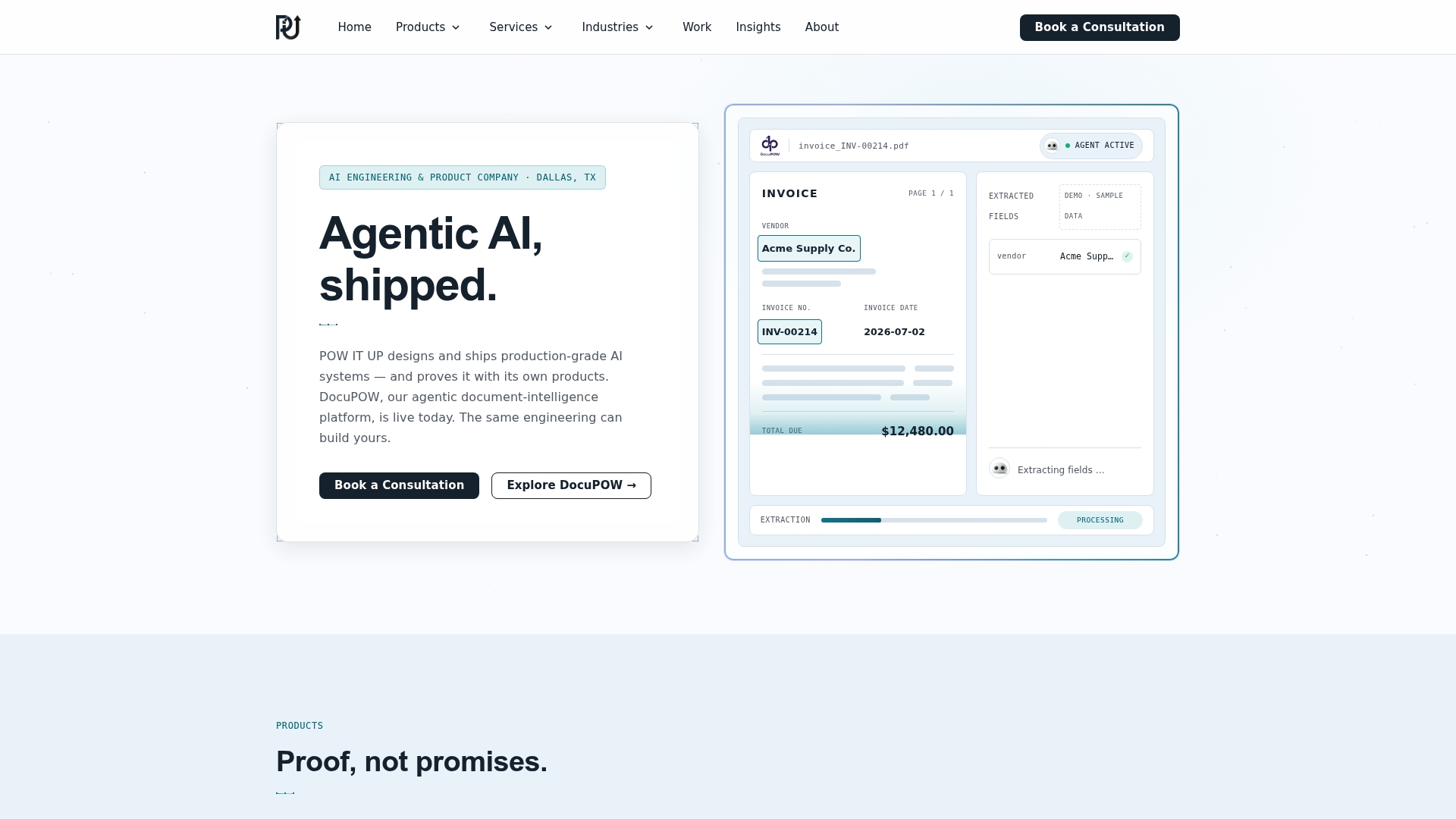
Whether you’re validating documents at scale with a tool like DocuPOW, routing approvals faster, or building a full digital workforce for high-volume operations, the path forward is the same: start with one measurable pilot instead of a company-wide rollout. If you’re ready to scope what that pilot looks like for your operation, request an AI integration consultation and get a concrete plan built around your data, not a generic template.
Sources
FAQ
Can AI make decisions on its own?
AI can autonomously execute well-defined, repetitive decisions like fraud flags or approval routing, but research on algorithms and human expertise shows it should not make transformative choices that involve human value judgments without oversight.
What is the 30% rule in AI?
There’s no single, widely recognized standard called the “30% rule” in AI decision-making; if you’ve heard the term applied to a specific framework, it likely refers to a vendor’s or team’s internal threshold rather than an industry-wide standard.
What is the 10-10-10 rule for decisions?
A common decision-making heuristic asks how a choice will look in the short, medium, and long term rather than being an AI-specific framework, and it’s more commonly applied to personal or strategic decisions than automated systems.
Can AI make its own decisions without any human input?
Technically yes, in narrow, well-scoped tasks, but production systems that skip human-in-the-loop review tend to accumulate risk quietly through model drift and edge cases the training data never covered.
How do I know if my company is ready for AI-powered decision making?
Readiness depends on data quality more than technology: if your data lives in unified, decision-ready pipelines rather than disconnected silos, you’re positioned to pilot AI integration with a real shot at measurable ROI.