
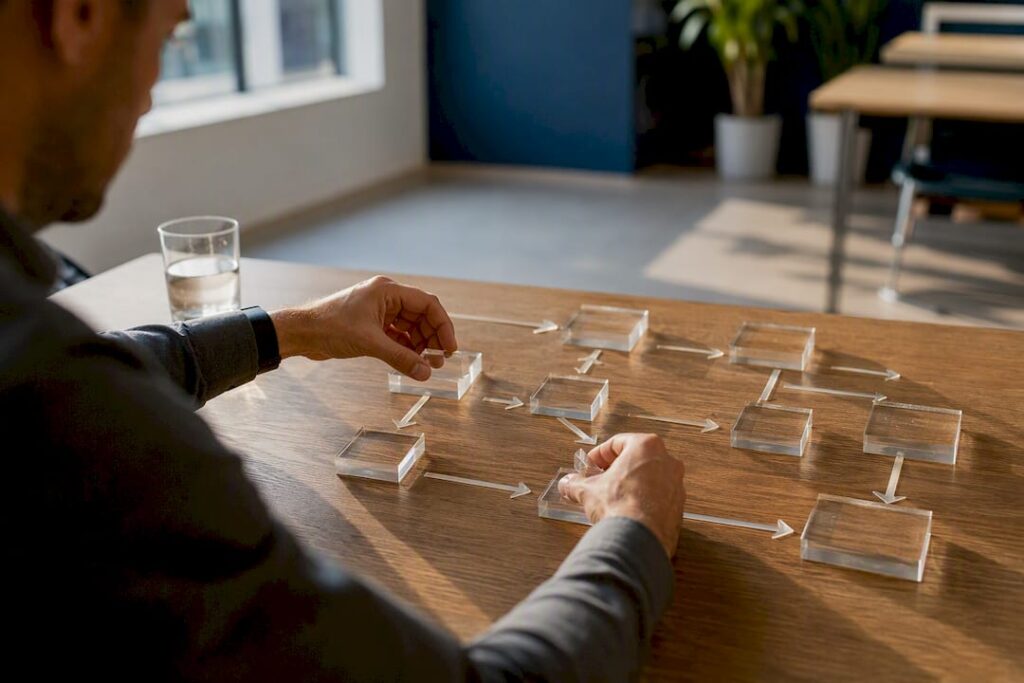
Business Process Reengineering is a management strategy that throws out an existing workflow and builds a new one from scratch, rather than patching what’s broken. It fits when a process is fundamentally failing, not just underperforming, and you can’t fix it with tweaks.
Leaders reach for BPR when they hit a wall that incremental fixes can’t solve. That distinction matters up front:
- Choose BPR when a process is broken at the structural level: too many handoffs, siloed systems, or a business model shift that makes the old workflow obsolete.
- Choose incremental improvement (Lean, Six Sigma, Kaizen) when the process mostly works but needs tightening, fewer defects, or faster cycle times.
- Choose BPR when leadership has appetite for disruption, budget for redesign, and a mandate to change how people actually work, not just what tools they use.
Done well, BPR targets four outcomes: lower operating cost, faster cycle time, fewer errors, and a better customer experience. Two things ground those claims in reality rather than consultant-speak: the KPIs you set before you start (cost per transaction, cycle time, error rate) and the process mining and AI tools that show you what’s actually happening on the ground, not what the org chart says should happen.
Key Takeaways
Business Process Reengineering succeeds when leaders pair a disciplined lifecycle with reliable data, a scoped pilot, and KPIs tracked before, during, and after rollout.
| Point | Details |
|---|---|
| Match the method to the problem | Use BPR for structurally broken processes; use Lean or Six Sigma for processes that just need tightening. |
| Fix data before redesigning | Establish a single source of truth first, since fragmented data undermines even a well-designed to-be process. |
| Pilot before you scale | Run a limited pilot to validate KPIs before committing to a full rollout. |
| Plan for disruption, not just ROI | Budget for training and change management alongside development and integration costs. |
| Consider a specialist partner | POW IT UP builds custom AI agents like DocuPOW and AuraPOW for organizations that need faster, done-for-you redesign support. |
Table of Contents
- What Is Business Process Reengineering and How Is It Different From Process Improvement?
- Where Did Business Process Reengineering Come From?
- Why Do Companies Decide to Reengineer a Process?
- What Are the Steps of a Business Process Reengineering Project?
- Which Frameworks Should You Use to Structure a BPR Project?
- How Do IT, Process Mining, and AI Change Modern BPR?
- What Benefits and KPIs Should You Expect From BPR?
- What Makes BPR Succeed or Fail?
- What Does a BPR Implementation Plan and Budget Actually Look Like?
- What Does BPR Look Like in Practice?
- When Should You Bring in an AI Integration Partner for BPR?
- How POW IT UP Approaches Business Process Reengineering
- Sources
- FAQ
What Is Business Process Reengineering and How Is It Different From Process Improvement?
BPR means rethinking a process from zero. You ask what the end goal is, then design the workflow that gets there fastest, rather than asking how to make the current one 10% better. That’s the core distinction from Business Process Improvement (BPI), Lean, and Six Sigma, which all assume the existing process is fundamentally sound and just needs refinement.
The difference shows up fast once you compare them side by side.
| Approach | Purpose | Typical scope | Speed of change | Risk level |
|---|---|---|---|---|
| BPR | Radical redesign of end-to-end process | Cross-functional, often enterprise-wide | Fast, disruptive rollout | High: organizational and workforce impact |
| Lean | Eliminate waste, improve flow | Single process or department | Gradual, continuous | Low to moderate |
| Six Sigma | Reduce defects and variation | Targeted process or metric | Gradual, data-driven | Low |
| BPI | Incremental fixes to existing steps | Narrow, process-specific | Gradual | Low |
Use this quick filter before committing to either path:
- If the process still meets its original design goals but runs inefficiently, pick Lean or Six Sigma.
- If the process no longer fits the business (new channels, new regulations, new customer expectations), pick BPR.
- If you need results in weeks, not quarters, and can’t tolerate disruption, don’t start with BPR.
Where Did Business Process Reengineering Come From?
BPR emerged in the early 1990s, largely credited to Michael Hammer and Thomas Davenport, who argued companies were automating broken processes instead of rethinking them.
- Early 1990s: Hammer’s work challenged firms to stop paving cow paths and start from a blank page.
- Davenport’s contribution: He tied process redesign explicitly to information technology as an enabler, not just an afterthought.
- 1990s to 2000s: BPR gained a reputation for aggressive workforce cuts, which cooled enthusiasm and pushed many firms toward gentler, incremental methods.
- 2010s to today: Process mining, robotic process automation, and now AI agents revived BPR by making “as-is” analysis cheap and accurate instead of guesswork.
The original insight behind BPR wasn’t about technology at all. It was that most companies had never questioned why a process existed in its current form. Hammer and Davenport pushed leaders to ask what the process should accomplish, then design backward from that goal, using end-to-end process thinking rather than department-by-department patches.
Modern BPR looks different mainly because verifying how work actually flows no longer requires months of interviews. Automated discovery tools do it in days.
Why Do Companies Decide to Reengineer a Process?
Most BPR initiatives start with one of a handful of triggers, and recognizing yours early saves months of scoping.
- Performance stagnation: Metrics have plateaued despite repeated smaller fixes.
- Scalability limits: The process works at current volume but collapses under growth.
- Technological disruption: A new system, channel, or competitor makes the old workflow obsolete.
- Poor customer experience: Complaints cluster around a specific handoff or delay.
- High operating cost: Manual steps or redundant approvals are eating margin.
Not every broken process deserves a full redesign. Prioritize candidates using four filters: customer impact (does this touch revenue or retention directly?), frequency (how often does it run?), cost (what does it consume in labor or errors?), and cross-functionality (does it span more than one department, where BPR’s structural rethink actually pays off)?
Before you pitch a BPR project internally, build a one-page business case with four fields: the target KPI, the current baseline, the expected gain, and a high-level estimate of cost and risk. Skipping this step is the fastest way to get a project killed mid-flight, because redesign work is often costly and disruptive, and executives will ask for the number before they ask for the vision.
Pro Tip: Pick your first BPR candidate from a process that’s cross-functional and customer-facing. Internal-only processes rarely generate the visible wins you need to justify a second project.
What Are the Steps of a Business Process Reengineering Project?
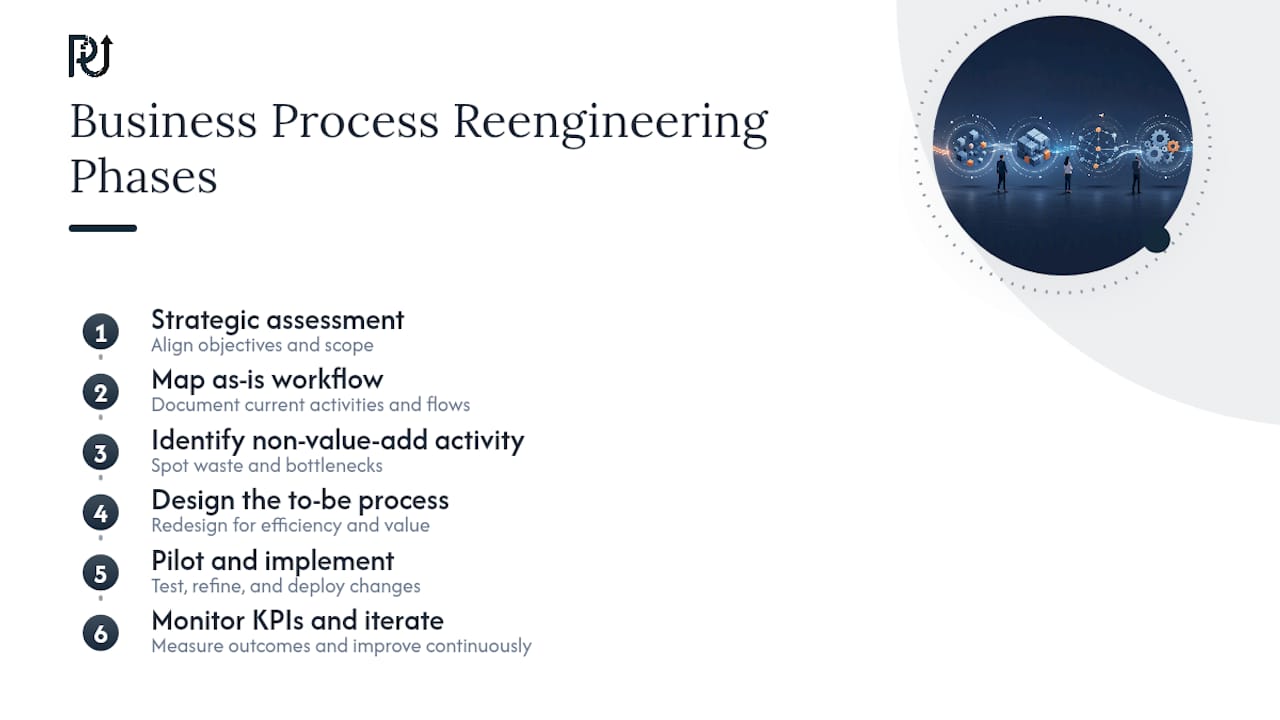
The canonical BPR lifecycle runs through six phases, each with its own deliverables and pitfalls.
- Strategic assessment. Confirm the process ties to a real business objective, not just a departmental complaint. Deliverable: a one-page charter naming the target KPI and executive sponsor.
- Map the current “as-is” workflow. Document every step, handoff, and system touchpoint as it actually happens, not as the manual describes it. Deliverable: a process map and a stakeholder list.
- Identify non-value-add activity. Flag redundant approvals, manual re-entry, and waiting time that add no customer or business value. Deliverable: a waste inventory with time and cost estimates attached to each item.
- Design the future-state “to-be” process. Rebuild the workflow around the target outcome, using automation and AI agents where they replace manual steps outright. Deliverable: a to-be process map and a rough ROI model comparing current versus projected cost.
- Pilot and implement. Run the new process on a limited scope, one team or one region, before rolling it out fully. Deliverable: a pilot scope document and a go/no-go checklist.
- Monitor KPIs and iterate. Track the metrics you set in phase one and adjust based on real performance data, not assumptions. Deliverable: a live KPI dashboard and a cadence for review.
Before greenlighting any phase transition, request four artifacts: the process map, raw data extracts (not summaries), a KPI baseline, and a written change plan. If a vendor or internal team can’t produce these, the project isn’t ready to move forward.
Pro Tip: Treat the pilot phase as non-negotiable, even under pressure to move fast. A short diagnostic period of two to four weeks that maps event logs and confirms KPIs catches expensive mistakes before they scale company-wide.
Which Frameworks Should You Use to Structure a BPR Project?
Three named approaches cover most of what leaders actually use in practice.
- INSPIRE: A structured framework that walks teams through Initiate, Negotiate, Survey, Prepare, Innovate, Redesign, and Evaluate phases, useful when you need a formal governance structure for a large or regulated organization.
- Classic Hammer/Davenport approach: The original radical redesign model, built around asking “why does this process exist” before touching any technology. Best suited to organizations with strong executive backing and appetite for disruption.
- Lean/Six Sigma hybrids: Combine BPR’s structural rethink with Lean’s waste elimination and Six Sigma’s statistical rigor, often used when a company wants radical redesign but with more measurement discipline built in.
Choosing between them comes down to three factors:
- Organization size and risk tolerance: Larger, risk-averse organizations often lean toward INSPIRE’s structured phases; smaller, faster-moving teams can run a leaner Hammer-style redesign.
- Data readiness: If you already have clean process data, a Lean/Six Sigma hybrid gets you measurable results faster.
- Regulatory exposure: Heavily regulated industries (banking, healthcare) benefit from INSPIRE’s documentation trail.
Most frameworks get paired with process mining software, simulation tools, and business process management (BPM) suites to model the to-be state before committing budget.
Pro Tip: Don’t pick a framework because a consultant recommends it. Pick it based on whether your data and governance requirements can actually support its documentation overhead.
How Do IT, Process Mining, and AI Change Modern BPR?
Technology no longer just implements a redesign, it now drives the discovery phase too. A handful of tools do most of the heavy lifting:
- Process mining reconstructs the actual workflow from system logs, revealing shadow processes nobody documented.
- Robotic process automation (RPA) handles repetitive, rules-based steps without a full system rebuild.
- Low-code orchestration platforms let non-developers assemble new workflows quickly.
- AI agents handle judgment-based tasks, document review, exception handling, that used to require a human in the loop.
- Integration middleware connects systems that were never designed to talk to each other.
None of this works without reliable data. Run through this checklist before you redesign anything:
- Do you have complete event logs for the process, not just summary reports?
- Is there a single, trusted source of master data (customer records, product data) across systems?
- Have you identified integration gaps between the systems the process touches?
- Can you establish a single source of truth before automation touches the process?
Fragmented data is the single biggest hurdle modern BPR projects run into, and it’s usually discovered too late.
Pro Tip: Validate process mining output against what employees actually say they do. People adapt around broken systems in ways logs alone won’t fully capture, and skipping this step means redesigning around a fiction.
What Benefits and KPIs Should You Expect From BPR?
BPR projects typically target five measurable outcomes: cost reduction, cycle time, error rate, customer satisfaction, and throughput. Vague goals like “improve efficiency” don’t survive a budget review, so name the number.
Build your measurement plan around five elements for each KPI:
- Baseline: What’s the current number, measured over a defined period?
- Target: What specific improvement are you committing to?
- Measurement frequency: Weekly, monthly, or per transaction batch?
- Owner: Who is accountable for reporting the number?
- Dashboard: Where does the data live so stakeholders can check it without asking?
One industry illustration puts realistic expectations in context: organizations moving from traditional to AI-optimized processes have seen operating cost drop by roughly 15% to 35%, with cycle times falling 30% to 50%. Treat that as a benchmark for what’s achievable under strong execution, not a guarantee for every project. Pair cost and cycle-time metrics with customer-facing measures like the ones detailed in this breakdown of CSAT, FCR, and AHT to keep the redesign honest about customer impact, not just internal savings.
What Makes BPR Succeed or Fail?
Five factors separate BPR projects that deliver from ones that quietly die in a steering committee.
- Executive sponsorship: Without a named executive who owns the outcome, the project loses priority the moment budgets tighten.
- Clear process ownership: One person, not a committee, needs to be accountable for the redesigned process after launch.
- Cross-functional teams: Redesigns that touch multiple departments need representation from each one at the table, not just IT and one business unit.
- Change management: Redesigns fail more often from people resisting new ways of working than from technical flaws.
- Data readiness: You can’t redesign a process you can’t measure accurately.
Certain failure patterns show up often enough to name directly, along with what actually fixes them.
| Common failure mode | Practical mitigation |
|---|---|
| Employee resistance to new workflows | Involve frontline staff in the to-be design, not just leadership; communicate the “why” before the “what” |
| Siloed or fragmented data | Build a single source of truth before redesign, not during rollout |
| Incomplete or assumed requirements | Base the to-be design on validated process mining data, not stakeholder memory |
| Big-bang rollout without a pilot | Scope a limited pilot first and expand only after KPIs confirm the redesign works |
Resistance deserves special attention. HBR’s research on why people resist change points to a consistent pattern: people don’t resist the change itself, they resist the loss of control, competence, or connections that come with it.
Pro Tip: Bake change management into every phase of the lifecycle, not as a communications add-on at the end. A redesign announced only at launch has already lost half its buy-in.
What Does a BPR Implementation Plan and Budget Actually Look Like?
Before kickoff, assign clear ownership across five roles: an executive sponsor to protect budget and priority, a process owner accountable for the outcome, a data lead to manage source-of-truth issues, an IT representative for integration work, and a change lead to manage communication and training.
A realistic timeline for a mid-sized process redesign runs roughly like this:
- Weeks 1 to 4: Strategic assessment and as-is mapping.
- Weeks 5 to 8: Non-value-add analysis and to-be design.
- Weeks 9 to 14: Build, integration, and pilot preparation.
- Weeks 15 to 18: Pilot run and KPI validation.
- Weeks 19 to 24: Full rollout and stabilization.
Costs cluster around a predictable set of drivers:
- Data cleanup: Fixing inconsistent or missing records before automation touches them.
- Integration: Connecting systems that weren’t built to communicate.
- Development: Building automation, AI agents, or custom workflow logic.
- Training: Getting staff comfortable operating the new process.
- Change management: Communication, feedback loops, and adoption support throughout rollout.
Phasing the rollout in stages, one team or region at a time, costs more in project management overhead but dramatically lowers the risk of a failed launch compared to a big-bang approach across the whole organization.
What Does BPR Look Like in Practice?
Case one: claims processing at a mid-sized insurer. Before: claims took an average of 12 days to process due to manual document review and five separate approval handoffs. The redesign consolidated approvals into two steps and introduced document intelligence to auto-validate routine claims. After: processing time dropped to roughly 4 days for standard claims, with staff redirected to complex exception handling.

Case two: order-to-cash at a logistics firm. Before: invoice disputes took weeks to resolve because billing and operations data lived in separate systems with no shared record. The redesign built a single source of truth linking order, shipment, and billing data, paired with automated matching. After: dispute resolution time fell sharply, and finance stopped spending hours reconciling spreadsheets manually.
Lessons from both: the redesign worked because the team fixed the data problem first, not last. And in both cases, leadership verified baseline numbers with real transaction data before publicizing any improvement, a step worth insisting on before you claim a win internally.
When Should You Bring in an AI Integration Partner for BPR?
Not every BPR project needs outside help, but a few signals suggest it’s worth the conversation.
- Data complexity exceeds internal capacity: If mapping your process data requires expertise your team doesn’t have in-house.
- You need custom AI agents, not off-the-shelf software: Generic tools rarely fit a process that’s genuinely unique to your business.
- Speed-to-value matters more than building internal capability right now: An experienced partner compresses the discovery and pilot phases significantly.
- Internal teams are stretched thin: BPR competes for the same people running day-to-day operations.
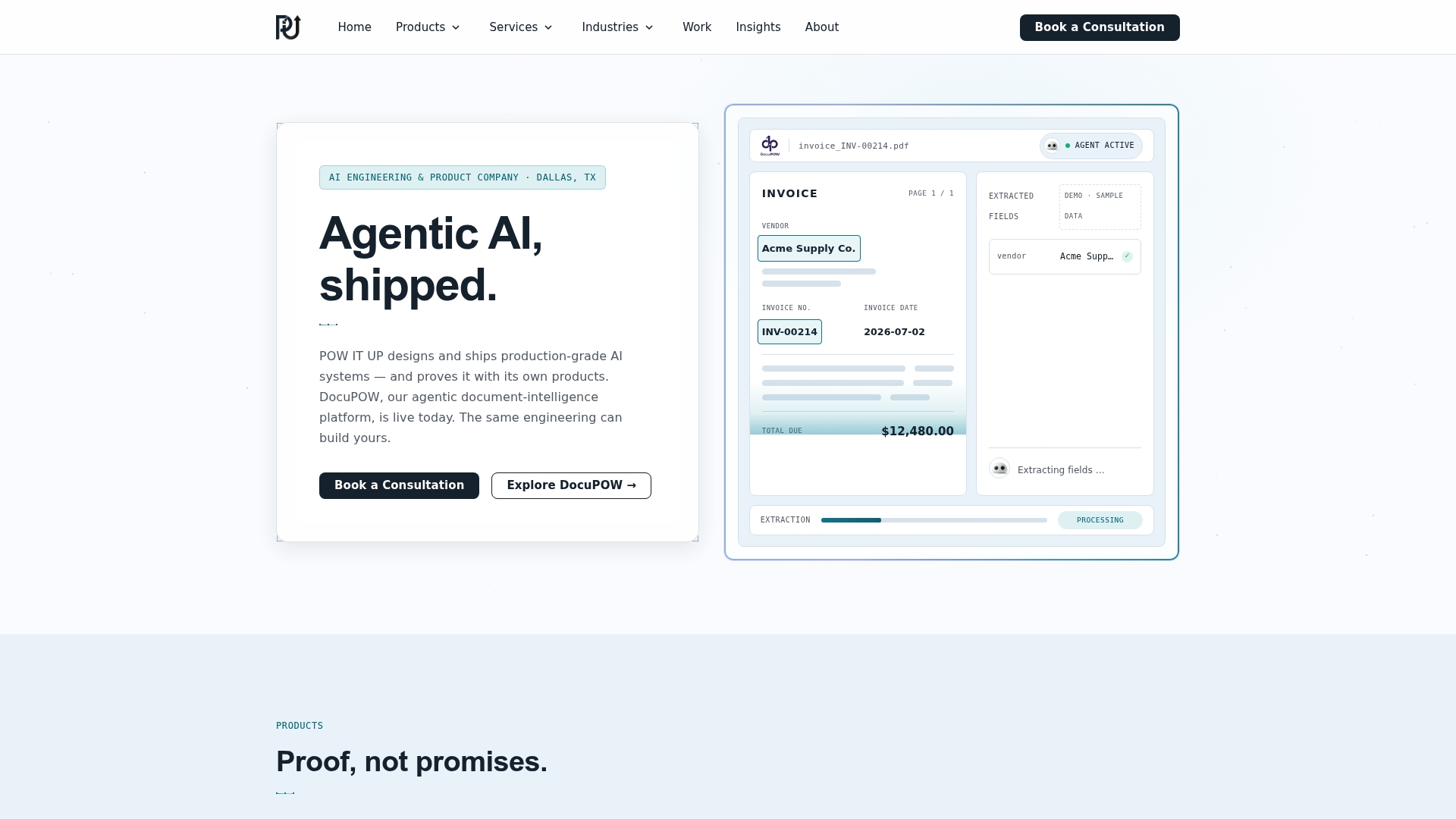
POW IT UP approaches BPR as strategic technical architecture, not scripting. The firm designs and deploys autonomous, context-aware AI agents that handle high-volume transactional work and hunt down the operational time leaks that manual process reviews miss. Its own tools illustrate the approach directly: DocuPOW automates document reading and validation, the kind of manual bottleneck that shows up in almost every claims or order-processing redesign, while AuraPOW monitors portfolio and client health analytics to catch performance drift after a redesign goes live.
Before signing with any vendor, ask these questions:
- What are the SLAs for uptime and support after handover?
- What does the handover process look like once the pilot ends?
- How is data governance handled during and after integration?
- What are the terms and duration of the pilot itself?
Pro Tip: Ask any prospective partner to show you their diagnostic process before you commit to a full engagement. If they can’t explain how they’d map your data in the first two weeks, they haven’t done this enough times.
A Consultant’s Take on What Actually Makes BPR Work
Most BPR write-ups treat the framework as the hard part. It isn’t. The lifecycle steps are well documented and have been for three decades. What separates the projects that deliver from the ones that stall is almost always execution discipline: honest baseline data, a pilot scope small enough to fail safely, and a sponsor willing to defend the project when the first uncomfortable metric shows up.
A few rules worth applying immediately, drawn from patterns across client engagements:
- Start every redesign by proving the value on one process, not five.
- Run the pilot before you believe your own to-be diagram.
- Measure early, even if the number is embarrassing. It’s the only way to know if the redesign is actually working.
If you’re weighing whether to run a pilot diagnostic on a specific process, that conversation is worth having before you commit to a full redesign.
How POW IT UP Approaches Business Process Reengineering
If your redesign needs custom AI agents rather than another generic workflow tool, that’s the gap POW IT UP was built to close. Traditional consultants hand you a process map and leave; POW IT UP designs, builds, and deploys the actual digital workforce that runs your new process, and stays accountable for whether it performs.
A typical engagement starts small and scoped, not with a company-wide overhaul:
- A short diagnostic to map your current process and data gaps.
- A scoped pilot on one process or team to prove impact before scaling.
- A data-readiness assessment that flags integration gaps before they become expensive surprises mid-project.
Expect a working prototype and measurable KPIs within weeks, not a six-month discovery phase that ends in a slide deck. If you’re ready to see what a scoped AI automation engagement looks like for your process, reach out through POW IT UP’s site to scope a pilot diagnostic.
Sources
- Business Process Redesign (BPR): Definition, Process, and Purpose | Investopedia
FAQ
What Are the Steps of a Business Process Reengineering Project?
The canonical lifecycle runs through six phases: strategic assessment, mapping the as-is workflow, identifying non-value-add activity, designing the to-be process, piloting and implementing, and monitoring KPIs to iterate.
What Is an Example of BPR?
A claims-processing redesign that consolidates five manual approval handoffs into two automated steps, cutting processing time from 12 days to roughly 4, is a typical BPR example.
What Is BPR in the Context of Six Sigma?
BPR and Six Sigma are often combined into a hybrid approach: BPR provides the radical structural redesign, while Six Sigma adds statistical rigor to measure and control variation in the new process.
What Are the Three R’s of Business Process Reengineering?
Definitions vary across sources, but a common version refers to Redesign, Retool, and Reorchestrate, the idea of rethinking the process structure, updating the technology that supports it, and realigning teams around the new workflow.
How Long Does a Typical BPR Project Take?
A process redesign generally takes several months from strategic assessment through stabilized rollout, though a scoped pilot diagnostic can start delivering findings within two to four weeks.