

You can deploy an AI workforce for transactional operations today, as long as you put governance, deterministic workflows, and human-in-the-loop gates in place before you scale. The single change most leaders need to make first is treating deployment as a phased, measured program rather than a one-off experiment. Start with a bounded lighthouse process, an agent registry, and basic test, evaluation, verification, and validation (TEVV) metrics.
TL;DR:
- Choose a high volume, bounded process such as invoice matching, define accuracy and failure thresholds before building, and instrument it within 90 days.
- Register each agent’s identity, owner, and scope; assign oversight by impact, repeat testing regularly, and retain audit logs with role based access controls.
- Use deterministic workflows for every step that changes data or moves money, and require human approval before payments, account changes, or external messages.
- Use packaged agents for narrow, low risk tasks with standard APIs; reserve custom engineering for differentiated processes or proprietary integrations, and consider hybrid orchestration.
- Track per agent usage, anomalies, and test metrics, then set token caps, quotas, budget alerts, rollback triggers, and retirement procedures before scaling.
Table of Contents
- A phased deployment checklist from pilot to production
- Governance essentials: inventory, ownership, risk tiers, and TEVV
- Orchestration and deterministic workflows for transactional work
- Data, memory, and security controls for safe agent operation
- Running, monitoring, and retiring agents at scale
- Custom engineering vs. packaged agents vs. hybrid approaches
- How we help: engineering, governed deployments, and live demos
- Why engineering-first governance unlocks scale
- FAQ
- Sources
A phased deployment checklist from pilot to production
Rushing straight to full-scale rollout is how AI workforce programs stall. A disciplined sequence protects both the budget and the business process you are automating.
- Pick the scope: choose a high-volume, bounded transactional process with measurable key performance indicators (invoice matching, claims intake, document validation).
- Define TEVV metrics first: decide what “working correctly” means, including accuracy thresholds and failure tolerances, before any agent is built.
- Build the agent registry: record identity, owner, and scope for every agent before it touches production data.
- Set human-in-the-loop gates: require explicit approval for irreversible actions like payments, account changes, or external communications.
- Roll out progressively: move from pilot to a lighthouse deployment, then to canaried production rollout with defined rollback triggers.
Pro Tip: Pick a process that is painful enough to matter but narrow enough to fully instrument within 90 days.
Governance essentials: inventory, ownership, risk tiers, and TEVV
Agents that operate without an inventory or an owner become invisible liabilities. Before you scale past a pilot, put a governance baseline in place that treats every agent as a managed production asset, not a script someone left running.
Start with a single agent registry that records identity, owner, and scope for each agent, matching the centralized governance layer that enterprise cloud adoption guidance recommends to prevent agent sprawl. From there:
- Map risks using the MAP, MEASURE, and MANAGE functions from the NIST AI RMF generative AI profile, and set a recurring TEVV cadence rather than a one-time test.
- Define policy tiers by impact: low-risk agents get lightweight oversight, high-risk agents require mandatory human review before execution.
- Write a charter for each agent that states what it is allowed to do and, just as important, what it is prohibited from doing.
- Keep traceable audit logs and role-based access controls so every action an agent takes can be reconstructed later.
Only a small share of enterprise functions currently run AI agents at scale, according to Forbes’ summary of McKinsey’s adoption data, which signals how early most organizations still are in moving past pilots. Treating governance as a prerequisite rather than an afterthought is what separates the ones that scale from the ones that stall.
Orchestration and deterministic workflows for transactional work
Transactional processes cannot tolerate probabilistic guessing on state-changing steps. A deterministic workflow forces the agent down a predictable, auditable path for anything that writes data, moves money, or triggers downstream systems, while leaving the model’s flexibility for judgment-heavy tasks like classification or summarization.
- Choose a managed orchestration platform when you need built-in compliance controls, or a code-first framework when you need fine-grained control over logic and state.
- Design deterministic hand-offs for every state-changing step. Deterministic workflows reduce operational risk compared with letting a model decide transaction outcomes on its own.
- Adopt standard protocols like Model Context Protocol (MCP) and Agent-to-Agent (A2A) communication, and decide deliberately when agents should run sequentially versus in parallel.
- Sandbox every tool invocation and require explicit confirmation before a high-impact tool call executes.
Agentic AI programs that redesign end-to-end processes outperform those that simply bolt agents onto existing workflows, which is the core argument for designing orchestration deliberately rather than improvising it.
Data, memory, and security controls for safe agent operation
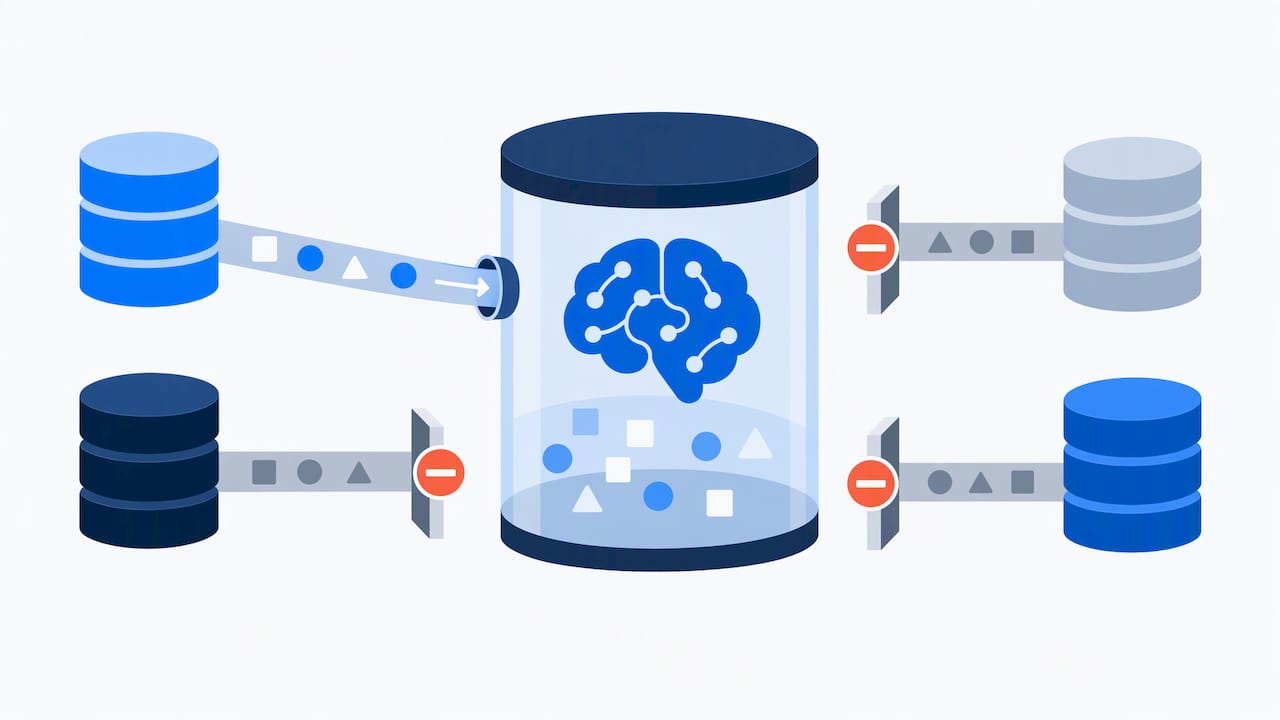
An agent’s memory and tool access are where most operational risk concentrates. Treat them with the same discipline you would apply to a privileged employee account, because functionally, that is what an autonomous agent is.
- Externalize agent memory and apply enterprise backup, retention, and access audit policies to it, the same as any other data store.
- Expose systems through narrow, purpose-built APIs, validate every input, and enforce least-privilege access on each connection.
- Segment knowledge and data access by agent role so a compromised or misbehaving agent cannot reach data outside its job.
- Manage secrets and identities centrally through vaults and managed identities, with credential rotation on a fixed schedule.
Every output an agent receives from a tool, a retrieval system, or another agent should be treated as untrusted input, with safety checks reapplied at each hop to prevent prompt injection and data leakage.
Pro Tip: If an agent can read it, assume an attacker eventually will too. Scope memory and data access accordingly.
Running, monitoring, and retiring agents at scale
Once agents move from pilot to production, operating them becomes a distinct discipline from building them. A fleet of a dozen agents needs the same rigor as a fleet of a hundred, just applied earlier.
- Centralize enforcement through a control plane or AI gateway so policy, credentials, and monitoring stay consistent as the fleet grows, rather than fragmenting across platforms.
- Track per-agent telemetry, including usage, anomalies, and TEVV metrics, with automated alerts for drift or failure.
- Apply cost governance through token caps, usage quotas, tagging, and budget alerts, since agent deployments can quickly consume compute and API budgets without active tracking.
- Manage the full lifecycle with versioning, canary deployments, defined rollback criteria, and a retirement procedure for agents that are no longer needed.
A fixed-price partner analysis of AI agent cost and risk patterns in SaaS operations found that unmanaged agent spend is one of the fastest-growing line items operations teams discover too late. Building cost governance in from day one avoids that surprise.
Custom engineering vs. packaged agents vs. hybrid approaches
Not every process needs a custom-built agent, and not every off-the-shelf agent will hold up under real transactional load. The decision comes down to how differentiated the process is and how much the data and integration complexity demand.
- Commission custom agent engineering when the process runs end-to-end, is strategically differentiating, or requires deep integration with proprietary data and systems, a case we cover in more detail in our breakdown of agent types for service teams.
- Use packaged agents for narrow, low-risk tasks that run against standard, well-documented APIs.
- Consider a hybrid model: off-the-shelf components glued together with custom orchestration, which McKinsey describes as an agentic mesh that balances speed with future flexibility.
- Weigh data sensitivity, determinism requirements, integration complexity, and the expected ROI horizon before committing to any single path.
How we help: engineering, governed deployments, and live demos
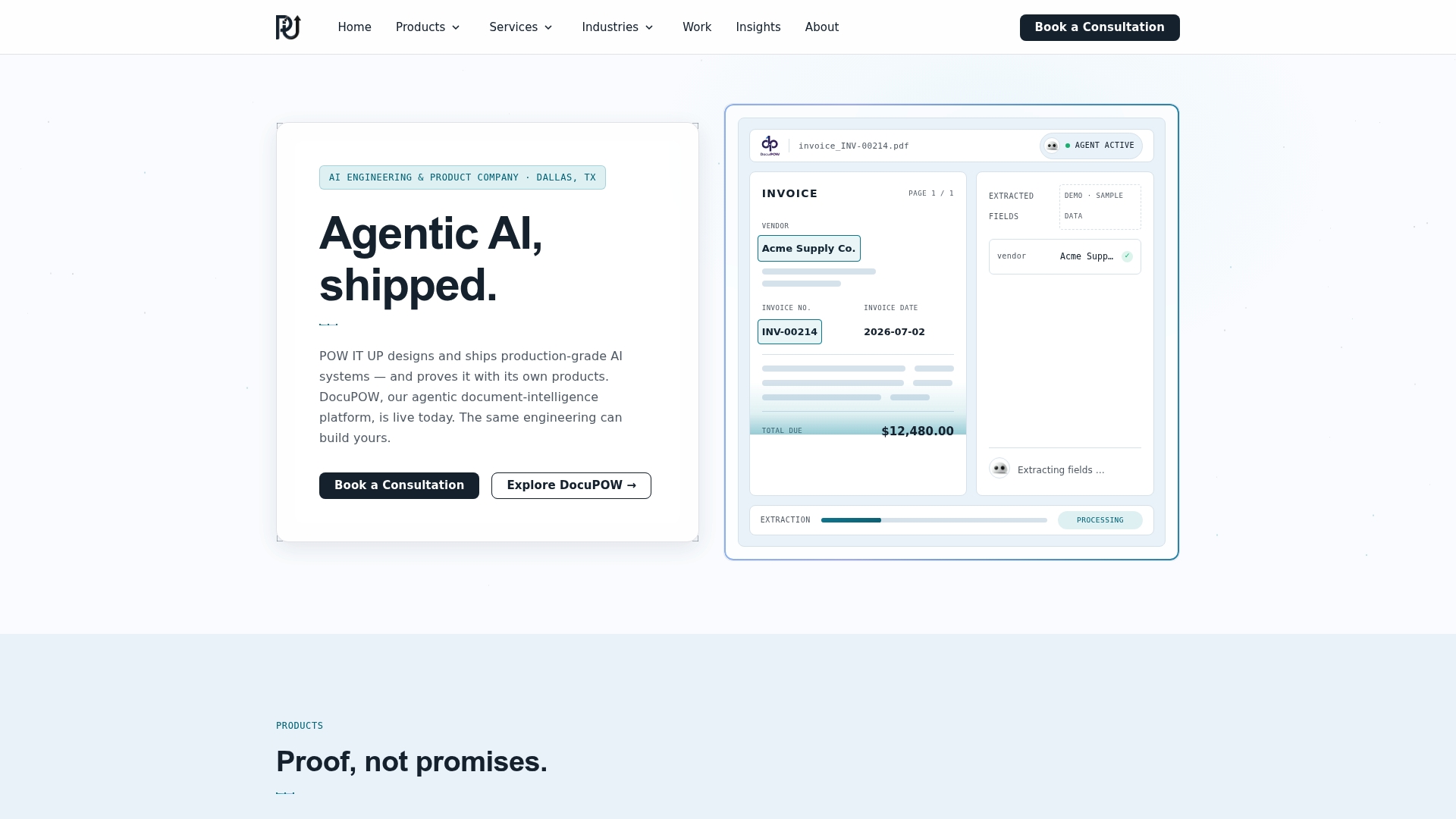
We design, build, and deploy custom digital workforces: autonomous, context-aware AI agents engineered to handle high-volume transactional work rather than generic scripts bolted onto existing tools. Our work spans AI Agents Development, AI Integration, and AI Automation, and you can see the approach in action through DocuPOW, our live demo product for document reading and validation.
Our engagement model follows the same pilot to lighthouse to production path this guide describes, and we deliver the governance artifacts, TEVV baselines, and handover documentation alongside the working system, not as an afterthought. If you are weighing whether a process needs custom engineering or a packaged solution, our AI Integration team can help map your data, systems, and risk profile before you commit budget.
- Request a DocuPOW demo to see document intelligence in action on your own files.
- Start a discovery conversation about custom agent development for your highest-volume transactional process.
Why engineering-first governance unlocks scale
Most AI workforce programs stall not because the models fail, but because nobody built the guardrails before turning the agents loose. Governance-first engineering is not a brake on speed. It is what lets a pilot survive contact with real production data and real financial consequences without someone pulling the plug at the first anomaly.
The organizations that move from pilot to measurable return tend to build cross-functional squads around a process, not around a tool, and they think in programs rather than one-off launches. If you are weighing whether now is the right time, it is. Start a single lighthouse project, instrument it properly, and let the data make the case for the next one.
— Syed Naveed Abbas
FAQ
How long does it take to deploy an AI workforce safely?
A well-scoped pilot can run within 90 days, with a lighthouse deployment following once TEVV metrics confirm the process is stable. Full production rollout timing depends on process complexity and integration depth, but rushing past the pilot and lighthouse stages is the most common cause of failed programs.
What is human-in-the-loop and when is it required?
Human-in-the-loop means a person must approve or review an action before it executes. Enterprise guidance on agent shared responsibility specifies it as required for irreversible, high-impact actions like payments, account changes, and external communications.
How many organizations are actually scaling AI agents today?
Around 23% of organizations report scaling agentic AI in at least one business function, while 10% of enterprise functions use agents at scale today.
Should we build custom agents or buy a packaged solution?
Custom engineering makes sense when a process is differentiating, end-to-end, or requires deep integration with proprietary systems and data. Packaged agents work well for narrow, low-risk tasks against standard APIs, and a hybrid approach often delivers faster value while keeping options open.
What does DocuPOW do and is pricing available?
DocuPOW handles document reading and validation as a live demo product, available for evaluation through a direct demo. Pricing is available on request rather than published.
Sources
- 10% of enterprise functions use AI agents, McKinsey finds — Forbes (summary of McKinsey)
- Artificial Intelligence Risk Management Framework: Generative Artificial Intelligence Profile — NIST
- Govern and secure AI agents across the organization — Microsoft Cloud Adoption Framework