

AI Process Engineering means designing autonomous, context-aware AI agents that model, orchestrate, and automate high-volume business workflows: document intake, claims processing, recurring reporting, and transaction handling. The outcome leaders care about is throughput without proportional headcount growth. POW IT UP builds these systems, and production research on multi-agent document pipelines backs the approach with measured results, not promises.
TL;DR:
- Multi-agent pipelines achieve around 97% automation and 98.5% accuracy in real-world document processing, depending on data variability.
- Enforcing schema-first design, version control, observability, and incremental rollouts reduces operational risks and improves system reliability.
- Scaling multi-agent systems requires strong governance, model selection, centralized data, and disciplined prompt engineering to prevent failure modes like agent bullwhip.
- Use a human-in-the-loop checkpoint before full deployment, and verify success metrics such as automation rate, accuracy, throughput, and cost savings.
- POW IT UP provides live demos with validator logic and custom architectures tailored to specific workflows, emphasizing flexible, resilient automation solutions.
Table of Contents
- Where AI Process Engineering applies and how it differs from RPA
- The multi-agent pipeline behind a production-grade system
- Five engineering rules that keep AI workflows maintainable
- Governance and orchestration: keeping reliability intact as agents scale
- What production data shows about automation rate and accuracy
- KPIs, SLAs, and a simple way to score a pilot
- A practical roadmap from pilot to production
- How an integration firm actually structures these projects
- Building your digital workforce with POW IT UP
- FAQ
- Sources
Where AI Process Engineering applies and how it differs from RPA
The practical scope covers three overlapping capabilities: agentic automation that makes decisions within guardrails, document intelligence that reads and validates unstructured inputs, and workflow orchestration that routes work across systems and people. Traditional robotic process automation follows a fixed script: click here, copy that field, paste it there. It breaks the moment a layout changes or an exception appears.
AI Process Engineering instead uses agents that interpret content, flag uncertainty, and route exceptions to a human reviewer rather than failing silently. That distinction matters most in high-volume, document-heavy processes where variability is the norm rather than the exception.
- Accounts payable: invoice capture, three-way matching, and exception routing.
- Claims intake: form parsing, coverage verification, and fraud flagging.
- KYC and onboarding: identity document validation and cross-field consistency checks.
- Recurring deliverables: monthly reports, compliance filings, and client health summaries.
The multi-agent pipeline behind a production-grade system
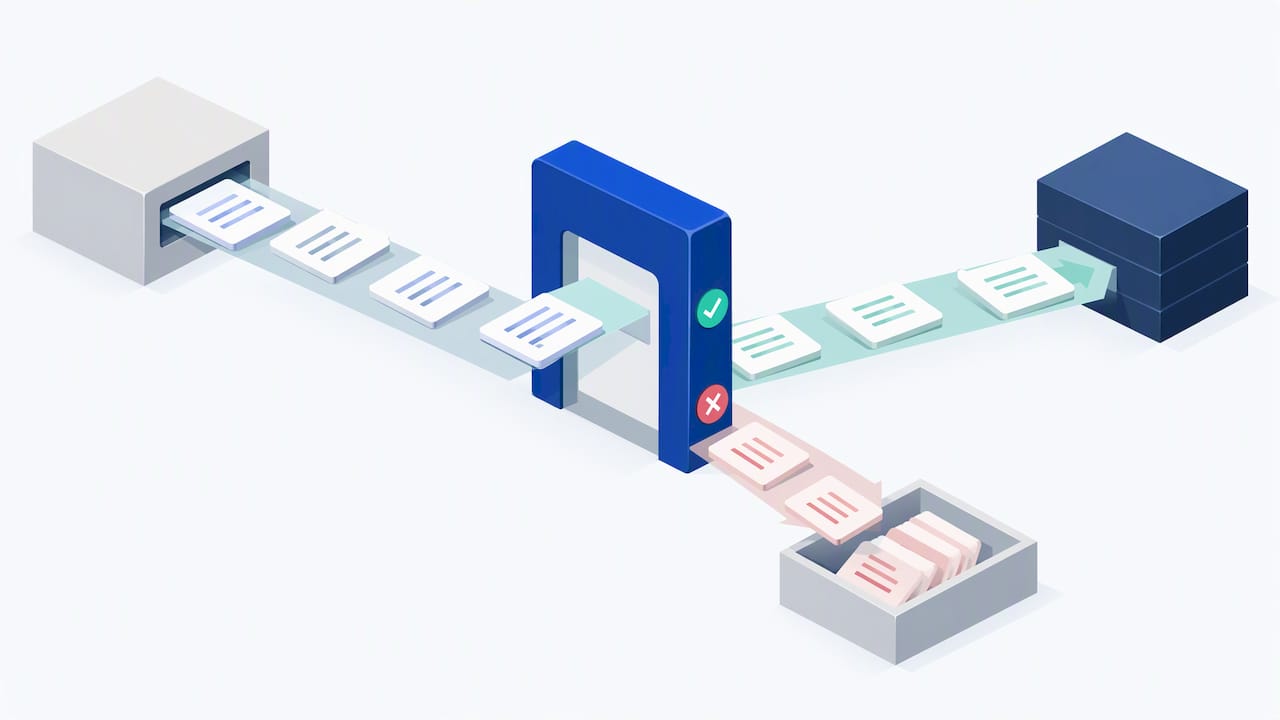
A durable AI Process Engineering build typically runs as a pipeline of specialized agents rather than one monolithic model. Each agent has a narrow job, which makes failures easier to isolate and fix.
- Classificator: identifies document or task type before any processing begins.
- Splitter: breaks multi-page or multi-item inputs into discrete units.
- Parser: converts raw content into structured, intermediate representations.
- Extraction agent: pulls specific fields against a defined schema.
- Validator: checks format, numeric relationships, and cross-field dependencies before anything moves downstream.
An orchestrator coordinates these agents, manages state, and decides when a case needs a human. Schema-first outputs constrain what a large language model is allowed to return, which cuts down on the kind of free-text drift that makes automated outputs hard to trust. Human review is inserted at the validator stage, and the corrections reviewers make feed back into prompt updates through a process known as Prompt Fine Tuning with Feedback Inheritance, or PFTFI. This lets the system improve from real corrections without retraining the underlying model.
Pro Tip: Ask any vendor to show you the validator agent’s rule set before you ask about the extraction model. The validator is what keeps bad data from reaching your ERP.
Five engineering rules that keep AI workflows maintainable
Systems that work in a demo often fail in production because nobody enforced a handful of unglamorous rules. These five, adapted from how POW IT UP approaches custom builds, are worth writing into any request for proposal or statement of work.
- Schema-first design: define the exact output structure before building any extraction logic.
- Versioned prompts and feedback: every prompt change is tracked, tested, and tied to a feedback source.
- Validator sentinels: automated checks catch format and logic errors before a human ever sees the case.
- Observability: every agent decision is logged with enough context to audit it later.
- Incremental rollouts: new process types go live on a small volume slice before scaling to full load.
Each rule reduces a specific operational risk: schema drift, silent prompt regressions, bad data reaching downstream systems, undiagnosable failures, and big-bang rollout disasters. Demand evidence of all five in any vendor proposal, not just a demo video.
Governance and orchestration: keeping reliability intact as agents scale
Orchestration and governance, not model quality, become the primary bottleneck once an organization runs more than a handful of agents at once. Industry commentary on agent readiness notes that without a unified operating model, integration costs and failure modes compound as agent counts grow.
Four levers keep multi-agent systems stable as they scale:
- Model selection: matching the right model to each agent’s task rather than using one model for everything.
- Policies and guardrails: explicit rules that bound what an agent can decide on its own.
- Centralized data sharing: a single source of truth that every agent reads from and writes to.
- Prompt engineering discipline: structured, versioned prompts rather than ad hoc instructions.
Orchestration and governance investments pay the largest marginal return as agent counts grow, according to industry analysis of agent-scale workforce trends: start with an operating model before multiplying agents. Research on autonomous agents in supply chain settings describes a related risk called “agent bullwhip,” where small decision errors amplify across linked agents. The mitigation is a shared training backbone, system-level rewards rather than isolated local optimization, and a centralized orchestrator that catches drift before it compounds.
What production data shows about automation rate and accuracy
A multi-agent document pipeline tested in a real production deployment reached a 97.0% full-pipeline automation rate across 955 documents, meaning most cases needed no human touch at all. On a separate 100-document ablation subset, the same architecture achieved high document-level accuracy.
The validator agent’s formal checks, field-format verification, numeric relationship checks, and cross-field dependency inspection, let the system maintain accuracy without retraining the core model after every correction.
In a 100,000-invoice-per-year scenario, the same research estimates roughly a 70% potential reduction in full-time equivalent staffing needs with a hybrid AI-plus-human-in-the-loop architecture. These figures come from one production study, and results vary with document variety, supplier formats, and how much a company’s inputs drift over time. Treat the numbers as evidence of what a well-governed pipeline can do, not a guarantee for every dataset.
KPIs, SLAs, and a simple way to score a pilot
Before green-lighting a pilot, agree on the handful of numbers that will decide whether it scales.
- Automation rate: the share of cases completed with no human intervention.
- Human review rate: the share routed to a person, and why.
- Accuracy: correct extractions or decisions measured against a sampled ground truth.
- Throughput: cases processed per hour or per day.
- Cost per transaction: total pipeline cost divided by volume.
- FTE delta: staffing hours freed up or reassigned.
Before scaling, run the math on expected volume, current unit cost, projected automation percentage, and how long until the savings outweigh the build cost.
A practical roadmap from pilot to production
Pick the first process by multiplying volume, complexity, and downstream impact: a high-volume, moderately complex process with visible downstream cost (like invoice processing) usually beats a low-volume, highly complex one.
- Confirm you have enough historical data to train and validate the pipeline.
- Design the human-in-the-loop checkpoint before writing any extraction logic.
- Set observability requirements so every decision is traceable after the fact.
- Define success criteria numerically before the pilot starts, not after.
- Plan the change management: who reviews exceptions, and how their time gets reallocated.
Once the pilot clears its success gates, scaling requires orchestration infrastructure, prompt versioning discipline, a named governance owner, and ongoing monitoring dashboards.
Pro Tip: Run the pilot on real production volume for at least two weeks before judging automation rate. Early results almost always look better or worse than steady-state performance.
How an integration firm actually structures these projects
Most automation failures trace back to treating agents as scripts instead of systems that need architecture, versioning, and governance from day one. At POW IT UP, we build digital workforces as layered pipelines with validator sentinels and feedback loops baked in, not bolted on afterward. DocuPOW applies that same architecture to document reading and validation, giving operations leaders a live example of schema-first extraction paired with human review.
— Syed Naveed Abbas
Building your digital workforce with POW IT UP
If you are weighing a custom build against a generic automation script, the real difference shows up six months in, when the script breaks on a format it has never seen and the engineered pipeline just routes the exception to a reviewer. DocuPOW handles document reading and validation out of the box, with a live demo available so you can see the validator logic before committing to anything.
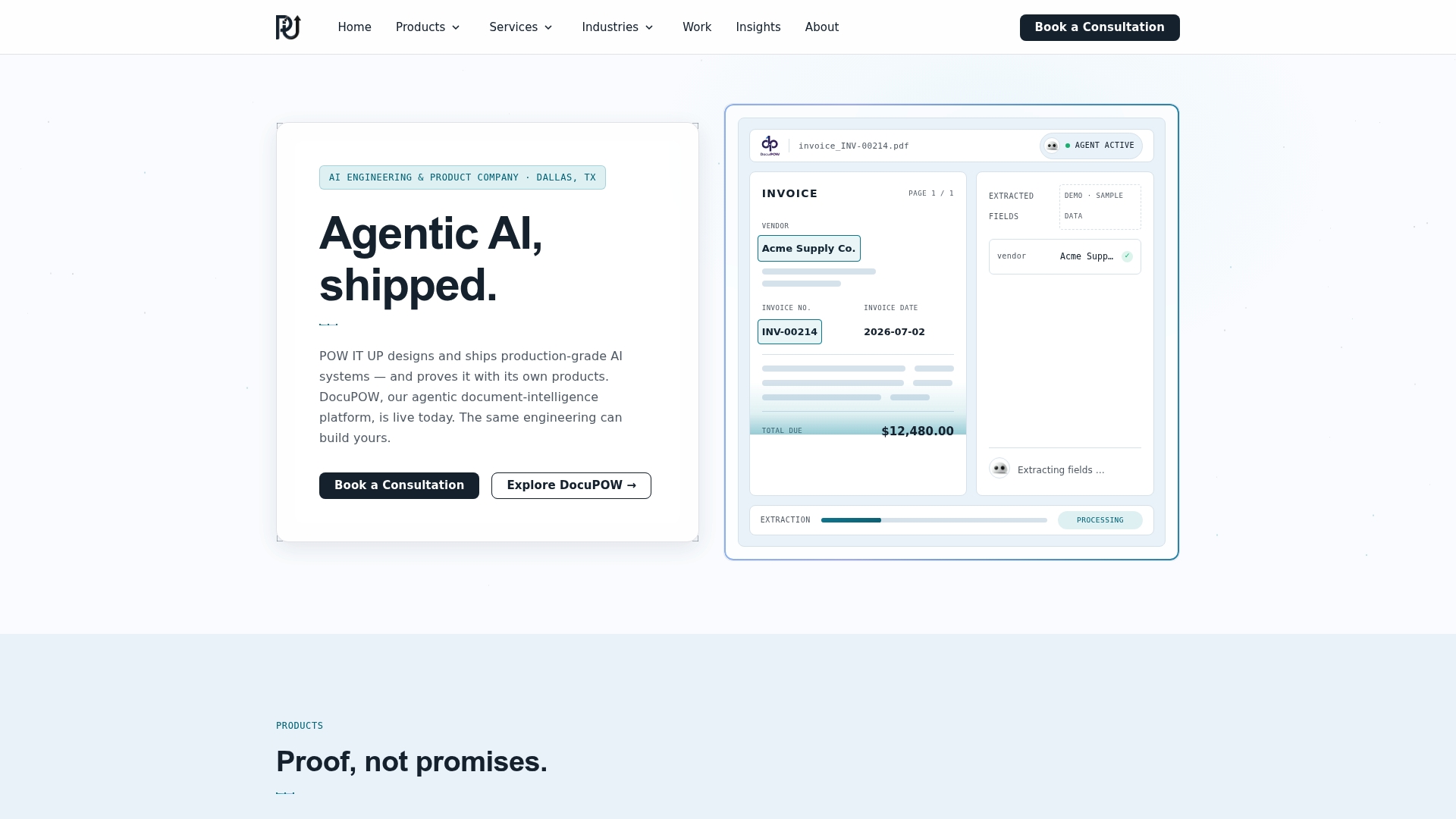
For processes that need a custom agent architecture rather than an off-the-shelf fit, AI Agents Development builds the classification, extraction, and validation pipeline around your specific documents and systems, and AI Integration connects that pipeline into what you already run. If you want a second opinion on tooling before committing to any vendor, ToolBino’s workflow-first comparison is a useful neutral starting point. The next step is a scoping call: bring one candidate process, and we will map out what a pilot would look like and what it would cost to build.
FAQ
What is AI Process Engineering in simple terms?
It is the practice of designing autonomous AI agents, classification, extraction, validation, and orchestration working together, to automate high-volume business workflows like document processing and transaction handling. The goal is to scale output without adding headcount at the same rate.
How is this different from traditional RPA?
Traditional RPA follows a fixed script and breaks when inputs change format. AI Process Engineering uses agents that interpret content and route uncertain cases to a human reviewer, which makes it more resilient to the variability found in real documents and transactions.
What results can a well-built pipeline actually achieve?
A production multi-agent document pipeline reached a 97.0% full-pipeline automation rate on real-world volume and 98.5% accuracy on a tested subset. Results depend heavily on document variety and data quality, so treat these as evidence of what is achievable, not a fixed outcome.
What is the “agent bullwhip” risk mentioned in governance discussions?
It describes how small decision errors in one agent can amplify as they pass through linked agents in a multi-agent system, similar to demand distortion in supply chains. Research on autonomous agents in supply chain settings points to shared training backbones and centralized orchestration as practical mitigations.
Does POW IT UP offer a way to try this before committing to a full build?
Yes, DocuPOW offers a live demo for document intelligence and validation, and custom builds start with a scoping conversation rather than a fixed package. Pricing for custom AI Agents Development work is available on request based on process complexity.
Sources
- Reliability and Effectiveness of Autonomous AI Agents in Supply Chain Management
- AI agents: the defining workforce trend of 2025