

AI business consulting means hiring a team to audit your workflows, build custom automation or AI agents to fix the worst bottlenecks, and hand you a production system your staff can run without a developer on call. It pays off fastest for leaders sitting on repetitive, high-volume transactional work like claims processing, document review, or client intake. Firms like POW IT UP structure engagements around measurable results, so the rest of this piece walks through how to evaluate one before you sign a contract.
TL;DR:
- AI consulting is most effective for high-volume, rule-based tasks where measurable time savings or revenue gains are clear and verifiable.
- A proper engagement includes a discovery audit, production deployment, owner documentation, and verifiable trust signals like live demos and case studies.
- Costs depend heavily on integration complexity, data quality, customization, and compliance requirements, with pilots typically going live within weeks.
- Strong contracts specify acceptance criteria, IP ownership, measurable ROI, and ongoing support to prevent system decay and ensure long-term value.
Table of Contents
- What AI Business Consulting Covers: Core Services and Expected Outcomes
- Which Industries Get the Biggest Wins From AI Consulting?
- How Does an AI Consulting Engagement Actually Run?
- How Much Does an AI Consultant Cost?
- How Do You Choose the Right AI Consultant?
- What Infrastructure and Governance Decisions Come With Agentic AI?
- How Do You Integrate AI Into Processes You Already Run?
- What Happens After the Consultant Leaves?
- Why POW IT UP Builds Automation This Way
- Start With a Fixed-Scope Audit, Not a Guess
- Sources
- FAQ
What AI Business Consulting Covers: Core Services and Expected Outcomes
Good AI business consulting starts with a discovery audit, not a pitch deck. A consultant sits with the people actually doing the work, maps the real workflow (not the org chart version), and scores automation candidates against a simple formula: hours saved or revenue recovered per month, divided by the cost to build it. That audit-first workflow is what separates a firm that ships from one that talks.
From there, expect four deliverables baked into a serious engagement:
- ROI scoring and a build-vs-buy call on each candidate workflow, so you’re not automating something a $30-a-month tool already solves.
- Production builds, meaning working AI agents or integrations, deployed into your existing stack, not a proof-of-concept that dies after the demo.
- Monitoring and handover, including documentation your team owns outright.
- Trust signals you can verify, like a live demo, a named case study with hard numbers attached, and clear IP terms stating you own what gets built.
If a firm can’t show you a working system in production, or won’t commit to acceptance criteria before the pilot starts, you’re buying strategy consulting with an AI label on it. AI automation services built around handover, not just recommendations, tend to hold up better once the consultant leaves the building.
Which Industries Get the Biggest Wins From AI Consulting?
Not every business needs this. The ones that benefit most share one trait: high transaction volume with predictable, rule-governed steps that still require a human to read something and decide.
- Fintech: fraud triage and portfolio monitoring, where consultants report meaningful reductions in manual review hours per week.
- Healthcare: intake triage and claims processing, where document intelligence agents cut error rates on data entry and speed up reimbursement cycles.
- Logistics: back-office automation for freight documentation and exception handling, measured in reduced processing time per shipment.
- Professional services: client intake and document review, where throughput gains show up as more cases handled per staff member per month.
- E-commerce: order exception handling and returns processing, where the payoff shows up directly in reduced cost-to-serve per order.
Document intelligence shows up across nearly every one of these because reading, extracting, and validating paperwork is the single most common time leak in mid-market operations. If your team spends hours a week rekeying data between systems, that’s usually the first thing worth automating.
How Does an AI Consulting Engagement Actually Run?
Most serious engagements follow a five-stage arc: audit, shortlist, build, pilot, and handover. Week one is the audit, and it should involve actual operators, not just department heads describing their team’s work secondhand. The consultant scores candidate workflows quantitatively, then presents a shortlist ranked by projected hours saved against build cost.
The build phase works best under one condition: the same people who mapped your workflow are the ones writing the integration. When those roles split across departments or subcontractors, incentives drift and handover becomes a negotiation instead of a formality.
- Pilot acceptance criteria get defined before the build starts, not after, so both sides agree on what “working” means.
- Production readiness means the system runs on real data volume, not a curated test set.
- Handover and training happen with documentation your team can act on without the consultant in the room.
- Ownership of deliverables, code, and data pipelines stays with you by default.
Pro Tip: Ask any prospective consultant to name, specifically, who on their team maps workflows and who writes code. If it’s two different people who’ve never worked the same project together, ask how handover has gone on their last three engagements.
How Much Does an AI Consultant Cost?
Pricing scales with scope, and the biggest cost driver isn’t the AI itself. It’s the number of systems you need it to talk to. A scoped diagnostic audit typically runs in the low four figures. A small production build, one workflow, one or two integrations, usually lands in the low five figures. Larger systems spanning multiple departments or legacy platforms climb from there.
Four factors move the price more than anything else:
- Number and age of integrations (a modern API costs far less to connect than a 15-year-old on-premise system).
- Data quality, since messy or unstructured source data adds build time.
- Customization depth, meaning how far the system deviates from an off-the-shelf template.
- Compliance requirements, particularly in healthcare and finance, where audit trails add engineering overhead.
Working pilots typically go live within weeks of kickoff, not quarters. Measurable ROI, hours saved or errors reduced, usually shows up within a few months of production deployment. A detailed ROI breakdown for AI automation costs walks through how those numbers get calculated in practice.
How Do You Choose the Right AI Consultant?
Ask direct questions before you sign anything, because vague answers here predict vague deliverables later. Start with who actually maps your workflow and who writes the code. If those are different people, ask how they coordinate. Ask how ROI gets measured, in what units, and by when. Ask who owns the intellectual property once the build ships.
- Require acceptance tests written into the contract before the build phase starts.
- Require a handover deliverables list, spelled out, not implied.
- Require service-level agreements covering post-launch support windows.
- Ask for at least one production example, not a demo environment.
| Red flag | What it usually means |
|---|---|
| Vague deliverables (“we’ll explore automation opportunities”) | No commitment to a measurable outcome |
| No production examples, only demos | The firm may not have shipped a real system before |
| No clear measurement plan | ROI will be impossible to verify after the fact |
| IP ownership left ambiguous | You may not own what you paid to build |
An enterprise AI roadmap built around ROI and real outcomes offers a useful independent gut check against whatever your prospective consultant is proposing.
What Infrastructure and Governance Decisions Come With Agentic AI?
Once you move past a single automation and into multiple AI agents acting across systems, infrastructure choices stop being a technical afterthought. Cloud-only setups are fast to stand up but get expensive fast for steady-state, high-compute AI workloads, which is why hybrid infrastructure strategies are becoming standard as AI workloads move from pilot to production. Data gravity, the tendency for compute to need to sit close to where data already lives, drives a lot of that shift.

The agentic era adds a governing principle worth memorizing: AI proposes, policy decides. Agents can draft a decision, flag an exception, or route a transaction, but a human-defined policy layer should approve anything consequential. That requires a control plane and an audit trail, not just a well-trained model.
Governance in practice means three things: monitoring that flags anomalous agent behavior, access controls limiting what each agent can touch, and a process for reviewing model updates before they hit production. Enterprise AI strategy increasingly treats these as infrastructure requirements, not compliance afterthoughts.
How Do You Integrate AI Into Processes You Already Run?
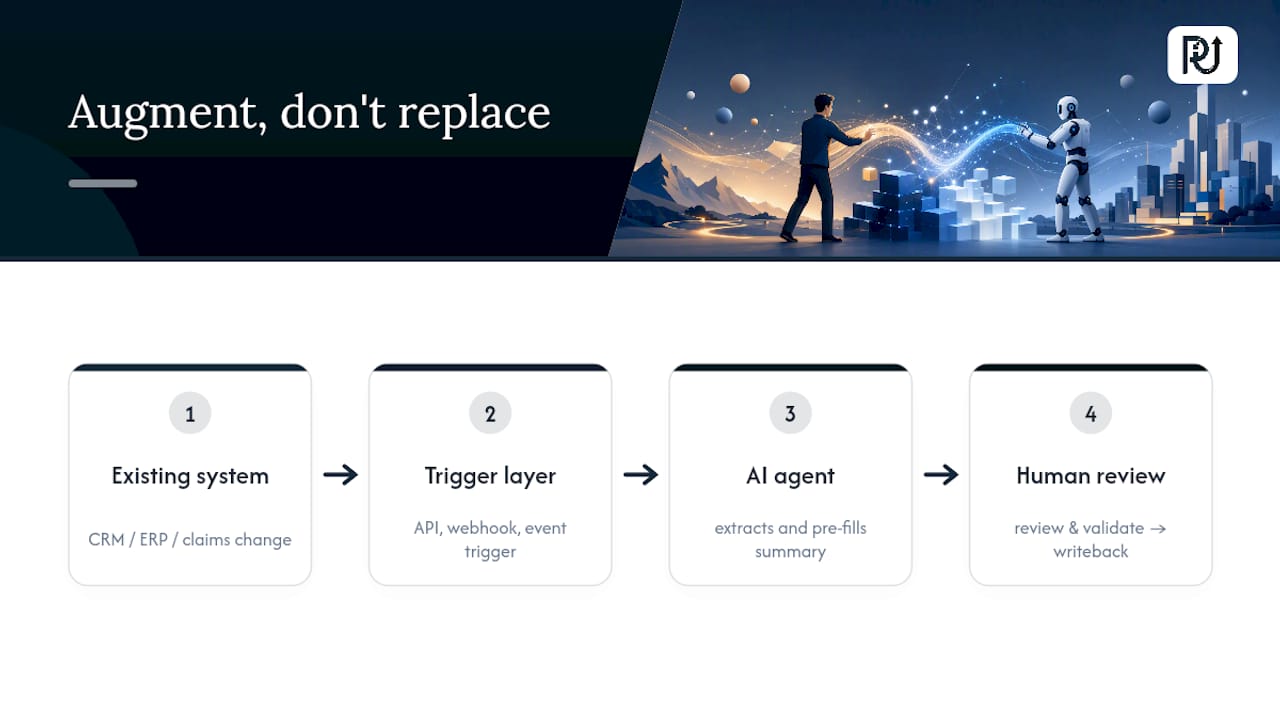
The mistake most leaders make is treating AI integration as a separate project that runs parallel to existing operations. It doesn’t work that way in practice. The systems your team already relies on, your CRM, your ERP, your claims platform, are the environment any new AI agent has to operate inside, not replace.
That means integration planning starts with an inventory of what already exists: which systems hold the source data, which ones need to receive outputs, and where human review currently sits in the workflow. An AI agent that reads incoming documents but can’t write validated data back into your existing database isn’t finished. It’s a demo.
The workflows that succeed keep the human decision point exactly where it currently sits, just faster. A claims processor who used to spend 20 minutes per file manually extracting data now reviews a pre-filled summary in two minutes. The job doesn’t disappear. It changes shape. Leaders who frame integration this way, augmenting a process rather than replacing a role, tend to get less internal resistance and faster adoption.
The technical side matters too. APIs, webhooks, and event triggers determine how cleanly a new agent slots into legacy software. Trigger-based automation is often the connective layer that lets an AI agent respond to a change in one system, say, a new claim filed, and act inside another without a person manually kicking off the process. Get that plumbing wrong and even a well-built agent sits idle waiting for someone to remember to run it.
What Happens After the Consultant Leaves?
A build that gets handed over and never touched again is a build that starts decaying the day it ships. Data schemas change, APIs get deprecated, and the rules your agent follows today may not match your business six months from now. Post-engagement support isn’t a nice-to-have add-on. It’s the difference between a system that keeps paying off and one that quietly breaks and gets blamed on “the AI.”
The better engagements build a review cadence into the handover itself: a 30-day check-in to catch early friction, then quarterly reviews to reassess whether the automation still matches the workflow it was built for. Consulting engagements that tie recommendations to quantified savings and ship production-ready systems tend to outperform slide-deck-only proposals precisely because someone stays accountable for the number after launch, not just at the pitch stage.
Ask any consultant what happens on day 31. If the answer is “call us and we’ll scope a new project,” that’s a different relationship than one built around a retainer or a defined support window. Neither is automatically wrong, but you should know which one you’re signing up for before the invoice arrives. The strongest setups also document why a rule exists inside the system, not just what it does, so your internal team can make small adjustments without waiting on an outside vendor for every minor change.
Continuous improvement, in practice, usually means monitoring dashboards that flag when an agent’s accuracy drifts, plus a defined process for updating rules as your business changes. That’s infrastructure work as much as it’s a service commitment.
Why POW IT UP Builds Automation This Way
Most consulting engagements fail at handover, not at the build. POW IT UP operates as strategic technical architects, meaning the people who audit your workflow are the same people who ship the integration, which is exactly the alignment service businesses need from AI architects in a market full of proposal-only vendors. Productized tools like DocuPOW, for document reading and validation, and AuraPOW, for portfolio monitoring and client health analytics, exist because the same document-intake and monitoring patterns show up across fintech, healthcare, and professional services engagements repeatedly. Build production systems, not decks.
— Syed Naveed Abbas
Start With a Fixed-Scope Audit, Not a Guess
POW IT UP runs a fixed-scope diagnostic audit before recommending anything, which means you get a scored list of automation candidates and real cost estimates before committing to a build. No open-ended discovery phase that drags for months.
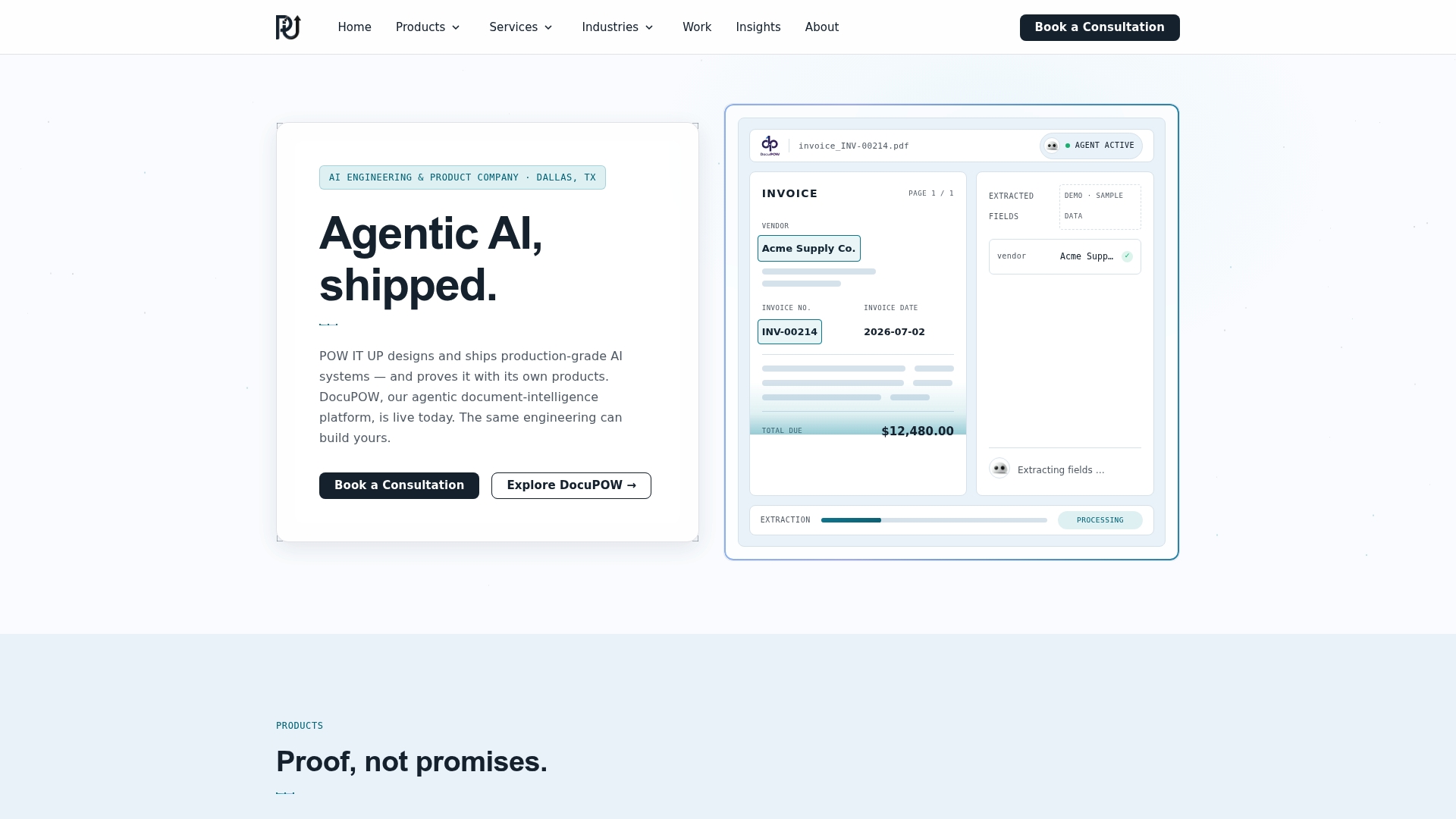
The first call covers three things: a walkthrough of your highest-volume manual workflows, a rough ROI estimate on the top two or three candidates, and a straight answer on whether a productized tool like DocuPOW fits your document volume or whether you need a custom build. You’ll leave that call with a number, not a vague promise about “exploring possibilities.”
If document intake, claims review, or client onboarding is eating hours your team could spend elsewhere, the next step is a conversation, not another internal debate about whether AI is worth the investment. Visit the AI integration services page to see the scope of what a custom build looks like, and book a diagnostic audit to get a specific number for your operation instead of an industry average.
Sources
- The AI Infrastructure Stack Is Being Rewritten For The Agentic Era — Forbes
- Beyond model building: AI as enterprise infrastructure — KPMG
- How AI Is Changing Businesses’ Infrastructure Strategies — BizTech Magazine
FAQ
What Is an AI Business Consultant?
An AI business consultant audits your workflows, identifies where automation or AI agents would save measurable time or money, and builds or oversees the system that delivers it, typically ending with a working, handed-over production system rather than just recommendations.
How Much Does an AI Consultant Cost?
A scoped diagnostic audit generally runs in the low four figures, while a small production build with one or two integrations typically starts in the low five figures; larger, multi-system engagements cost more depending on integration complexity and compliance needs.
What Is the 30% Rule in AI?
There’s no single, universally recognized “30% rule” in AI consulting; if you’ve seen the term used, it usually refers informally to a specific vendor’s or firm’s internal benchmark rather than an industry-wide standard, so ask any consultant citing it to define their exact methodology.
What Should I Look For in an AI Consulting Firm?
Look for firms that can show a working system in production, not just a demo, along with clear IP ownership terms, defined acceptance criteria, and a measurement plan tied to hours saved or revenue recovered. POW IT UP structures engagements around exactly these deliverables, from audit through handover.