

An intelligent automation framework combines deterministic orchestration, AI modules, and governance controls to turn manual, repeatable work into measurable, autonomous processes. It matters now because scaling automation without a data foundation and governance layer creates risk faster than it creates value. The frameworks that succeed treat governance as infrastructure, not paperwork, from day one.
TL;DR:
- Strengthening data quality and governance early in pilots accelerates transition to production and improves long-term ROI.
- Frameworks must support dynamic governance, real-time monitoring, and separation of deterministic control from AI reasoning to scale safely.
- Successful automation involves full process automation, not just individual tasks, to maximize efficiency and reduce exceptions effectively.
- Building integration, governance, and data cleanup into the initial design prevents costly rework during scaling.
- Adaptive process orchestration and agentic AI are emerging maturity levels that require planning and investment now to maintain competitive advantage.
Table of Contents
- Core components and architecture of intelligent automation frameworks
- Benefits and measurable outcomes decision-makers should expect
- What to look for in a framework: evaluation criteria and checklist
- Use cases by function and industry
- Implementation roadmap: pilot to production to scale
- Trust, governance, and risk controls aligned with NIST guidance
- The evolution and future: adaptive process orchestration and agentic AI
- How POW IT UP approaches frameworks: practical patterns and proof points
- When timing and complexity justify a framework investment
- Getting your framework built right the first time
- Authoritative resources and frameworks to read next
- Sources
- FAQ
Core components and architecture of intelligent automation frameworks
An intelligent automation framework is not a single tool. It is a stack of components that each handle a different job, connected through an orchestration layer that decides what happens next.
The main building blocks are:
- Robotic process automation (RPA): handles rule-based, repetitive tasks like data entry and file transfers.
- BPM and orchestration engines: sequence multistep processes and enforce business rules deterministically.
- Machine learning and large language models: add reasoning, classification, and language understanding to otherwise rigid workflows.
- Intelligent document processing (IDP): reads and extracts data from unstructured documents such as invoices or claims forms.
- Integration platforms (iPaaS): connect the framework to existing systems of record like ERPs and CRMs.
- Data layer: stores, cleans, and governs the information every other component depends on.
EY frames this as a seven-layer blueprint that runs from systems of record through an AI-native foundation, intelligence, trust, processes, workforce, and customer layers. Each layer builds on the one before it, which is why skipping the data or trust layers tends to stall projects later rather than sooner.
A key architectural decision is to separate deterministic orchestration from agentic, nondeterministic control. Typically, a workflow engine remains the authoritative controller of a process, while AI agents act as reasoning services it calls and validates, not the other way around.
Benefits and measurable outcomes decision-makers should expect
The business case for intelligent automation rests on a handful of measurable outcomes rather than vague productivity claims.
Track these from the first pilot:
- Throughput: cases or transactions processed per hour or day.
- Error reduction: exception rate compared to the manual baseline.
- Cost per case: fully loaded cost of processing one transaction end to end.
- Reclaimed employee time: hours redirected from repetitive work to judgment-based tasks.
Enterprises that strengthen data foundations and governance move from pilots to production faster and see stronger, sustained returns, according to the 2025 ISG State of Enterprise AI Adoption report. That single finding explains why so many pilots deliver a good demo but never reach production: the governance and data work gets deferred instead of built in.
Set a measurement cadence early: weekly during the pilot, monthly once in production. Pilots typically prove value on a narrow process within a defined test window, while production-grade ROI depends on how well governance and data foundations were built during the pilot, not just on the automation logic itself.
What to look for in a framework: evaluation criteria and checklist
Choosing a framework means testing it against six areas, in this order:
- Governance and responsible AI: does it support policy-as-code, human-in-the-loop checkpoints, and dynamic oversight rather than static, one-time approvals?
- Data foundation: does it enforce data quality and semantic clarity at the point of capture, what analysts call data by design, rather than cleaning data after the fact?
- Integration depth: can it connect to your systems of record through APIs without custom middleware for every new source?
- Observability: does it monitor the actions an AI agent takes, not just the outputs it produces?
- Scalability: can it add processing volume without a proportional increase in engineering effort?
- Extensibility for agentic workflows: can it support AI agents alongside deterministic workflows as the platform matures?
The 2025 ISG report describes this shift as moving governance from static controls to dynamic oversight with real-time monitoring, which is a meaningfully different requirement than most legacy RPA tools were built to meet.
When you talk to a vendor or an internal team, ask direct questions: How is agent behavior logged and reviewed? What happens when an agent’s confidence score falls below a threshold? Who can override an automated decision, and how fast?

Pro Tip: Ask any vendor to show you an audit trail for a single transaction, from trigger to human sign-off, before you ask about pricing.
Use cases by function and industry
Intelligent automation delivers different value depending on where you apply it, but the pattern is consistent: the biggest wins come from automating a full process, not a single task.
- Finance: invoice automation and reconciliation reduce manual matching and shorten the close cycle.
- Customer service: intelligent routing sends complex cases to the right specialist and lets simple ones resolve without a human touch.
- Operations and supply chain: exception handling automation catches shipment or inventory mismatches before they escalate.
- Healthcare and insurance: claims intake and document validation speed up processing while flagging incomplete submissions early.
Success in each case looks the same on paper: fewer manual touches per transaction, a shorter cycle time, and exceptions routed to a person instead of stalling the process. The common failure mode is automating one task in isolation instead of the process around it, which limits the gain to that single step.
Implementation roadmap: pilot to production to scale
Moving from a pilot to a governed production system follows a predictable sequence.
- Discovery and process selection: pick one end-to-end process tied to a real business objective, not the easiest one to automate.
- Pilot design: build the automation with the governance and data controls it will need in production, not as an afterthought.
- Governance controls: define escalation paths, approval gates, and logging before the pilot goes live.
- Rollout: expand to adjacent processes using reusable components rather than rebuilding from scratch.
- Observability: instrument monitoring for both outputs and agent actions from the first day of production.
- Continuous improvement: review performance monthly and retrain or adjust rules as exceptions surface.
EY and Capgemini both recommend starting with a pilot aligned to a strategic goal, then scaling through a library of reusable components rather than one-off builds. The most common blockers are messy data, thin AI or automation talent, and governance treated as a compliance checkbox instead of a design input. Each is easier to fix before the pilot than after it is running.
Pro Tip: Set your success gate before the pilot starts, not after you see the results, so you are not tempted to move the goalposts.
Trust, governance, and risk controls aligned with NIST guidance
Governance is what separates a framework that scales safely from one that creates hidden liabilities.
The NIST AI Risk Management Framework organizes this work into four functions: GOVERN, MAP, MEASURE, and MANAGE. GOVERN sets policy and accountability, MAP identifies where AI is used and what could go wrong, MEASURE tracks performance and risk indicators, and MANAGE responds to issues as they surface. NIST built the framework to be voluntary and practical, meant to be mapped into existing operational controls rather than adopted as a standalone compliance exercise.
In practice, that mapping looks like:
- Lineage tracking: recording where data came from and how it changed at each step.
- Policy-as-code: encoding access and action limits directly into the automation rather than relying on a manual review.
- Human escalation paths: routing low-confidence or high-stakes decisions to a person automatically.
- Drift monitoring: watching for a model’s performance degrading as real-world data shifts away from its training data.
Governance must evolve from static, one-time controls to dynamic oversight with embedded escalation logic and real-time monitoring of AI-driven actions.
2025 ISG State of Enterprise AI Adoption report
Framed this way, governance is not a brake on adoption. It is often the reason a program clears legal and security review fast enough to reach production at all.
The evolution and future: adaptive process orchestration and agentic AI
Adaptive process orchestration (APO) is the next maturity level beyond traditional RPA and BPM, and it is worth planning for now rather than after competitors adopt it.
Forrester describes APO as combining deterministic workflows with AI agents capable of nondeterministic reasoning, unifying both under one orchestration layer. This differs from classic RPA, which only executes fixed rules, and from basic BPM, which sequences steps without adapting to context. Forrester recommends five platform capabilities for APO, including agent creation, agentic orchestration, and built-in governance and data protection.
To get ready:
- Build data by design into new processes so agents have clean, structured inputs from the start.
- Choose platforms that separate deterministic control from agent reasoning, rather than letting a model act as the workflow engine itself.
- Invest in governance and skills now, since APO adoption depends more on operational maturity than on the AI models themselves.
How POW IT UP approaches frameworks: practical patterns and proof points
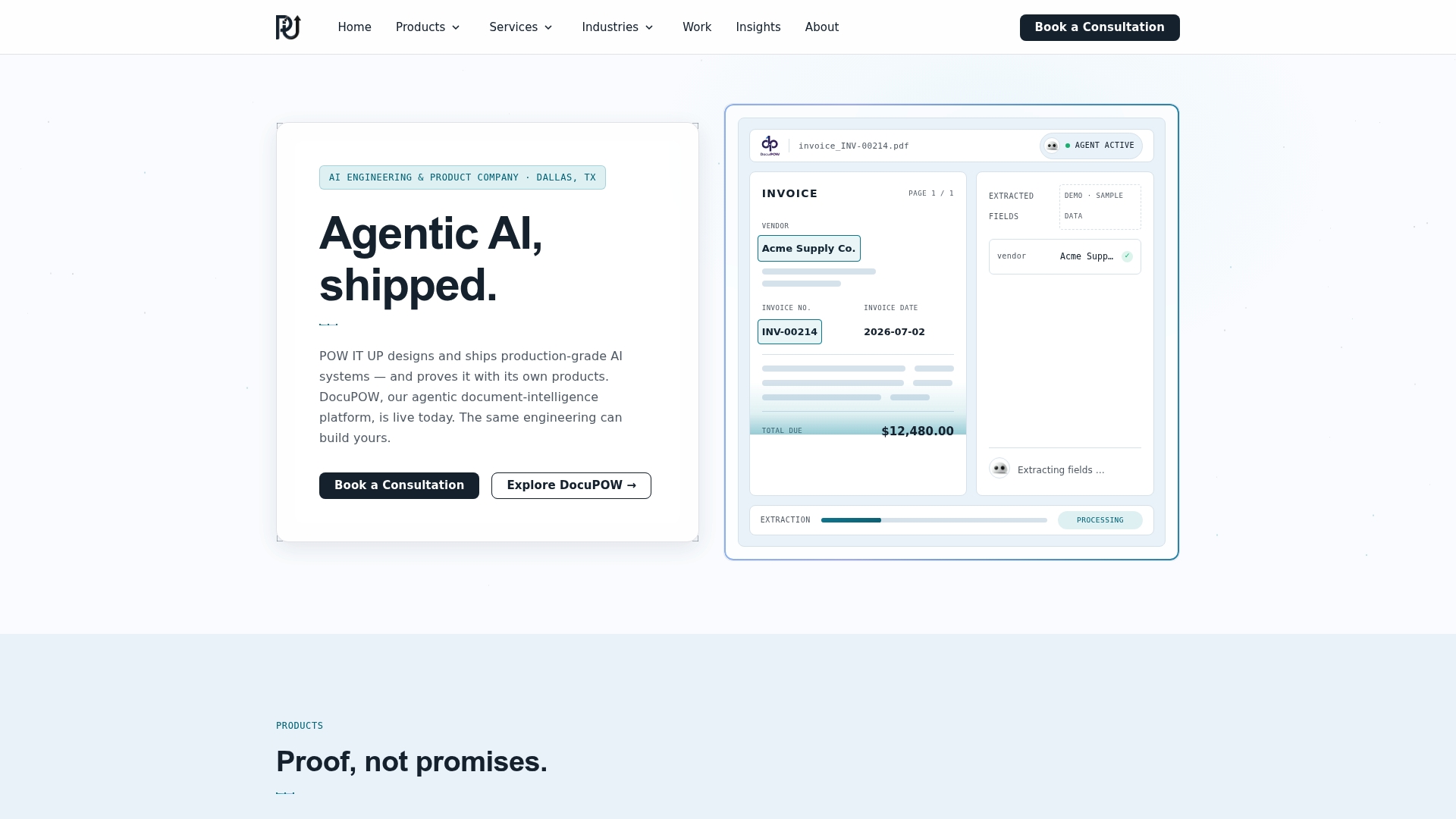
Custom AI agents and automation systems can be built for companies scaling transactional operations, including document intelligence, workflow orchestration, and transaction processing. The DocuPOW product applies these principles directly: automated document reading and validation built on the same separation of deterministic control and AI reasoning described throughout this article.
In production builds, POW IT UP keeps a deterministic engine as the process authority and calls AI agents as governed services, with validation gates and human-in-loop escalation built in rather than added later. Systems are modularized from the start so a client can add processing volume without a proportional rebuild. This mirrors the intelligent workflow automation approach decision-makers are evaluating across the market, applied with engineering accountability and durable client ownership of the resulting system.
When timing and complexity justify a framework investment
A full framework earns its cost when a process spans multiple systems, handles meaningful transaction volume, and needs judgment calls a fixed script cannot make. Below that threshold, a point solution is often faster and cheaper to justify.
The clearest readiness signal is not budget. It is whether a team already has clean, structured data and a named owner for governance decisions. Without both, a framework will surface problems a point solution would have hidden. Move fast where the process is simple and well understood. Move deliberately, with governance built in from the first design review, where the process is complex or customer-facing.
— Syed Naveed Abbas
Getting your framework built right the first time
Most companies lose time not on the automation logic itself but on the integration, governance, and data cleanup that make it reliable. Groundwork for integration, governance, and data cleanup is best built in from the start instead of treated as a cleanup phase later.
Our work spans a few connected offerings:
- DocuPOW: a document intelligence product for automated reading and validation, available for a live demo.
- AI Agents Development: custom, context-aware digital workforce components built for your specific processes.
- AI Integration: connecting new automation to the systems you already run on.
If you are weighing a framework investment against another quarter of manual workarounds, a conversation with our team costs nothing and usually clarifies which processes are worth automating first. Request a demo or consultation to see how this applies to your operation.
Authoritative resources and frameworks to read next
For readers who want to go deeper than this overview allows, these sources cover the technical and strategic ground in more detail.
- The NIST AI Risk Management Framework lays out the GOVERN, MAP, MEASURE, MANAGE structure referenced throughout this guide.
- Forrester’s report on agentic process management explains the platform capabilities APO requires.
- EY’s seven-layer blueprint offers a structured way to sequence transformation layers.
- The 2025 ISG State of Enterprise AI Adoption report grounds governance recommendations in data foundation practice.
- WVE Labs’ guidance on AI app development covers practical controls relevant to teams building AI features in-house.
Sources
- Artificial Intelligence Risk Management Framework (AI RMF 1.0)
- Reimagining Automation: The Need For Agentic Process Management
- AI transformation: seven-layer blueprint for ROI | EY – US
- 2025 ISG State of Enterprise AI Adoption report
FAQ
What are some examples of intelligent automation?
Common examples include invoice processing that reads and validates data from scanned documents, customer service systems that route tickets based on intent, and claims intake tools that check submissions for completeness before a human reviews them. Each combines document or language understanding with a rules-based workflow that decides what happens next.
What are the types of automation frameworks?
Frameworks generally fall into rule-based RPA, BPM and orchestration engines, and newer intelligent or agentic frameworks that add AI reasoning on top of deterministic control. The Forrester report on agentic process management describes adaptive process orchestration as the emerging category that unifies these approaches.
What are some popular intelligent automation platforms?
The market includes established RPA vendors, BPM and orchestration platforms, and newer agentic automation tools, with capabilities varying widely on governance and data handling. POW IT UP’s DocuPOW is one example built specifically for document intelligence and validation within this category.
What is intelligent automation?
Intelligent automation combines rule-based automation like RPA with AI capabilities such as machine learning and document understanding, coordinated through an orchestration layer. The goal is handling both predictable, repetitive work and tasks that require judgment or unstructured data, within a single governed system.