

Automation, used to create capacity rather than only cut cost, is a scalable engine for business growth. Organizations that rewire workflows around automation capture greater bottom-line impact than those that simply bolt automation onto existing tasks, and this effect has been observed with various clients in the industry. Start with one high-volume, well-defined process and run a focused pilot before scaling further.
TL;DR:
- Scaling automation around redesigned workflows produces greater bottom-line impact than automating individual tasks alone.
- High-volume, repeatable processes with clean data, such as invoice matching or order processing, are ideal first candidates for automation pilots.
- Continuous governance, KPI tracking, and phased implementation are critical to sustainable, scalable automation growth.
- The most effective automation generates measurable capacity, enabling teams to handle more work without additional hiring or costs.
- Focusing on high-impact areas like finance, customer operations, and document-intensive tasks delivers the fastest return on automation investments.
Table of Contents
- What business automation means when growth is the goal
- Key components and types of automation to know
- How automation produces measurable business growth
- High-value application areas and where to look first
- Implementation roadmap: from pilot to scale
- Risk management and governance for safe scaling
- What research and practitioner evidence says
- POW IT UP perspective and proof points
- How POW IT UP can help you build capacity
- Sources
- FAQ
What business automation means when growth is the goal
Business automation covers a spectrum of technologies: workflow automation that routes and tracks tasks, robotic process automation (RPA) that mimics repetitive clicks and data entry, intelligent automation that adds document understanding and decision logic, and agentic AI that plans and executes multistep work with limited human oversight. Most companies still treat these tools as a way to trim headcount or shave costs off a single task. That framing caps the upside.
Capacity creation asks a different question: how much more work can the same team handle without adding people. Say a claims team processes 500 cases a month and automation cuts manual handling time by half. Instead of laying off staff, the team now absorbs 1,000 cases a month at the same headcount, and the business can take on new clients or product lines without a hiring cycle.

McKinsey’s research on AI adoption found that redesigning the workflow itself, not just automating an isolated task, is the single attribute most associated with bottom-line impact. High performers use that redesigned capacity to absorb transaction growth and redeploy staff toward higher-value work.
The technologies worth knowing before you plan a pilot:
- RPA: scripted bots that handle structured, rule-based tasks like data transfer between systems.
- Workflow automation: orchestration layers that route approvals, notifications, and handoffs across teams.
- Intelligent automation: RPA combined with document intelligence or machine learning to handle semi-structured inputs.
- Agentic AI: autonomous agents that make decisions, call tools, and complete multistep processes with human checkpoints.
Key components and types of automation to know
Choosing the right technology depends on volume, variability, and how clean the underlying data is. A process with high volume and low variability, like invoice matching, is a strong RPA candidate. A process with high volume but variable inputs, like customer emails or scanned contracts, needs intelligent automation or document AI to extract meaning before any rule can act on it.
Process mining sits upstream of all of this. It maps how work actually flows through your systems today, often revealing bottlenecks nobody documented. Skipping this step is how companies end up automating a broken process and locking in its inefficiencies.
Orchestration ties the pieces together. A single customer request might trigger an RPA bot, a data lookup, an agentic AI decision, and a human review step in sequence. Without an orchestration layer, these components operate as disconnected point solutions that need constant manual stitching.
A short taxonomy for mapping tools to problems:
- RPA: best for high-volume, low-variability, rule-based tasks with clean structured data.
- Intelligent automation: fits high-volume tasks with semi-structured inputs like PDFs, emails, or scanned forms.
- Agentic AI: suited to multistep decisions that require judgment, tool use, or coordination across systems.
- Process mining: a diagnostic step that reveals where automation will have the biggest effect before you build anything.
Architecture matters as much as the automation logic itself. Any serious deployment needs stable integrations with existing systems of record, a data pipeline that keeps inputs clean and current, monitoring that flags failures before they cascade, and governance hooks that log decisions for audit and review. Skipping any one of these turns a promising pilot into a maintenance burden within a year.
How automation produces measurable business growth
Automation drives growth through a few concrete mechanisms: higher throughput per employee, shorter cycle times, fewer errors reaching customers, and freed-up capacity to take on more business without proportional hiring. Each of these converts into a number a leadership team can track.
Organizations that redesign workflows around automation, rather than automating isolated tasks, see the largest EBIT impact from their AI and automation investment, according to McKinsey’s state-of-AI research. That single finding reframes the whole conversation: the tool matters less than whether the surrounding process was rebuilt to use it.
Deloitte’s survey work on generative AI adoption points the same direction from a different angle: organizations that track KPIs and follow a phased road map report a higher likelihood of capturing return on scaled automation initiatives than those that roll out broadly without measurement discipline.
A practical KPI set for leaders evaluating automation-led growth:
- Revenue per employee: rises when the same headcount supports more transaction volume.
- Process cycle time: the clearest early signal that automation is working as designed.
- Cases or transactions per FTE: shows capacity gained without new hires.
- Error or rework rate: a drop here often compounds into customer retention gains.
- ARR or revenue uplift: the growth number leadership ultimately cares about.
None of these move on their own. They move because a team redesigned how work flows, then measured the result against a baseline instead of assuming the automation was working.
High-value application areas and where to look first
Not every process deserves automation attention at once. The functions that typically deliver the largest growth lift share three traits: high transaction volume, repeatable steps, and a clear tie to revenue or cost that leadership already tracks.
- Finance and back office: invoice processing, reconciliation, and expense approval are high-volume, rule-heavy, and easy to baseline before and after automation.
- Customer operations: ticket routing, intake triage, and status updates benefit from agentic task routing that matches request type to the right team or resource automatically.
- Document-heavy compliance and onboarding: contract review, KYC checks, and claims intake see a large gain from document intelligence tools that read and validate scanned or unstructured files, an approach similar to what DocuPOW applies to document reading and validation.
- Sales enablement: lead qualification, proposal assembly, and CRM data entry free up sales time for actual selling rather than administrative work.
- IT and operations: recurring reporting, system reconciliation, and ticket escalation are strong candidates because their inputs are already structured and repeatable, a pattern covered in more depth in how AI automates recurring operational deliverables.
A function is ready for automation when three signals line up: the volume is high enough to justify the build cost, the steps are repeatable enough that exceptions are the minority case, and the business value of speeding it up is measurable in dollars or hours, not just convenience. Case-style examples of this pattern, including where ROI showed up fastest, are worth reviewing in service business ROI automation examples.
Implementation roadmap: from pilot to scale
Automation-led growth follows a sequence, not a single deployment. Skipping steps to move faster is the most common reason pilots stall before scale.
- Identify and prioritize pilot candidates. Score candidate processes on volume, risk exposure, and data readiness. A process with messy, undocumented data is a poor first pilot no matter how much time it currently consumes.
- Design the pilot with clear KPIs and a fixed timeframe. Set a baseline before automation touches the process, define what success looks like in numbers, and build in TEVV, testing, evaluation, verification, and validation, from day one rather than retrofitting it after launch, following the approach described in the AI RMF Playbook.
- Assign governance roles before scaling. A steering committee sets priorities, a product owner manages the automation itself, and an operations owner is accountable for the process it touches. Without this split, accountability for failures becomes unclear fast.
- Apply a go or no-go checklist before scaling. Confirm the pilot hit its pre-agreed ROI threshold, confirm the system has run stably across a full business cycle, and confirm the exception rate is low enough that human review does not become a new bottleneck.
Pro Tip: Limit your first pilot to one well-mapped process, compare it against a fixed baseline instead of gut feel, and require a pre-agreed ROI threshold before anyone talks about scaling it.
Governance is not a compliance afterthought bolted on at the end. Building TEVV and role clarity into the pilot from the start is what makes the go or no-go decision fast and defensible instead of political.
Risk management and governance for safe scaling
Scaling automation without governance is how a promising pilot turns into an incident report. The NIST AI Risk Management Framework organizes this work into four continuous functions rather than a one-time checklist: Govern, Map, Measure, and Manage.
- Govern: establishes senior-level accountability, policies, and resourcing for AI risk management across the organization.
- Map: identifies context, intended use, and risk factors for each automated process before deployment.
- Measure: applies metrics and testing, including TEVV, to track performance and risk over time.
- Manage: responds to identified risks with monitoring, incident response, and corrective action as conditions change.
Translated into daily operations, this means supplier due diligence before adopting any third-party AI component, TEVV testing before and after launch, ongoing monitoring rather than a one-time audit, a documented incident playbook for when an automated decision goes wrong, and privacy safeguards for any process touching customer or employee data. Agentic systems need an extra layer here: staged autonomy increases with human-in-the-loop fallbacks, since an agent that can take multistep action without oversight carries more risk than a script that only moves data.
Governance done well speeds adoption rather than slowing it. A steering committee that already knows how to evaluate risk can approve a well-governed pilot for scale in weeks instead of months, because the evidence and controls are already documented.
What research and practitioner evidence says
Three independent bodies of work point toward the same conclusion from different angles, and together they validate the roadmap above.
- McKinsey: value comes from redesigning workflows around automation, not from automating a task in isolation, and this single factor correlates most strongly with EBIT impact according to McKinsey’s state-of-AI findings.
- Deloitte: phased adoption paired with governance and consistent KPI tracking correlates with a higher likelihood of capturing ROI, while layering automation onto an unmapped or broken process reduces the odds of success, per Deloitte’s generative AI survey.
- NIST: trustworthy scaling requires continuous risk management across the AI lifecycle, not a single approval gate, as laid out in the AI Risk Management Framework.
Larger organizations with formal road maps and dedicated governance teams report being further along in scaling their automation and AI initiatives than those without them, according to Deloitte’s survey findings, which underscores why structure tends to outperform speed alone.
Read together, these three sources make a consistent case: pick the process carefully, redesign the workflow rather than just automating the old one, govern it continuously, and measure it against a real baseline. Skip any one of these and the odds of durable growth drop sharply.
POW IT UP perspective and proof points
Most automation projects fail to move the growth needle because they target visible busywork instead of the quiet, high-volume “time leaks” draining capacity across finance, operations, and customer service. Some firms build digital workforces designed to address operational bottlenecks, using autonomous, context-aware agents intended to absorb transaction growth rather than just shorten a single task.
Certain client engagements have reported ARR growth within months, driven by automation strategies that freed staff to take on more billable and revenue-generating work instead of administrative overhead. Such patterns appear in projects using document intelligence and custom AI agents that read documents, validate them, route exceptions, and let people handle only cases needing judgment.
— Syed Naveed Abbas
How POW IT UP can help you build capacity
Most automation vendors sell you a script. POW IT UP designs a digital workforce built around your actual bottlenecks, so the capacity you gain compounds instead of leaking back out within a year.
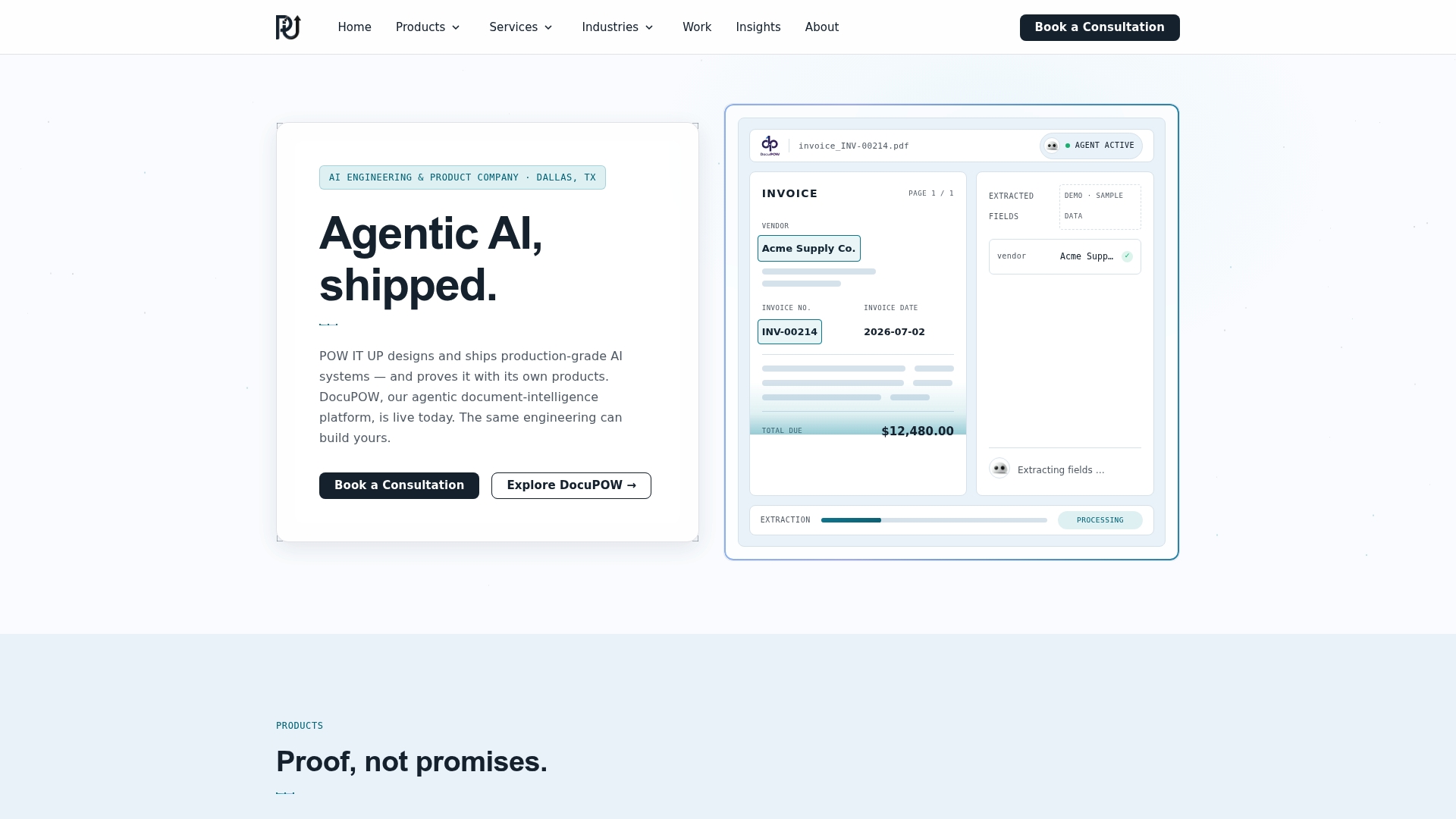
- DocuPOW reads and validates documents automatically, a fit for any team drowning in contracts, claims, or onboarding paperwork.
- AI Agents Development builds custom, context-aware agents that handle multistep decisions rather than a single scripted task.
- AI Integration connects new automation into the systems you already run, without ripping out what already works.
If you are weighing a first pilot, request a technical diagnostic or a live demo of DocuPOW to see how document automation performs against your own volume. For teams ready to move on a custom build, AI Agents Development is the natural next step toward a digital workforce built around your specific time leaks.
Sources
- The state of AI: how organizations are rewiring to capture value
- Artificial Intelligence Risk Management Framework (AI RMF 1.0)
FAQ
What is automation-led business growth?
Automation-led business growth means using automation to create capacity, letting the same team or budget handle more transaction volume, rather than using it only to cut costs. Organizations that redesign workflows around automation, instead of automating isolated tasks, capture the largest gains, according to McKinsey’s research.
What is the difference between RPA and agentic AI?
RPA follows fixed rules to handle structured, repetitive tasks like moving data between two systems. Agentic AI makes multistep decisions, calls tools, and adjusts its actions based on context, which suits more variable or judgment-heavy processes.
How do I choose the first process to automate?
Pick a process with high transaction volume, repeatable steps, and clean, well-mapped data, since messy or undocumented processes make poor first pilots. Score candidates against these criteria before committing budget, and set a measurable baseline before automation touches the workflow.
Why does governance matter for automation projects?
Continuous governance, following frameworks like NIST’s AI RMF, catches risks before they become incidents and gives leadership the evidence needed to approve scaling faster. Skipping governance tends to slow adoption later, since problems surface without a documented process to resolve them.
How does POW IT UP support automation-led growth?
POW IT UP designs custom AI agents and automation systems, including DocuPOW for document processing and AI Agents Development for building digital workforces, aimed at creating capacity rather than only cutting costs.