
Custom Workflow Engineering is the practice of building production-grade, agentic AI systems, as opposed to configuring low-code workflow builders, using standards like the NIST AI RMF to orchestrate agents, integrations, and observability so companies can scale transactional work without adding headcount. It fits organizations with high-volume, document-heavy, or case-processing operations. The right signal to pursue it: your transaction volume is growing faster than your team, and your data sources are clean enough to feed an agent reliably.
TL;DR:
- A well-engineered custom workflow requires clear separation of concerns, including dedicated agents, orchestration layers, memory stores, and verified data sources for durability and flexibility.
- Most failures originate from poor data quality, governance added after deployment, and inadequate observability that prevents early error detection in multi-step processes.
- Governance should be established before launch with documented roles, escalation thresholds, and Conditional Access policies tied to each agent’s security attributes.
- The typical rollout progresses through discovery, pilot, and industrialization stages, with KPIs like data quality, throughput, and error rates used to measure success at each phase.
- Vendors must provide detailed architecture diagrams, observability specifications, and testing artifacts before signing contracts, ensuring transparency and control over deployment.
Table of Contents
- Why custom workflow engineering pays for itself
- Core architecture checklist for production-grade agentic workflows
- Governance and security for agent fleets
- Pilot-to-production roadmap with milestone KPIs
- Implementation checklist for procurement and technical buyers
- What delivery engagements actually teach you
- How POW IT UP builds this without the headcount cost
- Sources
- FAQ
Why custom workflow engineering pays for itself
The business case rests on where the value actually comes from. Out of 25 organizational attributes tested in one analysis, workflow redesign, not simply layering AI tools onto existing processes, produced the largest impact on bottom-line value. That matters because most companies buy point tools first and redesign later, if at all.
The processes that benefit most share a pattern: high volume, repeatable structure, and a paper trail. Document intake and validation, insurance claims triage, order orchestration across fulfillment systems, and multi-step case management all fit. Savings show up in three places: fewer manual touches per transaction, lower error rates from consistent rule application, and faster cycle times that let the same staff handle more volume.
McKinsey’s 2025 research found that roughly 23% of organizations report scaling an agentic system in at least one function, meaning most companies are still experimenting rather than running agents in production.
Expected outcomes from a well-engineered rollout:
- Lower cost per transaction as agents absorb repetitive steps
- Fewer downstream errors from standardized decision logic
- Shorter time-to-resolution on case-based work
- Headcount that scales with strategy, not transaction volume
Core architecture checklist for production-grade agentic workflows
A durable system separates concerns instead of bundling everything into one model call. Five components form the baseline: agents that execute specific tasks, an orchestration layer (sometimes called an agentic mesh) that routes work and enforces sequencing, a memory or state store that persists context across steps, integration adapters that connect to existing systems, and grounding sources that supply verified data rather than model guesses.
Decoupling logic, memory, and interfaces keeps the system durable. When a vendor or model changes, you replace one layer instead of rebuilding the whole pipeline, and you avoid being locked into a single provider’s proprietary format.
Observability is where most production failures actually get caught, or missed. Practitioner guidance on AI observability points to a recurring cause: systems that only log outputs, not the reasoning traces and state behind them, cannot explain why an agent made a decision, which makes root-cause analysis nearly impossible once errors compound across steps.
Ask a vendor to produce these artifacts before signing anything:
- A canonical data contract defining every field an agent reads or writes
- A full list of API adapters and the systems they touch
- An architecture diagram showing agent, orchestration, memory, and integration boundaries
- A sample of reasoning traces and session logs from a test run
Without these, you are buying a black box that happens to work today.
Governance and security for agent fleets
Agentic systems fail differently than traditional software. A single bad decision does not just produce a wrong answer, it can trigger a chain of downstream actions before anyone notices. Deloitte’s guidance on agentic AI orchestration treats orchestration and governance as early, not optional, steps, warning that multi-step workflows compound hallucination risk unless human judgment and explicit decision rights are designed in from the start.
The NIST AI RMF and its Generative AI profile give a usable checklist for this: inventory every model and agent in production, define who owns risk decisions, and document the actions taken when an agent’s confidence falls below a threshold.
Identity matters as much as logic. Microsoft’s Entra guidance recommends treating each agent as its own identity, with a human sponsor, custom security attributes for classification, and Conditional Access policies that scale across a growing fleet rather than being configured one agent at a time.
Minimum governance checks before launch:
- Every agent has a named sponsor and a documented lifecycle, including offboarding.
- Escalation thresholds trigger human review before an agent takes an irreversible action.
- Incident response has an owner and a tested runbook, not just a policy document.
- Red-teaming runs before launch and on a recurring schedule after.
Pro Tip: Require a Conditional Access policy tied to each agent’s custom security attribute before it touches production data, not after.
Pilot-to-production roadmap with milestone KPIs
Most agentic projects move through three phases: discover, pilot, and industrialize. Discovery produces a sandbox environment and a data readiness assessment. Pilot adds a test harness and a canary release plan that limits exposure to a low-risk slice of transactions. Industrialization scales the canary into full production with monitoring in place.
Track different KPIs at each stage:
- Discovery: data quality score and integration coverage.
- Pilot: throughput, human-override rate, and cost per transaction.
- Industrialize: time-to-resolution and error rate at full volume.
Mid-market projects typically run leaner teams that combine engineering and operations roles, while enterprise projects tend to staff dedicated security and SRE functions earlier because of scale and compliance exposure.
The most common failure modes trace back to three gaps: data that looked clean in a spreadsheet but breaks integration at scale, governance built after launch instead of before, and observability that was scoped out to save time. McKinsey’s analysis found that organizations pairing workflow redesign with formal acceptance criteria and human validation points show the strongest correlation with bottom-line impact, which suggests skipping those steps to move faster tends to backfire.
Implementation checklist for procurement and technical buyers
Before signing a statement of work, require a defined set of deliverables and roles. This is also where organizational readiness for production deployment gets tested, since a vendor with no answer for ownership after launch is a vendor planning to disappear after handover.
Minimum deliverables:
- Full architecture diagram covering agents, orchestration, and integrations
- Observability specification listing what gets logged and where
- Runbooks for common failure scenarios and escalation paths
- A test suite covering both synthetic and production-like data
- A service level agreement and a documented handover plan
Ongoing operation needs named roles: an agent steward who owns the fleet’s behavior, an SRE responsible for uptime, and a security sponsor accountable for identity and access decisions. Contract terms should cover IP ownership, maintenance windows, incident responsibilities, and clear acceptance criteria for any demo.
Pro Tip: Insist on sandboxed acceptance tests using synthetic data before any agent touches a live transaction. It catches integration gaps a demo environment hides.

What delivery engagements actually teach you
Working across AI Agents Development and integration engagements surfaces the same patterns repeatedly. Governance built after launch always costs more than governance built before it. Observability gaps hide small errors until they compound into large ones. And projects without a named business owner for the agent’s decisions tend to stall at the pilot stage, regardless of how good the model is.
The leadership action that moves the needle: name a sponsor, set measurable KPIs before the pilot starts, and fund observability as part of the build, not as an afterthought.
— Syed Naveed Abbas
How POW IT UP builds this without the headcount cost
POW IT UP designs and deploys the systems this article describes: custom AI agents through AI Agents Development, the integration layer connecting agents to your existing stack through AI Integration, and document-heavy pipelines through DocuPOW, our document intelligence product with a live demo available.
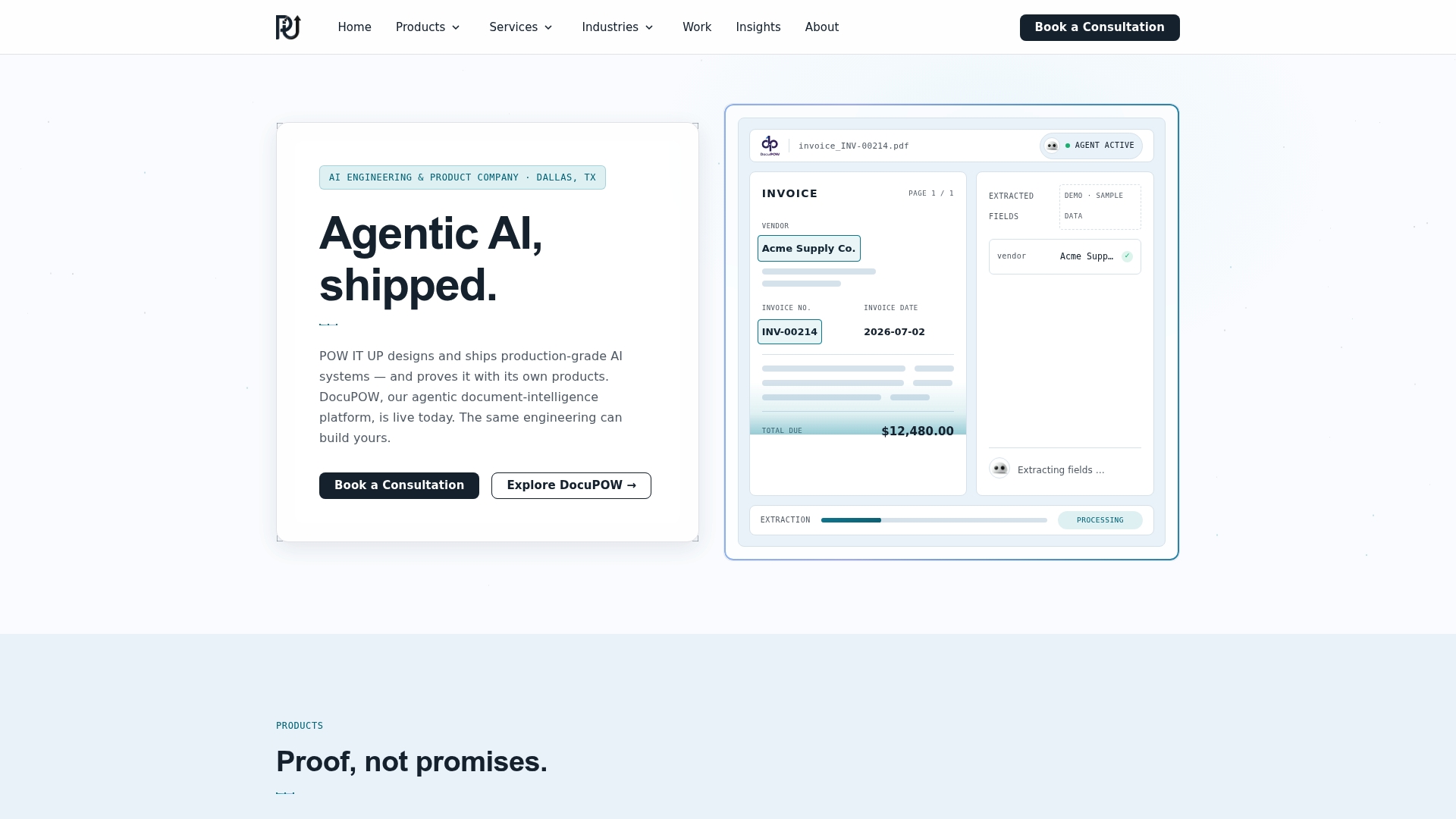
A discovery engagement typically produces an architecture proposal and a data readiness assessment before any build begins, so you know what you’re committing to before you commit to it. For governance frameworks specific to your industry, resources like MARFI’s secure AI and workflow automation guidance offer additional depth worth reviewing alongside your own vendor’s approach.
If your transaction volume is outpacing your team, start a discovery conversation with POW IT UP.
Sources
- NIST — Artificial Intelligence Risk Management Framework: Generative AI profile
- Microsoft Entra — Configure Microsoft Entra agent identities for increased security
- McKinsey — The state of AI 2025 (agents & innovation)
FAQ
What is Custom Workflow Engineering exactly?
It is the custom design and build of production-grade AI agent systems, including orchestration, memory, integrations, and observability, that automate high-volume transactional work. It differs from configuring an off-the-shelf workflow builder because every layer is engineered for your specific data and systems.
How long does a pilot-to-production rollout take?
Timelines vary by data readiness and integration complexity, but the path generally moves through discovery, a limited pilot, and a staged industrialization phase before full production. Organizations with clean, well-documented data sources tend to move through these phases faster than those still cleaning up legacy systems.
What causes most agentic AI pilots to fail?
The most common causes are poor data readiness, governance controls added after launch instead of before, and missing observability that lets small errors compound across multi-step workflows. McKinsey’s research found that formal acceptance criteria and human validation points distinguish organizations that capture real value.
Does POW IT UP offer a document processing product?
Yes, DocuPOW is POW IT UP’s document intelligence product built for reading and validating documents at scale, with a live demo available on request. Pricing details are available on request through the product page.
What security controls should an agent fleet have?
Each agent should have its own identity with a named sponsor, lifecycle management, and Conditional Access policies tied to its classification, following guidance from Microsoft’s Entra team. Escalation thresholds and incident response ownership should be documented before launch, not added afterward.