
Human-in-the-loop (HITL) is a design approach where a person reviews, corrects, or approves an AI system’s output at a defined point before that output becomes final. It exists because models still get edge cases wrong, and because some decisions (medical, legal, financial, safety-critical) require a person to own the call. Any team deploying automation into a regulated or high-stakes workflow needs an explicit HITL design, not an informal habit of “someone will check it.”
TL;DR:
- Human-in-the-loop systems must route uncertain or ambiguous cases to reviewers and balance uncertainty sampling with random sampling to catch systematic errors.
- Effective feedback loops require trace IDs, structured metadata, and timely review cycles to convert labeled data into meaningful model or process improvements.
- Reviewers tend to become complacent or biased, so oversight design must prevent automation bias, fatigue, and stale queues from undermining true evaluation.
- Metrics like cycle time to fix, judge-human agreement, and label-to-fix ratio are essential to prove oversight effectiveness and ensure accountability.
- Building HITL into AI workflows from the start avoids costly retrofitting and ensures review roles, sampling policies, and routing mechanisms support actionable feedback.
Table of Contents
- What Is Human-in-the-Loop, and How Does It Differ From Related Terms?
- When Does Human-in-the-Loop Actually Pay Off?
- What Design Patterns Do Teams Actually Use to Build Feedback Loops?
- How Do You Build an Annotation Pipeline That Actually Ships Fixes?
- Where Does Human Oversight Actually Break Down?
- What Should You Measure to Prove Human Oversight Is Working?
- What Does a Working Feedback Loop Look Like in Practice?
- Where Human Oversight Actually Belongs in AI Practice
- How POW IT UP Helps You Build a Feedback Loop That Actually Ships Fixes
- Sources
- FAQ
What Is Human-in-the-Loop, and How Does It Differ From Related Terms?
People use “human-in-the-loop” loosely, but the term has real technical siblings, and mixing them up leads to bad architecture decisions. Human-in-the-loop means a person sits inside the operational path: the system pauses, routes to a reviewer, and waits for a decision before proceeding. Human-on-the-loop means the human supervises in real time but the system runs autonomously unless someone intervenes, closer to a monitor watching a dashboard than a gatekeeper approving each transaction. Human-out-of-the-loop means the system runs without a person able to intervene during execution at all, sometimes by design, sometimes by neglect.
Stanford HAI frames the choice to keep humans in the loop as intentional. The point isn’t to add a rubber stamp. It’s to preserve a person’s actual ability to catch, question, and override a decision before it does damage.
Each variant tends to show up in different domains:
- Human-in-the-loop: model training with active learning, content moderation queues, loan underwriting, clinical decision support.
- Human-on-the-loop: live simulation environments, fraud monitoring dashboards, fleet or drone supervision.
- Human-out-of-the-loop: low-risk personalization engines, spam filtering, autocomplete.
Role names matter too. An operator executes routine interventions. A reviewer evaluates sampled outputs against a rubric. An overseer holds authority to stop or redirect the system entirely. A subject-matter expert (SME) handles the hardest cases that generalist reviewers escalate. Conflating these roles is a common early mistake: giving a part-time reviewer overseer-level authority, or expecting an SME to handle routine annotation volume, breaks the pipeline fast.
When Does Human-in-the-Loop Actually Pay Off?
HITL earns its cost in three situations: when errors are expensive, when edge cases are common, and when a regulator or auditor will eventually ask who approved a decision, highlighting the need for robust design principles and tooling for interactive AI systems. IBM’s coverage of HITL frames the core value proposition as combining machine efficiency with human judgment specifically for accuracy, safety, and auditability in domains where getting it wrong carries real consequences.
The benefits break down into a few concrete categories:
- Accuracy on the tail: models trained on typical cases still miss rare or ambiguous inputs; a human catches what statistical pattern matching misses.
- Ethical and contextual judgment: a person can weigh nuance (intent, extenuating circumstances, cultural context) that a scoring function can’t.
- Regulatory expectation: many financial, healthcare, and legal workflows require a documented human decision point, not just a model score.
- Continuous model improvement: reviewed cases become training signal, so the system gets better instead of just running in place.
Quick math on the trade-off: reviewer throughput typically runs 50 to 200 traces per day depending on rubric complexity. That number should drive staffing decisions directly. If your queue produces 2,000 flagged cases daily and each reviewer clears 100, you need roughly 20 reviewers just to keep pace, before accounting for calibration time or escalations.
The trade-offs are real: human review adds latency, costs money, and if the review touches personal data, it introduces privacy exposure that a fully automated path wouldn’t have. HITL is a deliberate investment, not a default setting.
What Design Patterns Do Teams Actually Use to Build Feedback Loops?
Four architectural patterns cover most production HITL systems, and picking the wrong one for your use case is the fastest way to waste reviewer time.
- Active learning with uncertainty sampling. The model flags the cases it’s the least confident about and routes those to human reviewers first, rather than sampling randomly. This concentrates human attention where it moves the model most, but it can create blind spots: if the model is confidently wrong in a systematic way, uncertainty sampling never surfaces those cases.
- Random sampling as a backstop. Because uncertainty-based routing misses “confident and wrong” errors, teams need a parallel stream of randomly sampled traces reviewed regardless of model confidence. Operational guidance suggests reserving 10 to 30 percent of the annotation budget for random sampling specifically to catch unknown unknowns.
- RLHF (reinforcement learning from human feedback). Useful when you need a reward model that generalizes human preference across many future outputs, not just a one-off correction. It’s overkill for a simple approve/reject workflow and genuinely necessary when you’re tuning generative behavior at scale.
- LLM-as-judge. A secondary model scores outputs against a rubric, with humans reviewing a sample of the judge’s own decisions. It scales cheaply but introduces a second layer that itself needs calibration, or you’re just automating the review you were trying to keep human.
Every one of these patterns depends on observability: trace IDs attached to every interaction, structured metadata describing what happened, and a record of which judge or reviewer made which call. Without that, feedback data becomes unqueryable within weeks.
Pro Tip: Don’t let your judge model grade its own homework unsupervised. Run a rolling agreement check between the judge and a human reference sample, and treat a sustained drop as a signal to retune, not noise to ignore.
How Do You Build an Annotation Pipeline That Actually Ships Fixes?
A feedback loop only matters if labeled data turns into product changes. Most pipelines stall not at annotation, but at the routing step, where labeled traces pile up without anyone connecting them to an eval suite, a retriever update, or a model swap.
Here’s the operational sequence that keeps a loop moving:
- Capture with context. Preserve a trace ID and structured metadata on every interaction from the start, separating explicit signals (a thumbs-down, a support ticket), implicit signals (a user retrying the same query three times), and reviewer annotations into distinct score types, as recommended in operational guidance on LLM feedback loops.
- Sample deliberately. Blend uncertainty-driven pulls with the random sampling floor described earlier, and size the reviewer pool against realistic throughput of 50 to 200 traces per person per day.
- Set a latency budget. Target single-digit days from trace generation to an applied label. Labels that sit in a queue for weeks lose their connection to the product state that produced them.
- Cap the queue. An unbounded backlog signals that sampling or staffing is misconfigured, not that reviewers need to work faster.
- Route to a destination, not a spreadsheet. Every labeled trace should feed one of: the eval suite, judge calibration, the retriever, or a model or prompt update. If a label doesn’t map to a destination, stop collecting it.
Practical checklist for the routing step:
- Confirm every label has a trace ID before it enters the queue.
- Assign each review outcome an explicit destination tag (eval, judge, retriever, model).
- Review cycle time weekly, not quarterly.
- Kill any feedback channel that hasn’t produced a shipped change in 90 days.
Where Does Human Oversight Actually Break Down?
The most common HITL failure isn’t a missing reviewer. It’s a reviewer who’s present but no longer evaluating anything.
Automation bias is the well-documented tendency for people to defer to a system’s output rather than independently assess it, and it quietly erodes the entire premise of human review. Research on automation bias and oversight design notes that this deference can eliminate a human’s effective evaluative agency even when a person is technically positioned to intervene. A reviewer who rubber-stamps 98 percent of model outputs isn’t providing oversight; they’re providing a compliance checkbox.
Related failure modes compound the problem:
- Oversight fatigue: reviewers burn out on repetitive, low-signal review tasks and start pattern-matching instead of evaluating.
- Sample bias: if only flagged or low-confidence cases get reviewed, the feedback loop never sees systematic, confidently wrong errors.
- Label corruption: inconsistent rubrics or untrained reviewers introduce noise that degrades the very signal the loop exists to capture.
- Stale queues: backlog accumulation means labels arrive too late to inform the decisions that generated them.
Cross-disciplinary oversight research argues that architectures must give overseers an actual, efficient way to verify and intervene. Otherwise the setup creates the appearance of control without real agency. Mitigations that work in practice: rotate SMEs so no single reviewer absorbs all the hardest cases, recalibrate judge models on a fixed schedule rather than reactively, monitor participation rates to catch disengagement early, and simplify feedback channels so reporting an issue takes seconds, not a support ticket.
What Should You Measure to Prove Human Oversight Is Working?
Governance for HITL systems comes down to three questions: what are you measuring, what can you prove after the fact, and who is accountable for the decision. Get those three right and the rest of the governance work follows.
On metrics, three numbers matter more than raw volume:
- Cycle time to fix: days from trace capture to a shipped change, the same single-digit-day target that governs the pipeline itself.
- Judge-human agreement: a rolling Cohen’s kappa between an automated judge and human reference labels; a drop below roughly 0.6 signals the judge needs retuning or replacement.
- Label-to-fix ratio: how many reviewed labels actually produce a shipped model, prompt, or retriever change, which exposes whether your review process is theater or leverage.
On accountability, the FINOS AI Governance Framework treats the human feedback loop as a formal control, recommending defined roles, structured triage, and traceability, not an informal habit. Academic work on oversight design goes further, arguing that meaningful human control should be built as an explicit split between the AI’s operative agency and the human’s evaluative agency, with clear handover points and provenance records showing exactly who decided what and when.
Practical governance steps worth adopting directly: log the identity and competency level of every human overseer against the decisions they approved, require a documented handover point wherever authority shifts from system to person, and audit trail every override so a regulator or internal review can reconstruct the decision path. Teams building this into their AI integration roadmap tend to treat these controls as part of the architecture, not paperwork added afterward.
What Does a Working Feedback Loop Look Like in Practice?
A representative worked example: a document-processing pipeline captures every extraction with a trace ID, tagging confidence scores and field-level metadata at ingestion. Low-confidence extractions and a random 15 percent sample route to a reviewer queue, sized against a 50 to 200 trace-per-day throughput assumption. Reviewers correct or confirm within a single-digit-day latency budget, and every correction gets tagged with a destination: retrain the extraction model, adjust a validation rule, or flag a template change for the eval suite.
This pattern underlies how POW IT UP approaches document intelligence work, including systems like DocuPOW, where document reading and validation depend on structured human checkpoints rather than one-time accuracy testing. As a single-location engineering firm focused on custom automation, POW IT UP treats the feedback loop as core architecture, not an afterthought bolted onto a finished pipeline.
Common pitfalls to avoid:
- Sampling only flagged cases and missing confidently wrong systematic errors.
- Letting queues grow past the latency budget without triggering an alert.
- Failing to tag review outcomes with a destination, so labels accumulate without shipping fixes.
Pro Tip: Before scaling reviewer headcount, check your label-to-fix ratio first. A low ratio usually means a routing problem, not a staffing problem.
Where Human Oversight Actually Belongs in AI Practice
Human-in-the-loop is not a compliance afterthought. It is a resourcing decision that should scale with the actual cost of getting something wrong, not with how uncomfortable a team feels about full automation. Most organizations get the ratio backward: they over-review low-stakes automation and under-invest oversight in the handful of high-consequence decisions that actually need it.
Scaling HITL responsibly means building the roles (reviewer, SME, overseer) and the metrics (cycle time, judge agreement, label-to-fix ratio) before volume forces the issue. My recommendation for practitioners: instrument the feedback loop on day one, even at small scale, because retrofitting trace IDs and provenance into a live system costs far more than designing them in from the start.
— Syed Naveed Abbas
How POW IT UP Helps You Build a Feedback Loop That Actually Ships Fixes
Most teams don’t fail at human-in-the-loop because they lack reviewers. They fail because nobody wired the annotation pipeline to actual production changes, and POW IT UP is built specifically to close that gap instead of leaving it as a manual, ad hoc process.
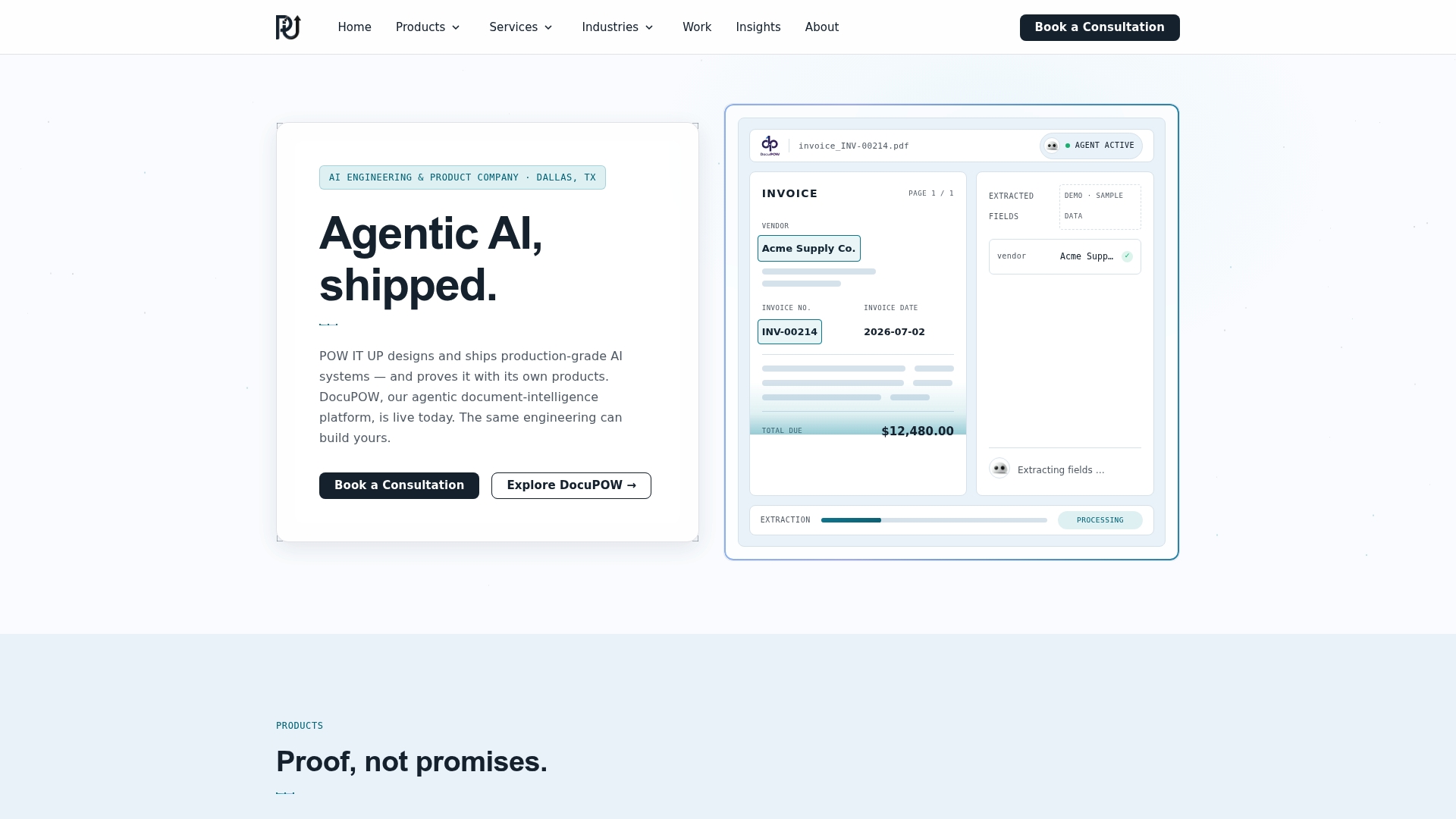
POW IT UP designs and builds custom AI agents and automation systems where human checkpoints are engineered into the architecture from the start, not added after something breaks. That includes document intelligence work through DocuPOW, portfolio and client health monitoring through AuraPOW, and broader AI integration engagements for teams that need trace capture, sampling policy, and routing built correctly the first time. As a single-location firm focused on engineering rather than templated scripts, POW IT UP works directly with your team to size reviewer throughput, set latency budgets, and connect labeled data to real model and workflow changes. If your current review process produces labels nobody acts on, request a demo or assessment through the AI integration page and see what a pilot engagement looks like for your workflow.
Sources
- PMC article on automation bias and HITL
- Human-in-the-Loop Feedback Loops for LLM Systems | Jatin Bansal
- FINOS AI Governance Framework — Human feedback loop
FAQ
What Is the Human-in-the-Loop Theory?
Human-in-the-loop theory holds that AI systems perform better and remain accountable when a person retains genuine evaluative authority at defined checkpoints, rather than simply monitoring an autonomous process. Stanford HAI frames this as an intentional design choice to keep people in charge, not a fallback for when automation fails.
What Does It Mean to Keep the Human in the Loop?
It means designing the system so a person reviews, corrects, or approves specific outputs before they become final, with a real ability to intervene rather than a ceremonial sign-off. That requires trace capture, a sampling policy, and a latency budget so the review actually happens in time to matter.
What Is the Human-in-the-Loop Problem?
The core problem is that oversight can become symbolic: reviewers exist on paper, but automation bias causes them to defer to model outputs so consistently that their evaluative agency effectively disappears. Research on automation bias and human oversight identifies this as a persistent risk that system design must actively counter, not assume away.
What Is the Meaning of Human Out of the Loop?
Human-out-of-the-loop describes a system that operates without any person able to intervene during execution, which is appropriate for low-risk automation like spam filtering but risky for high-stakes decisions where errors carry real consequences. Teams handling regulated or safety-critical workflows generally avoid this variant in favor of human-in-the-loop or human-on-the-loop designs.