

High-performance business systems, in the sense that matters for 2026, are agentic AI setups: autonomous agents that execute end-to-end transactional work with observable guardrails, not scripted bots that follow static rules. They benefit companies drowning in repeatable, high-volume processes: document review, claims intake, portfolio monitoring, back-office reconciliation. The right approach starts small. Fix the process, pilot one workflow, govern it tightly, then scale.
TL;DR:
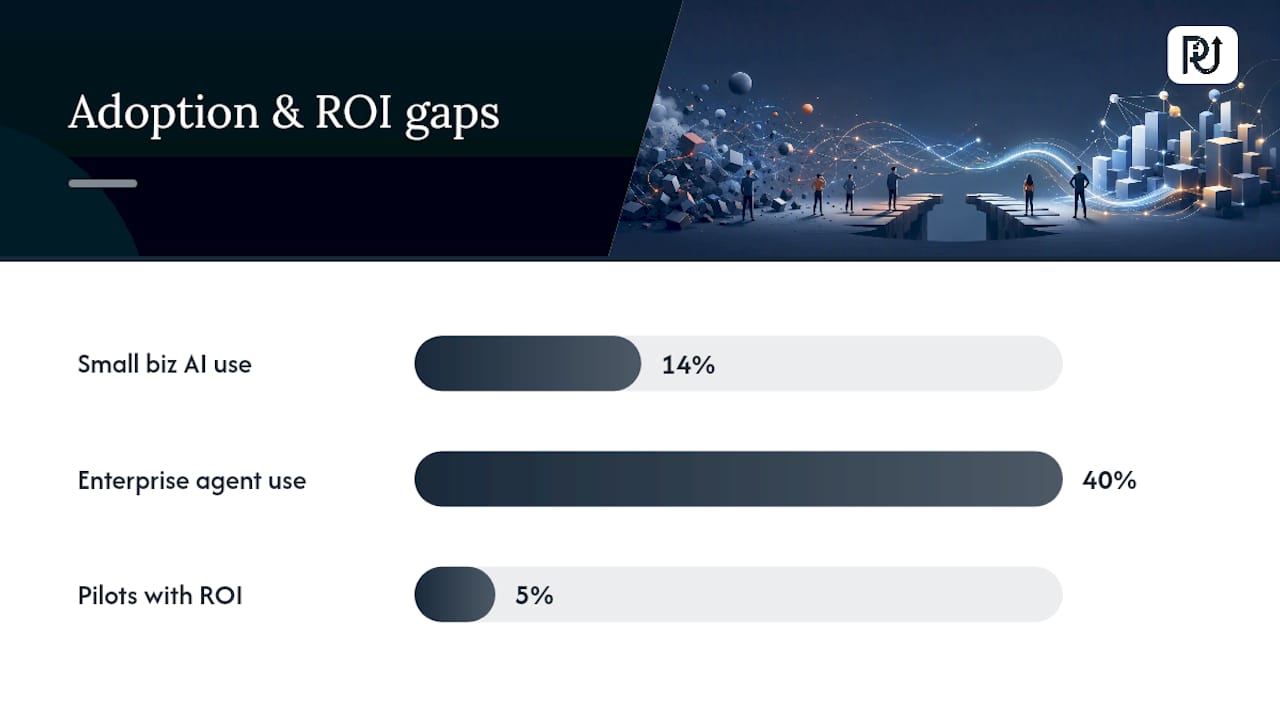
- Only about 14% of small businesses have integrated AI into core operations, while 40% of enterprise applications plan to embed task-specific agents by year’s end.
- Successful pilots require documented workflows, clear decision rules, clean data, secured access, and observability tools from the start.
- Adopting a simple, single-agent pattern is recommended for initial implementations due to easier governability and debugging.
- Pilot projects should focus on high-value, well-documented processes with measurable KPIs, rather than high-risk, chaotic workflows.
- Less than 5% of generative AI pilots achieve measurable ROI, emphasizing leadership, process maturity, and governance as critical success factors.
Table of Contents
- What Are High-Performance Business Systems Built From?
- Why Are Agentic Systems Suddenly Everywhere?
- What Do You Need Before You Automate Anything?
- Which Architecture Fits Your Process?
- How Do You Take a Pilot to Full Scale?
- What Should You Actually Measure?
- How POW IT UP Designs and Scales These Systems
- Where the Conventional Advice on This Gets It Backward
- Ready to Build a Real Pilot Instead of Another Slide Deck?
- Sources
- FAQ
What Are High-Performance Business Systems Built From?
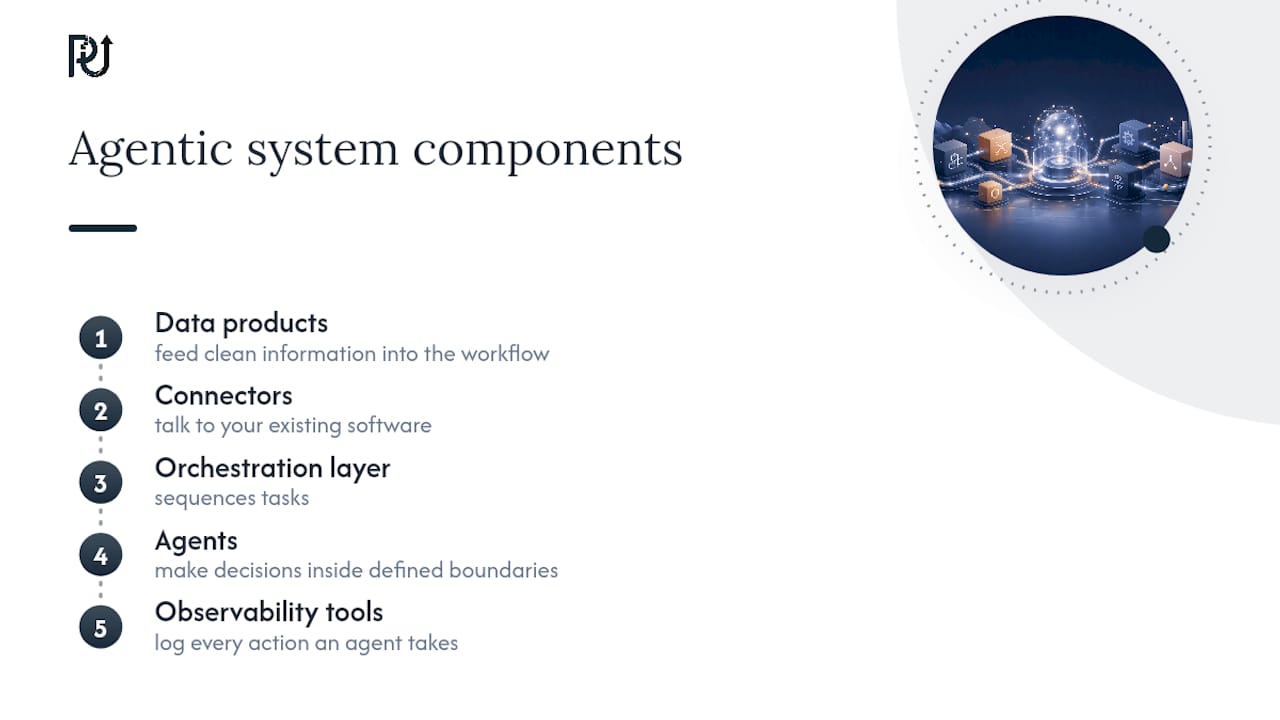
An agentic system has five working parts: agents that make decisions inside defined boundaries, an orchestration layer that sequences tasks, data products that feed clean information into the workflow, connectors that talk to your existing software, and observability tools that log every action an agent takes.
That last piece is what separates this from older automation. Traditional robotic process automation follows a fixed script, so it breaks the moment a screen layout changes or an exception appears. Agentic AI, according to Deloitte’s AI Institute, handles dynamic processes and unstructured data. It extends what RPA could ever do, but it demands real investment in orchestration and knowledge modeling before it pays off.
In practice, this shows up as an agent that reads an invoice PDF and validates it against a purchase order, a workflow that reconciles thousands of transactions overnight, or a monitoring layer that flags a client account showing early signs of churn.
Why Are Agentic Systems Suddenly Everywhere?
Adoption is moving fast, but unevenly. Only 14% of small business owners had woven AI into their core operations as of mid-2026, while Goldman Sachs projects enterprise applications will embed task-specific agents in roughly 40% of cases by the end of the year. That gap between big companies and small ones is the story.
The uncomfortable number every leader should see before signing a contract: only about 5% of generative AI pilots produce measurable ROI, and Forbes reporting traces most failures to leadership and process maturity, not the technology itself.
Companies that stumble usually automate a process nobody bothered to document first. Skills gaps and unclear ownership finish the job. The upside for the ones who get it right is real: elastic processing capacity that scales without adding headcount, and the ability to take on transaction volume that would have required a new department five years ago.
What Do You Need Before You Automate Anything?
Agentic AI amplifies whatever process you feed it. Feed it chaos, and you get faster chaos. That is not a theoretical risk. It is the single most common reason pilots stall before they ever reach production.
Run through this readiness checklist before you commission any build:
- Every target workflow is documented step by step, including exception paths.
- Decision rules and approval thresholds are written down, not tribal knowledge.
- Clean data products exist for the agent to read from, not scattered spreadsheets.
- Integration access (APIs, credentials, identity permissions) is confirmed and secured.
- Observability tooling is in place to log every agent action for audit.
Governance can’t be an afterthought bolted on after launch. Name a single owner for each end-to-end process before you automate it. Define tiered autonomy up front, so agents know exactly which actions they can take independently and which require a human sign-off. Set escalation paths and funding criteria for pilots that want to graduate to production.
On the people side, budget for training. Survey data from Techaisle shows data readiness and skills gaps as the top barriers SMBs report, and many now prefer private or hybrid architectures specifically to keep costs predictable.
- Documented workflows with exception handling
- Approval thresholds written into policy
- Clean, accessible data products
- Secured integration and identity access
- Observability and audit logging from day one
Pro Tip: Pick the process with the clearest paper trail for your first pilot, not the one with the biggest theoretical payoff. A messy high-value process will cost you more in cleanup than it saves in automation.
Which Architecture Fits Your Process?
Three patterns cover most real deployments, and picking the wrong one is an expensive mistake.
- Single agent with tools: one agent, a defined toolkit, narrow scope. OpenAI’s own guidance recommends starting here even for complex processes, because it’s easier to debug and govern.
- Manager/hand-off pattern: a lead agent routes subtasks to specialist agents and consolidates results. Useful once a single agent’s toolset gets unwieldy.
- Decentralized multi-agent: agents negotiate and coordinate directly. Powerful, but the hardest to govern and the easiest to lose track of.
Integration strategy matters just as much as the pattern you choose. APIs are the reliable path into legacy systems. UI automation (an agent clicking through screens like a person would) is sometimes the only option with older software, but it’s brittle. Document every UI fallback explicitly, because it will break first when a vendor pushes an update.
Treat observability as a design requirement, not a nice-to-have add-on. Every agent needs a managed identity, a configuration record, and automated drift detection so you notice when its behavior starts drifting from spec before a customer does.
How Do You Take a Pilot to Full Scale?
A four-stage rollout keeps risk contained while giving good pilots a real path forward.
- Identify. Pick one documented, high-value process with measurable KPIs already in place.
- Pilot. Build the narrow single-agent version, run it with a human review gate on every decision.
- Harden and define gates. Set performance thresholds, cost ceilings, and funding criteria the pilot must clear before it earns production status.
- Standardize and scale. Roll the proven pattern out to adjacent processes using the same governance template.
| Stage | Governance action | Exit signal |
|---|---|---|
| Identify | Confirm process is documented and owned | KPIs and decision rules exist on paper |
| Pilot | Human approval on every agent action | Error rate and review load are tracked |
| Harden | Cost and performance thresholds set | Pilot clears funding gate |
| Scale | Standardized ADLC and observability applied | Process runs with tiered autonomy |
BCG’s applied AI research calls this a graduation pathway, and it warns that once a company pushes 30 to 40% of its end-to-end processes into agentic operation, the sheer number of configuration items demands a formal Agent Development Lifecycle and observability-first operations. Skip that structure and scaling becomes its own failure mode.
What Should You Actually Measure?
Vanity metrics get pilots killed. Track throughput per hour, cycle time, the rate at which humans still have to intervene, error rate, and cost per transaction. Time-to-graduation (how long a pilot takes to clear its production gate) tells you whether your governance model is working or just adding friction.
| KPI | What it tells you |
|---|---|
| Throughput per hour | Capacity gained versus manual baseline |
| Human review rate | How close the agent is to full autonomy |
| Error rate | Reliability under real conditions |
| Cost per transaction | Whether the economics actually hold up |
| Time-to-graduation | Health of your pilot-to-scale pipeline |
Calibrate your timeline against the numbers already on the table: only about 5% of generative AI pilots hit measurable ROI, so treat an early win as a signal to expand carefully, not a green light to automate everything at once. Set drift alerts and guardrail violation logs from the start, and put an SLA on agent performance the same way you would on any vendor.
How POW IT UP Designs and Scales These Systems
POW IT UP works as a technical architect for custom AI agents, not a vendor scripting one-off integrations. The firm builds digital workforces designed for high-volume transactional work, with two productized tools already in the field: DocuPOW handles document reading and validation, and AuraPOW covers portfolio monitoring and client health analytics.
A typical engagement runs in four phases: an audit of existing processes and data readiness, a narrow pilot on one documented workflow, a hardening phase that adds guardrails and cost controls, and ongoing production support after the system clears its graduation gates. That sequence mirrors the pilot-to-scale roadmap above, applied to a client’s actual operations rather than a generic template.
Where the Conventional Advice on This Gets It Backward
Most of what circulates about agentic AI treats model selection as the hard problem. That’s backward. The failure data says otherwise: leadership gaps and undocumented processes sink far more projects than picking GPT over Claude ever will.
The overrated question is “which agent framework?” The underrated one is “who owns this process, and did anyone write down what it actually does?” A company with a mediocre model and a documented, well-governed process will outperform a company with a brilliant model bolted onto chaos, every time.
Here’s what I’d tell any operations leader staring at a vendor pitch deck: govern before you automate. Define tiered autonomy before the agent writes its first line of output. Pick the boring, well-documented process for your first pilot, not the exciting one. Process maturity is not a compliance checkbox you get to later. It’s the entire game.
— Syed Naveed Abbas
Ready to Build a Real Pilot Instead of Another Slide Deck?
Most firms sell you the model. The company builds systems including process audits, pilots to prove concepts on real transactions, and governance layers to control autonomous agents’ decisions. If your team has already tried a chatbot layered on top of a messy workflow and watched it stall, that’s the readiness gap this playbook is built to close.
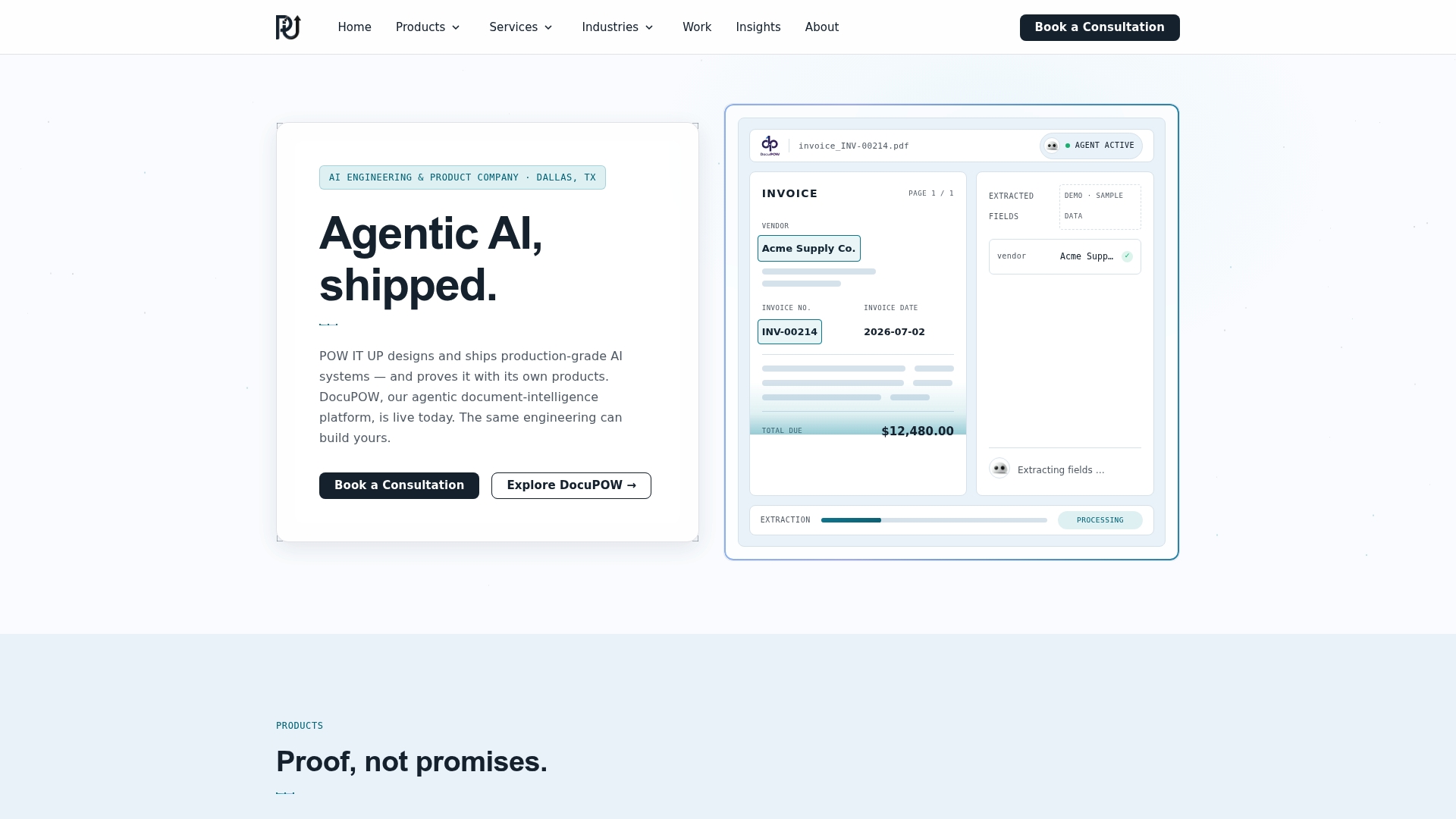
Whether the job is document intelligence and validation, back-office transaction processing, or a portfolio monitoring layer like AuraPOW, the engagement starts the same way: a process audit that tells you exactly where you stand before anyone writes a line of agent logic. Request a diagnostic through POW IT UP’s AI integration services and get a concrete readiness assessment instead of a generic sales call.
Sources
- Small businesses embrace AI but need training and support to fully harness it — Goldman Sachs (2026)
- Applied AI with agentic enterprise operations — BCG (2026)
- AI adoption fails 95% of the time. Small business leadership is why — Forbes (2026)
FAQ
What Is the Difference Between RPA and Agentic AI?
RPA follows fixed scripts and breaks on unexpected input. Agentic AI handles unstructured data and dynamic processes, though it needs more upfront investment in orchestration.
Do I Need Fully Documented Processes Before Automating?
Yes. Automating an undocumented process just scales the existing chaos faster, which is one of the most common reasons pilots fail to reach production.
What Should My First Automation Pilot Target?
Choose a single, already-documented, high-value process with measurable KPIs. That gives you a clean graduation template before you expand to other workflows.
Can POW IT UP Help With Both the Pilot and the Scale-Up?
Yes. The company runs engagements through an audit, pilot, hardening, and production support cycle, using available tools where they fit the workflow.