

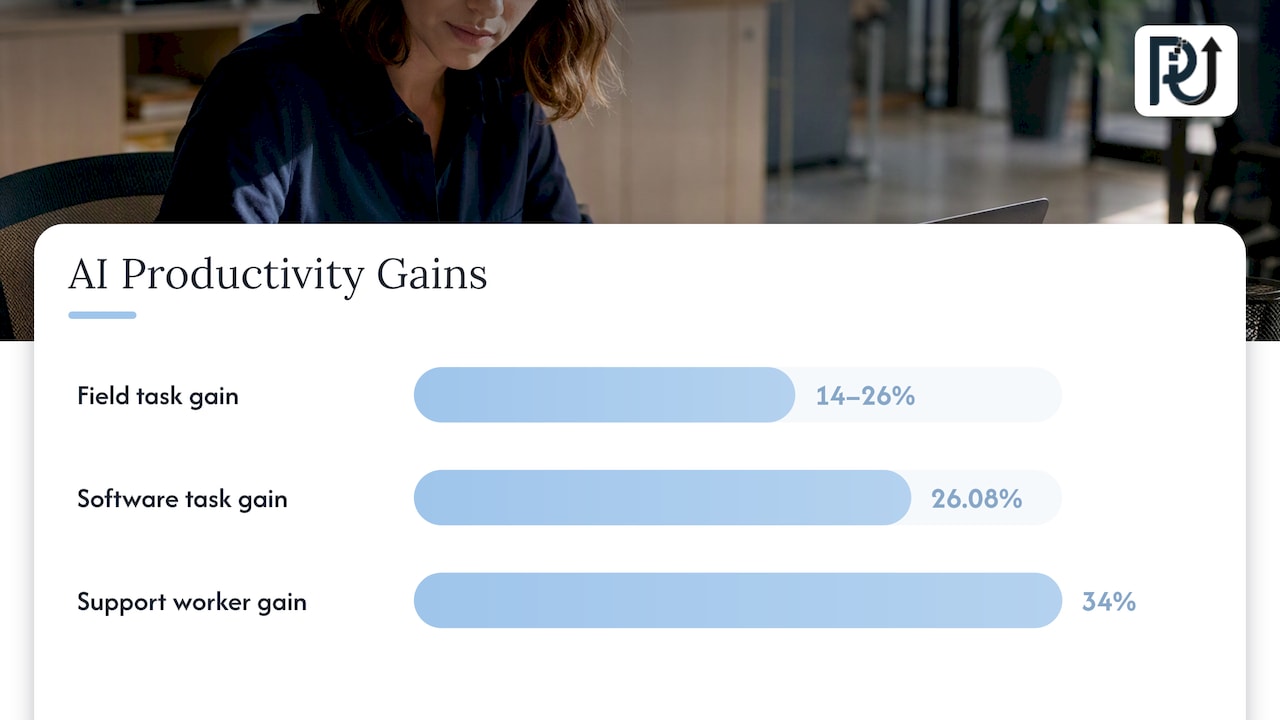
AI-powered organizational efficiency can mean more throughput and shorter cycle times, and it may be valuable in operations, finance, support and software teams. Field experiments report task-level gains of roughly 14% to 26%. The NIST AI Risk Management Framework is the governance standard we recommend for keeping those gains trustworthy.
TL;DR:
- Prioritize document heavy, repeatable workflows with clean data, assign an executive owner, and baseline throughput, cycle time, error rates, and cost per transaction.
- BCG client cases report end to end agentic redesign delivering threefold productivity gains, 80% shorter cycle times, and cost reductions above 60% over time.
- Census survey data found AI use at 18% of firms, or 32% when weighted by employment; broader integration also correlated with employment declines.
- Use NIST’s continuous Govern, Map, Measure, and Manage cycle, scaling oversight to risk; a lending agent needs tighter controls than an internal summarizer.
- Define supervision, monitoring, rollback criteria, and baselines before launch; phased rollouts or team comparisons reveal causation, while early adjustment costs can mask gains.
Table of Contents
- What does the evidence say AI actually delivers?
- Where do AI efficiency gains show up first?
- Why does agentic process redesign beat point tools?
- How do you move from pilot to production?
- How do you govern agentic systems with the NIST AI RMF?
- How do you measure ROI and the productivity J-curve?
- What changes for your people?
- What technology do agentic workflows need in production?
- Where should you start, and what should you avoid?
- How can we help you move from pilot to production?
- FAQ
- Sources
What does the evidence say AI actually delivers?
The strongest proof comes from controlled work, not vendor claims. Across field experiments, generative AI raised completed tasks per hour by about 14% to 26%, with a combined estimate of a 26.08% increase in completed software development tasks. Customer support showed a 34% gain for less-experienced workers, which tells you the biggest lift goes to people still climbing the learning curve.
The Stanford-reported field experiments put the gain at 26.08% more completed software development tasks, and the same research suggests AI also reshapes how teams are organized, not just how fast they work. Read the Stanford summary before you set targets.
Adoption data adds a second signal. The 2026 AI supplement to the Census Bureau’s business survey, described in The Microstructure of AI Diffusion, found that 18% of firms used AI, rising to 32% when weighted by employment. Broader integration correlates with better firm performance, though also with a higher chance of employment decreases, so leaders should plan the people side early.
What you can reasonably expect:
- Shorter cycle times on repetitive, rules-based work
- More capacity without proportional headcount growth
- Fewer keying and validation errors
- Faster decision cycles when AI summarizes and flags what matters
Where do AI efficiency gains show up first?
Start where work is high-volume, document-heavy or decision-dense. Each use case below has a metric you can baseline before you begin.
- Task automation and orchestration: Invoicing, claims and lending workflows move from queue-based handoffs to agent-driven flows. The metrics are throughput per FTE and cycle time.
- Document intelligence: Reading documents, extracting fields and running rule checks replaces manual re-keying. Track FTE-hours saved and error rates.
- Decision support and forecasting: Scenario agents, forecasts and anomaly detection surface problems earlier. Watch forecast accuracy and time to decision.
- Customer-facing automation: Triage, resolution and knowledge lookup shorten response times. Measure first-contact resolution and handling time.
- Cross-functional work: Sales follow-up, finance close tasks and IT ticket routing all follow the same pattern: one repeatable process, one baseline, one owner.
Service businesses already apply this at small scale. Picshaw, for example, runs an AI receptionist for local service businesses that handles missed and after-hours calls, a concrete picture of automation absorbing work that used to fall through the cracks.
Pick the use case where your data is cleanest. A messy process automated quickly is still a messy process, only faster. If you want a broader strategic frame first, our leader’s guide to AI-powered business operations walks through it.
Why does agentic process redesign beat point tools?
Copilots help one person finish one task faster. Agentic redesign changes who or what does the work end to end, and that is where the larger outcomes appear. BCG reports that end-to-end agentic redesign delivered substantially larger results than task-level AI in client cases, including three-fold productivity increases, 80% cycle-time reductions and 60%+ long-term cost reductions where redesign and governance were applied.
McKinsey describes the agentic organization as outcome-focused agentic teams, embedded control agents, agent factories and agent-to-agent protocols, built on five pillars: business model, operating model, governance, workforce, and technology and data.
Design principles we apply:
- Start from the outcome (a closed claim, a funded loan), not from the task list
- Build agent factories so new agents are assembled from reusable parts
- Embed control agents that check the work of other agents
- Give every agent a strict action contract and shared business context
That last point matters. Practitioner guidance stresses a machine-readable business ontology so agents share context and stay inside safe inputs and outputs.
Pro Tip: Spend more of your budget on data, runtime and observability than on model selection. Models change frequently; clean data products and monitoring keep paying off.
Our own write-up on agentic productivity systems for operations shows what this looks like in a case-study format.
How do you move from pilot to production?
Most stalled projects skip a step, not a technology. Work through the sequence below in order.
- Assess: Inventory systems and processes, map your data products, and estimate both value and risk exposure for each candidate workflow.
- Prioritize: Choose one or two outcome-led domains for agentic redesign, each with named KPIs and an executive owner.
- Pilot: Define scope, the human supervision model, monitoring, rollback criteria, testing and validation checks, and a measurement plan before anything goes live.
- Harden: Move to production runtimes with observability, version control and incident handling.
- Scale: Fund the platform as a shared capability and add workflows through the same agent factory.
Legacy systems are the usual obstacle. Wrap them behind APIs or event streams instead of rewriting them, and let agents work through those interfaces. That keeps the pilot honest, because it runs on the same systems production will.
Pro Tip: Write the rollback plan before the pilot starts. Teams that know how to switch an agent off are far more willing to switch one on.
For help choosing domains, see our guide on turning pilots into production.
How do you govern agentic systems with the NIST AI RMF?
The NIST AI RMF recommends a continuous lifecycle built on four functions: Govern, Map, Measure and Manage. Here is what each means for operations.
- Govern: Set policies, assign roles and responsibilities, and decide who can approve and retire a system.
- Map: Document each system’s purpose, context, data and likely impacts before launch.
- Measure: Test, track and document performance, errors and bias against defined thresholds.
- Manage: Prioritize risks, respond to incidents and review systems on a schedule.
The AI RMF Playbook adds concrete actions: keep a system inventory, run impact assessments, document processes, plan ongoing monitoring and periodic review, and resource risk management according to risk priorities. Apply that last idea literally. A low-risk internal summarizer does not need the oversight a lending agent does. Tier your systems, and spend control effort where harm would be greatest. Decommissioning belongs on the list too: retire agents that no longer have an owner.
How do you measure ROI and the productivity J-curve?
Expect a dip before the climb. Research on industrial AI adoption describes an AI productivity J-curve: short-term losses and costly adjustments can precede longer-term gains, particularly in older firms. Judging a program too early can produce a false negative.
Industrial AI adoption shows a J-curve in which short-term performance losses and adjustment costs can precede longer-term productivity gains, so build the dip into your business case. See the Census working paper.
KPIs worth tracking:
- Throughput per FTE
- End-to-end cycle time
- Error and rework rates
- Cost per transaction
- Adoption breadth across functions
To show cause and not just correlation, define baselines before launch and use phased rollouts or A/B comparisons between teams. Treated and untreated groups tell you more than a before-and-after chart. A field experiment across 66 firms saved treated workers about two hours a week on email, the kind of specific, measurable result your own pilot should aim to produce.
What changes for your people?
Efficiency gains stick only when roles and incentives change with the technology. These roles tend to appear:
- Agentic process owner: Accountable for an outcome, not a task list
- AI operations lead: Runs monitoring, incidents and agent lifecycle
- Data product manager: Keeps the data agents depend on reliable
- Compliance lead: Maps controls to the framework and signs off on risk tiers
Upskill supervisors first. Their new job is to review exceptions and tune agents, which takes judgment more than keystrokes. Involve pilot teams early, explain which tasks change and why, and redefine roles before automation lands. The adoption data cited earlier links broader integration with a higher chance of employment decreases, so honest communication about redeployment is part of the plan, not an afterthought.
What technology do agentic workflows need in production?
Treat this as a procurement checklist. You need all of these building blocks, whatever vendor supplies them.
- Agent runtimes: Containerized environments where agents execute with access controls
- Orchestration: Event-driven coordination and agent-to-agent protocols
- Document intelligence: Reading, extraction and validation of unstructured files
- Data products: Governed, documented datasets with clear owners
- Observability: Logs, traces and alerts for every agent action
- Testing and secure deployment: Validation before release and gateways for API access
| Category | What it supplies |
|---|---|
| Agent runtime | Isolated, access-controlled execution |
| Orchestration | Event-driven coordination between agents |
| Data products | Governed inputs with named owners |
| Observability | Audit trail for every agent action |
When comparing platforms, ask about scalability, audit logs, explainability and access controls. If a platform cannot show you what an agent did and why, it will not survive a compliance review.
Where should you start, and what should you avoid?
Start small, but design for scale and governance from day one. In our experience, the programs that reach production pick a single document-heavy workflow, assign one accountable owner, and instrument it before they automate it. The pitfalls are just as consistent: automating a broken process, skipping the supervision model, and funding a pilot with no path to a runtime.
This quarter, I would do three things. Inventory your highest-volume processes and pick one. Baseline its cycle time and error rate. Then write the risk tier and rollback plan before anyone builds. Those steps cost almost nothing and prevent most of the expensive failures.
— Syed Naveed Abbas
How can we help you move from pilot to production?
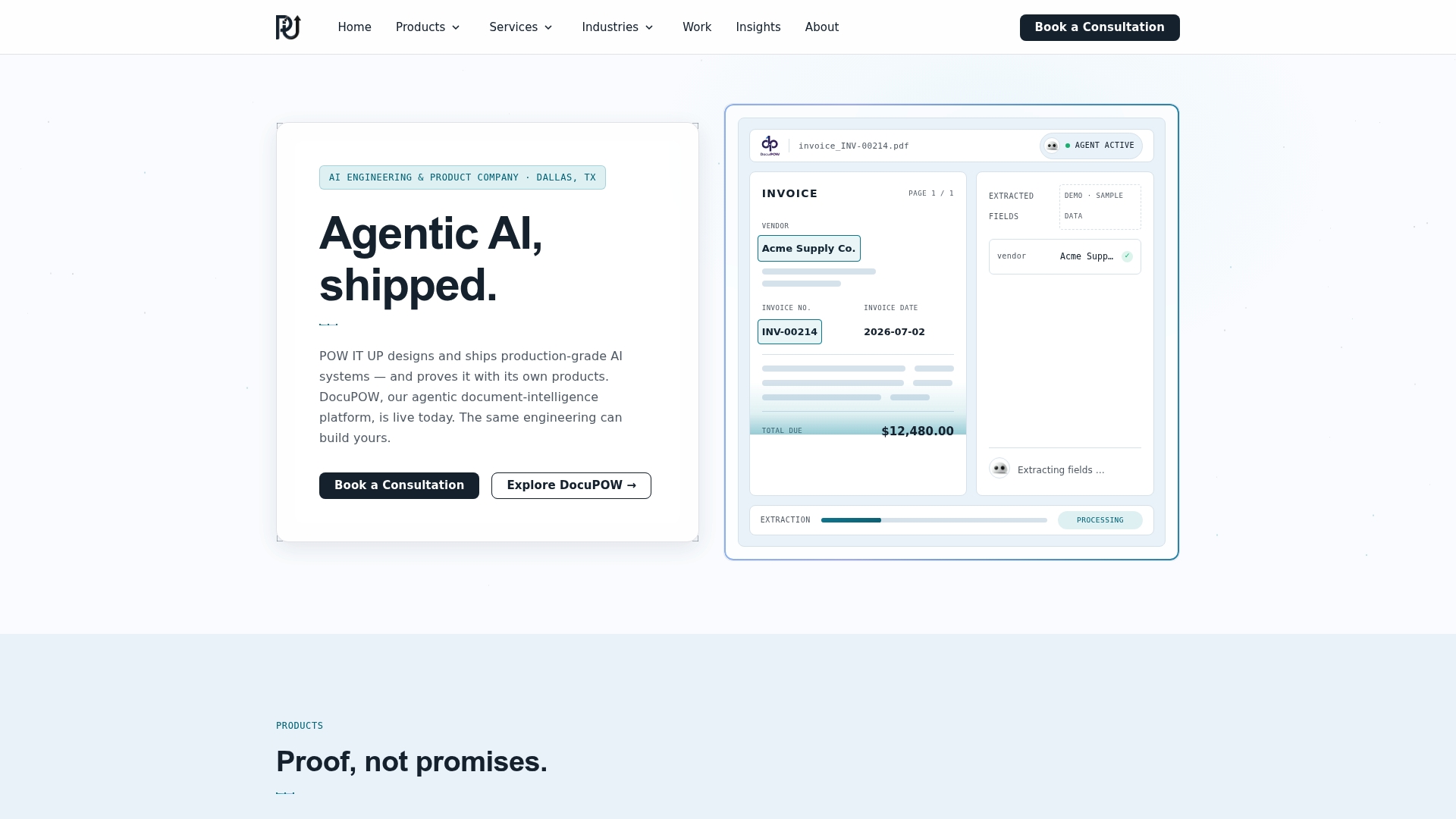
If you have a workflow ready to redesign, we build the digital workforce behind it. Our team covers AI agents development, AI integration and AI automation, plus DocuPOW for document reading and validation.
- We take a single outcome from pilot to a production agent factory
- We wire agents into your existing systems without a rewrite
- We set up monitoring so you can prove the gains
Request a DocuPOW demo or book a pilot scoping call at Powitup, and bring your highest-volume process.
FAQ
How can AI make an organization more efficient?
AI raises efficiency by automating repetitive work, speeding up document handling and supporting faster decisions. Field experiments report task-level gains of roughly 14% to 26%, and larger gains appear when whole processes are redesigned around AI agents.
What are the main disadvantages of AI in operations?
The main drawbacks are integration effort, data quality problems and the need for ongoing oversight. Early performance can also dip before gains arrive, as the AI productivity J-curve research describes, so plan governance and patience from the start.
What are the main areas of AI used in business?
Business use clusters around automation, document intelligence, forecasting and decision support, and customer-facing assistants. In the Census adoption data, common functions among adopters include sales and marketing, strategy and IT.
Which framework should guide AI governance?
The NIST AI Risk Management Framework is a widely used starting point. It organizes governance into Govern, Map, Measure and Manage, applied continuously across a system’s life.
Sources
- Gsb
- The Microstructure of AI Diffusion: Evidence From Firms, Business Functions, and Worker Tasks
- Nist