

An effective AI strategy is a prioritized portfolio of initiatives led directly by the C-suite, paired with an operating model and clear go or no-go gates at every stage. The first move is a targeted readiness assessment tied to those portfolio choices. Adoption is no longer the question: A majority of organizations reported using AI in 2024, up sharply from the year before. Execution discipline, anchored by frameworks like NIST’s AI Risk Management Framework and FTC guidance on data use, now separates the winners from the rest.
TL;DR:
- Assess use cases separately: low maturity organizations may need six to twelve months of foundation work, while moderately mature teams can pilot within 90 days.
- Score candidates from one to five for value and feasibility, then assign each selected pilot an owner and a milestone due within 90 days.
- Model as a service speeds deployment but increases vendor dependence; custom models offer control at higher engineering cost, and either path needs drift monitoring.
- Map risks and document each model before deployment; vendor contracts should bar unauthorized training on company data and preserve audit rights.
- Pilots should run for 60 to 90 days and track clear outcomes; set thresholds before launch, since early revenue gains often stay under 5%.
Table of Contents
- A Practical AI Strategy Framework for Leaders
- Assess Organizational Readiness Before You Commit Capital
- Selecting and Prioritizing AI Use Cases
- Data, Platform, and Technical Enablers for Production
- Operationalizing Responsible AI: NIST and FTC in Practice
- Roadmap to Production: Pilots, Gates, and Scale
- What Most AI Strategies Get Wrong
- Turning Strategy Into a Working System With POW IT UP
- FAQ
- Sources
A Practical AI Strategy Framework for Leaders
Most AI strategies fail not from a lack of ambition but from skipping the translation step between vision and execution. A workable framework moves through four stages: define the vision, map where value actually sits in the business, prioritize a short list of bets, then build the operating model and KPIs that keep everyone honest.
Start by naming the two or three business outcomes AI is supposed to move, whether that is cycle time, error rates, or revenue per employee. Then map value pools: the specific processes, departments, or customer touchpoints where automation or intelligence could change the economics. From there, prioritization determines which initiatives get capital and talent first.
PwC’s Lead-Lag-Exit framework is useful here because it forces explicit tradeoffs instead of a flat list of projects. Leaders sort initiatives into three buckets:
- Lead bets: projects where the business commits serious capital and talent because the upside is large and timing matters.
- Lag choices: areas where the business watches the market, adopts proven tools later, and avoids spending on unproven ground.
- Exit decisions: initiatives or legacy processes the business deliberately stops investing in, freeing budget for the leads.
Executive ownership matters more than most leaders expect. Without a named sponsor at the C-suite level, AI projects drift into IT backlogs and lose the cross-functional authority needed to change workflows. The operating model should specify who approves scaling decisions, how often the portfolio gets reviewed, and which KPIs (cost per transaction, cycle time, model accuracy) get reported alongside standard financial metrics.
Assess Organizational Readiness Before You Commit Capital
Before locking in a portfolio, run a readiness diagnostic across five dimensions. This keeps ambition matched to actual capacity.
- Data maturity: Is the data needed for priority use cases labeled, accessible, and governed, or scattered across disconnected systems?
- Technical infrastructure: Can current platforms support model hosting, monitoring, and integration without a rebuild?
- Talent and skills: Does the team include people who can own model performance, not just initial deployment?
- Process documentation: Are the target workflows mapped well enough to automate, or still tribal knowledge?
- Governance capacity: Is there a function, even a small one, that can own risk review and compliance documentation?
A simple three-tier scale helps interpret the results. Organizations scoring low across most dimensions should expect six to twelve months of foundational work before a production pilot. Mid-tier organizations can often launch a scoped pilot within 90 days. High-maturity organizations, with clean data and existing MLOps practices, can move from pilot to limited production in a single quarter.
Pro Tip: Run the readiness assessment on the specific use case you intend to pilot, not on the organization in the abstract. Readiness varies wildly by department.
Selecting and Prioritizing AI Use Cases
Capital and talent are always scarcer than the list of possible AI projects, so scoring matters. A value times feasibility approach keeps the list honest: score each candidate on revenue impact, cost savings potential, data availability, and risk exposure, then plot the results.
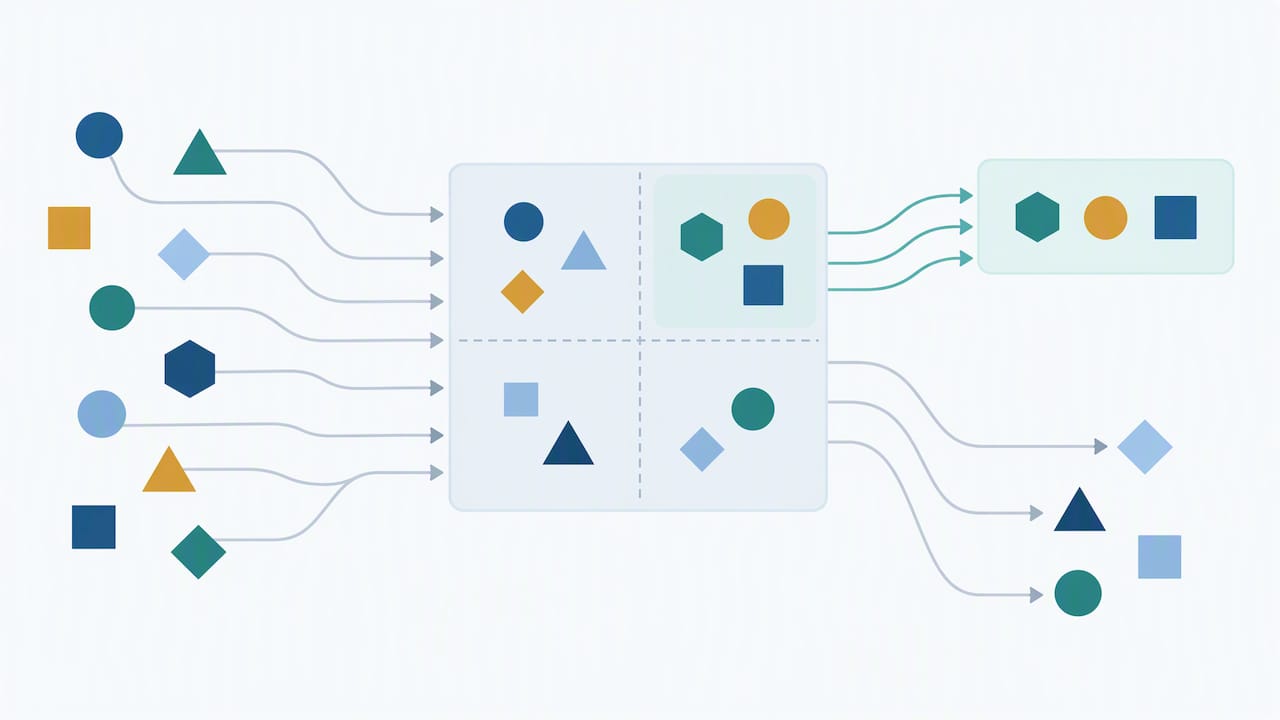
Quick wins tend to involve bounded, high-volume, repetitive work: document classification, invoice matching, customer inquiry triage. Strategic bets usually involve more ambiguity and higher stakes: predictive maintenance for complex equipment, or autonomous agents handling multi-step transaction workflows across systems. Both categories deserve a place on the roadmap, but they get funded and staffed differently.
A workshop format works well for this:
- Gather stakeholders from finance, operations, and IT in one room with the candidate list pre-populated.
- Score each use case on a 1 to 5 scale for value and a separate 1 to 5 scale for feasibility.
- Plot results on a simple two-axis grid and circle the top-right quadrant: high value, high feasibility.
- Assign each selected use case an owner and a 90-day pilot milestone before the workshop ends.
This approach avoids the common trap of chasing the most technically impressive project rather than the one that actually moves a KPI. Different agent types suit different use cases, and matching the right pattern to the right workflow early prevents costly rework later.
Data, Platform, and Technical Enablers for Production
Pilots fail to reach production most often because the underlying data and platform work was never budgeted. Three areas need attention before scaling.
Data readiness means more than volume. Lineage tracking, consistent labeling, and privacy-safe handling practices need to exist before a model touches customer or transaction data. Data clean rooms are sometimes pitched as a privacy solution, but FTC guidance notes that data clean rooms can increase attack surface if misconfigured.
Platform choice is a real fork: model-as-a-service options move faster but create vendor dependency, while custom models offer control at higher engineering cost. Either path needs MLOps practices: monitoring for drift, versioned retraining, and a CI/CD pipeline for model updates, not just application code.
- Data governance: lineage, access logs, and labeling standards before any model training begins.
- Platform decision: MaaS for speed, custom models for control and differentiation.
- Monitoring: drift detection and retraining triggers built in from day one, not added later.
- Security controls: encryption, role-based access, and contractual limits on vendor data use.
Public and private investment in AI surged through 2024, and organizations that run regular portfolio reviews with predefined proof thresholds scale initiatives faster than those that do not. This pattern shows up consistently in Stanford HAI’s 2025 AI Index.
Operationalizing Responsible AI: NIST and FTC in Practice
Governance only works when it is built into the lifecycle rather than bolted on at the end. The NIST AI Risk Management Framework and its generative AI profile organize this into four functions, each with suggested actions teams can actually execute.
- Govern: Assign clear accountability for AI risk decisions, typically a cross-functional committee with executive sponsorship.
- Map: Document the context, intended use, and foreseeable risks of each model before deployment.
- Measure: Test models for accuracy, bias, and robustness using defined metrics, not ad hoc review.
- Manage: Build incident response playbooks and review cadences for models already in production.
FTC enforcement has made documentation a practical necessity rather than a nice-to-have. FTC actions have targeted deceptive AI claims and improper data use, with penalties that have included mandatory deletion of models trained on unlawfully obtained data. Teams working with model-as-a-service vendors need contracts that explicitly prohibit unauthorized training uses and preserve audit rights.
Operational governance roles worth naming on paper: a model register that tracks every production model and its owner, a test evaluation and verification validation (TEVV) process for pre-deployment checks, and an incident playbook specifying who gets notified when a model misbehaves. For teams that want a structured starting point, Forge Private AI’s guide to operationalizing NIST AI RMF walks through the six steps practitioners use to turn the framework into day-to-day controls.
Pro Tip: Keep the model register in a shared document from day one. Retrofitting governance after five models are already in production is far harder than starting with one.
Roadmap to Production: Pilots, Gates, and Scale
A pilot without defined success criteria is just a demo. Before launch, write down the metric threshold that triggers scaling, the timeline for the pilot (typically 60 to 90 days), and who signs off on the go or no-go decision.
KPIs should speak the CFO’s language as much as the technical team’s. Cycle time reduction, error rate, and cost per transaction translate directly into budget conversations, while model accuracy and uptime stay useful for the technical review. Realistic expectations matter here: early-stage AI initiatives commonly report revenue gains under 5% and cost savings under 10% in the first measurement cycle, which should shape how aggressively a go or no-go gate is set.
- Pilot design: fixed timeline, named owner, and a single primary success metric agreed before launch.
- Go or no-go triggers: a specific threshold (for example, 20% cycle time reduction) rather than a vague “if it works” standard.
- Funding cadence: quarterly portfolio reviews where underperforming bets get cut and winners get reallocated budget.
- Staffing model: a core platform team supporting multiple use cases rather than a separate team per project.
Budgeting realistically for this phase matters as much as the technical build. A closer look at typical cost and ROI patterns helps leaders set funding expectations before the first pilot even launches.
What Most AI Strategies Get Wrong
The most common mistake in AI strategy work is not technical, it is sequencing. Leaders fund the flashiest use case first instead of the one with the cleanest data and clearest owner, then wonder why the pilot stalls for months. The conventional wisdom treats AI strategy as a technology decision, when it functions far more like a capital allocation decision with technology risk attached.
The second underrated gap is governance timing. Teams that treat NIST and FTC compliance as a final checkbox before launch spend far more time retrofitting documentation than teams that build the model register and risk mapping alongside the first pilot. Responsible AI is cheaper early and expensive late.
What actually works tends to look less exciting than what gets pitched in strategy decks: a short list of well-scoped use cases, a named executive sponsor, and a quarterly review that is willing to kill projects that miss their threshold. Momentum without a kill switch is how organizations end up with five stalled pilots and no production system.
— Syed Naveed Abbas
Turning Strategy Into a Working System With POW IT UP
We build systems that follow the strategies described in this playbook, designing autonomous, context-aware agents to handle high-volume transactional work, identify operational inefficiencies through readiness assessments, and allow processing volume to scale without a corresponding increase in headcount. Our engagements typically involve a diagnostic phase, a scoped pilot, and a managed approach to scaling production.
Our AI Agents Development service builds the custom agents behind these use cases, and DocuPOW handles document reading and validation for teams starting with document-centric pilots. If your portfolio is ready for execution, a conversation about AI Integration is the next concrete step.
FAQ
What should an AI strategy include?
A solid AI strategy includes an executive vision tied to specific business outcomes, a prioritized portfolio of use cases scored on value and feasibility, a defined operating model with clear ownership, and governance controls mapped to frameworks like the NIST AI Risk Management Framework. It also needs KPIs and go or no-go gates that connect technical performance to financial outcomes.
What are the core components of an AI agent?
Definitions vary across vendors, but a common version includes a reasoning or planning layer, access to tools or systems it can act on, memory for context across steps, a set of guardrails or permissions, and a feedback mechanism for monitoring performance. Not every production agent includes all five in equal depth.
What is the 30% rule for AI?
Leaders sometimes use informal thresholds in budgeting conversations, but any specific percentage should be treated as a planning assumption, not an established standard.
Who are the leading AI companies?
The landscape shifts quickly and varies by category, from foundation model developers to cloud infrastructure providers to specialized agent and automation firms. Rather than naming a fixed list, it is more useful to evaluate vendors against the specific use case, data requirements, and governance needs identified in your own readiness assessment.
Sources
- 2025 AI Index Report — Stanford HAI
- Artificial Intelligence Risk Management Framework: Generative Artificial Intelligence Profile — NIST