

If your business has a repeatable task that consumes people-hours or blocks revenue; hire an AI consultant to run a pilot that proves hours saved and scales the automation. Pilots that succeed generally share one trait: a measurable baseline, a tight scope, and a clear owner before the first line of code gets written.
TL;DR:
- If customer records remain split across inconsistent spreadsheets, clean and connect them before a consultant begins; otherwise, data cleanup can consume the pilot.
- Document processing often proves value fastest because predictable invoice and contract formats make errors easy to validate and labor savings straightforward to measure.
- Allow a one to two week discovery sprint, then a four to eight week pilot that tracks the same baseline KPI weekly.
- Favor existing software and prebuilt models for faster, lower maintenance pilots; reserve custom development for workflows that off the shelf tools cannot handle.
- Keep human review on high stakes decisions, and reject partners who promise full autonomy, give vague data security answers, or propose a roadmap without a fixed scope.
Table of Contents
- Key takeaways before you hire
- What AI consulting for SMBs actually involves
- When should you actually hire an AI consultant?
- Where SMBs see the fastest payoff
- How consultants actually deliver the work
- How to choose the right AI consulting partner
- A pilot-first roadmap you can start this quarter
- Why small, measured bets beat big AI promises
- Ready to run your first pilot?
- FAQ
- Sources
Key takeaways before you hire
Hiring makes sense once you can point to a specific bottleneck rather than a vague ambition to “use AI.” These signals, pulled from how pilots succeed or stall, should guide your next move.
- Hire when a manual task eats measurable hours each week or a prior AI attempt has stalled without a clear owner.
- Prioritize marketing automation, customer support, document processing, or inventory forecasting as the first pilot candidates.
- Check for a defined KPI, a data owner, and integration access before signing any contract.
- Expect a discovery sprint of one to two weeks followed by a pilot of four to eight weeks.
- Treat NIST’s governance functions and human sign-off on high-stakes decisions as non-negotiable from day one.
What AI consulting for SMBs actually involves
AI consulting for small and mid-sized businesses means hiring outside expertise to identify where automation saves time or money, then building and handing off a working system rather than a slide deck. A good engagement starts with an opportunity assessment: a consultant walks your workflows, flags the ones that repeat often enough to automate, and estimates the hours or revenue at stake.
From there, the work turns into a pilot build focused on one process, followed by integration with the tools you already use, staff training, and a documented handoff so your team can run the system without the consultant in the room.
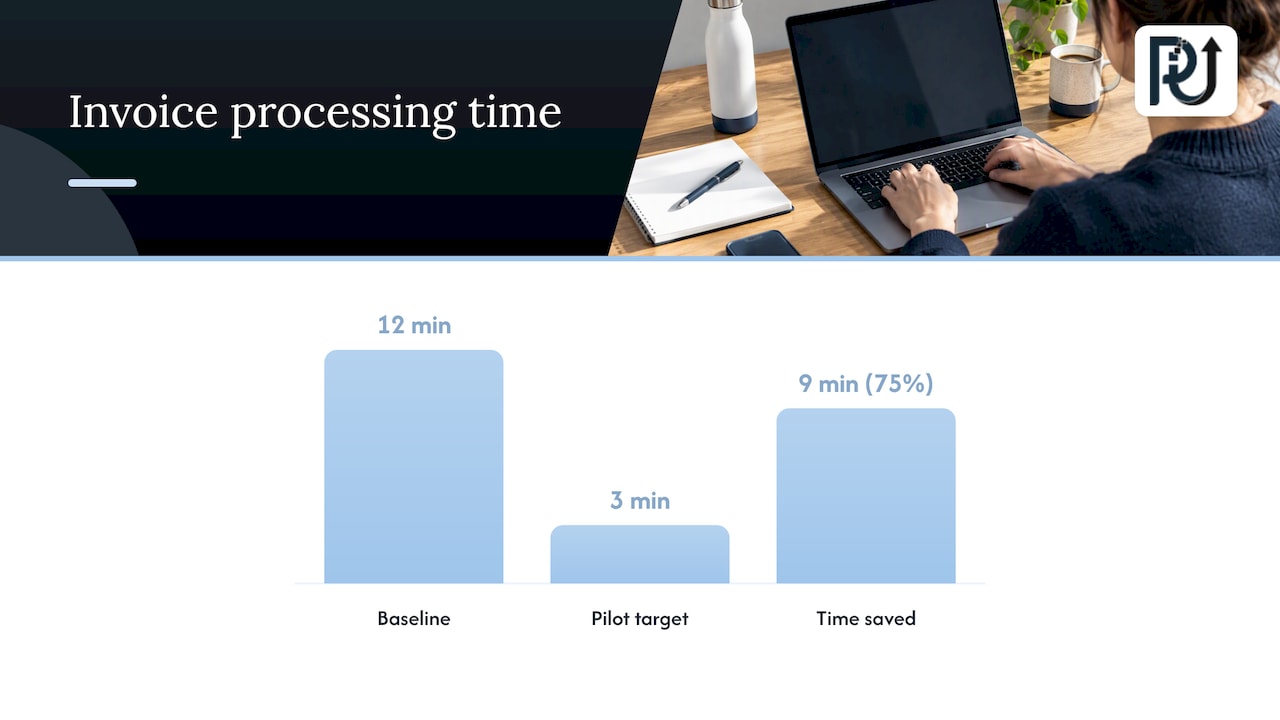
The difference between a useful engagement and a wasted one is whether the consultant translates your business goal into a number you can track. “Save time on invoice entry” becomes “cut average processing time from 12 minutes to 3 minutes per invoice.” That KPI, defined before the pilot starts, is what tells you later whether the project worked. The Small Business Administration’s guidance on AI frames this correctly: treat AI as an operational extension of your team, not a replacement for judgment, and keep a human reviewing any high-stakes output before it ships.
When should you actually hire an AI consultant?
The clearest signal is a task that already shows up on a spreadsheet as a cost: hours spent on data entry, a backlog of support tickets, or a sales forecast built by gut feel every Monday morning. If you can describe the task, measure how long it takes, and name who owns it today, you are closer to scoping a pilot.
Data readiness matters as much as task selection. A consultant needs access to clean, structured records from your CRM, accounting software, or ticketing system. If your customer data lives in three disconnected spreadsheets with no consistent format, that gap needs fixing first, or it becomes the pilot’s first deliverable.
Postpone hiring when none of your teams can name a KPI for success, when no single person owns the workflow end to end, or when the data behind the process is too fragmented to connect. Research from the SBA Office of Advocacy found that small firms are closing the adoption gap with larger companies but still lag in training and vendor investment, a pattern consistent with businesses jumping into tools before fixing ownership and data issues first.
Where SMBs see the fastest payoff
Not every workflow deserves a pilot. The ones that pay off fastest share a pattern: high volume, repetitive steps, and a clear before-and-after metric.
- Marketing and sales automation: auto-tagging leads, drafting follow-up sequences, and scoring inquiries based on past conversion patterns.
- Customer support: routing tickets, drafting first-response replies, and flagging escalations before a human ever opens the queue.
- Document and invoice processing: reading, validating, and routing invoices or contracts, a use case our DocuPOW product targets directly for document intelligence.
- Operational workflows: automating approval chains, scheduling, and routine status updates that currently live in email threads.
- Inventory and sales forecasting: using historical sales data to flag reorder points and smooth demand spikes before they become stockouts.
Marketing automation shows up especially often among small firms adopting AI, according to industry survey data on small-business AI use, likely because the data (email lists, campaign history) is already structured and the output is easy to measure against open rates and conversions.
Document processing tends to deliver the fastest proof because invoices and contracts follow predictable formats, which makes validation errors easy to catch and hours saved easy to count. Customer support automation takes slightly longer to tune since tone and escalation judgment need a few weeks of human review before the system runs unsupervised.
How consultants actually deliver the work
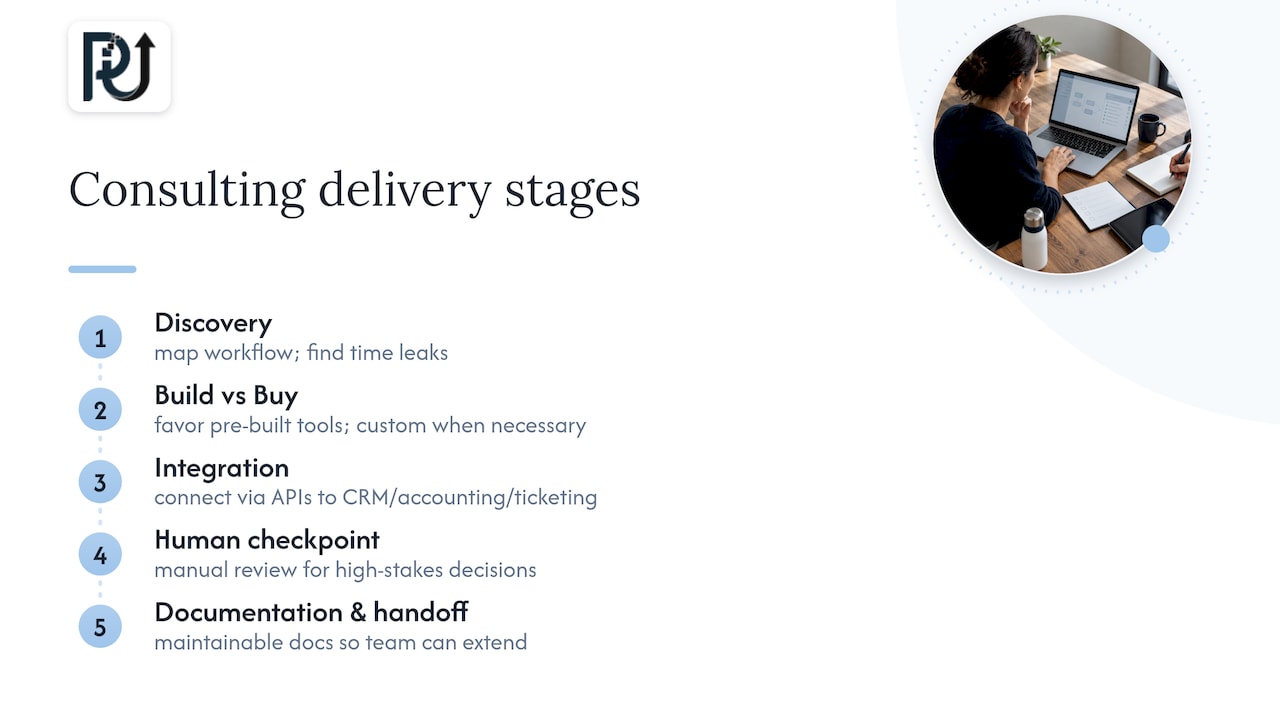
A consulting engagement starts with discovery: mapping your workflow step by step to find where time disappears, often in approvals that wait on one person or data entry duplicated across systems. This “time-leak” analysis is what turns a vague automation wish into a scoped pilot.
The next decision is build versus buy. Pre-built models and SaaS connectors get you to a working pilot faster and cost less to maintain, which is why the SBA’s guidance and most practitioner experience favor integrating existing tools over building custom models from scratch, reserving custom agent development for workflows too specific or sensitive for off-the-shelf tools to handle well.
Integration work connects the automation to your CRM, accounting platform, or ticketing system through APIs, which is where a lot of pilots fail quietly if the consultant underestimates how messy your existing data connections are. Once live, the system needs a human-in-the-loop checkpoint for any decision with real consequences, a practice the SBA recommends explicitly for high-stakes tasks.
Documentation closes the loop: a maintainable handoff means your team can troubleshoot and extend the system without calling the consultant for every tweak, which is the real test of whether the engagement built you an asset or just a demo.
How to choose the right AI consulting partner
Evaluate partners on five criteria: a track record of measurable outcomes, experience in your specific industry workflows, integration skill with the systems you already run, clear data security practices, and a system built to be maintained by your own team after handoff.
- Ask what KPI the last three pilots were measured against and what the actual result was.
- Ask how they handle data security and who has access to your records during the engagement.
- Ask whether they prefer pre-built tools or custom builds for a use case like yours, and why.
- Ask what the handoff documentation looks like and who maintains the system after launch.
- Ask for a fixed-scope pilot proposal before committing to a full implementation contract.
Watch for these red flags before signing anything:
- Promises of fully autonomous systems with no human review step.
- No concrete pilot plan, just a long-term roadmap and a large upfront invoice.
- Vague answers about where your data is stored or who can access it.
Pricing typically splits into two shapes: a scoped pilot covering one use case, and a larger implementation contract once the pilot proves out. Budget the pilot as the smaller, faster commitment and treat the full build as a separate decision made with evidence in hand.
Pro Tip: Ask any prospective consultant to walk you through how they’d document a handoff, not just how they’d build the pilot. The answer reveals whether they think past the first demo.
For guidance on vetting outside communications and deliverables from any consultant, resources on evaluating consulting work from independent consulting communities can help you ask sharper questions in early calls.
A pilot-first roadmap you can start this quarter
A pilot-first plan keeps risk small and gives you evidence before you commit real budget. Here is the sequence that tends to work:
- Discovery sprint (1 to 2 weeks): map the target process, define the KPI, and confirm who owns the data.
- Pilot build (4 to 8 weeks): scope one use case, favor SaaS tools or pre-built models where they fit, and connect to one or two core systems.
- Measurement: baseline the current hours or revenue impact before launch, then track the same metric weekly once the pilot runs.
- Governance: build a simple risk map and keep a human reviewing high-stakes outputs, following the GOVERN and MAP functions in NIST’s AI Risk Management Framework.
- Scale: once the pilot hits its KPI, move the workflow into standard operations and use the same measurement approach for the next use case.
Pro Tip: Design every pilot to produce one number, hours saved or revenue impact, rather than a count of features shipped. That number is what gets you budget for the next project.
Our own pilot-first playbook follows this same sequence for the engagements we run.
Why small, measured bets beat big AI promises
The businesses that get the most out of AI consulting are the ones that resist the urge to automate everything at once. A single pilot with a clear KPI gives you evidence, and evidence is what convinces a skeptical team to support the next project.
A short pilot outline we’d recommend to most SMBs: pick one manual workflow, baseline the current hours spent, automate it with the lightest tool that fits, and measure again in six weeks.
— Syed Naveed Abbas
Ready to run your first pilot?
Custom AI agents and automation systems can provide proof before scaling, rather than just a roadmap full of promises. Whether the bottleneck is document processing, customer support routing, or a forecasting workflow buried in spreadsheets, our pilot-first engagements are built to hand you a working system and a measured result, not just a recommendation.
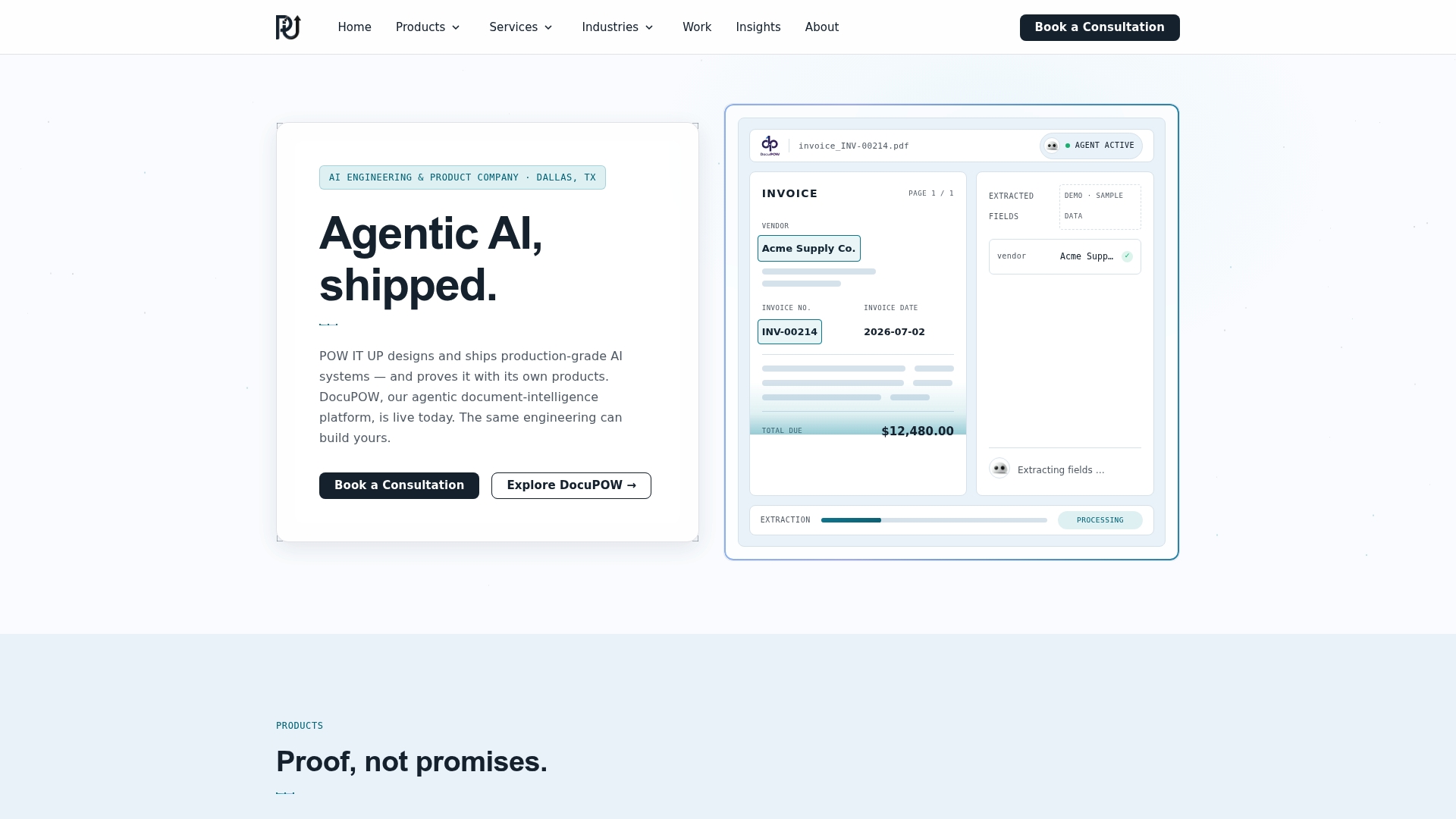
- Explore DocuPOW if document reading and validation is your first target.
- Start with AI Agents Development to scope a custom pilot for your specific workflow.
Request a pilot scope through our AI Agents Development page and get a working system before you commit to a full build.
FAQ
What does AI consulting for small businesses typically include?
It includes an opportunity assessment to find the highest-payoff workflow, a scoped pilot build, integration with your existing tools, staff training, and a documented handoff. The goal is a working system your team can run, not just recommendations.
How long does a typical AI pilot take?
A discovery sprint usually runs one to two weeks, followed by a pilot build of four to eight weeks depending on the complexity of the use case and how many systems it needs to connect to. Measurement against a baseline KPI starts as soon as the pilot goes live.
How much should an SMB budget for an AI consulting pilot?
Pricing depends on scope, and a fixed-scope pilot covering one use case costs less than a full implementation contract, so ask any partner for a pilot proposal before committing to a larger build. Our own services list pilot and project pricing available on request based on scope.
What’s the biggest reason AI projects fail at small businesses?
The most common causes are unclear ownership of the workflow, fragmented or messy data, and no defined KPI to measure success against. A pilot with a baseline metric and a named owner avoids most of these failures from the start.
Do SMBs need a formal AI governance policy before starting?
A full policy isn’t required to start a small pilot, but basic governance such as human review of high-stakes outputs matters from day one. The NIST AI Risk Management Framework offers practical functions that small teams can scale to fit their resources.
Sources
- AI for small business | U.S. Small Business Administration
- Artificial Intelligence Risk Management Framework (AI RMF 1.0) | NIST
- Research spotlight: AI in business — Small firms closing in | SBA Office of Advocacy