

Autonomous business systems are AI-driven digital workforces, coordinated agents, a governance-enabled orchestrator, and machine-readable data, that execute core workflows with only human supervision for exceptions. The payoff is faster decisions, scale without adding headcount, and more resilient operations. Getting there requires deliberate architecture and governance, which the sections below walk through in practical order.
TL;DR:
- Autonomous systems rely heavily on a mix of task automators, orchestration agents, and validation agents to work effectively together.
- High-volume, rule-based workflows like invoice matching, demand sensing, and routine customer service tasks provide the clearest return on autonomous system investments.
- Governance must be integrated into the system design from the start, with risk tiers, escalation protocols, and traceability to ensure compliance and safety.
- Successful scaling depends on a step-by-step approach with measurable KPIs, and requires ownership from leadership, especially CEO sponsorship.
- Data productization, proper architecture, and a clear operating model are critical for overcoming adoption barriers such as data quality issues and skills shortages.
Table of Contents
- The Core Components and Architecture Behind Autonomous Systems
- What Business Value Do Autonomous Systems Actually Deliver?
- How Do Autonomous Agents Sense, Reason, Act, and Escalate?
- A Step-by-Step Roadmap From Pilot to Scale
- Governance and Risk Controls for Autonomous Agents
- Our Approach to Building Autonomous Business Systems
- Why Leadership Ownership Decides Whether This Works
- How POW IT UP Can Help You Build This
- FAQ
- Sources
The Core Components and Architecture Behind Autonomous Systems
Before anyone signs off on a pilot, it helps to know what you are actually buying or building. An autonomous business system is not one piece of software. It is a stack of agents, coordination logic, and data plumbing that has to work together or the whole thing stalls.
Start with the agents themselves. Most deployments use a mix of task automators that handle narrow, repeatable actions, orchestrator agents that sequence work across systems, and guardrail or validation agents that check outputs before anything touches a customer record or a ledger. That taxonomy matters because vendors often blur it, selling a single chatbot as a full autonomous system when it is really one task automator with no orchestration layer behind it.
Orchestration is the part leaders underestimate most. Some architectures use an agentic mesh, where agents negotiate tasks peer to peer, while others rely on a central orchestrator agent that assigns work and tracks state. AUTOBUS demonstrates a neuro-symbolic variant that pairs large language model agents with logic programming and enterprise knowledge graphs, which keeps the reasoning traceable rather than opaque.
Data foundations decide whether any of this works at scale. Agents need machine-readable documents, semantic grounding against a knowledge graph, and what practitioners call data productization, treating internal data as a maintained product rather than a byproduct of other systems.
Finally, the integration surface: APIs, event streams, and connections into ERP and CRM platforms, plus observability and telemetry so you can see what an agent did and why. Our overview of types of AI agents for service teams breaks down how these roles map to real deployments.
- Task automators handle narrow, repeatable actions like data entry or routing.
- Orchestrator agents sequence multi-step work across systems and agents.
- Guardrail agents validate outputs against rules before actions execute.
- Data productization turns internal records into structured, agent-readable assets.
What Business Value Do Autonomous Systems Actually Deliver?
Enterprises are moving past pilots, and the numbers back it up. IBM’s 2025 study found that enterprises expected AI-enabled workflows to grow from 3% in early 2025 to 25% by the end of that year, and 83% of surveyed executives expected AI agents to improve process efficiency by 2026. Reengineering workflows around agents rather than layering AI onto legacy processes can produce 2 to 10 times the productivity gains, according to practitioner research published in the Harvard Data Science Review.
The highest-value use cases share a pattern: high transaction volume, clear rules, and a measurable outcome.
- Finance and accounts payable: invoice matching, exception flagging, and reconciliation run continuously instead of in weekly batches.
- Supply chain: demand sensing and reorder agents react to inventory signals in real time rather than on a fixed schedule.
- Customer service: triage agents resolve routine tickets and escalate only ambiguous or high-risk cases to a person.
- Sales operations: lead qualification and quote generation agents cut the lag between inquiry and response.
- HR: onboarding and policy-question agents handle repetitive requests so HR staff focus on judgment calls.
When picking a first workflow, weigh three criteria: repeatability (does the task follow consistent logic), cross-functional benefit (does fixing it help more than one team), and measurable outcome (can you track time saved or error reduction from day one). Our guide to AI agents for small and mid-size businesses walks through how smaller teams prioritize their first use case without overbuilding.
How Do Autonomous Agents Sense, Reason, Act, and Escalate?
Picture an invoice-to-pay workflow. An invoice arrives by email or API feed, triggering the process. A data enrichment agent extracts line items, matches them against a purchase order, and checks vendor records against the knowledge graph. A reasoning agent then evaluates whether the invoice meets approval thresholds, flags discrepancies, and decides the next action. If everything checks out, an action agent routes the payment for execution. A monitoring agent logs every step, and if something falls outside tolerance, a remediation path kicks in instead of a silent failure.
This is where governance actually lives, not in a policy document but in the runtime. California Management Review’s research describes this as a shift from Human-in-the-Loop, where a person approves every action, to Human-on-the-Loop, where people supervise exceptions flagged by confidence scoring and escalation thresholds. At enterprise scale, requiring sign-off on every transaction becomes the bottleneck, not the agents.
- Trigger: an event, document, or schedule starts the workflow.
- Enrichment: agents pull and validate context from connected systems.
- Reasoning: a decision agent applies rules or learned logic to choose an action.
- Action and monitoring: the system executes and logs the result for audit.
- Remediation: guardrail agents intervene when outputs fall outside set tolerances.
Auditable logic matters more than it sounds. A neuro-symbolic approach, combining logic programs with enterprise knowledge graphs as AUTOBUS outlines, lets you trace exactly why an agent approved or rejected something, which matters for finance and compliance workflows where “the model said so” is not an acceptable answer.
Pro Tip: Start your first pilot on a workflow where a wrong decision is cheap to reverse, so you can tune guardrails before moving to higher-stakes processes.
A Step-by-Step Roadmap From Pilot to Scale
Treating autonomous systems as a single big-bang rollout is how most initiatives stall. A sprint-based approach gives you checkpoints to prove value before committing further budget.
- Audit and gauge (weeks 1 to 2): map the target workflow, quantify current cycle time and error rates, and identify the data sources agents will need.
- Engineer (weeks 3 to 6): build the agent set, connect APIs, and productize the data feeding the workflow.
- Govern and test (weeks 7 to 8): define risk tiers, set escalation thresholds, and run the system in shadow mode alongside existing staff.
- Scale (week 9 onward): template the agent pattern for adjacent workflows and move from Human-in-the-Loop to Human-on-the-Loop supervision.
Each sprint needs its own KPIs: time saved per transaction, error rate reduction, and throughput increase are the three that matter most to a finance or operations sponsor.
One in four organizations reports scaling an agentic system in at least one business function, while 39% have experimented without reaching that stage, which suggests the gap between piloting and scaling is where most initiatives get stuck.
Team composition matters as much as tooling. You need someone who owns data productization, an integration engineer comfortable with API layers, and an operations lead who understands the workflow being automated, not just the technology. McKinsey’s research on agentic AI points to the same four enablers: people, governance, technology architecture, and data, arguing that scattered pilots fail without program-level investment in all four. For guidance on scoping a pilot without overcommitting resources, this consulting resource for smaller teams covers how to structure early engagements. Our own breakdown of AI automation services covers how we structure the organizational side of this handoff between people and digital workers.
Governance and Risk Controls for Autonomous Agents
Governance is not a separate workstream bolted onto a technical build. The NIST AI Risk Management Framework organizes this into four functions, Govern, Map, Measure, Manage, and each maps cleanly onto the agent lifecycle.
- Govern: establish an agent registry with clear ownership for every deployed agent.
- Map: assign risk tiers based on what an agent can touch, financial transactions rank higher than internal scheduling.
- Measure: run red-teaming and ongoing monitoring against defined performance and safety thresholds.
- Manage: build escalation protocols so guardrail agents route uncertain cases to a named human owner.
CMR’s research frames agentic deployment as an institutional change rather than a technology project, arguing that governance has to be designed into the operating model from the start rather than added after an incident. That includes supplier risk assessment: if you rely on third-party models or orchestration platforms, you need traceability into what data they touch and how their outputs get validated before they reach a guardrail agent. A compliance-focused resource on AI compliance automation covers specific capabilities risk and compliance teams should expect from vendors in this space.
Our Approach to Building Autonomous Business Systems
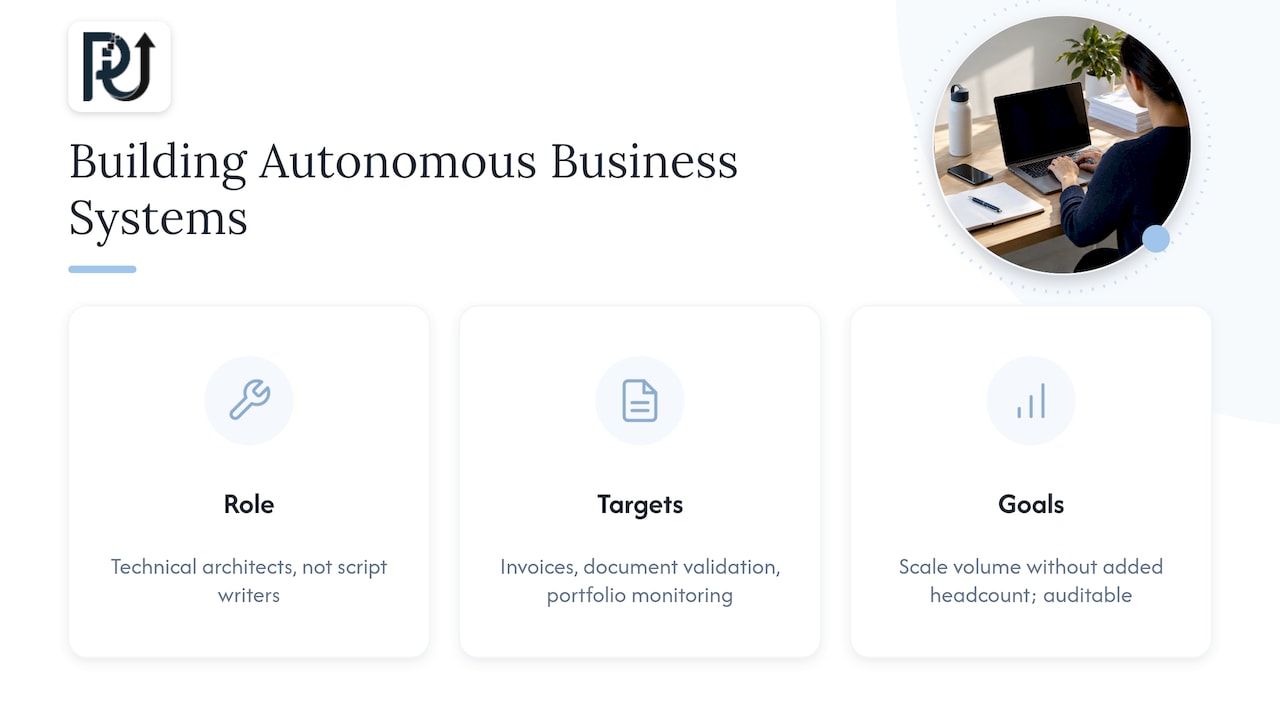
As a premier AI integration and automation firm, we function as technical architects rather than script writers. Our work centers on designing and deploying custom digital workforces using autonomous, context-aware AI agents built for a specific operational environment rather than a generic template.
The systems we build target high-volume transactional work such as invoice processing, document validation, and portfolio monitoring where manual handling creates recurring “time leaks.” The goal is processing volume that scales without a matching increase in headcount, built on architecture that stays auditable as it grows.
Why Leadership Ownership Decides Whether This Works
The biggest mistake I see is treating agents as plugins you bolt onto existing workflows. They are not. They require operating-model change: new ownership structures, new escalation paths, new ways of measuring work. That only happens with direct CEO sponsorship behind a lighthouse project, not a departmental experiment nobody above the director level reviews.
Invest in data productization before you invest in agents. Embed governance from sprint one, not after the first near-miss.
— Syed Naveed Abbas
How POW IT UP Can Help You Build This
If you are ready to move past the planning stage, we offer a direct path into production. Our AI Agents Development service builds the custom, context-aware agents described throughout this guide, scoped to your actual workflows rather than a generic template. For teams that need existing systems connected first, AI Integration handles the API and data layer work that agents depend on, and AI Automation covers the broader workflow redesign.
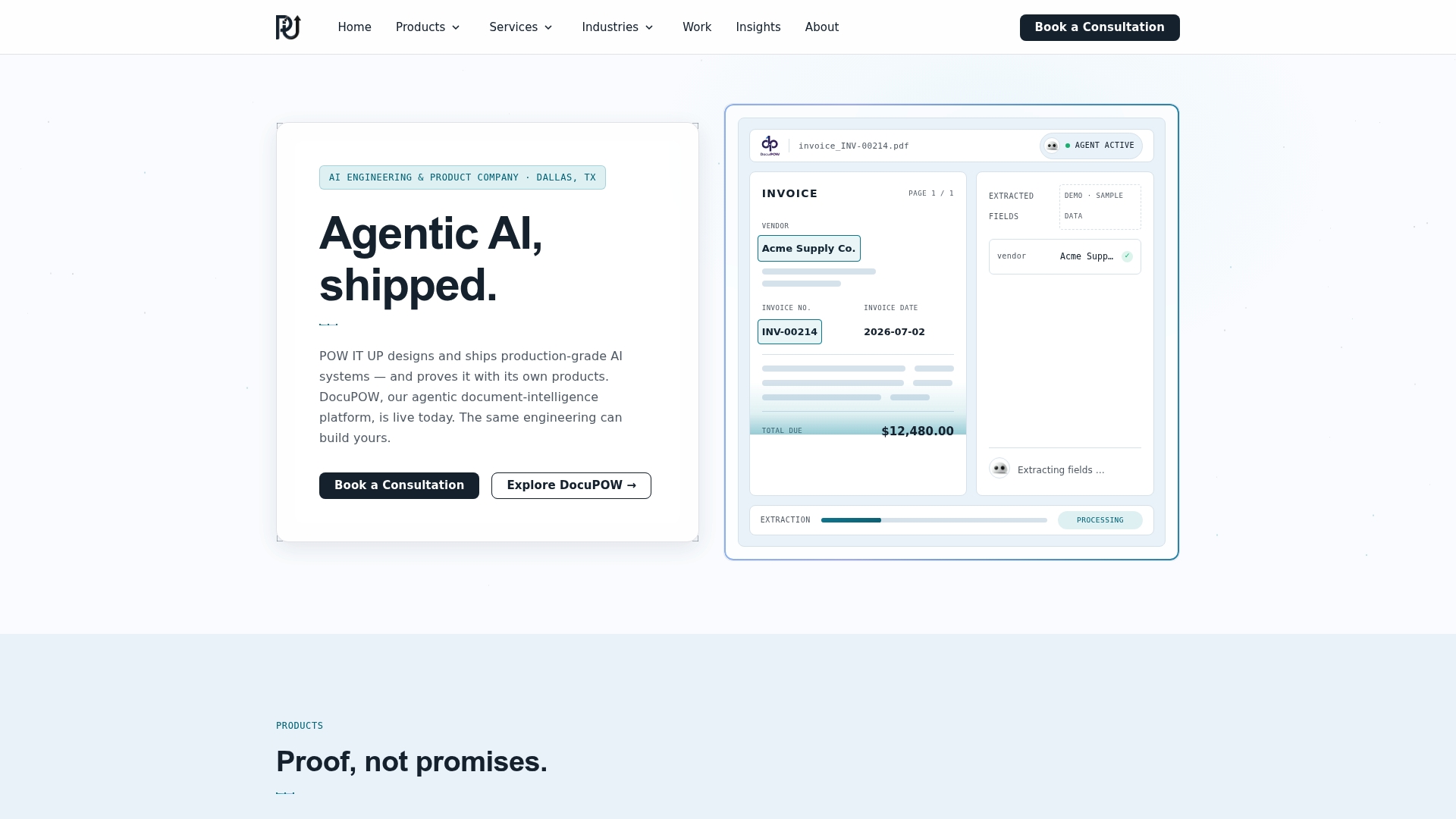
For a concrete, demoable starting point, DocuPOW handles document reading and validation, the kind of high-volume transactional work this entire framework is built around. You can request a live demo to see how it handles your document types before committing to a larger build, or reach out to scope a pilot engagement against one of the workflows covered above.
FAQ
What are examples of autonomous systems?
Common examples include invoice-to-pay agents that match and approve transactions, customer service triage agents that resolve routine tickets and escalate the rest, and supply chain agents that adjust reorder quantities based on real-time demand signals. Document processing systems like DocuPOW are another example, reading and validating documents without manual review for every file.
What is autonomous business?
An autonomous business runs core workflows through coordinated AI agents, an orchestrator, and machine-readable data, with human oversight reserved for exceptions rather than routine approvals. The operating model shifts from Human-in-the-Loop to Human-on-the-Loop supervision as the system scales, according to governance research from CMR.
Will RPA be replaced by AI?
Autonomous systems do not simply replace robotic process automation, they subsume it by adding reasoning, planning, memory, and cross-department orchestration that rule-based RPA lacks, according to research published in the Harvard Data Science Review. RPA still handles narrow, rule-based tasks well, but it cannot adapt to exceptions the way an agent-based system can.
What are the top adoption barriers for autonomous business systems?
IBM’s 2025 study found data quality concerns, trust and explainability issues, and skills shortages as the leading barriers to adoption. Addressing these typically starts with data productization and a governance framework before scaling beyond a pilot.
Sources
- IBM: AI Projects to Profits study (newsroom release)
- Artificial Intelligence Risk Management Framework (AI RMF 1.0)
- AUTOBUS: An Autonomous Business System (arXiv paper)
- The Agent-Centric Enterprise (HDSR / MIT Press)
- Governing the Agentic Enterprise (California Management Review)