
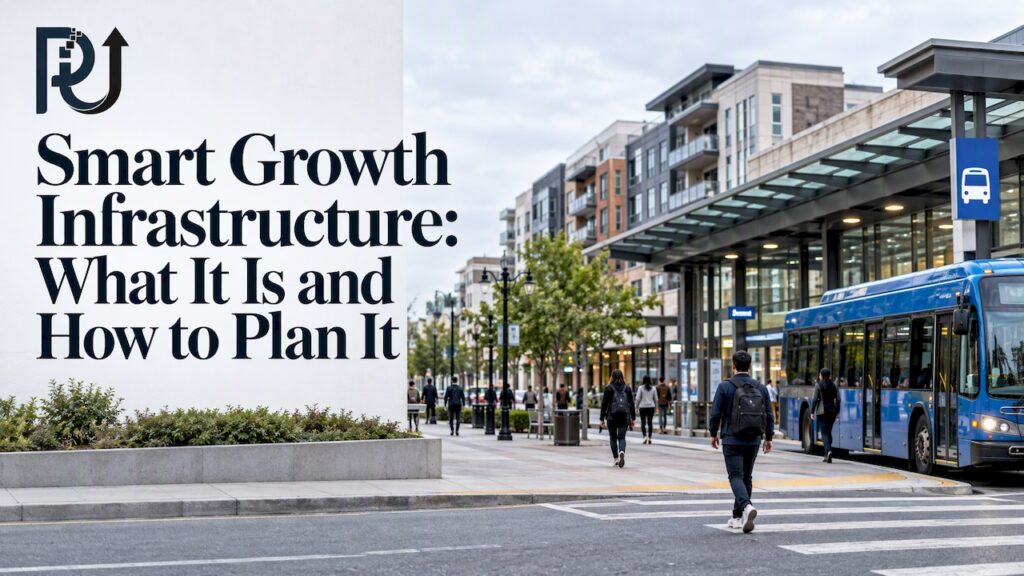
Smart growth infrastructure is the roads, transit, water and sewer lines, public facilities and, increasingly, data systems that a community builds and manages to support compact, mixed-use, walkable development instead of spread-out sprawl. The idea is simple: put growth where infrastructure already exists, plan transportation and land use together, and make every public dollar do more work. This guide explains the principles, how infrastructure fits in, what it costs and saves, where the trade-offs sit, and how digital tools are changing the way planners and operators run it.
TL;DR
- Smart growth is a set of development and conservation strategies. Infrastructure is the part that makes it real: transit, streets, utilities and public services aligned with where people live and work.
- The EPA lists 10 principles, from mixed land uses and compact design to transportation choices and predictable, fair decisions.
- Compact development generally costs less to serve with water, sewer and roads than dispersed development, according to EPA’s review of local government studies.
- Smart infrastructure, meaning sensors and analytics layered on physical assets, is a related but separate idea. It helps operators maintain what smart growth builds.
- Trade-offs depend on local context, so community engagement is part of the infrastructure plan, not an add-on.
Table of Contents
- What smart growth means in community planning
- The 10 principles of smart growth
- How infrastructure supports smart growth
- Quick reference: which infrastructure serves which principle
- What the benefits look like
- Trade-offs communities should plan for
- Smart infrastructure and smart growth: how they connect
- Where digital operations meet infrastructure delivery
- Perspective
- How POW IT UP can help
- A practical sequence for planners and operators
- FAQ
- Sources
What smart growth means in community planning
The U.S. Environmental Protection Agency describes smart growth as an overall approach of development and conservation strategies that can help protect health and the natural environment while making communities more attractive, economically stronger and more resilient to climate change (EPA).
Two misreadings come up often. The first is that smart growth means high-rise density everywhere. The American Planning Association’s policy guide says the opposite: it is about retrofitting communities to offer more choices, not a choice between large suburban homes and dense urban towers. The second is that it only applies to big cities. EPA’s guide notes that the principles are flexible and have been applied in cities, suburbs, small towns and rural areas.
The APA also frames smart growth as supporting choice and opportunity, including where and how people live, work and play, through efficient and sustainable land development (APA). Infrastructure is how that choice becomes practical. A neighborhood can be zoned for mixed use, but without sidewalks, bus service and pipes with spare capacity, the zoning changes nothing.
The 10 principles of smart growth
The 10 principles were developed by the Smart Growth Network and are summarized by EPA:
- Mix land uses
- Use compact building design
- Create a range of housing choices
- Create walkable neighborhoods
- Foster distinctive, attractive communities
- Preserve open space, farmland and natural areas
- Direct development toward existing communities
- Provide a variety of transportation choices
- Make development decisions predictable and fair
- Encourage community and stakeholder collaboration
Read them as an infrastructure checklist and a pattern appears. Principles 1, 2 and 4 describe what gets built. Principles 7 and 8 describe where public systems are extended and which modes they serve. Principles 9 and 10 describe the process that keeps the investment credible.
How infrastructure supports smart growth
Land use and transportation planned together
EPA says infrastructure supports smart growth through coordinated land use and transportation planning, multimodal access, and planning transportation and other infrastructure so that it aligns with development and redevelopment (EPA, Smart Growth and Transportation). Federal transportation planning rules point the same way: they require consideration of strategies that protect and enhance the environment and promote consistency between transportation improvements and planned growth and economic development (FHWA).
The U.S. Department of Transportation goes further. Its January 2025 paper argues that land use policy is the most fiscally responsible transportation solution because it shapes travel demand and therefore the infrastructure investments needed in the first place.
Transit-oriented development
Transit-oriented development is the clearest example of infrastructure and land use working as one system. It means compact development around a transit station or within easy walking distance, with a mix of uses that supports walkable communities (EPA). The station is the anchor; housing, shops, offices and safe pedestrian links are what turn it into a destination.
Infill and existing networks
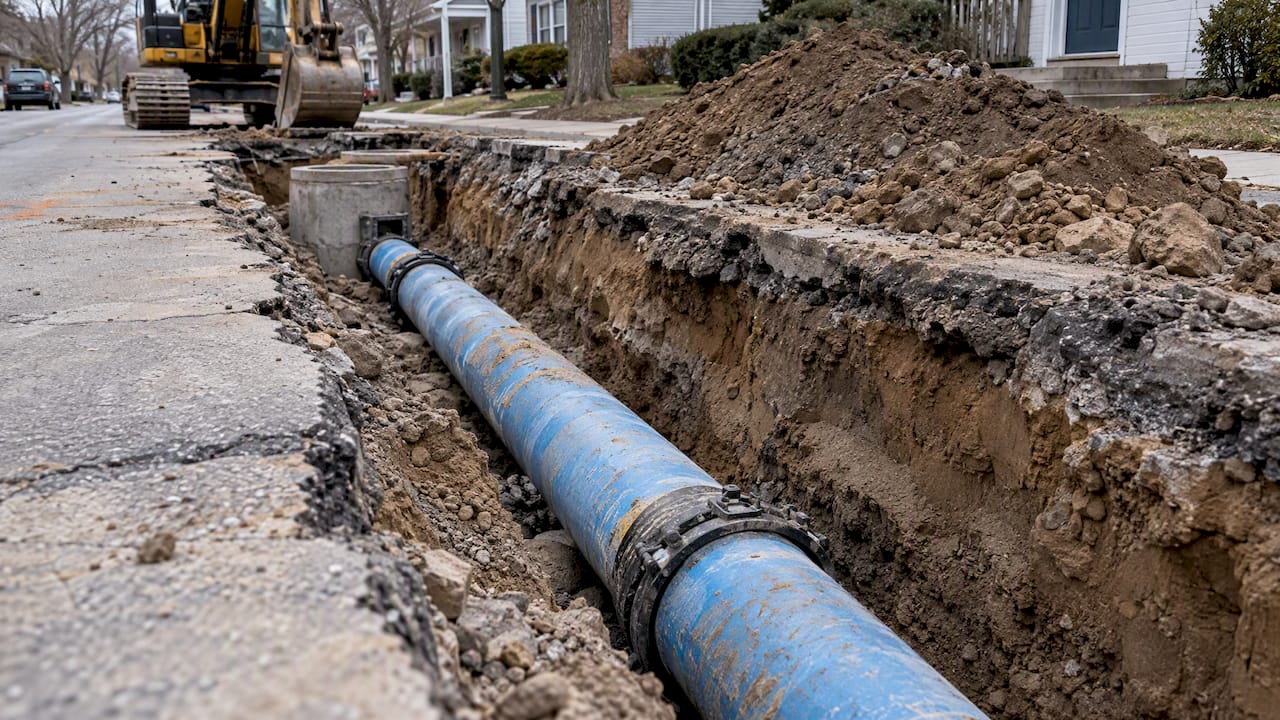
Building on vacant or underused land in existing neighborhoods puts the existing pipes and roads to work. Idaho Smart Growth notes that infill makes the most of public investments in water and sewer lines, roads and emergency services. Every new household on an existing line adds revenue to a system already paid for, rather than adding miles of new pipe to maintain.
Green infrastructure
Natural systems count as infrastructure too. NOAA points to Portland, Oregon, which has used compact development and green infrastructure policies, and whose Metropolitan Greenspaces Program acquires natural areas and trails for recreation and for water-quality, floodplain and habitat protection (NOAA).
Quick reference: which infrastructure serves which principle
| Infrastructure type | What it does | Principles it supports |
|---|---|---|
| Transit and station areas | Anchors compact, mixed-use growth | Transportation choices, compact design, mixed uses |
| Sidewalks, trails, complete streets | Makes short trips safe without a car | Walkable neighborhoods, transportation choices |
| Water, sewer and stormwater | Serves new homes on existing lines; manages runoff | Direct development to existing communities, open space |
| Green infrastructure and parks | Protects habitat and floodplains | Preserve open space, distinctive communities |
| Public facilities and services | Fire, schools, libraries within reach | Mixed uses, range of housing choices |
| Data and permitting systems | Makes decisions faster and more consistent | Predictable and fair decisions, collaboration |
What the benefits look like
EPA’s 2011 guide lists energy savings, reduced energy and transportation costs, reduced pollution, improved public health and enhanced quality of life as benefits (EPA Smart Growth Guide). Three of them matter most to local officials.
Lower public costs. EPA’s review of local government research found that water, sewer and road infrastructure cost less in compact development than in more dispersed development, and that ongoing expenses such as police, fire, street maintenance and trash removal run higher per capita when development is spread out (EPA). For a town with a shrinking tax base, that is the argument that gets a council’s attention.
Access for people who cannot or choose not to drive. Transportation choices can give low-income residents, seniors and people with disabilities more freedom and mobility (EPA).
Stable property values. Idaho Smart Growth reports that mixed-use neighborhoods are in demand, which can boost property values, keep them stable and protect municipal tax revenues (Idaho Smart Growth).
Trade-offs communities should plan for
Smart growth is not a template. The DOT’s land use paper makes the point that land use and transportation choices affect costs, emissions and access in different ways, and the results depend on local context (U.S. DOT). A few practical questions follow from that.
- Capacity. Infill puts more load on old systems. Before approving density, check whether the pipe, the substation and the intersection can absorb it, and budget for upgrades where they cannot.
- Sequencing. Zoning for walkable centers works best when streetscape, transit service and utilities arrive on the same timeline as the housing.
- Who is at the table. Idaho Smart Growth stresses that community needs and strategies vary and are best defined by the people who live and work there (Idaho Smart Growth). The APA says effective planning is multi-disciplinary and inclusionary and respects local land-use priorities (APA).
- Regional coordination. EPA notes that implementing the principles often means rethinking development approaches and taking a regionally coordinated approach to land use planning, and that smart growth can help areas attain and maintain Clean Air Act air quality standards (EPA Smart Growth Guide).
Treat these as design inputs. A plan that names its capacity limits and its sequencing up front is easier to defend at a public hearing than one that discovers them mid-construction.
Smart infrastructure and smart growth: how they connect
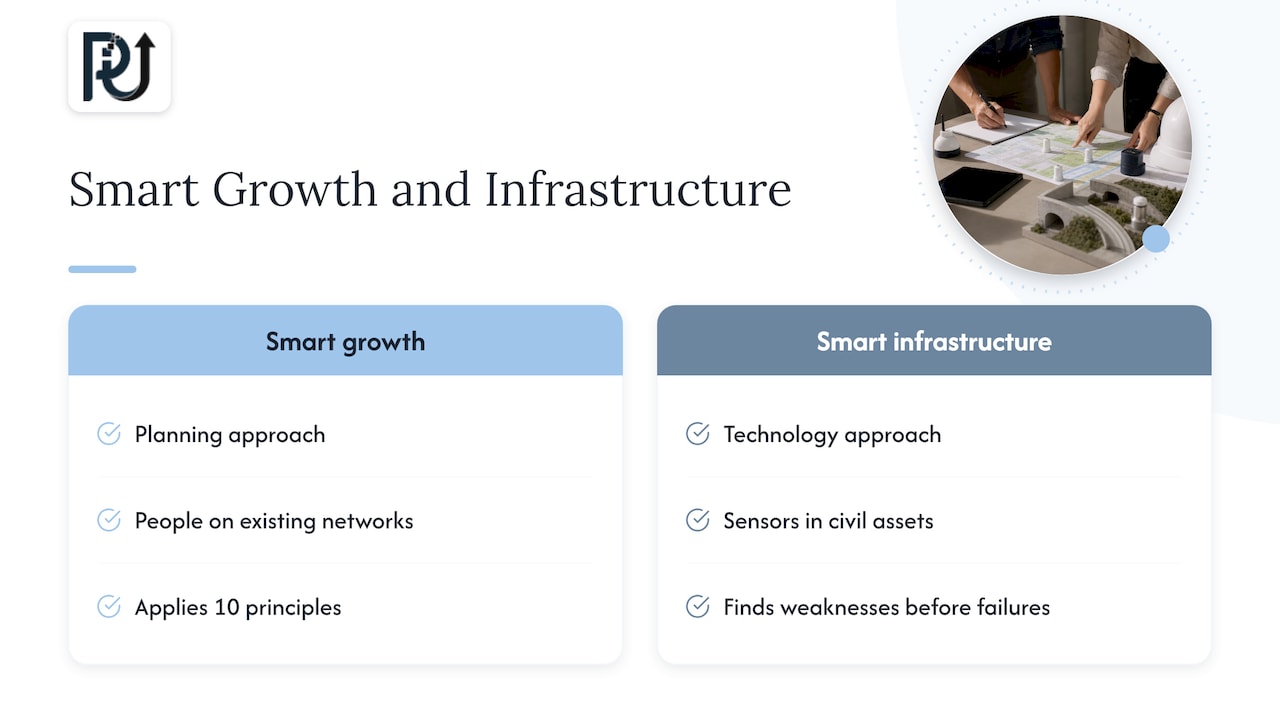
The two phrases sound alike and are often confused. Smart growth is a planning approach. Smart infrastructure is a technology approach: a Harvard Kennedy School policy brief describes intelligent infrastructure as smart sensors with embedded microprocessors and wireless connectivity built into civil assets, along with the tools for collecting, storing and analyzing the data. The brief argues that this kind of system can be layered onto existing infrastructure and can help identify weaknesses before they become failures, and it cites sewer and bridge monitoring programs as examples.
The link is practical. Smart growth concentrates people on existing networks, which raises the stakes on keeping those networks reliable. Monitoring that shows where a sewer main is degrading, where a bus corridor is overloaded or which permits are stuck gives planners the evidence to apply the 10 principles with confidence. It also supports principle 9, predictable and fair decisions, because the data is shared and consistent.
That is where operations work enters the picture. Cities, utilities, developers and the firms that serve them all run on documents, approvals and reporting: permit applications, inspection reports, invoices, grant paperwork, project cost records. The slower those flows, the slower the infrastructure gets built and maintained.
Where digital operations meet infrastructure delivery
Most of the delay in infrastructure projects is not concrete. It is paperwork moving between people. A few places where automation and analytics apply:
- Document-heavy intake. Permit packets, engineering submittals and compliance forms arrive in mixed formats. Reading and validating them automatically cuts re-keying and catches missing fields early.
- Project cost visibility. Contractors and public agencies working on mixed-use and transit projects need live views of budget against progress, not month-end spreadsheets.
- Asset and performance analytics. Dashboards that bring together sensor feeds, maintenance logs and service requests help operators prioritize repairs.
- Routine coordination. Status updates, reminders and handoffs between departments and vendors are repetitive and well suited to autonomous agents with clear rules and human review.
For teams thinking about how to build this foundation, our guide to scalable digital infrastructure covers the architecture side, and our digital transformation overview covers the organizational side.
Perspective
We build digital workforces for organizations whose operations are limited by volume, not by ideas. That is exactly the situation a community faces when it commits to smart growth: the plan is sound, but the permits, inspections, reporting and coordination behind it pile up faster than staff can handle.
Our view is that physical infrastructure and operational infrastructure should be planned together. A transit-oriented district needs good stations, and it also needs the back office that processes its approvals, tracks its costs and watches its service levels. Where those processes are manual, they become the hidden bottleneck.
We design context-aware AI agents and analytics systems to take on high-volume transactional work, find the time leaks in a process and let a team handle more volume without adding headcount. We favor systems built to be maintainable and owned by the client, because infrastructure outlives any single project, and the software around it should too.
The practical starting point is rarely a grand platform. Pick one flow, such as document intake or project cost reporting, make it reliable, and expand from there.
Syed Naveed Abbas
How POW IT UP can help
If your organization delivers or operates infrastructure, whether you are a developer, engineering or consulting firm, contractor or service business, we can help you remove the paperwork drag. DocuPOW reads and validates documents so submittals, invoices and forms move without manual re-entry. Our AI automation and AI agents development services build custom workflows around your own approval steps, and our cloud analytics work puts your numbers on one live view.

To see how these fit your operation, start at our services page and book a conversation about the one process costing you the most time.
A practical sequence for planners and operators
- Map where growth is already served. Identify corridors with spare water, sewer and road capacity. This is principle 7 in practice.
- Pair zoning with service. For each growth area, schedule transit, sidewalks and utility upgrades alongside the housing and commercial entitlements.
- Set the process rules. Publish clear review steps and timelines so developers and neighbors know what to expect.
- Engage early and often. Bring residents, businesses and utilities in before designs are fixed.
- Instrument what you build. Add monitoring and reporting so maintenance decisions rest on current data.
- Automate the routine. Once the process is clear and stable, automate document handling, status tracking and reporting so staff time goes to judgment calls. Our piece on a tech roadmap for strategic planning shows how to sequence that work.
FAQ
What are the 10 principles of smart growth?
They are: mix land uses, use compact building design, create a range of housing choices, create walkable neighborhoods, foster distinctive communities, preserve open space, direct development toward existing communities, provide transportation choices, make development decisions predictable and fair, and encourage collaboration. The Smart Growth Network developed them, and EPA publishes the list.
What is the concept of smart infrastructure?
Smart infrastructure adds sensors, connectivity and data analysis to physical assets such as pipes, bridges and roads so operators can monitor condition and act earlier. It is separate from smart growth, which is a land use approach, but the two reinforce each other when growth is concentrated on existing networks. See the Harvard Kennedy School brief for a detailed treatment.
Does smart growth only apply to big cities?
No. EPA says the principles are flexible and adaptable and have been applied in cities, suburbs, small towns and rural areas (EPA). In a small town the focus might be a walkable main street and infill on existing lots rather than rail transit.
Does smart growth really lower infrastructure costs?
EPA’s review of local government studies found that water, sewer and road infrastructure cost less in compact development than in dispersed development (EPA). Actual savings depend on local conditions, including existing system capacity.
Can a business use AI to support infrastructure projects?
Yes, mainly on the operational side: reading and validating documents, tracking project costs, producing reports and coordinating routine handoffs. Our AI integration service connects these tools to the systems you already use.
Sources
- About Smart Growth, US EPA
- Smart Growth Guide, US EPA (2011)
- Smart Growth and Transportation, US EPA
- Smart Growth and Economic Success: Strategies for Local Governments, US EPA
- APA Policy Guide on Smart Growth
- Land Use and Transportation Planning, FHWA
- Land Use as a Strategy for Transportation, U.S. DOT (January 2025)
- What is smart growth? Idaho Smart Growth
- What is smart growth? NOAA
- Building Back Better with Intelligent Civil Infrastructure, Harvard Kennedy School