AI-driven competitive differentiation does not come from using AI. It comes from what you build around it: proprietary data, expert people, customer trust and workflows redesigned so the AI does real work. Your competitors can buy the same models you can. They cannot easily copy your data, your processes or your reputation.
This guide explains what separates a durable AI advantage from a short-lived one. It also shows how to find the right places to apply AI, how to put the work into practice, and how to measure whether it is paying off.
TL;DR
- Adopting AI is not a moat. MIT Sloan Management Review argues that once AI is widely available, common access tends to homogenize firms instead of favoring one.
- Durable advantage comes from combining proprietary data, experienced employees’ expertise and customer trust with agentic AI, according to MIT Sloan.
- Pick use cases where your own data and workflows give the AI something rivals lack, then embed the AI in the workflow rather than leaving it as a side tool.
- Measure with indicators tied to your chosen advantage, such as cost per transaction, and govern risk from day one.
Table of Contents
- Why using AI is not the same as being different
- What actually makes an AI advantage durable
- Automating tasks versus redesigning the operation
- How to find where AI can create a real advantage
- Putting it into practice: from pilot to scale
- Perspective: where we see differentiation come from
- Where this applies by industry
- Measuring whether AI is making you different
- Risks to manage while you differentiate
- How POW IT UP can help
- FAQ
- Sources
Why using AI is not the same as being different
Most businesses now have access to the same large language models, the same cloud platforms and the same vendors. That is the core problem with treating AI adoption as a strategy. MIT Sloan Management Review reported in May 2025 that simply adopting AI is unlikely to create sustainable advantage once the technology is widely available. Common access can lift the market as a whole while making firms look more alike.
That has a practical meaning for an operator. If your plan is “we will add a chatbot and a summarizer,” you will be matching the baseline, not beating it. A defensive move like that can be worth making, since falling behind on productivity is costly. But it is not differentiation.
Differentiation starts when the AI does something your rivals’ AI cannot, because it is wired into things only you have.
What actually makes an AI advantage durable
The research points to a consistent answer: the durable part is not the model, it is the surrounding assets. Three of them matter most.
Proprietary data and a strong digital core
The California Management Review described the AI-era shift as a move away from competing mainly through industry positioning or superior resources. The new basis is differentiating through data and the digital core, the rate of organizational learning, capability reinvention, external partnerships and trusted, responsible AI use.
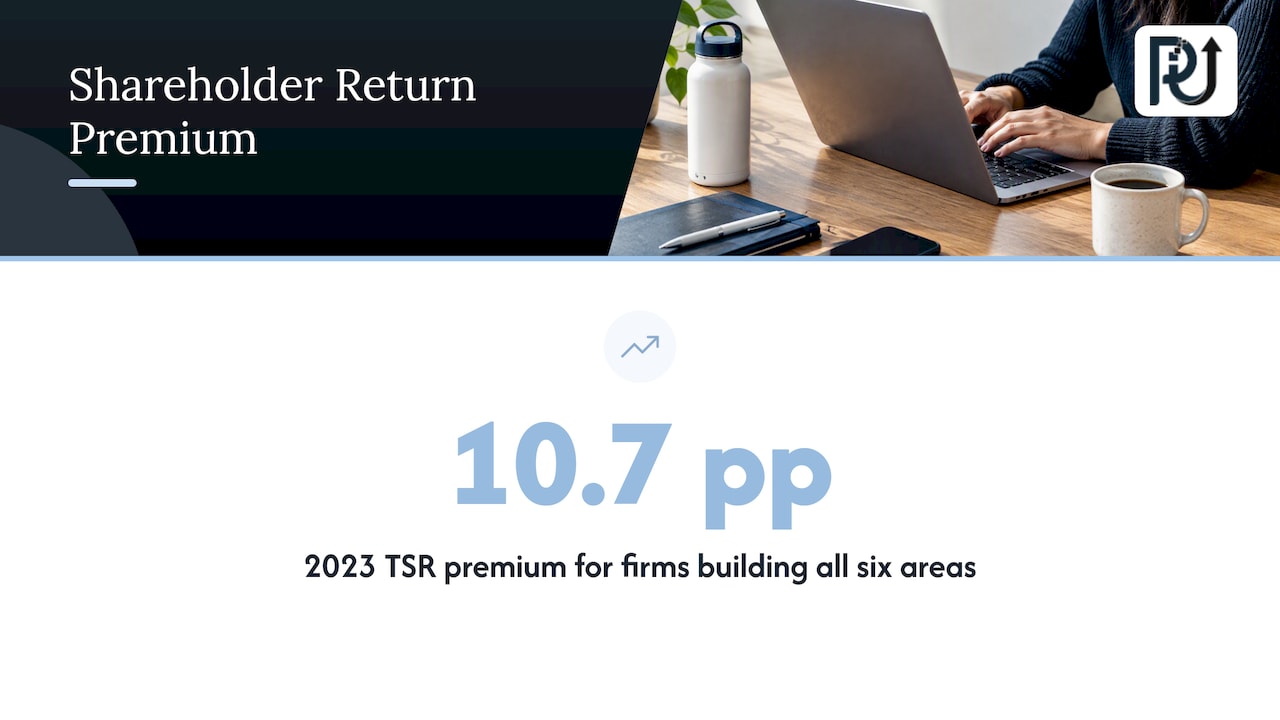
The same article reported that companies building all six of those areas earned a 10.7-percentage-point total-return-to-shareholders premium in 2023 compared with companies that did not, controlling for company size, headquarters location and industry. It is a correlation from one study and one year, so treat it as a signal about direction rather than a promise for your business.
For a mid-sized company, “proprietary data” is usually unglamorous: years of claims, invoices, intake forms, case notes, pricing history and customer communications. Nobody else has yours.
Expertise your people carry
MIT Sloan’s Katherine Kellogg argues that leaders should stop debating automation versus augmentation. Instead, they should set a deliberate path that tilts the AI portfolio toward growth and new value over time. Experienced employees are the source of the judgment that makes an AI system’s output good, and they are the ones who know which exceptions matter.
An automation that encodes your best underwriter’s, claims reviewer’s or coordinator’s decision logic is hard to copy. A generic tool that anyone can license is not.
Customer trust
Trust is the third asset in the same MIT Sloan argument. A business that handles sensitive documents, money or health information accurately and transparently earns permission to automate more of the relationship. A business that gets it wrong loses that permission quickly. That is why governance, covered below, is part of the strategy and not a compliance afterthought.
Management capability, not speed of adoption
In October 2026, MIT Sloan reported that durable differentiation depends less on how quickly companies adopt AI than on the management capabilities built around it. These include proprietary data, employee expertise, trust, operating capabilities and work redesign. Being first matters less than being deliberate.
Automating tasks versus redesigning the operation
Harvard Business School’s AI Institute frames the opportunity as redesigning the operating model: removing human bottlenecks and building scalable systems that learn from growing operational complexity, rather than automating isolated tasks. The difference is easy to see in a simple comparison.
| Task automation | Operating-model redesign | |
|---|---|---|
| Scope | One step, such as drafting an email | A whole workflow, such as intake to approval |
| Data | Public or generic | Your own transaction and customer history |
| Human role | Does the work, AI assists | Handles exceptions and judgment, AI does volume |
| Copyability | Anyone can license it | Hard to replicate without your data and process knowledge |
| Effect on growth | Small productivity gain | Volume can grow without a matching rise in headcount |
The right-hand column is where differentiation lives. It is also harder, which is exactly why it is defensible.
How to find where AI can create a real advantage
The research does not hand you a formula for choosing use cases, so here is the practical approach we use with operations leaders. It is our working method, not a finding from the studies above.
- List your high-volume, repeatable work. Document intake, data entry across systems, reconciliations, status updates, scheduling, routine client communications. Volume is where automation compounds.
- Find the time leaks. Ask the people doing the work where hours disappear: re-keying data, chasing missing information, waiting for approvals, fixing errors downstream. These are rarely visible in a dashboard.
- Ask what only you know. For each candidate, check whether your data, rules or expertise would make the result better than a generic tool’s. If not, buy a commodity tool and move on.
- Check customer impact. Prefer processes where speed, accuracy or responsiveness is something your customers notice and choose you for.
- Score by value, risk and readiness. Is the data accessible? Is the process stable enough to automate? What happens if the AI is wrong?
A useful frame comes from a Gartner-reproduced guide on generative AI business value. It suggests classifying ambition as defending, extending or upending your competitive position. Defensive assistants improve task productivity. Embedded AI that uses unique enterprise data can extend processes and create differentiation. New products, services or business models can upend an industry but demand greater risk tolerance.
Most mid-sized companies get the best return from the middle category: extending an existing process with their own data.
Putting it into practice: from pilot to scale
Start with one workflow and a fixed scope
Pick a single process with a clear owner, a measurable baseline and accessible data. Define what “done” looks like before building. Our guidance on proving AI consulting ROI in a matter of weeks covers how to scope a first engagement so the result is visible and the handover is clean.
Build the human escalation path in from the start
Harvard Business School research on enterprise AI describes an operating model that links development (idea intake and specification) with execution (agent autonomy). Orchestration routines coordinate tasks and escalate to human supervision when necessary. In practice, that means every automated workflow should know when to stop and ask a person.
Integrate, don’t bolt on
An AI tool in a separate browser tab is advice. An AI agent connected to your CRM, document store and accounting system is part of the workflow. Integration depth is what turns a clever demo into an operating advantage. Our AI integration service is built around that connection work.
Scale what works, and retire what doesn’t
Once the first workflow holds up, reuse the data pipelines, review rules and monitoring for the next one. Each additional automation is cheaper, and the accumulated knowledge about your operation becomes harder for a rival to reproduce.
Perspective: where we see differentiation come from
We build digital workforces, so we see the same pattern in many businesses. The companies that pull ahead are rarely the ones with the most AI tools. They are the ones that picked a process that matters to their customers, fed it their own data and put their best people’s judgment into the rules.
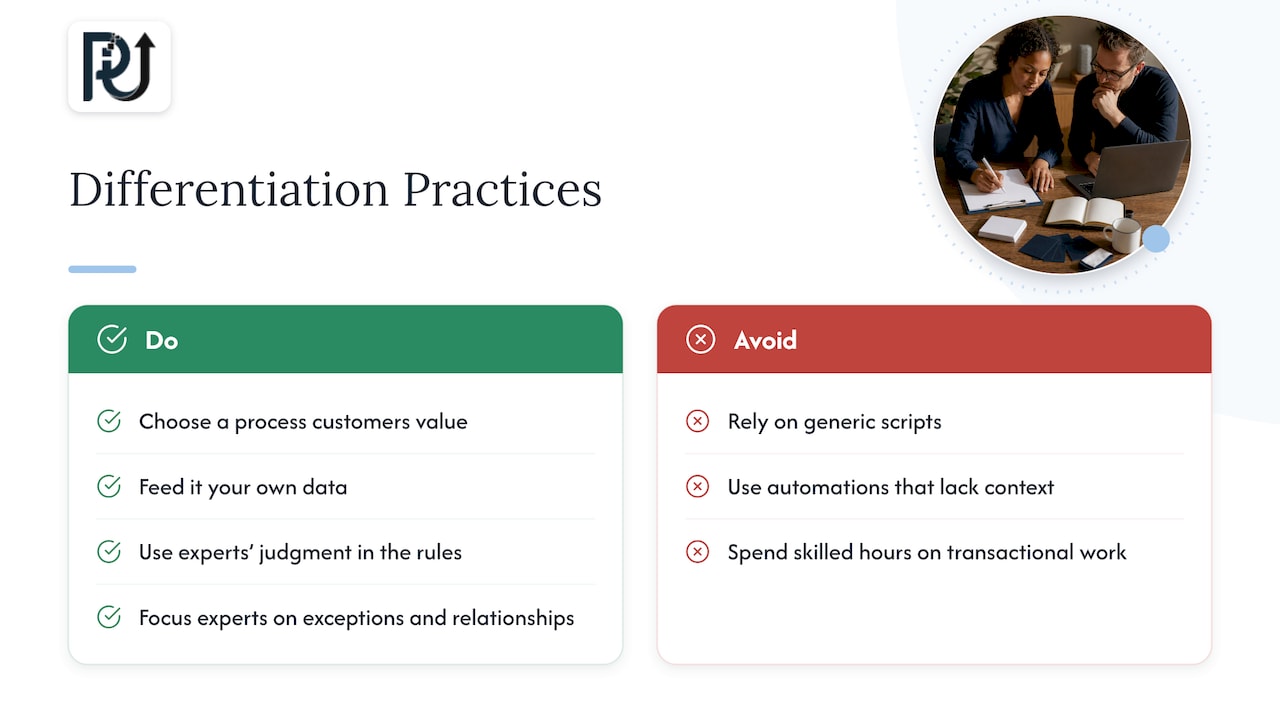
We also see the opposite: generic scripts and off-the-shelf automations that work for a month, then break when an input changes. A system that does not understand context becomes another thing for your staff to babysit. That is why we focus on custom, context-aware agents, documented and handed over so you own what is built and can maintain it.
One more view: the goal is not to remove people. It is to stop spending skilled people’s hours on transactional work, so volume can grow without a matching rise in headcount, and so your experts spend their time on the exceptions and relationships that customers actually value. Our piece on why service businesses need AI architects goes deeper on this design role.
— Syed Naveed Abbas
Where this applies by industry
The principles are the same everywhere; the assets differ.
- Fintech and financial services. Transaction history, document flows and client portfolio signals are the proprietary data. Reading and validating documents and monitoring portfolio health are natural places to extend a process. See our view on AI integration in core banking systems.
- Healthcare practices. Intake, referrals, authorizations and billing paperwork consume staff time. Because patient data is sensitive, governance and human review matter more here than anywhere else.
- Service businesses. Agencies, consultancies and accounting firms differentiate on turnaround, consistency and client experience. Standardizing delivery with AI is a lever; we discuss it in why service firms standardize with AI.
- Logistics, insurance and e-commerce. High-volume documents and exceptions make these good candidates for agents that read, validate and route work.
If you are choosing which kind of agent fits a service team, types of AI agents for service teams lays out the options.
Measuring whether AI is making you different
Track leading indicators tied to the advantage you chose. The NIST AI Risk Management Resource Center lists examples such as cost per transaction, network liquidity and the share of customer interactions mediated by AI. Pick the ones that match your moat and ignore the rest.
A practical set for an operations leader:
- Cost per transaction before and after, on the same process.
- Cycle time from request to completion.
- Exception rate, meaning how often a human must step in, and whether it is falling.
- Error rate found downstream, which shows whether quality is holding.
- Volume handled per employee, the clearest sign of scaling without a headcount increase.
- Customer-facing results such as response time and retention in the affected segment.
Set the baseline before you build. Without it, any improvement is an anecdote.
Risks to manage while you differentiate
Differentiation through AI fails in predictable ways. The NIST AI Risk Management Framework names key risk areas: unclear human and AI roles and oversight, plus inadequate governance, risk assessment, security and ongoing testing and validation.
The framework, published in 2023, also describes a cross-cutting “govern” function and a “measure” function that uses rigorous, scalable testing, evaluation, verification and validation to monitor risk and performance. For a business owner, that translates into a few habits:
- Name an owner for each automated workflow.
- Define what the AI may decide alone and what needs human sign-off.
- Test on real edge cases before launch, and keep testing after.
- Secure the data the agents touch, especially in healthcare and finance.
- Keep an audit trail so you can explain any outcome to a customer or regulator.
If your business is regulated, ask your compliance counsel or the relevant regulator which rules apply to your specific use before you automate a decision.
How POW IT UP can help
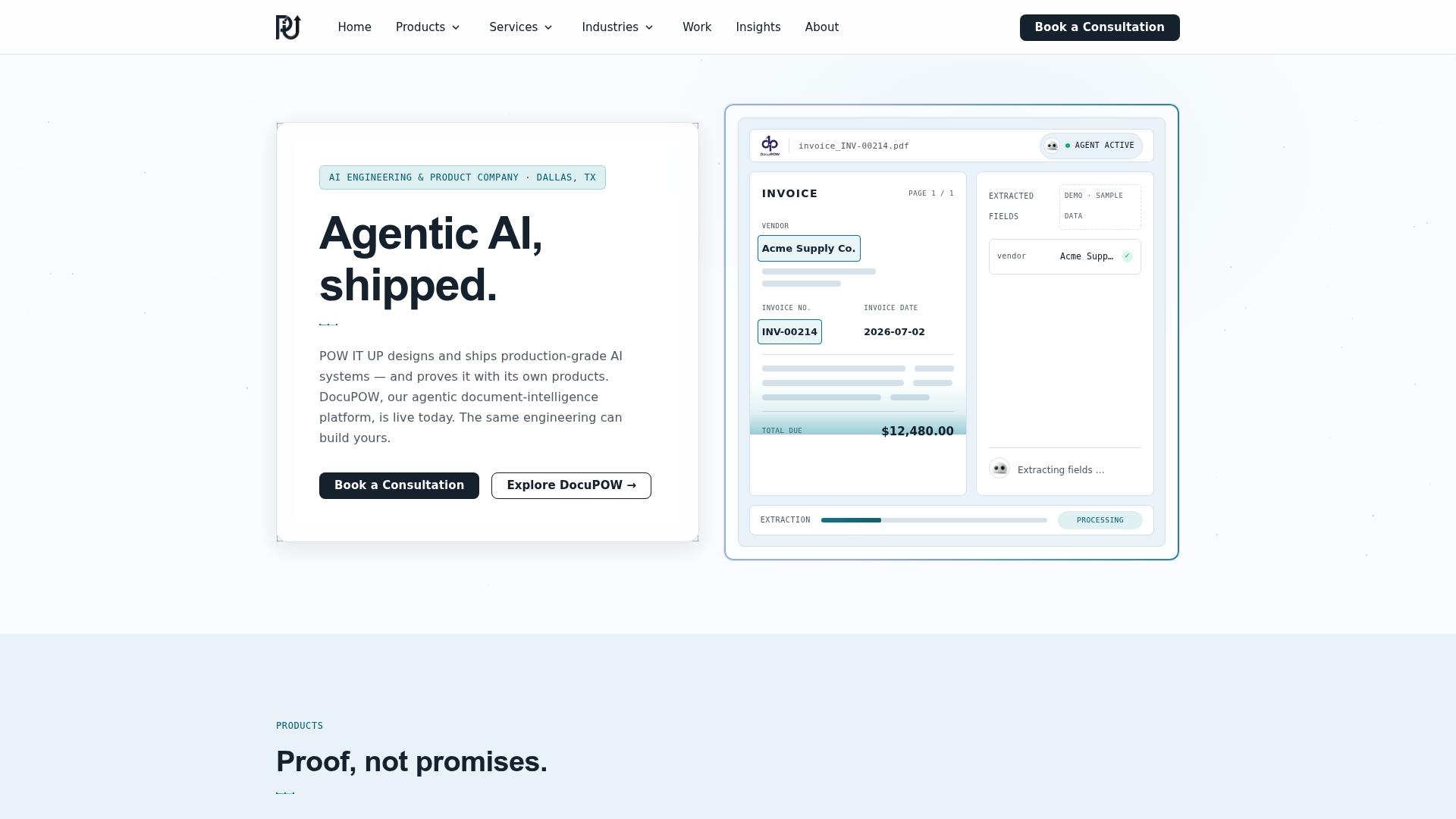
We design, build and deploy custom AI agents and automation for operations-heavy businesses, with documented engineering and a handover so you own the result. If your first step is reading and validating documents, DocuPOW is our live product for exactly that, and you can see it work on a demo. If you need something tailored to your own workflows, our AI agents development team scopes a first workflow with you.
Pricing is not published for these services, so the quickest route is to talk through your process with us on the POW IT UP site.
FAQ
Can AI really be a competitive advantage if everyone uses it?
Not by itself. MIT Sloan Management Review argues that widespread access tends to homogenize firms. The advantage comes from what you add: proprietary data, expert judgment, customer trust and redesigned workflows that rivals cannot copy easily.
What is the first step toward AI-driven differentiation?
Choose one high-volume process where your own data or expertise would make the result better than a generic tool. Measure its current cost, cycle time and error rate, then scope a small, fixed project around it.
How do I know if my data is valuable enough?
Ask whether the data is unique to you, reasonably clean and tied to a process your customers care about. Years of transactions, documents and client history usually qualify. If the data is scattered, cleaning and connecting it is often the first project.
Will AI differentiation reduce my headcount?
The goal for most of our clients is to grow volume without adding staff in proportion, not to cut people. Skilled employees move to exceptions and relationships, and their expertise is part of what makes the advantage durable.
What are the biggest risks?
Unclear human oversight, weak governance and insufficient testing are the main ones named by NIST. Assign owners, define escalation rules and keep validating results after launch.
Sources
- Why AI Will Not Provide Sustainable Competitive Advantage, MIT Sloan Management Review
- Stop debating automation vs. augmentation, MIT Sloan
- Competitive Advantage in the Age of AI, California Management Review
- 5 things to know about how companies can create value from AI, MIT Sloan
- Competing in an AI-driven world, Harvard Business School AI Institute
- Organizing AI at Enterprise Scale: Agentic Operating Models, Harvard Business School
- How to Calculate Business Value and Cost for Generative AI, Gartner guide
- AI RMF Core, NIST AI Resource Center
- Artificial Intelligence Risk Management Framework (AI RMF 1.0), NIST