

TL;DR:
- Process streamlining involves analyzing, simplifying, and automating workflows to eliminate waste and improve efficiency. It delivers measurable benefits such as cycle time reduction, error rate decrease, and cost savings. Success depends on thorough mapping, proper technology selection, clear ownership, and continuous monitoring, especially with AI advancements.
Process streamlining is the systematic practice of analyzing, simplifying, and automating workflows to eliminate waste, reduce errors, and accelerate outcomes. In formal operations management, this practice is also called business process optimization. Both terms describe the same discipline: removing every step that consumes resources without adding value. The payoff is measurable. Eliminating non-value-adding steps reduces cycle times by 30–50%, cuts error rates by over 70%, and lowers labor costs by 30%. Those numbers represent real dollars recovered from work that was never necessary in the first place. Organizations that treat process streamlining as a one-time project miss the point. The leaders who sustain gains treat it as a permanent operating discipline.
What is process streamlining and why does it matter?
Process streamlining is not about working harder. It is about removing friction from the path between input and outcome. Every organization accumulates redundant approvals, duplicate data entry, and manual handoffs over time. These inefficiencies compound quietly until they consume a significant share of operating capacity.
The financial case is direct. Streamlining efforts yield 10–50% cost reductions and up to 50% faster cycle times within the first year of implementation. That kind of return does not come from cutting headcount. The primary value is enabling teams to do more with existing resources through cost avoidance. Scaling output without scaling payroll is the real prize.
Business leaders across manufacturing, financial services, healthcare, and professional services all face the same root problem: processes designed for a smaller, simpler operation that never got updated as the organization grew. Process streamlining gives leaders a repeatable method to close that gap.
What prerequisites and tools are essential before starting?
Preparation determines whether a process improvement project succeeds or stalls. Skipping the foundation phase is the single most common reason initiatives fail to deliver lasting results.
Process mapping comes first
Process mapping is the act of drawing every step, decision point, and handoff in a workflow before changing anything. It reveals bottlenecks, redundant approvals, and shadow processes that no one documented. Without a current-state map, teams redesign based on assumptions rather than facts. Tools like BPMN (Business Process Model and Notation) diagrams or simple swimlane flowcharts work well for this step.

Data and system integration
Clean, unified data is the foundation of any improvement effort. Fragmented systems produce conflicting records, which forces manual reconciliation and creates the exact waste you are trying to eliminate. CRM integration is one of the highest-leverage starting points for service businesses, because customer data touches nearly every operational workflow.
Technology options worth evaluating
The right tool depends on the complexity of the process and the technical capacity of your team. Three categories cover most use cases:
- Workflow automation platforms: Rule-based engines that route tasks, send notifications, and trigger actions without human intervention. Best for structured, predictable processes.
- Robotic Process Automation (RPA): Software bots that replicate repetitive human actions across existing systems. Ideal when replacing legacy interfaces is not feasible.
- Low-code platforms: Visual development environments that let operations teams build and modify workflows without writing code. Reduce dependency on IT for routine changes.
Pro Tip: Use an Impact vs. Effort matrix before selecting any tool. Plot each candidate process by the value it would deliver against the effort required to change it. Start with high-impact, low-effort processes to build momentum and demonstrate ROI quickly.
Most mid-market organizations should limit process improvements to two high-value projects per quarter to avoid paralysis. Spreading effort across too many initiatives at once produces mediocre results everywhere.
| Evaluation criterion | Entry-level workflow tools | Enterprise automation platforms |
|---|---|---|
| Setup complexity | Low | High |
| Integration depth | Limited | Broad |
| Best fit | Single-department processes | Cross-functional, multi-system workflows |
| Typical time to value | Weeks | Months |
How to implement a step-by-step process improvement framework
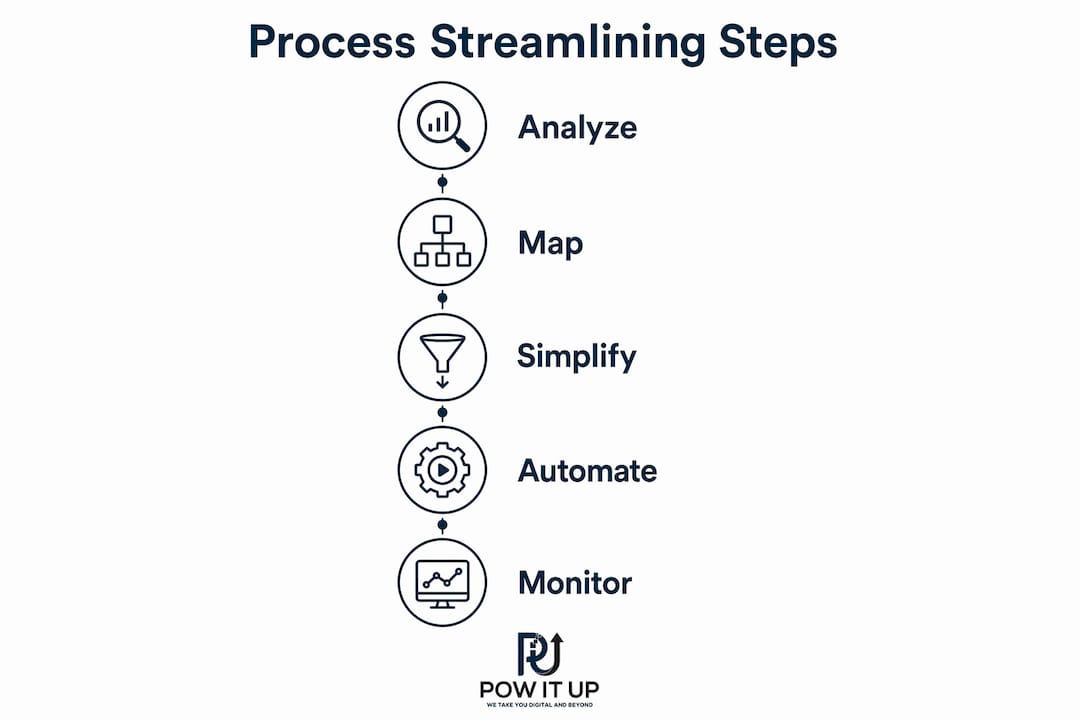
The standard five-step cycle for business process improvement is: Map the current state, analyze bottlenecks, redesign for efficiency, implement the new process, and monitor for performance. This cycle is not a one-time project. It is a repeating loop that compounds gains over time.
-
Map the current state. Document every step as it actually happens, not as the procedure manual says it should happen. Interview the people doing the work. Shadow the process if necessary. The gap between documented and actual workflows is almost always larger than leaders expect.
-
Analyze for bottlenecks and waste. Apply queue analysis to identify where work piles up. Use time-based metrics to measure how long each step takes versus how long it should take. Lean management techniques like value stream mapping help separate value-adding steps from pure waste.
-
Redesign for efficiency. Simplification comes before automation. Combine steps that can be merged. Eliminate approvals that add no control value. Automate only what remains after the process has been cleaned up. Automating a broken process without redesign produces inefficiency executed faster and at higher cost.
-
Implement with a pilot. Roll out the redesigned process in one team or one region before scaling. A pilot surfaces edge cases and resistance points at low cost. Adjust based on what the pilot reveals, then scale with confidence.
-
Monitor for performance. Set clear KPIs before launch: cycle time, error rate, cost per transaction, and throughput. Review them weekly for the first 90 days. Declining metrics after launch signal either a design flaw or an adoption problem, and the two require different responses.
Pro Tip: Apply one high-impact process improvement per quarter. That cadence builds organizational capability without overwhelming teams or creating change fatigue.
The comparison below shows how two common approaches differ in practice:
| Approach | Best for | Primary tool | Risk |
|---|---|---|---|
| Lean process management | Waste elimination in physical or service workflows | Value stream mapping | Slow adoption without leadership buy-in |
| Workflow automation | Repetitive, rule-based digital tasks | RPA or low-code platforms | Automating flawed processes amplifies errors |
What common mistakes should leaders avoid during streamlining?
Most process improvement projects do not fail because of bad technology. They fail because of bad sequencing and poor governance.
- Automating before optimizing. The most expensive mistake in this discipline is deploying automation on a process that still contains unnecessary steps. The automation runs perfectly and delivers waste at machine speed. Redesign the process first, then automate what remains.
- Running too many methodologies at once. Lean, Six Sigma, Agile, and Total Quality Management each address different root causes. Attempting multiple methodologies simultaneously leads to confusion and diluted results. Select one based on the root cause of the problem, execute it fully, then evaluate whether a second approach is needed.
- Skipping documentation. A redesigned process that exists only in people’s heads will revert to the old way within weeks. Document the new workflow, update training materials, and store them where the team can access them.
- Leaving no one in charge. Every improved process needs an owner. That person monitors performance, enforces the new design, and escalates deviations.
“Continuous improvement requires ownership and regular performance monitoring to prevent a relapse into inefficient practices. Documentation of redesigned processes is critical to avoid regressions.” — Business Process Improvement: Complete Guide
The governance structure does not need to be complex. A named process owner, a monthly review cadence, and a documented escalation path cover most of what organizations need to sustain gains.
How can AI and modern technology elevate process improvement?
AI does not replace the five-step cycle. It accelerates every phase of it and makes the monitoring phase continuous rather than periodic.
- AI-powered process mining. AI-powered process mining automatically discovers real workflows by analyzing event logs across systems. It surfaces shadow processes and inefficiencies that manual mapping misses entirely. This compresses the Map and Analyze phases from weeks to days.
- Low-code and AI-assisted automation. Modern low-code platforms now embed AI to suggest workflow improvements, predict failure points, and auto-generate rule logic. Operations teams can build and modify workflows without waiting for IT.
- Agentic AI for complex task handling. Agentic AI systems handle multi-step tasks across different systems autonomously. They do not just execute rules. They make contextual decisions, escalate exceptions, and adapt based on outcomes. POWITUP builds and deploys these systems for organizations that need to scale processing volume without adding headcount.
- Continuous monitoring and feedback loops. AI-driven monitoring detects regression in real time. When a workflow starts drifting back toward old patterns, the system flags it before the degradation becomes visible in financial results.
You can explore a detailed breakdown of automation tools for 2026 to evaluate which technology tier fits your current operational maturity.
| Technology | Primary function | Stage it supports |
|---|---|---|
| Process mining | Workflow discovery and mapping | Map, Analyze |
| RPA | Repetitive task automation | Implement |
| Agentic AI | Autonomous multi-step decision execution | Implement, Monitor |
| AI monitoring | Real-time regression detection | Monitor |
The benefits of automating repetitive tasks compound over time because each cycle of improvement creates capacity for the next one.
Key Takeaways
Process improvement delivers lasting results only when redesign precedes automation, ownership is assigned, and monitoring is continuous rather than periodic.
| Point | Details |
|---|---|
| Redesign before automating | Fix the process first; automation on a flawed workflow amplifies errors and raises costs. |
| Use the five-step cycle | Map, Analyze, Redesign, Implement, and Monitor form a repeating loop, not a one-time project. |
| Limit scope per quarter | Two high-value projects per quarter prevents paralysis and builds sustainable momentum. |
| Assign process ownership | Every redesigned workflow needs a named owner who monitors performance and prevents reversion. |
| AI accelerates every phase | Process mining, agentic AI, and continuous monitoring compress timelines and sustain gains. |
Why I think most leaders underestimate the governance side
After working through process improvement projects across industries, the pattern I see most often is this: the technology gets deployed correctly, the redesign is solid, and then the gains erode within six months because no one owns the process after launch.
Leaders invest heavily in the Map and Implement phases. They treat Monitor as an afterthought. That is backwards. The Monitor phase is where value is either protected or lost. A process without an owner and a review cadence will drift back to its old state. Human behavior defaults to familiar patterns under pressure, and pressure is constant in most organizations.
The other thing I have learned is that cross-functional collaboration is not optional. Processes that span departments require buy-in from every team whose work touches the workflow. When one department improves its piece without coordinating with upstream and downstream teams, the bottleneck moves rather than disappears. The total cycle time barely changes.
My recommendation: pick two processes, assign an owner to each, and review performance monthly for a full year before expanding the program. That discipline builds the organizational muscle that makes every subsequent improvement faster and stickier.
— Sameer Abbas
POWITUP: AI integration built for complex operational workflows
Redesigning processes is the hard part. Deploying the technology to sustain those gains at scale is where most organizations need a specialist.
POWITUP designs and deploys custom AI agent systems that automate high-volume transactional operations, detect time leaks in real time, and allow organizations to scale processing capacity without adding headcount. The work goes beyond basic integrations. POWITUP functions as a technical architect, building context-aware digital workforces tailored to your specific workflows. If you are ready to move from process redesign to full AI integration, the team at POWITUP can assess your current state and map a path to measurable ROI. Book a discovery call to see where your highest-value automation opportunities are.
FAQ
What is process streamlining in business?
Process streamlining is the practice of analyzing, simplifying, and automating workflows to remove waste and reduce cycle times. It is also called business process optimization in formal operations management.
How long does it take to see results from process improvement?
Organizations typically see initial results within 3–6 months, with enterprise-wide programs taking 12–18 months. Nearly 60% of automation-focused initiatives report positive ROI within the first year.
What is the biggest mistake in process streamlining?
The most costly mistake is automating a process before redesigning it. Automation on a flawed workflow produces inefficiency at higher speed and greater cost.
How do you prioritize which processes to improve first?
Use an Impact vs. Effort matrix to rank candidate processes. Start with high-impact, low-effort workflows and limit changes to two projects per quarter to maintain focus and avoid operational disruption.
How does AI improve business process optimization?
AI-powered process mining discovers real workflows automatically by analyzing system event logs. Agentic AI then handles multi-step task execution across systems, while continuous AI monitoring detects regression before it affects financial performance.