

TL;DR:
- Process Intelligence offers leaders a real-time, data-driven view of operational workflows to identify and address bottlenecks fast. It combines process mining, task mining, monitoring, prediction, and simulation into a continuous discipline that enables ongoing process improvement. By focusing on high-volume, cross-system processes, organizations can surface hidden waste, reduce costs, and accelerate cycle times through immediate, evidence-based actions.
Process Intelligence gives leaders an always-on, data-driven view of how work actually runs so they can find and fix bottlenecks fast. It combines process mining, task mining, real-time monitoring, predictive analytics, and simulation into a single continuous discipline. If you run operations at scale, the single most useful thing you can do this quarter is identify one high-volume, cross-system process and instrument it for discovery. That one move typically surfaces more waste than a year of manual process reviews.
Table of Contents
- What process intelligence actually covers
- How does process intelligence differ from process mining and BI?
- Top business benefits and the KPIs you should track
- Where process intelligence delivers the fastest results
- What to look for in process intelligence software
- How to start a process intelligence program: a practical checklist
- Common pitfalls and how to avoid them
- How POW IT UP applies process intelligence in client engagements
- Key Takeaways
- Why most process intelligence programs stop at the diagnosis
- POW IT UP turns process intelligence into a working system
- FAQ
What process intelligence actually covers
Most leaders have heard of process mining. Process Intelligence is the broader discipline that contains it. Think of process mining as the diagnostic scan and process intelligence as the full clinical program: diagnosis, ongoing monitoring, prognosis, and treatment.
The five core pillars are discovery, analysis, monitoring, prediction, and simulation. Together they move a program from “here is what happened” to “here is what will happen and what you should do about it.”
What the discipline includes:
- Process mining: Reconstructing actual process flows from event logs in ERP, CRM, and ITSM systems to expose deviations from the designed path.
- Task mining: Capturing desktop-level user interactions to fill gaps where system logs are thin or absent.
- Real-time monitoring: Continuous tracking of live process instances against defined SLAs and compliance rules, with automated alerts when deviations occur.
- Predictive analytics: Using historical patterns to flag cases likely to breach SLA or require rework before they do.
- Simulation and what-if analysis: Testing proposed changes against historical data before committing engineering resources.
- Decision intelligence and dashboards: Surfacing recommendations and KPIs in a form operations leaders can act on.
Where it applies most directly:
- Finance operations (invoice processing, reconciliation, period-close)
- Order-to-cash and procure-to-pay cycles
- Insurance claims and underwriting workflows
- Employee and customer onboarding
- Compliance and audit workflows
A concrete before-and-after: a logistics company’s purchase-order approval process is designed as a four-step flow. Process mining on the ERP event log reveals that a substantial share of orders loop back to step two at least once, adding extra days to cycle time. That loop was invisible in every dashboard the team had. Process Intelligence surfaces it, quantifies the cost, and points directly to the root cause, whether that is a missing data field, an approval threshold, or a training gap.
How does process intelligence differ from process mining and BI?
These three terms get conflated constantly, and the confusion leads to under-scoped projects. The table below draws the lines clearly.
| Dimension | Process Mining | Business Intelligence (BI) | Process Intelligence |
|---|---|---|---|
| Scope | Reconstructs process flows from event logs | Aggregates and reports on business metrics | End-to-end: discovery, monitoring, prediction, simulation |
| Primary data input | System event logs (ERP, CRM, ITSM) | Structured data warehouses, databases | Event logs + task telemetry + APIs + human activity data |
| Typical output | Process maps, conformance reports, deviation lists | Dashboards, KPI reports, ad hoc queries | Continuous process insights, automated alerts, AI recommendations, simulation results |
| Who uses it | Process analysts, BPM teams | Finance, strategy, executive teams | Operations leaders, IT, compliance, automation teams |
| Time horizon | Retrospective (what happened) | Retrospective and current state | Retrospective + real-time + predictive |
| Actionability | Diagnostic | Reporting | Diagnostic + prescriptive + triggerable |
The practical decision rule: use BI when you need to report on outcomes. Use process mining when you need to understand why a specific process deviates. Use Process Intelligence when you need all three layers running continuously and connected to automation.
Process Intelligence also has a direct relationship with robotic process automation (RPA) and intelligent process automation (IPA). Discovery and monitoring layers identify which tasks are worth automating and then verify that the automation is performing as designed after deployment. Without that feedback loop, RPA programs tend to automate the wrong steps or automate the right steps badly and never know it.
Business process optimization sits within the broader BPM lifecycle, and Process Intelligence is what makes that lifecycle data-driven rather than opinion-driven. The combination of process mapping, process mining, and automation that BPO relies on is exactly the stack that a mature Process Intelligence program operationalizes continuously.
Top business benefits and the KPIs you should track
The primary value of workflow intelligence is that it replaces assumptions about how work runs with evidence. That shift has measurable consequences across several dimensions.
Visibility and baseline. Leaders cannot improve what they cannot see. Consolidating KPI tracking and digitizing reporting materially reduces bottlenecks caused by manual signatures, paper-based handoffs, and siloed data. The City of San Diego’s ESD operational analysis found exactly this: recommendations to digitize incident reporting and consolidate dashboards onto a single platform were central to its efficiency improvement program.
Targeted automation. Discovery runs reveal which steps are high-volume, rule-based, and error-prone. Those are the automation candidates with the fastest payback. Without this data, automation teams often pick visible processes rather than costly ones.
Lower operational cost. Rework loops, unnecessary approvals, and manual re-keying are expensive and largely invisible until you instrument the process. Eliminating even one rework loop in a high-volume process can cut cost per transaction significantly.
Faster cycle times. Bottleneck identification is the most immediate output of any discovery run. Cycle time reduction is typically the first KPI that moves.
Compliance and risk reduction. Real-time monitoring flags deviations from regulatory or contractual sequences before they become audit findings.
Continuous improvement. Unlike a one-off process mapping exercise, a live Process Intelligence program feeds new data into the improvement cycle permanently.
KPIs to track from day one:
| KPI | What it measures |
|---|---|
| Cycle time (end-to-end) | Total elapsed time from process start to completion |
| Automation rate | Percentage of cases handled without human intervention |
| Throughput | Volume of cases completed per period |
| Error and rework rate | Percentage of cases requiring correction or re-entry |
| SLA adherence | Percentage of cases completed within defined time targets |
| Cost per transaction | Total process cost divided by case volume |
| Conformance rate | Percentage of cases following the intended process path |
A simple ROI framing for a business case: multiply your current cost per transaction by annual volume, then estimate the reduction percentage from eliminating your top two or three identified bottlenecks. Even a conservative 10–15% reduction in cost per transaction on a high-volume process typically covers program costs in the first year.
Where process intelligence delivers the fastest results
Not every process is worth instrumenting first. The highest-value candidates share three traits: high volume, high variability, and meaningful cost-per-error.
High-impact use cases:
- Order-to-cash: Long cycle times, frequent rework on invoice exceptions, and cross-system handoffs between order management, fulfillment, and AR make this a reliable first target.
- Procure-to-pay: Approval bottlenecks, duplicate payments, and three-way match failures are almost always larger than finance teams estimate until discovery runs confirm the numbers.
- Claims processing: High case volume, strict regulatory timelines, and significant rework on incomplete submissions make insurance claims one of the clearest ROI cases.
- Employee and customer onboarding: Cross-departmental handoffs, document collection, and compliance checks create natural bottlenecks that discovery surfaces quickly.
- Compliance workflows: Audit trails, approval sequences, and exception handling are exactly what process monitoring was built for.
Industry examples:
- Fintech and financial services: Payment reconciliation, loan origination, and KYC verification all generate dense event logs and carry high cost-per-error, making them natural fits.
- Healthcare: Prior authorization, claims adjudication, and patient intake involve multi-system handoffs and strict SLA requirements.
- Logistics and supply chain: Freight booking, customs clearance, and warehouse receiving are high-frequency processes where even small cycle time reductions compound across millions of transactions.
- Insurance: First notice of loss through settlement involves 15–30 distinct steps across multiple systems. Conformance monitoring alone reduces leakage.
- Public services: Permit processing, benefits administration, and procurement all benefit from the transparency and auditability that monitoring provides.
Pilot selection guidance: Pick a process that crosses at least two systems, runs more than 500 cases per month, and has a known pain point your team has been unable to quantify. Cross-system dependency means richer event data. Volume means statistical significance. A known pain point means stakeholders are already motivated.
What to look for in process intelligence software
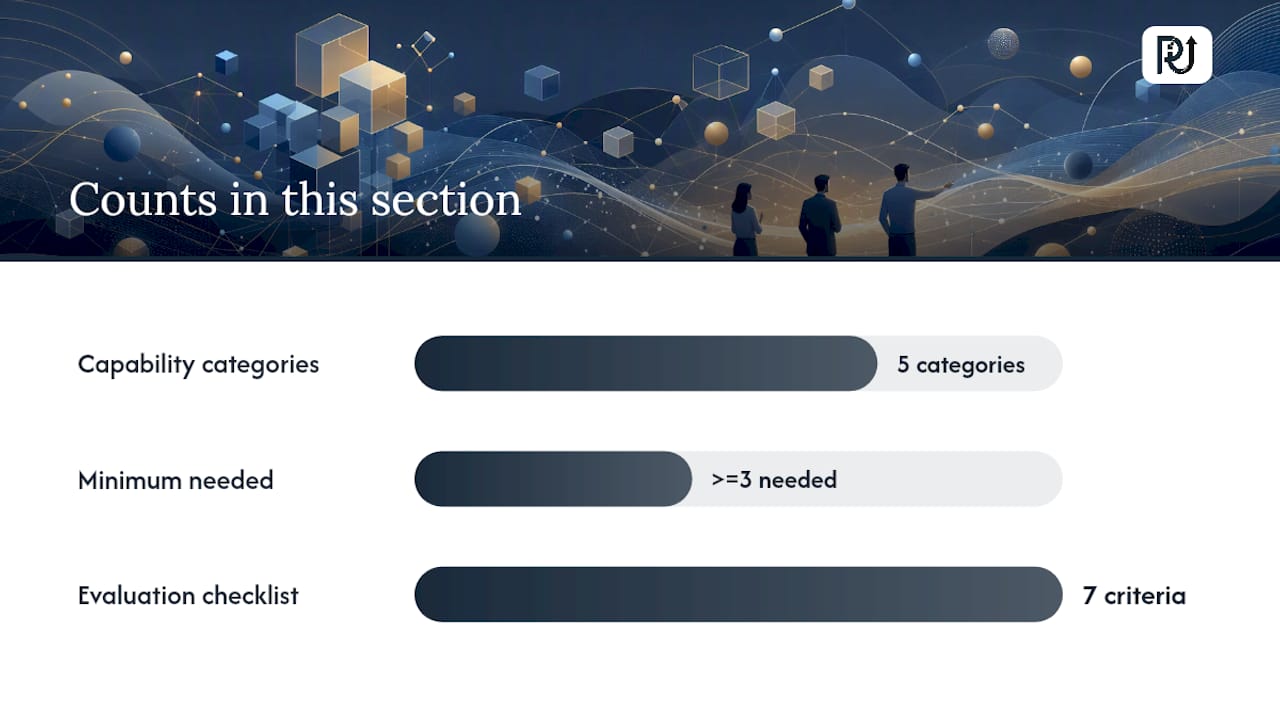
The market breaks into five capability categories. Most enterprise programs need at least three of them working together.
Process discovery and mining tools reconstruct actual process flows from event logs. Evaluate them on connector breadth (how many source systems they support out of the box), the fidelity of their process graphs, and their conformance checking capabilities.
Task mining tools capture desktop activity to fill gaps in system logs. Key criteria: privacy controls, data minimization options, and the ability to merge task-level data with system event data into a unified process view.
Monitoring and decision intelligence platforms provide real-time dashboards, deviation alerts, and AI-generated recommendations. The critical question here is actionability: can the platform trigger a workflow, send an alert to a specific owner, or hand off a case to an automation layer? A purely diagnostic tool leaves the response loop open.
Orchestration and automation platforms execute the fixes that discovery and monitoring identify. RPA, IPA, and AI agent platforms sit here. The integration between the intelligence layer and the execution layer is where most programs either succeed or stall.
Digital twin and context layers model the full process environment, including dependencies, resource constraints, and business rules, so simulation results reflect operational reality rather than idealized flows.
Evaluation checklist for any tool or partner:
- Pre-built connectors for your core systems (ERP, CRM, ITSM)
- Real-time monitoring with configurable alert thresholds
- Simulation and what-if analysis capability
- AI-generated recommendations that are tied to specific process steps
- Role-based access controls and audit logging
- Clear data residency and security certifications (SOC 2, ISO 27001)
- Measurable outcome tracking, not just feature delivery
The vendor selection mistake most teams make is evaluating tools on feature lists rather than on integration depth and data quality support. A tool with 200 features and weak connectors to your actual systems will underperform a simpler tool with native, well-maintained integrations.
How to start a process intelligence program: a practical checklist
Prioritizing high-volume processes, securing data access early, and expecting an 8–16 week pilot period for discovery and validation is the standard rollout pattern. Here is the full sequence.
-
Identify and prioritize target processes. Score candidates on volume, variability, cost-per-error, and cross-system dependency. Pick one process for the pilot. Resist the temptation to start with three.
-
Secure data access and assess log quality. Map which systems generate event data for the target process. Audit log completeness: timestamps, case IDs, activity labels, and resource attributes must all be present. Fix gaps before running discovery, not after.
-
Set a baseline. Collect reliable data, establish baseline KPIs, and define measurement intervals before any changes are made. Without a baseline, you cannot demonstrate improvement.
-
Run process discovery. Connect your mining tool to the event logs and generate the actual process graph. Compare it to the designed process. Document every deviation, rework loop, and bottleneck.
-
Validate insights with process owners. Discovery outputs are hypotheses until a process owner confirms them. Schedule a working session within the first two weeks of discovery to validate findings and identify root causes.
-
Pilot targeted automation or process changes. Address the top one or two bottlenecks identified. This might mean an RPA bot, an AI agent, a rule change, or a simple approval threshold adjustment. Keep the scope narrow.
-
Measure impact against baseline KPIs. Run the process for four to six weeks post-change and compare cycle time, error rate, and cost per transaction against the baseline you set in step three.
-
Document and scale. Package the pilot methodology, data access patterns, and KPI framework into a repeatable playbook. Apply it to the next process on your priority list.
Suggested timeline for a pilot:
- Weeks 1–2: Data access, log audit, baseline KPI setting
- Weeks 3–6: Discovery run and process graph generation
- Weeks 7–9: Insight validation with process owners
- Weeks 10–13: Pilot automation or process change
- Weeks 14–16: Impact measurement and scale decision
Typical cost factors to budget for: engineering time for connector setup and data cleaning (often the largest line item), tool licensing, change management and training, and ongoing monitoring infrastructure. Data cleaning alone can consume 30–40% of pilot effort on programs where event logs have not been maintained.
Common pitfalls and how to avoid them
Most Process Intelligence programs that fail do so for operational reasons, not technical ones. The problems are predictable.
Data quality gaps. Event logs missing case IDs or timestamps produce process maps that look authoritative but reflect noise. Audit logs before committing to a discovery run.
Missing or incomplete event logs. Many processes partially live in email, spreadsheets, or phone calls. Task mining can fill some of these gaps, but processes with large unlogged segments require instrumentation investment before discovery is meaningful.
Siloed ownership. A process that crosses three departments has three owners, none of whom feel fully accountable for the end-to-end result. Without a named program sponsor who has cross-functional authority, findings sit in a report and nothing changes.
Unrealistic ROI expectations. Discovery runs surface opportunities. Realizing them requires engineering, change management, and time. Programs that promise 40% cost reduction in 90 days typically deliver neither the reduction nor the credibility needed to scale.
Change resistance. Process visibility can feel threatening to teams whose workarounds and manual interventions become visible. Stakeholder alignment, model validation, and early measurable wins are the three levers that drive adoption. Engage process owners early, share findings before they become recommendations, and celebrate the first small win publicly.
Governance checklist:
- Data access agreements signed before any log extraction
- Role-based views so frontline staff see only their process data
- Audit trail on all model outputs and recommendations
- Model validation step before any recommendation triggers automation
- Clear escalation path for anomalies or unexpected findings
The single highest-leverage early investment is data instrumentation: adding structured logging to systems that currently produce thin or unstructured event data. Every dollar spent here multiplies the value of every subsequent discovery run.
How POW IT UP applies process intelligence in client engagements
POW IT UP approaches process intelligence as an architecture problem, not a reporting problem. The goal is always a closed loop: discover, automate, monitor, improve. Here is how that plays out in practice.
Engagement flow:
- Data consolidation: Event logs, task telemetry, and document data are consolidated into a unified process data layer. For document-heavy processes, DocuPOW handles document reading, extraction, and validation, converting unstructured inputs into structured event data that feeds directly into the discovery pipeline.
- Monitoring and ROI tracking: Post-deployment, AuraPOW provides portfolio-level monitoring and client health analytics, tracking KPI movement against baseline and flagging process drift before it compounds. Leaders get a live view of cycle time, automation rate, error rate, and cost per transaction.
The AI automation services POW IT UP delivers are designed to be maintainable: every agent, connector, and monitoring rule is documented and handed over with full operational runbooks, so the program does not depend on a single vendor relationship to keep running.
Key Takeaways
Process Intelligence is most valuable when discovery connects directly to automation and monitoring, creating a continuous improvement loop rather than a one-time diagnostic exercise.
| Point | Details |
|---|---|
| Definition and scope | Process Intelligence combines process mining, task mining, monitoring, prediction, and simulation into one continuous discipline. |
| Pilot selection | Pick a high-volume, cross-system process with a known pain point; expect an 8–16 week discovery-to-validation cycle. |
| KPIs to track | Cycle time, automation rate, error rate, SLA adherence, and cost per transaction are the five metrics that move first. |
| Governance first | Audit event log quality and secure data access agreements before running discovery; data gaps invalidate findings. |
| POW IT UP’s approach | POW IT UP closes the loop from discovery to automation using DocuPOW for document intelligence and AuraPOW for live process monitoring. |
Why most process intelligence programs stop at the diagnosis
The gap between a process intelligence program that delivers ROI and one that produces a shelf report is almost always the same: the discovery layer was never connected to an execution layer.
Most organizations invest in mining tools, run a discovery sprint, and generate a compelling process graph showing exactly where the bottlenecks are. Then the findings go into a presentation. The presentation goes into a review cycle. The review cycle produces a roadmap. The roadmap waits for budget. Six months later, the process has drifted further from the designed path and the discovery data is stale.
The fix is architectural, not methodological. Process Intelligence needs to be wired to automation from the start, not bolted on after the insights are “ready.” That means choosing tools and partners who can both discover and act, designing the monitoring layer before the pilot ends, and treating the first automation as proof of concept for the closed loop, not as a separate project.
There is also an underappreciated governance dimension. Pairing AI transformation strategy with process intelligence requires clear data ownership, role-based access, and model validation checkpoints. Without those guardrails, recommendations from predictive models get applied inconsistently, and the program loses credibility with the process owners whose cooperation it depends on.
Pro Tip: When selecting your pilot process, avoid the one your executive sponsor cares most about. Pick the second most important one. A successful pilot on a lower-stakes process builds the credibility and the playbook you need before you touch the process that has the most political weight.
POW IT UP turns process intelligence into a working system
Most teams already know where the pain is. What they lack is the architecture to instrument it, automate the fix, and keep monitoring it after the consultant leaves.
POW IT UP builds that architecture. From event log consolidation and discovery runs to custom AI agent deployment and live KPI monitoring through AuraPOW, the full engagement is designed to produce a closed loop, not a report. DocuPOW handles document-heavy process steps that standard mining tools cannot reach, converting invoices, claims forms, and onboarding packets into structured data that feeds directly into the intelligence layer.
For operations leaders ready to move from diagnosis to execution, the practical next step is a scoping call where POW IT UP maps your highest-value process candidate, audits your event log readiness, and outlines a pilot timeline. Book that conversation through the AI integration services page, or review the full automation service offering to see where your use case fits.
FAQ
What is process intelligence?
Process Intelligence is a continuous operational discipline that combines process mining, task mining, real-time monitoring, predictive analytics, and simulation to give leaders an evidence-based view of how work actually runs and where to improve it.
What is the difference between process mining and process intelligence?
Process mining is one component of process intelligence: it reconstructs actual process flows from system event logs. Process Intelligence is the broader program that adds real-time monitoring, predictive models, simulation, and a connection to automation so insights translate into action.
What are the five steps of process intelligence?
The five pillars are discovery, analysis, monitoring, prediction, and simulation. Together they move a program from retrospective diagnosis through real-time alerting to forward-looking recommendations and what-if testing.
What is SAP Signavio process intelligence?
SAP Signavio Process Intelligence is SAP’s commercial platform for process mining and analytics, built on the Signavio acquisition. It connects to SAP system event logs to reconstruct process flows and surface conformance and performance insights within the SAP ecosystem.
How long does a process intelligence pilot take?
A well-scoped pilot, covering discovery, insight validation, and a targeted automation or process change, typically runs several weeks to a few months. The largest variable is event log quality: clean, complete logs compress the timeline; logs requiring remediation extend it.