
TL;DR:
- Modern business operations focus on redesigning workflows, clarifying decision rights, and measuring performance.
- Mapping processes, running targeted pilots, and measuring outcomes are the recommended steps to drive scalable improvements.
Modern business operations are the intentional combination of clarified decision rights, redesigned workflows, measurable performance indicators, and enabling technology — and the single best next step you can take today is to map your highest-volume process, run a 30-day pilot on one targeted improvement, and measure the result. According to modern-ops.com, every effective operating model answers three questions: how work flows, who owns decisions, and how performance is measured.
Three immediate benefits of getting this right:
- Productivity: Fewer handoffs, less rework, and faster cycle times across every function you touch.
- Predictability: Documented decision rights and process maps replace tribal knowledge with repeatable outcomes.
- Capacity to scale: Automation and AI agents handle volume growth without a proportional headcount increase.
Your first-priority checklist: map → pilot → measure. That sequence appears throughout this guide because it is the one that actually works.
Table of Contents
- What falls inside modern business operations — and what doesn’t
- Why modernizing your operations is urgent right now
- The four pillars every leader needs to assess
- Which technology categories actually move the needle
- Why process redesign must come before broad automation
- A practical modernization roadmap: assess, pilot, scale
- How to measure modernization progress with KPIs and a maturity model
- Common pitfalls that derail modernization programs
- What modernization looks like in practice: three before/after examples
- Key Takeaways
- What actually separates programs that succeed from ones that stall
- How POW IT UP helps leaders run the assess-pilot-scale model
- Useful sources for further reading
- FAQ
What falls inside modern business operations — and what doesn’t
The scope covers every function responsible for delivering value through repeatable, measurable work: procurement, legal operations, IT operations, finance and accounting, supply chain, HR operations, and customer or service operations. These functions share a common trait: they run on processes that can be documented, measured, and improved.
What this guide does not cover: basic IT helpdesk ticketing, marketing creative strategy, or the mechanics of vendor pricing negotiation. Those areas matter, but they operate on different rhythms and require different improvement levers.
Ownership of modernization typically sits with a COO, VP of Operations, or a Chief Digital Officer. The CDO role in particular has grown in importance: research published in the Journal of the Knowledge Economy found that appointing a CDO enhances firm performance, with the effect being more pronounced when the CDO is hired externally. Whoever holds the sponsor role, the key is that it is a single named executive with budget authority and cross-functional reach — not a committee.
Why modernizing your operations is urgent right now
The pressure to modernize is coming from multiple directions at once. AI and autonomous agents have moved from experiment to production deployment. Cloud platforms have made enterprise-grade analytics accessible to mid-market teams. Customer expectations for speed and accuracy have risen sharply. And talent costs keep climbing while labor markets stay tight.
The business case is concrete. AI-optimized processes typically deliver operating cost reductions in the range of 15–35% and cycle-time reductions of 30–50% in targeted workflows. Microsoft’s own internal programs are a useful benchmark: their AI toolkit identified high-volume, repeatable workflows and achieved an 80% improvement in process quality alongside a 33% reduction in cost per transaction.
Those numbers are not outliers. They reflect what happens when you apply automation to a process that has already been redesigned — not one that is still broken.
The strategic link matters too. Leaders who treat modernization as a cost-reduction play alone miss the bigger prize: faster time-to-market, better service consistency, and the organizational resilience to absorb disruption without crisis. Research on digital transformation alignment consistently shows that treating modernization as an IT project rather than a leadership and culture initiative is the primary cause of failure. The technology is the easy part.
The four pillars every leader needs to assess
Effective operational modernization rests on four pillars. Think of them as a diagnostic framework: if any one is weak, the others underperform.
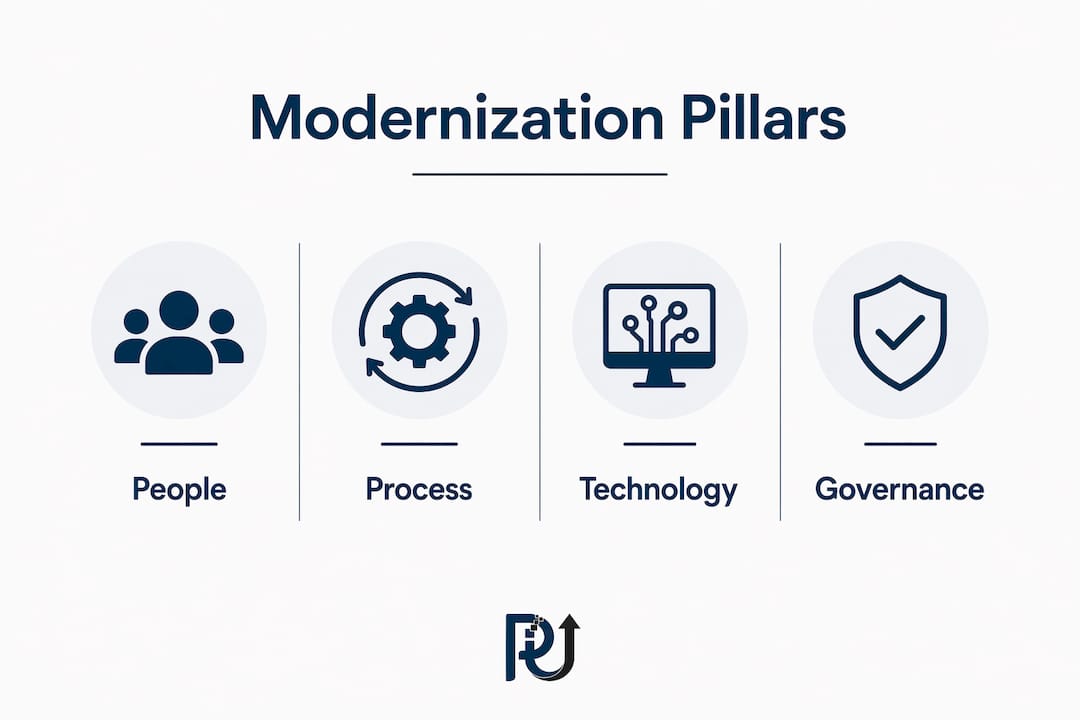
People
This pillar covers roles, skills, change readiness, and the human-in-the-loop controls that keep AI systems accountable. Key artifacts: a skills gap assessment, a RACI matrix for each core process, and a training roadmap.
Diagnostic question: “Do the people running our highest-volume processes have documented roles, and do they know what decisions they own versus what gets escalated?”
Process
Documented, mapped, and measured workflows. This includes process maps, standard operating procedures, and a shadow-process inventory (the workarounds your team has built that no one has written down).

Diagnostic question: “Can I pull an event log from our core system and see exactly how a transaction moves from start to finish — including every exception path?”
Technology
The integration catalog, automation layer, analytics stack, and AI agent infrastructure. A healthy technology pillar means tools are connected, data flows without manual re-entry, and the stack has been chosen to match process maturity.

Diagnostic question: “Do our systems talk to each other, or does someone manually move data between them every day?”
Governance
Decision rights, program ownership, a structured enhancement backlog, and audit trails. Without governance, modernization programs drift: scope expands, accountability blurs, and adoption stalls.
Diagnostic question: “Is there a named owner for each process, a scheduled review cadence, and a backlog where improvement ideas get prioritized?”
Pro Tip: Build a one-page operating model canvas that maps each pillar to a named owner and a single KPI. It takes two hours and immediately surfaces which pillar is under-indexed — usually governance.
Which technology categories actually move the needle
Understanding the capability landscape helps you buy the right thing at the right time. Here are the core categories, what they do, and when to reach for them.
- Process mining (e.g., Celonis, SAP Signavio): Reads event logs from your existing systems to generate objective process maps. Use it during discovery, before you buy anything else.
- RPA / task automation (e.g., UiPath, Automation Anywhere): Automates rule-based, repetitive tasks at the UI layer. Best for quick wins on stable, high-volume processes where API integration is not available.
- AI agents (custom-built or platform-based): Autonomous, context-aware systems that handle multi-step decision workflows. Use these when a process requires judgment, not just rule-following. POW IT UP’s custom AI agent development is built specifically for this tier.
- iPaaS / integration platforms (e.g., MuleSoft, Boomi): Connects disparate systems so data flows without manual intervention. A prerequisite for any serious automation program.
- Low-code / no-code platforms (e.g., Microsoft Power Platform, Appian): Lets operations teams build and modify workflows without engineering support. Ideal for the pilot phase when speed matters more than scale.
- Cloud analytics / DataOps (e.g., Snowflake, dbt, Looker): Centralizes operational data and makes it queryable in near-real time. Use when your KPI dashboards are still built in spreadsheets.
- Document intelligence / IDP (e.g., POW IT UP’s DocuPOW): Reads, validates, and routes unstructured documents — invoices, contracts, onboarding packets. High ROI in finance, legal ops, and procurement.
- Orchestration / workflow engines (e.g., Temporal, Apache Airflow): Coordinates multi-system, multi-step processes with retry logic and audit trails. Use at scale when you need reliability guarantees across complex workflows.
Process mining and digital twins are also emerging as continuous monitoring architectures — not just discovery tools — allowing teams to track live process drift and trigger alerts when a workflow deviates from its designed path. For a deeper look at automation tool categories and how to evaluate them, POW IT UP has a practical breakdown worth reviewing.
Why process redesign must come before broad automation
Automation executes tasks. Business process optimization analyzes and redesigns workflows first — so that only value-added steps get scaled. That distinction is the most important one in this guide.
When organizations skip redesign and go straight to automation, they scale their existing inefficiencies. A broken approval chain that takes five days manually will still take five days when automated, because the bottleneck is in the design, not the execution speed. Salesforce’s process optimization research makes this explicit: process mining and mapping before automation reduces the risk of encoding workarounds into permanent systems.
Discovery checklist before any automation investment:
- Pull event logs from your core transaction system and identify the actual end-to-end flow (not the assumed one).
- Conduct structured stakeholder interviews to surface shadow processes — the informal workarounds that exist because the official process does not work.
- Validate your process map against real transaction data to confirm exception rates and rework loops.
- Audit data quality in source systems: incomplete or inconsistent data will break any automation you build on top of it.
- Document human-in-the-loop control points explicitly — where does a human need to review, approve, or override before the next step executes?
Pro Tip: Before signing any automation contract, ask the vendor to show you the process map they plan to automate. If they cannot produce one based on your actual event logs, they are selling you a solution before they understand your problem.
The governance note here is simple: every automated workflow needs an explicit owner, a rollback plan, and a scheduled review date. AI systems that run without human oversight tend to drift — and when they do, the errors compound faster than a manual process ever would.
A practical modernization roadmap: assess, pilot, scale
This is the sequence that reduces risk and makes ROI attributable. Running sales, finance, and operations modernization simultaneously is one of the most common ways mid-market programs fail — change-management capacity gets exhausted and no single initiative gets the attention it needs.
Phase sequence and timeline
| Phase | Key Activities | Duration |
|---|---|---|
| Assess | Process mining, stakeholder interviews, shadow-process discovery, data quality audit, operating model canvas | 4–8 weeks |
| Pilot | Select one high-volume process, deploy targeted automation or AI agent, measure baseline vs. outcome | 8–12 weeks |
| Scale | Expand to adjacent processes, integrate systems, build governance cadence, train teams, track adoption | — |
Primary cost drivers to budget for
- Integration complexity: The more legacy systems involved, the higher the engineering cost to connect them cleanly.
- Data cleaning: Poor data quality in source systems is consistently underestimated — budget 20–30% of project time here.
- Software licensing: Process mining, iPaaS, and AI platforms carry meaningful per-user or consumption-based fees.
- Change management: Training, communication, and adoption support are not optional line items — they are where most programs succeed or fail.
- Custom engineering: Off-the-shelf tools rarely cover the full scope; budget for bespoke configuration or custom agent development.
Vendor and partner evaluation questions
Ask these before you sign anything:
- Who owns the outcome — you or the vendor? What does success look like in writing?
- How does your solution handle exceptions that require human judgment?
- What is your data governance model, and where does our data reside?
- What is the rollback plan if the automation produces errors at scale?
- Can you show us a reference engagement at a similar process complexity and volume?
A phased approach — foundational systems first, then integrations, then automation — preserves operational stability and makes it possible to attribute ROI to specific investments rather than a blurry “transformation program.”
How to measure modernization progress with KPIs and a maturity model
Three-level operational maturity model
Level 1 — Foundational: Processes are documented but largely manual. Data lives in spreadsheets. Decision rights are informal. Technology is siloed. Most mid-market organizations start here.
Level 2 — Managed: Core processes are mapped and measured. Key systems are integrated. Automation handles high-volume, rule-based tasks. KPI dashboards exist and are reviewed regularly. Decision rights are documented.
Level 3 — Agentic/Optimized: AI agents handle multi-step decision workflows autonomously within defined domains. Process mining runs continuously. The organization can scale transaction volume without adding headcount. Governance includes structured enhancement backlogs and audit trails.
Five KPIs for your operational dashboard
- Cycle time per process: End-to-end time from trigger to completion. Target a 30–50% reduction in piloted workflows.
- Cost per transaction: Total cost (labor + technology) divided by transaction volume. Track against the pre-automation baseline.
- Adoption rate: Percentage of intended users actively using the new system weekly. A practical guardrail: 70% weekly usage after 90 days indicates real adoption, not just launch-day activity.
- Error / compliance rate: Frequency of rework, exceptions, or compliance flags per 100 transactions. Near-zero is achievable in well-designed automated workflows.
- Time recaptured per FTE: Hours per week freed from manual tasks and redirected to higher-value work. This is often the most compelling metric for executive sponsors.
For a deeper framework on scaling operations with governance and measurement, the POW IT UP resource on operational efficiency covers target-setting in detail.
Common pitfalls that derail modernization programs
Most failures are predictable. Here is where programs go wrong and what to do about it.
The most common pitfalls:
- Tool-first procurement: Buying software before mapping the process it will run on. The technology amplifies whatever structure exists — if the process is disorganized, the tool scales the disorder.
- Scope creep: Starting with one process and expanding to five before the first one is stable. Sequence tightly.
- Under-investing in training: Assuming people will figure out the new system. They will not, and adoption will stall at 30–40%.
- Bad data migration: Moving dirty data into a new system and expecting clean outputs. Audit and clean before you migrate.
- No executive sponsor: Programs without a named C-suite owner lose budget priority and stall when cross-functional conflicts arise.
Governance structure that works:
A program lead owns the roadmap and backlog. Each department has a named adoption owner responsible for training and usage metrics. The executive sponsor resolves cross-functional blockers and holds the budget. Reviews happen on a fixed cadence — monthly during the pilot, quarterly at scale.
Security and risk controls to require:
- Role-based access controls on all automated workflows and AI agent decision domains.
- Immutable audit trails for every automated transaction.
- Explicit rollback procedures tested before go-live.
- Human-in-the-loop approval gates for any AI decision above a defined risk threshold.
Promoting a digital transformation culture is not a soft initiative — it is the structural work that determines whether governance holds when the program gets hard.
What modernization looks like in practice: three before/after examples
These vignettes are industry-agnostic. The patterns repeat across finance, healthcare, logistics, and professional services.
Invoice processing (finance operations)
Before: AP team manually keyed invoice data from PDFs into the ERP, matched line items against POs by hand, and routed approvals via email. Average cycle time: 8 days. Error rate: roughly 12% requiring rework.
After: AI-driven document validation (similar to DocuPOW’s extraction and validation layer) reads and validates invoices on receipt, auto-matches against POs, and routes exceptions only. Cycle time dropped to under 24 hours. Rework rate fell to under 2%.
Employee onboarding (HR operations)
Before: New hire paperwork collected via email, IT provisioning requested manually, compliance training tracked in a spreadsheet. Average time to full productivity: 3 weeks.
After: Workflow orchestration triggers provisioning, document collection, and training assignment automatically on day one. Time to productivity cut to under one week. HR team redirected from coordination to culture and retention work.
Contract intake (legal operations)
Before: Contracts arrived by email, were manually logged, routed to the right reviewer by a paralegal, and tracked in a shared drive. Average review queue: 11 days.
After: Process-mined contract intake workflow with automated classification, routing, and status tracking. Queue dropped to 3 days. Paralegal time on intake coordination fell by over 60%, freeing capacity for substantive review support.
The metric pattern across all three: cycle time reduction, error rate reduction, and FTE time recaptured. Those are the three numbers worth tracking in any pilot.
Key Takeaways
Modern business operations succeed when process redesign precedes automation, governance is explicit, and technology is chosen to amplify a clarified operating model — not to substitute for one.
| Point | Details |
|---|---|
| Redesign before automating | Map and optimize the process first; automation applied to a broken workflow scales the problem. |
| Use the assess-pilot-scale sequence | Run a 4–8 week assessment, an 8–12 week pilot, then scale over — to keep ROI attributable. |
| Track five core KPIs | Cycle time, cost per transaction, adoption rate, error rate, and time recaptured per FTE are the metrics that matter. |
| Governance is non-negotiable | Name a program lead, department adoption owners, and an executive sponsor before the pilot starts. |
| POW IT UP accelerates the sequence | POW IT UP designs and deploys custom AI agents, document intelligence, and integration systems that fit the assess-pilot-scale model. |
What actually separates programs that succeed from ones that stall
The programs that work share one trait that is easy to overlook: the executive sponsor treats modernization as an operating model decision, not a technology purchase. When the framing is “we are buying an automation platform,” the program gets managed like a procurement event. When the framing is “we are redesigning how work flows and who owns what,” it gets managed like a business transformation — with change management, adoption targets, and a governance structure that outlasts the launch.
The second pattern I observe consistently: organizations that sequence tightly outperform those that try to modernize everything at once. A single well-executed pilot, measured rigorously, builds the internal credibility and the data needed to justify the next investment. A sprawling multi-function rollout burns change-management capacity and produces results that no one can attribute to a specific decision.
The technology itself is rarely the constraint. Process mining tools are mature. AI agents are deployable today. Integration platforms have solved most of the hard connectivity problems. What slows programs down is the organizational work: getting decision rights documented, getting data clean enough to trust, and getting people to actually use the new system at the 70% weekly adoption threshold that signals real behavior change rather than launch-day novelty.
How POW IT UP helps leaders run the assess-pilot-scale model
Most leaders know what they want to achieve. The gap is between the current state process map and a production-ready automated workflow — and that gap is where most programs stall.
POW IT UP closes that gap as a strategic technical partner, not just a software vendor. The engagement starts with a discovery workshop: POW IT UP’s team pulls event logs, interviews process owners, and produces an objective process map with prioritized automation opportunities ranked by volume and complexity. From there, a scoped pilot deploys a custom AI agent, document intelligence layer (DocuPOW), or integration workflow against a single high-value process — with a baseline measurement and a 90-day adoption target built in from day one.
The deliverables for a typical pilot include a working automated workflow, a KPI dashboard tracking cycle time and error rate, and a documented rollback plan. No sprawling multi-year contracts. No black-box systems your team cannot maintain.
If you are ready to identify your highest-ROI automation opportunity, request a discovery workshop with POW IT UP or review the full AI integration service offering to understand the engagement model before you commit.
Useful sources for further reading
- Microsoft Inside Track — AI Toolkit for Business Operations: Microsoft’s documented case study on using an AI toolkit to identify high-volume workflows and achieve measurable quality and cost improvements.
- Salesforce — Process Optimization Guide: Covers the distinction between automation and business process optimization, with practical guidance on process mining and redesign sequencing.
- Kissflow — Business Process Optimization Guide: A thorough walkthrough of the BPO methodology, from process mapping through continuous improvement cycles.
- Springer Nature — Digital Transformation Alignment Research: Academic research on why leadership vision, culture, and process redesign must align with technology for transformation to succeed.
- Journal of the Knowledge Economy — Digital Transformation Complexity: Examines drivers, barriers, actors, and strategies in digital transformation with a multi-level contingency framework.
- Rework — Digital Transformation Strategy for Mid-Market Leaders: Practical framework for sequencing foundational, integration, and automation investments in mid-market organizations.
- Modern-Ops — What Modern Business Operations Actually Means: Defines the operating model concept and explains the three foundational questions every operation must answer.
- POW IT UP — AI Integration Services for Business Leaders: POW IT UP’s approach to AI integration, engagement model, and expected outcomes for business leaders.
- POW IT UP — Process Optimization Strategies: Distinguishes BPO from automation and provides frameworks for process analysis and redesign.
- POW IT UP — Operational Efficiency: A Leader’s Guide to Scale: Long-form resource on governance, KPI frameworks, and scaling operations with measurable targets.
- BizSquare — Advisory Services and SME Performance Tracking: Partner case material on KPI-driven improvement in professional services contexts; useful for benchmarking advisory and service operations.
- The Industry Leaders — Business Operations Fundamentals: Accessible overview of business operations principles and practical tips for leaders running day-to-day functions.
FAQ
What are modern business operations?
Modern business operations are the intentional combination of documented decision rights, redesigned workflows, measurable KPIs, and enabling technology — covering functions like procurement, finance, HR, supply chain, and service operations. The goal is predictable, scalable performance rather than reliance on individual expertise or manual effort.
What are the latest trends driving operational change?
The dominant trends are AI and autonomous agent deployment, process mining for continuous workflow monitoring, cloud analytics replacing spreadsheet-based reporting, and a shift toward human-in-the-loop governance models that keep AI decisions accountable. Resilience and sustainability requirements are also reshaping supply chain and procurement operations.
What are the four types of business operations?
Business operations are typically grouped into production/service delivery, finance and accounting, HR and people operations, and supply chain and procurement. In practice, most modernization programs also treat legal operations and IT operations as distinct functions with their own process maps and KPIs.
What does business process optimization actually involve?
Business process optimization (BPO) is the systematic redesign of workflows to eliminate waste, reduce costs, and improve consistency — and it is distinct from automation. BPO analyzes and maps the process first; automation then executes the redesigned steps at scale. Skipping the redesign phase and automating an existing broken process is the most common and costly mistake in operations modernization.
What are the 5 P’s of operations management?
Definitions vary across frameworks, but a widely used version covers People, Process, Plant (or Technology), Planning, and Performance. In the context of modern operations, these map closely to the four-pillar model in this guide: People, Process, Technology, and Governance — with Planning and Performance embedded in the Governance pillar.