

The biggest intelligent automation trend in 2026 is the move from single-task bots to AI agents that run multi-step workflows, with people kept in the loop and risk controls built in from day one. Spending is rising, the early returns are real, and the gap is widening between companies that treat automation as an engineering discipline and those that bolt tools onto broken processes. This guide covers the trends worth your attention, what they look like in fintech, healthcare and service businesses, and how to pick the first project.
TL;DR
- Intelligent automation now means systems that read unstructured inputs, infer context and improve over time, not just scripts that follow rules.
- AI agents are moving into multi-stage workflows: in one 2026 survey of US technical leaders, 57% of organizations already deploy them that way.
- Workers prefer partnership over replacement, so human review at critical points is a design requirement, not a concession.
- Governance, tool access and security are the main implementation risks, and NIST offers a free framework for handling them.
- Start with one high-volume, document-heavy process, measure it, then scale.
Table of Contents
- What intelligent automation means now
- Trend 1: Spending is shifting toward software and AI
- Trend 2: From single tasks to agents in multi-step workflows
- Trend 3: Human-AI collaboration, not replacement
- Trend 4: Proof of ROI is replacing pilot enthusiasm
- Trend 5: Governance and security move to the front
- Trend 6: Document intelligence becomes the entry point
- What it looks like in practice
- Our perspective: build the workforce, not the demo
- How to act on these trends
- Work with us on your first workflow
- FAQ
- Sources
What intelligent automation means now
Traditional robotic process automation handles repetitive, rule-based work. AWS explains that intelligent automation adds machine learning, natural-language processing, generative AI and optical character recognition, so workflows can cope with unstructured data and changing conditions. A script that copies a field from one system to another is RPA. A system that reads a scanned loan package, notices a missing signature and routes the exception to the right person is intelligent automation.
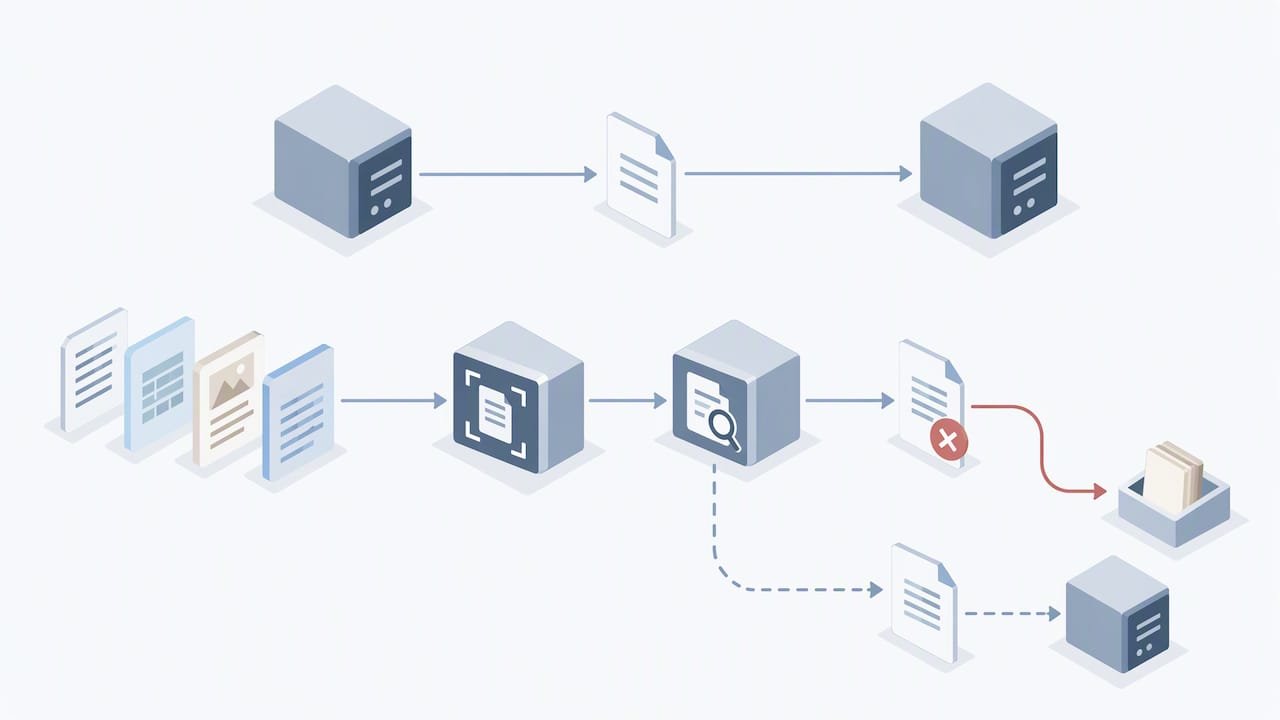
IEEE frames it as a spectrum: at one end, tools that augment human work; at the other, autonomous systems that interpret unstructured inputs, infer context, make probabilistic decisions and improve with experience. That framing is useful because it tells you where you are. Most businesses should not jump to the far end. They should pick the point on the spectrum that fits the risk of each process.
AI alone is not the same thing either. A language model answers questions. Intelligent automation wraps models in workflow logic, data connections, permissions and monitoring so the answer turns into a completed task.
Trend 1: Spending is shifting toward software and AI
The money is already moving. The Bureau of Labor Statistics reported in May 2026 that private-business software investment grew at an 11.1% compound annual rate from 2019 to 2024, compared with 7.9% from 2007 to 2019, alongside increased use of AI-related software.
What this means for you: software is taking a larger share of capital budgets, and your competitors are funding it. Waiting is also a decision, and it shows up later as slower cycle times and higher cost per transaction.
Trend 2: From single tasks to agents in multi-step workflows
The clearest shift is from assistants that answer to agents that act. Anthropic’s 2026 State of AI Agents report, based on more than 500 US technical leaders, says 57% of organizations deploy agents in multi-stage workflows and 16% use them across functions. The same report says 81% plan more complex agent use cases in 2026, including 39% developing agents for multi-step processes and 29% deploying them for cross-functional projects.
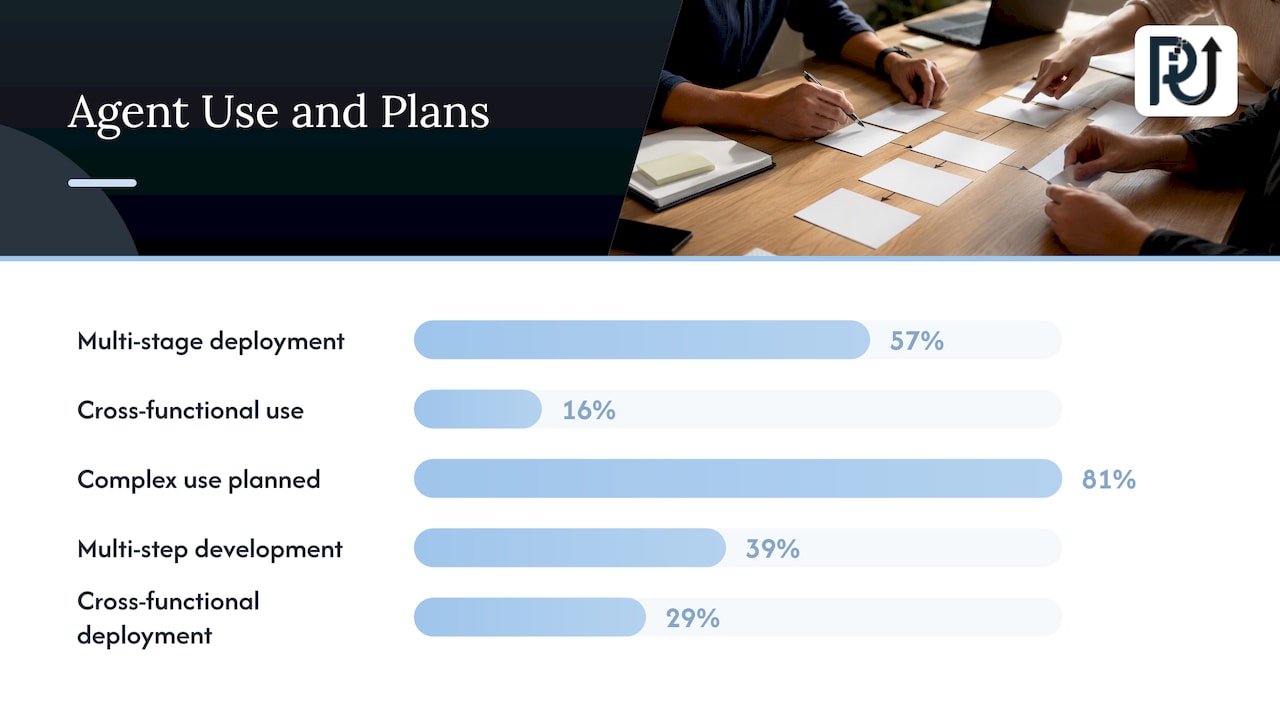
Treat vendor-published survey data as directional. It comes from technical leaders already using the technology, so it skews optimistic. The direction is still clear: the unit of automation is becoming the whole process, not the single click.
In practice, a multi-step agent might:
- Receive an invoice, contract or claim by email.
- Extract and validate the data against your records.
- Decide whether it can proceed or needs a human.
- Write the result to your system of record.
- Log what it did so you can audit it.
The fifth step is the one cheap projects skip, and it is the one that keeps automation maintainable.
Trend 3: Human-AI collaboration, not replacement
There is a persistent assumption that the goal is zero human involvement. Workers disagree. A Stanford study, covered by Stanford News in July 2025, found that 45.2% of respondents preferred an equal worker-AI partnership and 35.6% wanted human oversight at critical junctures. Few wanted full automation.
That matches how good systems are designed. Let the agent handle volume and routine cases. Send ambiguity, high-dollar decisions and sensitive customer situations to a person, with the agent’s work already prepared. The result is faster throughput without removing accountability.
Trend 4: Proof of ROI is replacing pilot enthusiasm
Boards and owners have stopped funding experiments that cannot show a number. The good news is that returns are showing up. Anthropic reports that 80% of surveyed organizations see measurable economic returns from AI agents, and that the highest-impact non-engineering uses are data analysis and report generation (60%) and internal process automation (48%).
That is a self-reported figure from one survey, so do not promise yourself 80% odds. Use it as a signal about where to look first: reporting and internal operations, where the work is repetitive, the data is already in your systems and the result is easy to measure.
To build a business case, measure before you automate: hours per transaction, error and rework rates, cycle time and volume per person. Our guides on automation ROI and what AI automation costs walk through the calculation. If you also want an outside view on evaluating the investment, this piece on automation consulting for operations leaders covers diagnostics and roadmaps for mid-market companies.
Trend 5: Governance and security move to the front
As agents gain access to tools, data and the ability to act, the risk profile changes. NIST’s January 2026 workshop materials note that AI agents combine traditional software threats with risks from model outputs interacting with tools, and list agent identities and adversarial machine learning among the topics under discussion.
The practical questions are plain:
- What systems can the agent touch, and with what permissions?
- Does the agent have its own identity, separate from a human user’s login?
- What happens when a model output is wrong, or when someone tries to manipulate it?
- Who reviews logs, and how often?
For a framework, NIST’s Generative AI Profile, released July 26, 2024, is a cross-sector companion to its voluntary AI Risk Management Framework. It helps organizations build trustworthiness into AI design, development, use and evaluation. For a plain-language take on setting an enterprise baseline for agents, see this overview of AI agent governance.
If you handle health records or financial data, bring your compliance counsel or security lead into the design stage, not the launch week.
Trend 6: Document intelligence becomes the entry point
Most back-office work still starts with a document: a PDF, a scan, an email attachment, a statement. Because intelligent automation can read unstructured inputs, document processing is where many companies see the first dependable win. It is high volume, the rules for correct are usually known, and exceptions can go to a person.
This is the reason we built DocuPOW, our product for reading and validating documents. It is also why lenders, accountants and healthcare billing teams so often start here. Our loan processing guide shows the steps in a lending workflow.
What it looks like in practice
Here are two documented examples from US healthcare, a sector where the stakes are high and oversight matters.
| Organization | What was automated | Reported result |
|---|---|---|
| Stanford Health Care | Billing message replies using 25 smart templates, piloted on 1,000 messages | Saved 17 hours across 10 billing representatives; later expanded enterprise-wide with 60% utilization, with clinicians keeping review and choice |
| Weill Cornell | Collections segmentation and targeted dialing | $15 million in pending patient payments and $7 million less in annual bad-debt placements, with a stated 7:6:1 return on investment |
The Weill Cornell figures come from a vendor case study, so read them as one organization’s reported outcome, not a benchmark. Both examples share a pattern worth copying: a narrow, measurable process, a pilot, then expansion, and humans retained where judgment matters.
For service businesses, the same pattern applies to intake, scheduling, quoting and follow-up. See our service business ROI examples and the types of service business automation tools. In fintech, the entry points are usually onboarding documents, loan files and core system integration, covered in our guide to AI integration in core banking systems.
Our perspective: build the workforce, not the demo
We design and deploy digital workforces made of context-aware AI agents, and the same pattern shows up in almost every engagement. The technology is rarely the hard part. The hard parts are the process nobody has written down, the exception that happens in one case in ten, and the system that has no clean way to receive an agent’s output.
Three convictions shape how we work:
- Hunt the time leaks first. Every operation has places where hours disappear into re-keying, chasing, checking and reformatting. We find those before we propose anything, because automating a process that should not exist is expensive.
- Custom beats generic when the process is yours. Generic scripts break the first time an input changes. Context-aware agents that understand your documents, rules and exceptions keep working, and that is what lets volume grow without a matching rise in headcount.
- You should own what we build. Systems need to be maintainable, documented and handed over with clear scope. If you cannot explain what your automation does, you cannot govern it.
We also think the human-in-the-loop trend is undersold. The best automation makes your people better at the decisions only they can make.
— Syed Naveed Abbas
How to act on these trends
A responsible path, in order:
- Pick one process. Choose something high volume, document heavy and measurable. Invoice handling, intake, claims prep and reporting are common candidates.
- Baseline it. Record time per item, error rate, cycle time and cost before you change anything.
- Decide the human checkpoints. Define which cases the agent finishes alone and which go to a person.
- Assess the risk. NIST suggests comparing your current and target AI-risk profiles to find gaps, then using risk-based action plans to prioritize mitigation by your needs, risk tolerance and resources. Apply that to agent permissions and data handling.
- Pilot, measure, expand. Run it on a slice of volume. If the numbers hold, extend to adjacent processes.
- Keep it maintainable. Document the logic, log every action and plan who owns the system after launch.
Avoid the two common failure modes: buying a platform before choosing a process, and building an impressive agent that nobody reviews.
Work with us on your first workflow
If you want a partner for the build, our AI automation service covers assessment through deployment, and our AI agents development work focuses on custom agents for multi-step processes. If your bottleneck is documents, you can see DocuPOW in a live demo. To talk through your situation, start at powitup.com.
FAQ
What are the current trends in intelligent automation?
The main ones are agents running multi-step workflows, document intelligence for unstructured inputs, human-AI collaboration with oversight at key points, a demand for proven ROI, and stronger governance. Software investment is also climbing, according to BLS data on US private businesses.
What is the difference between RPA and intelligent automation?
RPA follows fixed rules on structured data. Intelligent automation adds machine learning, language processing and optical character recognition, so it can handle unstructured data and changing conditions. Many organizations use both: RPA for stable steps, intelligent automation where judgment or reading is involved.
What are some examples of intelligent automation?
Reading and validating loan or invoice documents, drafting billing replies for human review, segmenting patient collections, and generating recurring reports. The healthcare examples above show reported outcomes from real US organizations.
Will intelligent automation replace my team?
In most well-designed deployments it shifts what the team does rather than removing it. Research on worker preferences shows most people want partnership with AI and oversight at critical points. The usual business goal is handling more volume without hiring at the same rate.
What is the biggest risk when deploying AI agents?
Uncontrolled access and unchecked outputs. Agents that can act on your systems inherit software risks plus new ones from model behavior, so permissions, logging and human review need to be designed up front. NIST’s AI Risk Management Framework is a good starting reference.
Sources
- What is Intelligent Automation? (AWS)
- Intelligent automation (IEEE Technology Navigator)
- AI and the rise of software investment (BLS)
- The 2026 State of AI Agents Report (Anthropic)
- What workers really want from AI (Stanford News)
- How Stanford Healthcare prescribes AI (CIO)
- Weill Cornell collections case study (Experian Health)
- Cyber AI Profile workshop slides, January 2026 (NIST)
- Generative AI Profile (NIST)
- AI RMF Profiles (NIST AIRC)