

Automation drives real growth, but only when it targets high-frequency, high-value processes and gets built to scale past a single pilot. One operator used AI tooling to run an entire growth function alone and achieved notable ARR growth within six months. The action for leaders: audit your highest-volume processes now, then read the prioritization framework below before you fund anything.
TL;DR:
- Automation provides the fastest growth when applied to high-volume, repetitive processes with low compliance risk, such as sales outreach and customer support.
- Building scalable automation relies on adopting AI and context-aware systems to reduce maintenance costs, rather than relying on brittle script-based RPA.
- Leaders should prioritize automation projects based on value, frequency, repeatability, and low compliance risk, starting with processes that leak the most time and cost.
- Successful scaling requires redesigning workflows and organizational models to enable process owners to build and maintain their own automations, avoiding the Maintenance Wall.
Table of Contents
- Why Automation-Driven Growth Actually Works
- Where Automation Delivers the Fastest Growth Wins
- How Should Leaders Prioritize What To Automate First?
- Why Do So Many Automation Programs Stall At Scale?
- What Does Automation Actually Cost, And When Does It Pay Back?
- What Do the Research and Real Cases Actually Show?
- The Gap Between Automation’s Promise And What Leaders Actually Get
- Build Automation-Driven Growth With A Partner Who Designs For Scale
- Sources
- FAQ
Why Automation-Driven Growth Actually Works
Automation changes the math of growth by attacking three levers at once: speed, accuracy, and capacity. When a process runs faster and with fewer errors, you free the people who used to run it manually to work on something that actually requires judgment. That reallocation is where most of the growth shows up, not in the automation itself.
The Bessemer Venture Partners case is the clearest illustration of this. A single COO built an end-to-end growth engine covering ideal customer profile research, paid campaigns, outbound sequences, and CRM updates, and the business posted a significant increase in annual recurring revenue without hiring a growth team. No headcount increase, no agency retainer. Just one person directing systems that acted, measured, and adjusted continuously.
That kind of result depends on treating automation as a capability rather than a tool purchase. Harvard Business Review’s coverage of workplace automation makes a related point: automation embedded into how a company operates, with cross-functional ownership, reduces burnout and improves retention, not just output. That matters for growth because retained, engaged employees compound institutional knowledge instead of walking out the door with it.
Here’s what shows up consistently in the evidence:
- Automation frees skilled staff for higher-value work rather than eliminating roles outright
- Consistency and speed gains tend to compound over months, not days
- The upfront cost curve is real. Britannica notes automation requires meaningful capital investment and ongoing maintenance compared to manual operations
- Adoption resistance drops when leaders frame automation as capacity creation, not job replacement
Automation isn’t a linear improvement. A survey of business automation adoption found that more than 74% of employees who work with automated systems report that it speeds up their work. That’s a self-reinforcing effect: once teams feel automation working for them instead of around them, adoption accelerates on its own.
Where Automation Delivers the Fastest Growth Wins
Not every department benefits equally, and not every use case pays back at the same speed. Here’s where the returns show up fastest, based on process volume and error cost.
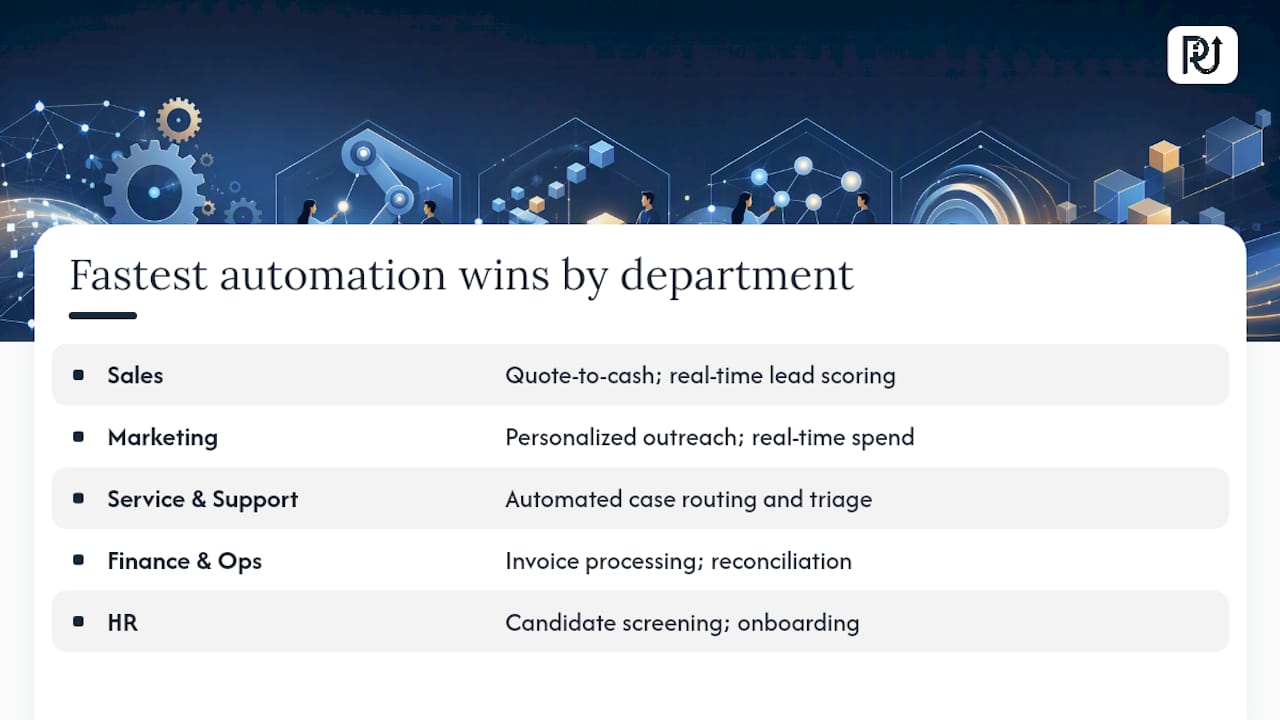
Sales sees the quickest wins because the processes are repetitive and revenue-linked. Quote-to-cash acceleration, lead scoring that actually updates in real time, and automated outreach sequences turn a rep’s week from admin work into selling time. The gap between scheduled drip sequences and true autonomous growth automation is worth understanding here: a drip campaign runs on a calendar, while an autonomous system detects a signal, like a prospect visiting a pricing page twice, and acts on it within minutes.
Marketing benefits from that same shift toward autonomous systems. Personalization at scale used to mean segmenting an email list into five buckets. Now it means generating individualized outreach and adjusting campaign spend based on real-time conversion signals, which is closer to how the single-operator growth engine in the Bessemer case actually functioned.
Service and support teams gain the most visible operational relief. Automated case routing and triage cut the time between a customer filing a ticket and a qualified person picking it up. That directly improves service-level agreement compliance, and it’s one of the easiest automation wins to measure because the before-and-after numbers are so clean.
Finance and operations carry some of the highest-value, highest-risk automation opportunities. Accounts payable reconciliation, invoice processing, and exception handling in reconciliation workflows are high-volume, rules-heavy, and expensive to get wrong. This is also where document intelligence tools that read, validate, and flag anomalies in unstructured paperwork earn their keep fastest, since the manual alternative is someone re-keying numbers from a PDF into a spreadsheet.
HR rounds out the list with candidate screening and onboarding workflows. Neither is glamorous, but both touch every new hire, and a broken onboarding sequence quietly costs you weeks of new-employee productivity. A structured approach to onboarding automation applies just as well internally as it does with clients.
How Should Leaders Prioritize What To Automate First?
The mistake most executives make is automating whatever is loudest, not whatever is most valuable. Use four criteria to rank candidate processes before you commit budget:
- Value. How much revenue, cost, or risk does this process touch per cycle?
- Frequency. Is this happening ten times a month or ten thousand?
- Repeatability. Does the process follow consistent logic, or does every instance require a judgment call?
- Compliance risk. Would a mistake here trigger a regulatory or contractual problem?
High value plus high frequency plus high repeatability plus low compliance risk is your first pilot. Everything else waits.
From there, follow a three-step path. Start with a genuine process audit, not a wish list, mapping where time actually leaks in your operation. Next, run a pilot on unstructured, messy data rather than the cleanest process you have. MIT Sloan Management Review’s research on scaling automation found that the programs that scaled successfully paired process experts directly with developers and restructured the workflow itself, not just the tooling around it. Finally, build a center of enablement rather than a one-off project team, so the second and third automation build faster than the first.
Governance needs an owner from day one: someone accountable for exception handling, a clear escalation path when the automation gets something wrong, and a named business stakeholder who isn’t IT.
Pro Tip: Run your first pilot on a process that’s annoying but not mission-critical. You want to learn how your organization handles automation failure before you bet a revenue-critical workflow on it.
Why Do So Many Automation Programs Stall At Scale?
Programs that succeed with pilot one and fail at pilot fifteen usually hit what practitioners call the Maintenance Wall. Legacy robotic process automation relies on rigid, coordinate-based scripts that break the moment a screen layout changes or a vendor updates their portal. Each new bot adds to a maintenance burden that grows in a straight line with the number of processes automated, which is why scaling enterprise automation strategy research identifies this wall as the point where automation programs quietly stop expanding.
The fix isn’t more RPA bots. It’s a different architecture. Modern automation increasingly relies on AI agents that reason over context instead of following brittle scripts, neurosymbolic systems that combine pattern recognition with rule-based logic, and what some practitioners call English-as-Code, where a subject-matter expert describes a process in plain language and the system builds the automation logic around it. Conversational exception handling matters here too: instead of a bot halting entirely when it hits something unexpected, it flags the exception and asks a human a specific question, then resumes.
That architectural shift needs an organizational one to match. The programs that scale, per MIT Sloan’s research, move away from a centralized “bot factory” model and toward a federated enablement structure. Process owners in each department get tools to build and adjust their own automations, with a central team setting standards and providing infrastructure rather than building every workflow itself.
- Legacy RPA: maintenance cost rises linearly with every process added
- Agent-based systems: designed to absorb process variation without a rebuild
- Centralized bot factories: fast to start, slow to scale past a handful of processes
- Federated enablement models: slower to start, but the ones that keep expanding two years in
Pro Tip: Ask any vendor how their system handles a process exception it has never seen before. If the answer is “it stops and alerts someone,” you’re still buying legacy RPA with better branding.
What Does Automation Actually Cost, And When Does It Pay Back?
Cost conversations go sideways when leaders compare automation to zero, instead of comparing it to the fully loaded cost of the manual process it replaces. Four categories drive most automation budgets: initial design and process mapping, system integration, ongoing licensing, and maintenance. Britannica’s overview of automation economics is blunt about this trade-off: automation delivers higher throughput and consistency, but it demands real upfront capital and a higher maintenance requirement than a purely manual operation ever would.
A simple ROI model works better than a complicated one. Take the hours a process consumes monthly, multiply by the fully loaded hourly cost of the people running it, then subtract the automation’s monthly run cost, including maintenance. If a reconciliation process eats 80 hours a month at a fully loaded rate of $45 an hour, that’s $3,600 in monthly labor cost alone, before counting the error-correction time nobody tracks.
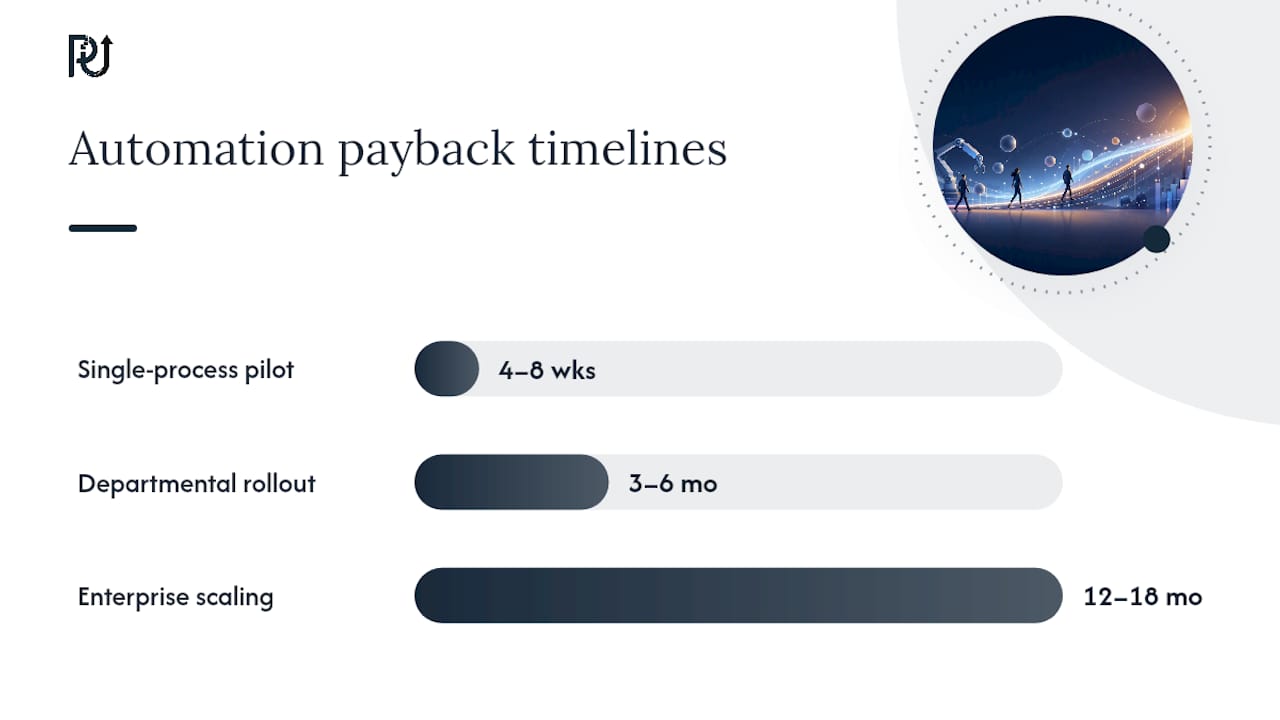
Timelines vary by ambition. A single-process pilot typically shows results in four to eight weeks. Departmental rollout across a function usually runs three to six months. Enterprise-wide scaling, if you avoid the Maintenance Wall, stretches across twelve to eighteen months but should show compounding returns well before that finish line.
- Design and mapping: front-loaded, highest in the first project
- Integration: scales with system complexity, not headcount
- Licensing: usually predictable and subscription-based
- Maintenance: the cost that determines whether your program survives past year one
What Do the Research and Real Cases Actually Show?
The evidence base here is smaller than the marketing around automation would suggest, but what exists is consistent. A few threads worth pulling on directly:
- The Bessemer case shows automation compressing a full growth function into one operator’s workload without lowering output, a result detailed in BVP’s Atlas coverage
- Britannica’s framing of automation economics is a useful counterweight: the upside is real, but so is the capital and maintenance commitment
- MIT Sloan’s research on scaling shows the organizational model matters as much as the technology choice
- The lesson for most leaders isn’t “copy the single-operator model exactly.” It’s recognizing that autonomous, feedback-driven systems consistently outperform scheduled, static automation, and building toward that even if you start smaller
The Gap Between Automation’s Promise And What Leaders Actually Get
Most automation pitches oversell the technology and undersell the organizational work required to make it stick. The Maintenance Wall isn’t a technology failure. It’s what happens when leaders buy tools and skip the redesign of the underlying process, which is exactly what the MIT Sloan research on scaling found separates programs that plateau from ones that keep expanding.
The uncomfortable truth is that automation-driven growth rewards the leaders willing to restructure how work actually flows, not just the ones with the biggest software budget. A resilient, agent-based system built around a poorly mapped process will still hit the same wall, just later and more expensively. Work designing custom AI agents and document intelligence systems consistently starts with that redesign step, because skipping it is the single most predictable reason automation programs stall after a promising pilot… The checklist any leader should demand from an automation partner is short: how does the system handle an exception it hasn’t seen, who owns maintenance six months after launch, and what metrics beyond ROI will you actually see in the first quarter.
— Syed Naveed Abbas
Build Automation-Driven Growth With A Partner Who Designs For Scale
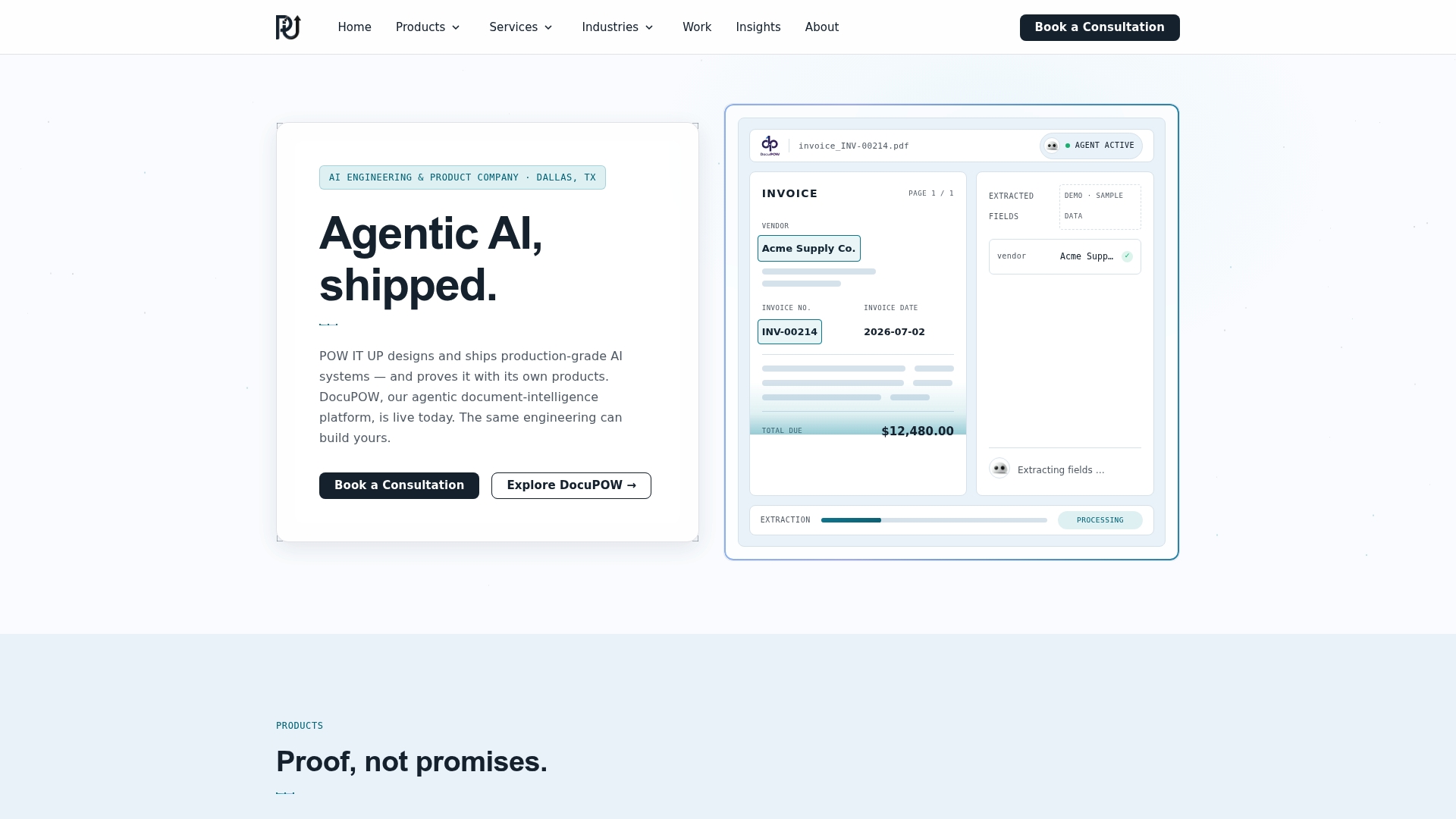
Some automation vendors skip building systems designed to survive past the pilot. Instead of scripting brittle bots that add to a linear maintenance burden, custom AI agents, document intelligence tools, and portfolio monitoring systems can be designed to absorb process variation instead of breaking against it.
The engagement model follows the same audit, pilot, scale path this article laid out: a process audit to find where time actually leaks, a focused pilot on a genuinely high-value workflow, and a scaling plan that avoids the Maintenance Wall from the start. If your finance team is still re-keying invoices or your sales team is running outreach on spreadsheets, that’s a reasonable place to start the conversation. Get a clear picture of what’s automatable in your operation and what it would take to build it right through POW IT UP’s AI integration services.
Sources
- Building a growth engine from zero: How one COO boosted ARR 38% using Claude Code – Bessemer Venture Partners
- Automation – Efficiency, Cost-Savings, Robotics | Britannica
- Scaling automation: two proven paths to success – MIT Sloan Management Review
- 70 Business Automation Statistics Driving Growth in 2025 – Vena Solutions
FAQ
Which jobs are least likely to survive AI-driven automation?
Roles built almost entirely on repetitive, rules-based data entry, such as manual invoice keying, basic transcription, and routine data reconciliation, face the highest displacement risk since these are exactly the high-frequency, low-judgment tasks automation targets first.
What are the four main types of automation?
The commonly recognized categories are fixed automation for high-volume single-task processes, programmable automation for batch production runs, flexible automation for variable but predictable tasks, and integrated automation, which links multiple systems and now increasingly includes AI agent-based orchestration.
Which jobs are safest from AI-driven automation?
Roles requiring complex judgment, relationship management, and situational adaptability, such as senior client strategy, skilled trades, and roles centered on negotiation or crisis handling, tend to hold up best, since these depend on the human context automation still struggles to replicate.
How long does it take to see returns from automation?
A single-process pilot typically shows measurable results in four to eight weeks, while departmental rollouts usually take three to six months to demonstrate compounding productivity gains.