
Future-ready business operations run on outcomes, not tasks: every process is instrumented, governed, and staffed to let autonomous AI agents execute end-to-end work reliably, with humans overseeing exceptions rather than running every step. The single highest-value move for a leader right now is to pick one or two end-to-end processes and redesign them for agentic execution, with measurement and guardrails built in from day one. What follows is the framework, the workforce playbook, and the metrics to make that redesign stick.
TL;DR:
- Successful deployment depends on treating automation as an engineering discipline with built-in governance and rigorous instrumentation from the start.
- Prioritize process redesign in areas with clear ownership, good data quality, and straightforward outcomes, then conduct pilots focused on measurable, narrow results.
- Achieving true future-ready operations requires a comprehensive framework: outcome ownership, observability, safety thresholds, platform decisions, and workforce redesign.
- Regulatory compliance must be embedded in design, ensuring audit trails and decision transparency to meet sector-specific legal obligations.
- Building ethical and sustainable AI workflows involves explicit bias checks, energy-conscious infrastructure choices, and considering environmental impacts from the outset.
Table of Contents
- What Future-Ready Business Operations Actually Look Like
- A Practical Five-Part Framework for Future-Ready Operations
- How AI and Agentic Automation Change the Design Requirements
- Managing the AI Workforce Transition: A Staged Playbook
- A Prioritized Roadmap: Assess, Pilot, Scale
- How to Measure Progress: KPIs and Maturity Checkpoints
- How Regulation and Compliance Shape Future-Ready Operations
- Where Sustainability and Ethics Fit Into the Redesign
- Author Perspective: What Actually Separates Successful Deployments
- Getting Execution Support for Your Redesign
- Sources
- FAQ
What Future-Ready Business Operations Actually Look Like
Most companies still automate tasks: a form gets auto-filled, an email gets auto-sent. Future-ready operations automate outcomes instead, meaning a customer’s refund request is resolved start to finish without a human touching a queue. That shift changes what “capacity” means. Work no longer scales with headcount; it scales with how many processes can run continuously, at any hour, without a shift schedule.
A few properties separate future-ready operations from a merely digitized one:
- Outcome ownership: someone is accountable for the result (order fulfilled, claim resolved), not just a task inside it.
- Elastic, always-on execution: agents handle volume spikes and off-hours work without overtime or backlog.
- Observability: every process step emits data you can see, not just data you can audit after a failure.
- Governed autonomy: agents operate inside defined limits, with clear rollback if something goes wrong.
Companies that get this right see it in fulfillment speed, fewer exceptions escalated to humans, and service that genuinely runs 24 hours a day rather than “24 hours with a morning backlog.”
A Practical Five-Part Framework for Future-Ready Operations
Redesigning a process for agentic execution without a framework is how pilots stall at the demo stage. Five components need to be in place, in roughly this order.
- Outcome definition and end-to-end ownership. Name the outcome (not the task) and assign one owner with clear decision rights over the whole process, not just their functional slice.
- Instrumentation and process telemetry. Before automating anything, measure cycle time, error rate, and volume at each handoff. You cannot govern what you cannot see, which is exactly the point TechRadar’s analysis of operational readiness makes about agents acting on unobservable systems: it multiplies risk rather than reducing it.
- Governance and safety thresholds. Set explicit human-in-the-loop checkpoints: which decisions an agent can make alone, which need sign-off, and what triggers an automatic rollback.
- Technology and platform choices. Decide early whether you are extending existing systems (brownfield) or building a new platform layer (greenfield). Everest Group’s roadmap for autonomous operations argues that sequencing cloud modernization ahead of large platform bets creates a sturdier foundation than jumping straight to a full rebuild.
- Workforce and role redesign. Build a skill matrix mapping current roles to the judgment-heavy, exception-handling work agents can’t do, and certify people into those roles deliberately.
Pro Tip: Instrument the process for at least two to four weeks before you automate a single step. Baseline data is the only way to prove the redesign actually worked, rather than just feeling faster.
How AI and Agentic Automation Change the Design Requirements
A single-task bot that reads an invoice and enters a number is forgiving of messy surrounding systems. A multistep agent that reads the invoice, checks it against a contract, flags a discrepancy, and routes an exception is not. BCG’s research on agentic enterprise operations makes the case plainly: scaling value from AI requires redesigning the end-to-end process, not stitching automation onto individual tasks, because agentic workflows fail at the seams between systems, not inside any single step.
That means the operational substrate matters more than the agent itself. Before deploying agents at any real volume, you need:
- Clean, reconciled data that doesn’t require a human to “just double check” first.
- Unified context across systems, so an agent handling a customer isn’t blind to what another system already knows.
- Observability deep enough to catch a failure in minutes, not at month-end close.
- Automated remediation paths, so a stuck agent doesn’t sit stalled until someone notices.
Skip this substrate and agents don’t just fail quietly. They introduce new failure modes: silent data drift, decisions made on stale context, and a slow leakage of institutional memory as the people who used to catch these errors manually get reassigned. That’s also why portability matters when choosing to build versus buy. BCG notes that as agentic footprints grow into the hundreds or thousands of discrete solutions, organizations need a real delivery lifecycle for agents, not an ad hoc collection of one-off scripts.
Managing the AI Workforce Transition: A Staged Playbook
Redesigning a process changes the humans around it more than it changes the software. The AI workforce transition playbook from Recurrent recommends starting with a detailed task inventory before touching headcount, classifying work into repeatable, judgment-based, exception-handling, and relationship-driven buckets. That classification tells you exactly which tasks an agent can absorb and which need a trained human on the other side.
From there:
- Score each role for retraining feasibility using a skill matrix: what does this person already know that transfers to exception review or agent oversight?
- Stage retraining over 30, 60, and 90 days: general AI literacy first, then shadowing an agent-run process, then full ownership of exceptions and edge cases.
- Redesign roles explicitly, for example turning a data-entry clerk into an “exception reviewer” with a certification tied to the new process.
- Track redeployment versus layoffs as a KPI in its own right, alongside adoption rates among the staff now working alongside agents.
Pro Tip: Run the 30/60/90 clock from the day training starts, not the day the agent goes live. Staff who feel rushed into oversight roles disengage fast, and that disengagement shows up in error rates within weeks.
A Prioritized Roadmap: Assess, Pilot, Scale
Sequencing beats ambition here. Start with an honest maturity scan: which end-to-end processes already have decent data and clear ownership, and which are still tangled across three systems and two spreadsheets? Pick pilots from the first group.
A safe pilot has four features:
- A narrow, well-defined outcome, not “automate customer service” but “resolve tier-one refund requests under $200.”
- Measurable signals from day one, tied to the instrumentation built during the framework phase.
- A rollback plan that’s been tested, not just documented.
- An executive sponsor who can unblock cross-functional friction, since most stalls happen at handoffs between departments, not inside the agent itself.
Once a pilot proves out, scaling works best through what’s effectively a process transformation factory: a repeatable playbook for onboarding the next process rather than reinventing the pilot’s approach each time. Balance a few visible quick wins against one or two larger platform bets. Quick wins fund the appetite for the bigger, slower infrastructure work that pays off over a longer horizon.
How to Measure Progress: KPIs and Maturity Checkpoints
Three categories of metrics tell you whether operations are actually becoming future-ready, or just automated at the edges.
Outcome KPIs: cycle time per process, accuracy rate, size of the exception backlog, customer satisfaction, and the percentage of work redeployed to higher-value roles rather than eliminated.
Operational safety KPIs: percentage of processes with full observability coverage, number of rollback incidents per quarter, and the human override rate, which tells you whether agents are actually trusted or being second-guessed constantly.
Maturity checkpoints: share of end-to-end processes fully instrumented, share of processes running agentically versus manually, and adoption rates among the managers actually running these processes day to day. Bain’s research on AI-powered operations found organizations that rearchitect workflows around AI report EBITDA gains of 10% to 25%, but only when adoption keeps pace with the tooling. That gap between deployment and adoption is where most transformations quietly lose their return.
How Regulation and Compliance Shape Future-Ready Operations
Compliance isn’t a constraint bolted onto future-ready operations after the fact. It has to be part of the design from the outcome-definition stage, because an agent making decisions at machine speed inherits every regulatory obligation the human process used to carry, often with less room for judgment calls.
Financial services, healthcare, and insurance operators face the sharpest version of this. An agent approving a loan step or flagging a claim discrepancy needs audit trails detailed enough to satisfy a regulator asking “why did the system decide this,” not just “what did the system decide.” That’s a direct extension of the governance layer in the five-part framework: human-in-the-loop thresholds aren’t just a safety feature, they’re often the difference between a defensible process and an indefensible one under examination.

IBM’s perspective on autonomous infrastructure operations points to a related requirement: policy enforcement and a documented source of truth have to exist before agents act on infrastructure at speed, precisely because compliance failures at machine speed compound faster than a human team could ever create them manually.
The practical implication for leaders: build compliance checkpoints into the instrumentation layer, not as a separate audit function that reviews agent decisions after the fact. Regulatory requirements also shift by sector and jurisdiction, so a redesign that works cleanly for a logistics company may need an entirely different approval chain for a healthcare claims process. Treat that variation as a design input, not an afterthought bolted onto a finished pilot.
Where Sustainability and Ethics Fit Into the Redesign
Agentic operations change the resource footprint of a business in ways that are easy to overlook when the focus is on speed and accuracy. Running processes continuously, at scale, with far less marginal cost per transaction, means the environmental and ethical stakes of how those agents behave scale right alongside the volume.
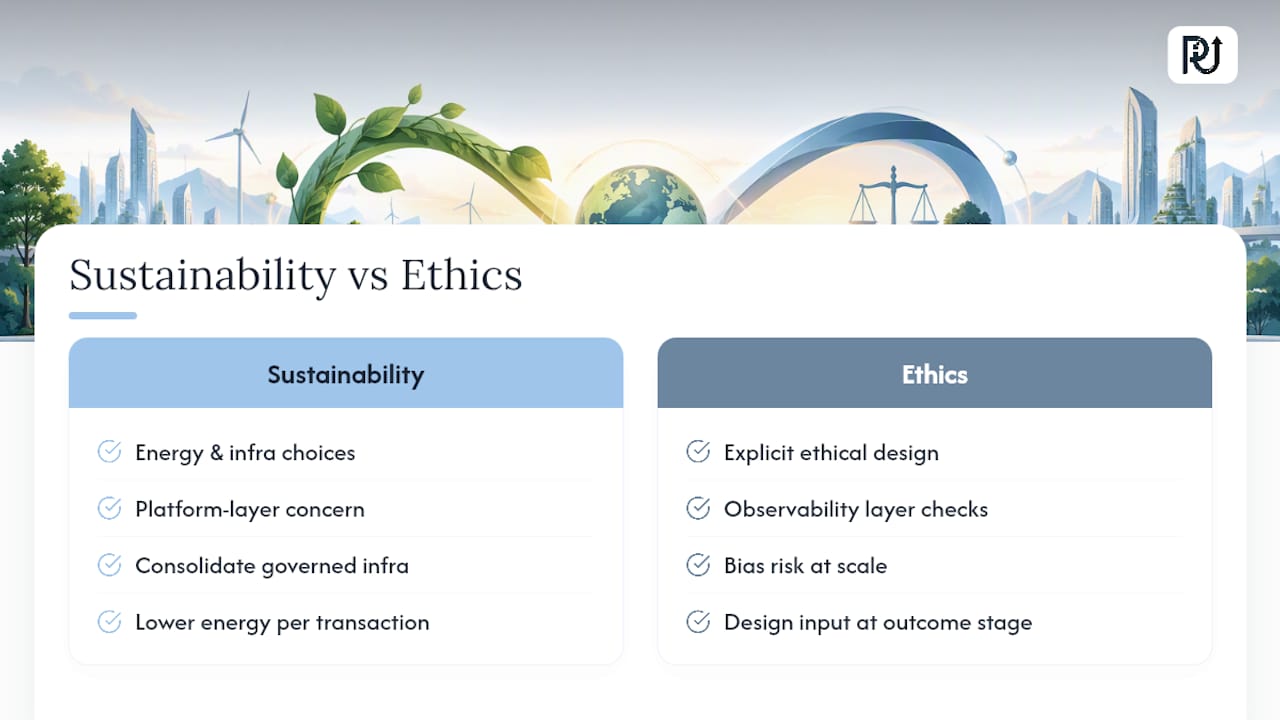
Two considerations matter in practice. First, energy and infrastructure choices behind the agents deserve the same scrutiny as any other capital decision. Cloud modernization choices, covered in the platform layer of the framework above, are also sustainability choices, since consolidated, well-governed infrastructure tends to run more efficiently than a sprawl of one-off automation scripts.
Second, ethical design has to be explicit, not assumed. An agent handling customer disputes, hiring screens, or credit decisions carries the same bias risks a human process does, except it applies that bias at far greater volume and speed. Building fairness checks into the same observability layer that catches operational errors, rather than treating ethics as a separate review, keeps the two concerns from drifting apart as a process scales. The organizations that treat sustainability and ethics as design inputs at the outcome-definition stage tend to avoid the retrofitting scramble that hits companies who bolt these considerations on after a pilot has already gone live.
Author Perspective: What Actually Separates Successful Deployments
The gap between companies that succeed with agentic operations and those that stall isn’t ambition or budget. It’s whether they treated automation as an engineering discipline with governance built in, or as a shortcut to headcount reduction. POW IT UP designs and deploys autonomous, context-aware digital workforces built on exactly this principle: outcomes first, guardrails always. The company’s ongoing analysis of modern business operations reflects a consistent pattern across deployments: the organizations that invest in instrumentation before automation are the ones whose agents survive contact with real, messy production data.
— Syed Naveed Abbas
Getting Execution Support for Your Redesign
Most operations leaders don’t stall on strategy. They stall on execution, specifically the gap between “we know which process to redesign” and “we have an engineer who can build it safely.” This gap can be closed by working with technical architects who design, build, and deploy custom AI agents that handle high-volume transactional work end to end, with the observability and governance this article argues you need before scaling anything.
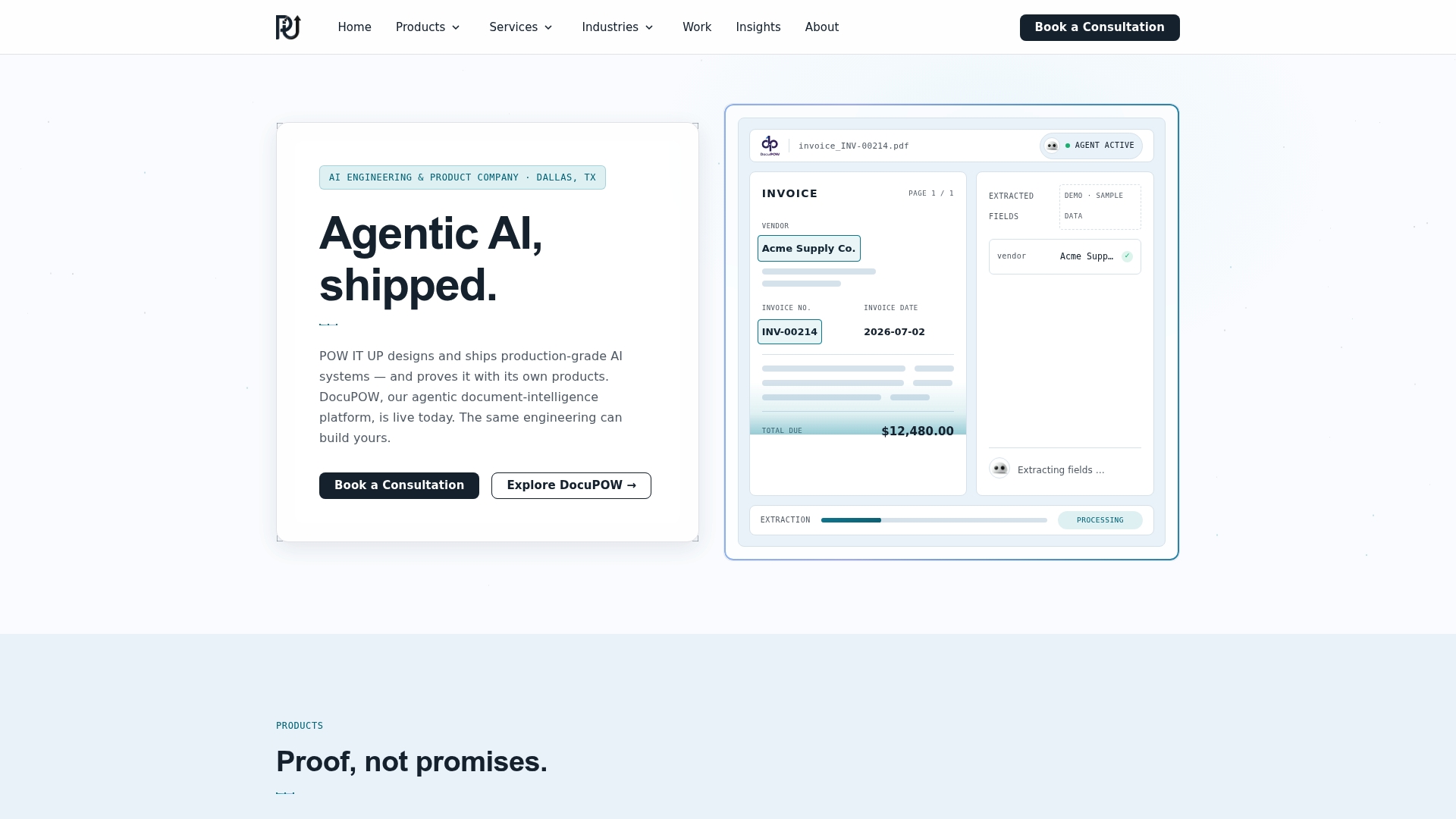
If your bottleneck is document-heavy processes, invoices, contracts, claims, DocuPOW reads and validates documents at the volume a human team can’t sustain. If you’re further along and need a custom agent built for a specific end-to-end outcome, AI Agents Development is where that engineering work happens. For companies with existing systems that a new agent needs to plug into cleanly, AI Integration covers exactly that brownfield problem, and broader AI Automation engagements handle the larger transformation when more than one process needs redesigning at once. Start with a pilot assessment on one process rather than trying to redesign everything at once.
Sources
- Applied AI with agentic enterprise operations (BCG, 2026)
- How to future-proof enterprise operations in the age of invisible AI | TechRadar
- What are AI-powered operations and how do they work? | Bain & Company
- AI workforce transition playbook for operations leaders | Recurrent
- Future-proofing enterprise operations: autonomous digital fabric (Everest Group, 2026)
FAQ
What Business Will Boom by Making Operations Future-Ready?
No single sector has a monopoly on this. Companies with high transaction volume and repetitive, document-heavy processes, including logistics, insurance, healthcare claims, and financial services, tend to see the fastest returns because agentic automation removes the biggest bottlenecks first. Bain’s research found EBITDA gains of 10% to 25% concentrated in organizations that also invested in workflow adoption, not just tooling.
What Is the Future-Ready Framework?
It’s a five-part approach covering outcome definition and ownership, instrumentation and telemetry, governance and safety thresholds, technology and platform choices, and workforce and role redesign. Each part builds on the last, so instrumentation has to exist before governance thresholds mean anything, and platform choices come before workforce redesign locks in.
What Are Future-Ready Skills?
They center on judgment, exception handling, and agent oversight rather than repetitive task execution. The AI workforce transition playbook recommends classifying existing work into repeatable, judgment-based, exception-handling, and relationship-driven categories, then building skill matrices and certifications around the latter three, since those are what agents can’t fully absorb.
What Is Another Way to Say “Future-Ready”?
Common alternatives include “resilient operations,” “adaptive business infrastructure,” and “future-proof operations.” All point to the same underlying idea: an operating model built to absorb disruption and scale new capabilities without a full rebuild each time conditions change.
How Do I Start Making Operations Future-Ready?
Pick one or two end-to-end processes with clean data and clear ownership, instrument them for several weeks to establish a baseline, then pilot agentic execution with a tested rollback plan. Engineering partners like POW IT UP can run this assessment and build the pilot without requiring a full platform commitment upfront.