
AI-driven operational excellence means using autonomous AI agents to run high-volume, rule-bound operational work while people manage exceptions and judgment calls. The measurable payoff shows up as fewer errors, faster cycle times, and lower cost per transaction. The right first move isn’t a company-wide rollout. It’s picking one high-friction loop, like invoice matching or claims triage and running a tightly measured pilot before you scale anything further.
TL;DR:
- Successful pilots focus on high-volume, rule-based processes like invoice matching or claims triage, with clear input-output and measurable KPI targets.
- Building trust requires rigorous process mapping, data cleaning, and assigning accountability before deploying AI agents, with governance and observability integrated from the start.
- A layered architecture with coordination through orchestration and shared semantic understanding ensures reliable multi-agent operation across departments.
- Starting with a one-KPI, 90-day pilot on a low-judgment process, and measuring weekly against baseline results, significantly increases the chance of scalable success.
- Robust governance, including scoped permissions, kill switches, audit trails, and human checkpoints, is essential to manage AI mistakes and ensure trustworthy autonomous actions.
Table of Contents
- What AI-Driven Operational Excellence Actually Changes
- What Architecture Actually Supports AI-Native Operations?
- How Do You Run a 90-Day One-KPI Pilot?
- What Guardrails Keep Autonomous Agents Trustworthy?
- Which KPIs Actually Prove AI Is Working?
- What Do Real AI-Driven Operational Excellence Case Studies Show?
- What Should You Do in the First 30 Days?
- Why Process Discipline Comes Before the Algorithm
- How POW IT UP Builds Your First AI Pilot
- Sources
- FAQ
What AI-Driven Operational Excellence Actually Changes
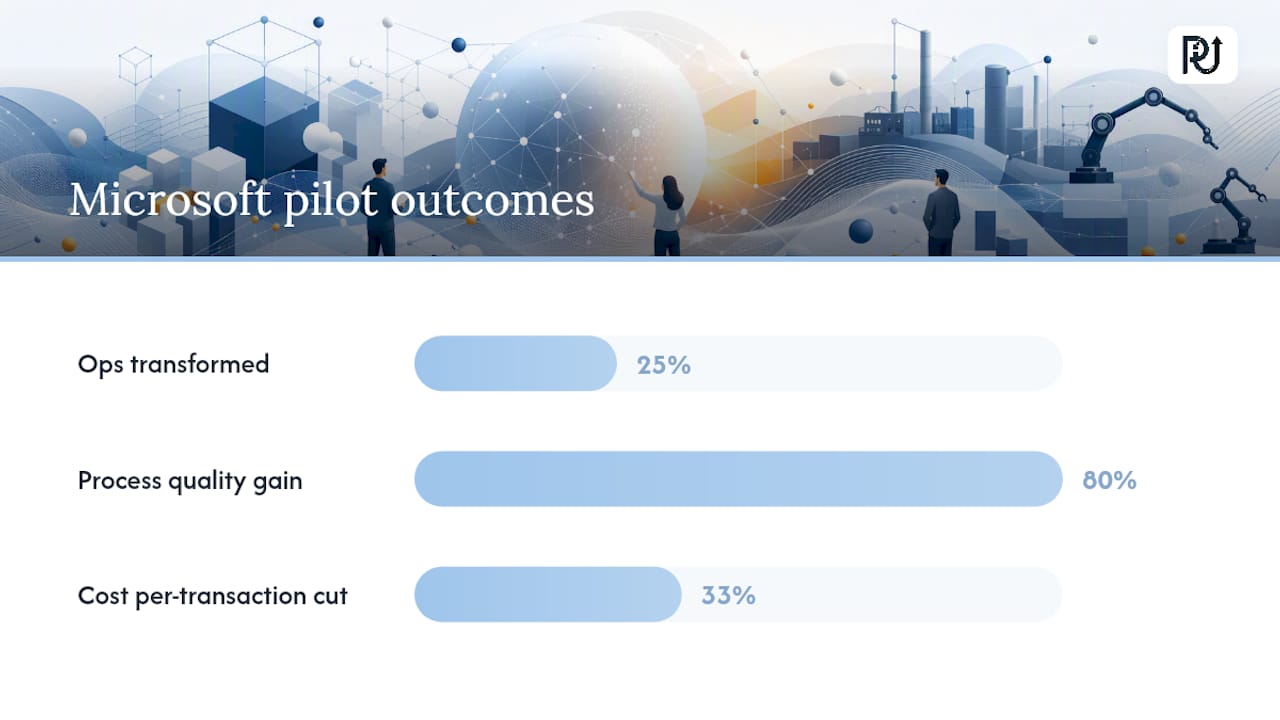
Most executives picture AI-driven operational excellence as faster software. That undersells it. The real shift is autonomous execution: agents that read a document, check it against three systems, flag the exception, and route the clean cases through without a human touching them. Microsoft’s internal AI toolkit program transformed roughly 25% of its business process operations, delivering an 80% improvement in process quality and a 33% cut in cost per transaction. That’s not a chatbot answering questions. That’s a digital worker doing the job.
Agentic execution differs from older automation in one key way: the agent can decide, not just follow a script. A traditional bot breaks the moment a field is formatted differently than expected. An agent reasons about the exception, applies context, and either resolves it or escalates it with a recommendation attached. Predictive analytics layered on top means the system doesn’t wait for a failure. It flags a payment likely to bounce, a machine likely to fail, or a shipment likely to miss its window, before the cost hits the books.
The use cases converging fastest right now:
- Document intelligence: reading contracts, invoices, and claims, then validating them against source systems in seconds instead of days.
- Self-healing payment operations: agents that detect a failed transaction, diagnose the cause, and retry or reroute it without a ticket ever reaching a human queue.
- Predictive maintenance: sensor and usage data feeding models that schedule repairs before a breakdown stops a line.
- Capacity optimization: dynamic reallocation of staff, inventory, or compute based on real-time demand signals rather than last quarter’s forecast.
None of this works if the underlying process is a mess. MIT Technology Review makes the point plainly: organizations with mature Lean, Six Sigma, or BPM discipline convert AI investment into results far more reliably than those without it. AI amplifies whatever process maturity already exists. Bolt it onto a chaotic workflow, and it will automate the chaos faster.
What Architecture Actually Supports AI-Native Operations?
Bolting an AI agent onto a single app is easy. Making a dozen agents work together across finance, ops, and customer service without stepping on each other is a design problem, not a shopping list. SAP’s engineering team frames this as a four-layer structure, and it’s a useful mental model regardless of which vendor stack you run: a user layer where humans interact and approve, a process layer where agents execute steps, a foundation layer holding the business logic and rules, and a platform layer managing data, identity, and compute underneath it all. SAP’s own AI-native architecture work cites Takeda achieving up to 10% productivity gains and fewer stock-outs using this kind of layered design.
The harder question is coordination. Do agents work through orchestration, where a central controller assigns tasks and sequences them, or choreography, where agents react to shared events without a central boss? Most enterprise deployments end up hybrid: a central orchestration layer for cross-department workflows, with local choreography inside a single team’s process. Salesforce’s architecture guidance for agentic systems argues that without a dedicated orchestration and observability layer, agent networks become unreliable fast, because nobody can trace which agent decided what.
Underneath the orchestration sits something less glamorous but more important: semantic grounding. Agents need a shared understanding of what “customer,” “order,” and “exception” actually mean across systems that were never designed to talk to each other. That usually takes the form of an enterprise knowledge graph or a semantic layer sitting on top of your data warehouse. A peer-reviewed study on agent-orchestrated pipelines found that well-grounded architectures achieve high action consistency and improved fault classification accuracy while cutting monthly operational costs. Skip this layer, and agents will confidently make decisions using the wrong definition of “done.”
Three things worth budgeting for before you write a single agent:
- A data integration plan that connects legacy systems (ERPs, core banking platforms, CRMs) without forcing a rip-and-replace.
- A semantic layer or knowledge graph that gives every agent a consistent vocabulary.
- An orchestration and observability layer that lets a human trace any decision back to its source.
How Do You Run a 90-Day One-KPI Pilot?
Skip the enterprise rollout. The organizations getting real traction pick one operational loop, prove it works, and expand from there. Bessemer’s case study on a COO who grew ARR by 38% in six months didn’t happen through a sprawling transformation program. It happened by automating ICP research, outbound sequences, and CRM workflows one piece at a time, measuring each one, and building on what worked.
Here’s the sequence that holds up across most operational contexts:
- Pick the loop. Choose a high-volume, rule-bound process with a clear input and output. Invoice matching, claims intake, or ticket triage are common starting points.
- Map the process as it actually runs, not as the flowchart says it runs. Talk to the people doing the work today.
- Clean the data feeding that loop. Agents inherit every data quality problem you already have; garbage in still means garbage out, just faster.
- Assign a named owner and set SLAs. Someone has to be accountable for the pilot’s outcome, not the IT department in general.
- Build the agent with guardrails attached, not after the fact. Permissions, escalation paths, and rollback triggers get designed alongside the logic.
- Run the pilot for 4 to 12 weeks with a defined baseline and a stop/go decision gate tied to the one KPI you chose.
- Measure against that baseline and decide whether to expand the loop, adjust it, or kill it.
Industry playbooks consistently recommend starting with one low-judgment, high-volume loop specifically because it lets the system, and your team, build trust incrementally rather than betting the operation on a big-bang launch.
The roles matter as much as the sequence. You need an AI Operations Architect who understands both the business process and the technical build, not just one or the other. You need the process owner, the person whose KPI actually moves, sitting at the table from day one. You need a platform engineer handling the integration and infrastructure work, and a compliance reviewer signing off on data handling and audit requirements before the agent touches production data.
Four artifacts should exist before you flip the pilot on: a documented process map, a KPI baseline captured before the agent runs, explicit rollback and gating criteria, and an observability dashboard that shows what the agent did and why. Without that dashboard, you’re trusting a black box with real transactions. POW IT UP’s own pilot framework treats this gated, 4 to 12 week structure as the standard shape for proving operational intelligence before wider deployment.
Pro Tip: Pick a loop where a wrong decision costs a delay, not a lawsuit. Save the high-stakes processes for after your team has run at least one successful pilot and knows how the agent actually behaves under real data.
Practical roadmaps for this kind of sequencing also show up in process optimization guidance for business leaders, which pairs well with the pilot structure above when a team needs a broader improvement framework alongside the AI-specific build.
What Guardrails Keep Autonomous Agents Trustworthy?
An agent that can act on its own can also act on its own mistakes, at scale, before anyone notices. That’s the tradeoff leaders sign up for with autonomy, and it’s why governance isn’t a compliance afterthought here. It’s the thing that determines whether the pilot survives contact with your legal and risk teams.
Every agent needs its own identity and a scoped set of permissions, the same discipline you’d apply to a new employee, not broader access “just in case.” Pair that with a kill switch that any authorized person can trigger instantly, and policy-as-code that encodes your compliance rules directly into the agent’s decision logic rather than trusting a manual review to catch violations after the fact.
Traceability closes the loop. Every action an agent takes should generate an audit log tied back to a specific business KPI, not just a technical event log nobody reads. When a regulator or an internal auditor asks why a payment got approved, “the agent decided” isn’t an answer. A timestamped trace showing which rule fired and which data it used, is.
Process Excellence Network’s guidance on AI governance emphasizes that mature process frameworks make agents more accountable, not less, because clear ownership and defined exception paths already exist to plug the AI into.
The practical checklist:
- Scoped, agent-specific identity and permissions, reviewed on the same cycle as human access rights.
- A kill switch accessible without a ticket or an escalation chain.
- Policy-as-code encoding compliance rules into the agent’s execution path.
- Audit trails tied to specific KPIs, not generic system logs.
- Human-in-the-loop checkpoints for any decision above a defined risk or dollar threshold, with clear routing when the agent is uncertain.
Which KPIs Actually Prove AI Is Working?
Cycle time, cost per transaction, error rate, automation coverage, and revenue per employee are the five metrics that hold up under scrutiny. Pick one as your primary pilot KPI. Track the rest as context, but resist the urge to report on all five as if they’re equally important, that’s how a pilot loses its focus.
Set the baseline before the agent goes live, not after. Measure the current process for at least two to four weeks under normal conditions, including the messy weeks, not just the clean ones. A baseline built during an unusually quiet period will make your “improvement” look bigger than it is.
Microsoft’s internal program transformed about 25% of its business process operations and reported an 80% improvement in process quality alongside a 33% reduction in cost per transaction. That’s the scale of outcome a mature, well-governed pilot can realistically point toward, not a guarantee, but a useful benchmark for what “working” looks like.
Set your realistic lift target below that benchmark for a first pilot.
Report on a short cadence, weekly during the pilot, not quarterly. Quarterly reporting hides the exact week something broke and lets a bad pattern run for months before anyone notices. Watch for measurement bias too: if the team running the pilot also owns the baseline numbers, build in an independent check, even something as simple as a second person spot-auditing the data. For deeper cost modeling once you’re past the pilot stage, ROI breakdowns for AI automation projects offer a useful framework for translating pilot results into a full business case.
What Do Real AI-Driven Operational Excellence Case Studies Show?
The pattern across successful deployments is consistent: pilot first, measure hard, scale only what’s proven. POW IT UP’s own playbooks follow that same discipline. The Operational Excellence Leader’s Implementation Playbook walks through the architecture and governance decisions leaders face before committing budget to a build. The companion 2026 Leader’s Guide to AI-Powered Business Operations extends that into practical sequencing for teams evaluating vendors and internal capability.
The one-KPI pilot framework documented by POW IT UP applies the exact structure covered above: a single loop, a named owner, a gated timeline, and a stop/go decision tied to one measurable outcome. That structure came out of direct engineering work with operations teams building their first agentic systems, work led by Syed Naveed Abbas, whose background sits at the intersection of AI integration architecture and hands-on automation delivery.
The throughline across these playbooks:
- Start narrow, one process, one KPI, one owner, before touching a second workflow.
- Treat governance and observability as part of the build, not an add-on after launch.
- Measure against a real baseline, not an assumption about what “should” improve.
- Use the first pilot’s data to justify the second, rather than pitching a full rollout on faith.
What Should You Do in the First 30 Days?
Momentum matters more than perfection in month one. Here’s the sequence that gets a pilot off the ground without stalling in committee:
- Week 1: Pick the pilot loop and its single KPI. Appoint a named owner who’s accountable for the outcome, not just informed about the project.
- Week 1 to 2: Snapshot the current process data as your baseline, and write down explicit success criteria before the agent touches anything.
- Week 2 to 3: Build the agent with observable checkpoints, and define the stop/go gates in writing before the pilot launches.
- Week 3 onward: Run the pilot. Review the dashboard weekly, and be willing to pause it if the data looks off rather than pushing through to a launch date.
- Throughout: Keep stakeholders briefed on a simple, consistent cadence, a short weekly update beats a polished monthly deck for keeping trust intact during an unproven pilot.
Simple governance beats elaborate governance in month one. A shared document tracking decisions and a weekly quick check-in will carry a pilot further than a formal steering committee that meets once a month.
Why Process Discipline Comes Before the Algorithm
Process discipline first, always. AI doesn’t fix a broken workflow, it scales it. The organizations getting real results paired mature process thinking with agentic systems, not with AI as a substitute for it. I’d argue the strategic role that matters most over the next few years isn’t the AI vendor. It’s the AI Operations Architect, someone fluent in both the business process and the technical build. Stay pilot first. Measure everything. Resist the temptation to skip the boring baseline work.
— Syed Naveed Abbas
How POW IT UP Builds Your First AI Pilot
Some firms offer custom-built digital workforces designed around actual processes, with live products you can see in action before committing to a build, as an alternative to slow, generic automation providers.
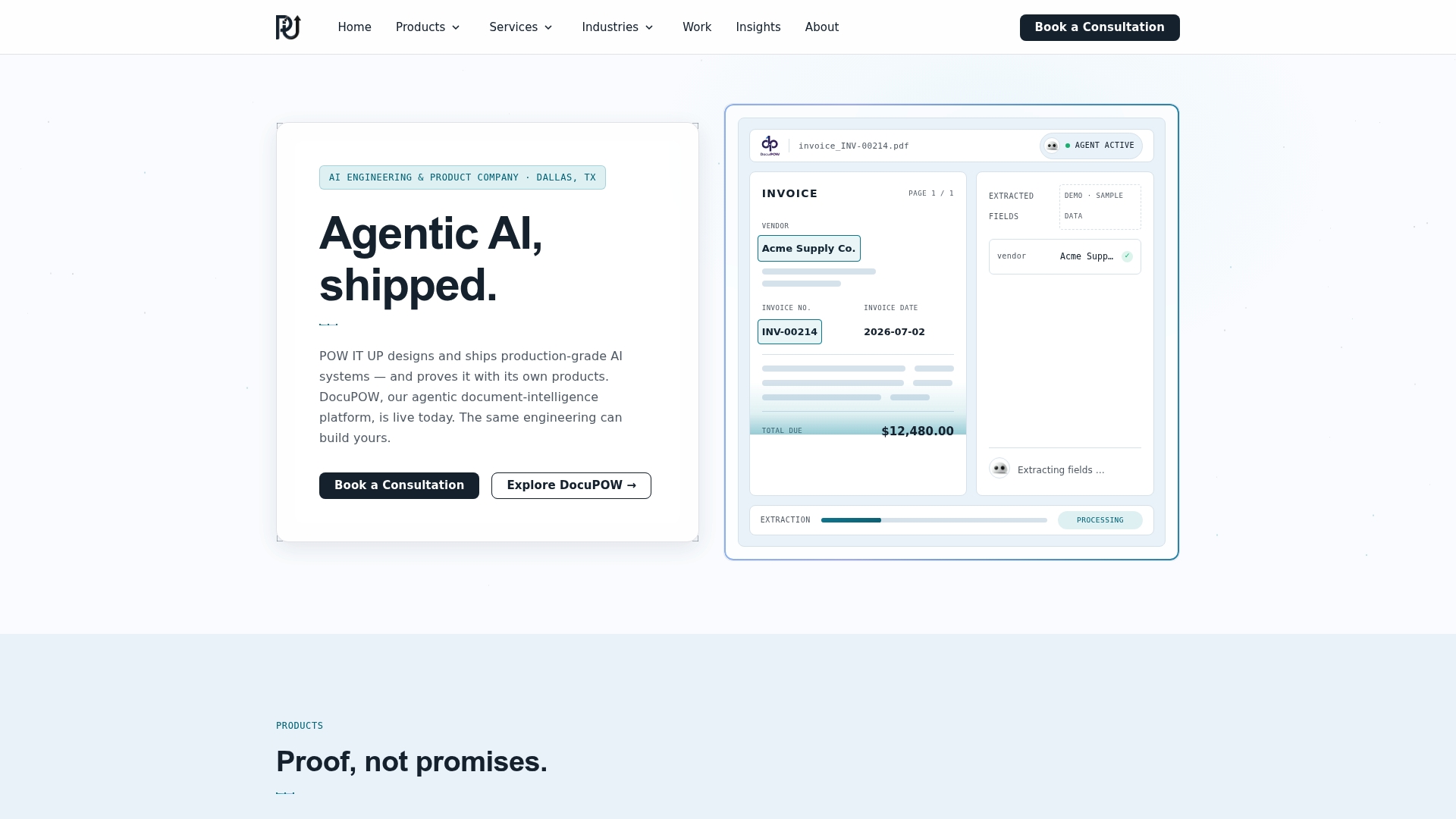
That’s the practical difference between a consulting deck and an engineering firm. DocuPOW handles document reading and validation for teams drowning in invoices, contracts, or claims, and you can see it work before you scope a project around it. For teams ready to build agents specific to their own workflows, AI Agents Development and AI Integration connect that agent logic directly into the systems you already run, no rip-and-replace required. AI Automation rounds out the offering for teams looking to automate a full operational loop rather than a single task.
Typical engagements follow the same one-KPI pilot structure covered above: a scoped loop, a measurable target, and a working result inside weeks, not a multi-quarter transformation program. If you have one operational bottleneck worth fixing first, request a scoped pilot conversation and see what a custom-built agent looks like for your specific process.
Sources
- Streamlining business operations at Microsoft with an AI toolkit
- Agent-driven reference architectures for autonomous enterprise operations (Nature)
FAQ
What Is the 30% Rule in AI Adoption?
Definitions vary by source and context, so treat any specific percentage you see cited as one framework among several rather than an established standard.
What Kind of Role Pays Around $900,000 in AI?
Roles at that pay level are typically senior leadership or highly specialized technical positions at large enterprises or well-funded startups, think Chief AI Officer, VP of AI Engineering, or a founding technical role at a fast-growing AI company. Titles and compensation vary widely by company size, equity structure, and location, and no single job title guarantees that figure.
Which Jobs Are Most Likely to Survive AI Disruption?
Roles requiring judgment under ambiguity, human relationship management, and physical dexterity tend to be more resistant to full automation. Skilled trades, senior clinical roles, and strategic leadership positions, including the emerging AI Operations Architect role described above, fall into that category because they combine technical fluency with decisions machines still can’t make reliably.
What Are the Four Pillars of Operational Excellence?
Frameworks vary across consultancies, but most converge on process discipline, continuous improvement culture, data-driven decision making, and leadership commitment as the core pillars. MIT Technology Review’s analysis adds that AI accelerates results only when these foundations are already in place, it doesn’t substitute for them.
How Long Does a Typical AI Operations Pilot Take?
Most well-structured pilots run four to twelve weeks, long enough to establish a baseline, run the agent against real data, and hit a stop/go decision point. POW IT UP’s one-KPI pilot framework follows this same window, and pricing for a scoped pilot engagement is available on request through AI Agents Development.