

A context-aware AI agent is one whose runtime input is assembled from structured, provenance-traceable context and actively managed by dedicated context-engineering processes, not simply an agent bolted onto a database. Most systems marketed this way are only context-connected: they can query a data source, but nothing governs what reaches the model, in what shape, or with what accountability. This article shows engineers and technical decision-makers how to build, evaluate, or buy the real thing, and points to a full checklist in the evaluation section below.
TL;DR:
- Genuine context-aware agents actively curate and manage runtime data, unlike simple context-connected systems that only query data sources without filtering or tracking provenance.
- Building an effective architecture requires separating durable state from working context and implementing modular retrieval pipelines with clear provenance and observability.
- Four key patterns—deterministic preselect plus rerank, callable compression, evolving playbooks, and intent-aware retrieval—address most production needs for maintaining relevant context.
- Controlling context growth involves tiered memory, incremental compaction, and scoped retrieval to prevent relevance decay and manage token costs in long-horizon tasks.
- Proper evaluation relies on separation of storage and presentation, retrieval tests, long-horizon stability checks, and provenance audits to distinguish true context-aware systems from superficial ones.
Table of Contents
- What “context-aware” actually means for an agent
- Core architecture and components for context-aware agents
- Context engineering techniques that keep agents sharp
- Memory tiers and multi-agent scaling without context explosion
- Governance, testing, and risk management for context-aware agents
- How to evaluate a system that claims to be context-aware
- Production patterns and where they tend to break
- Practitioner notes on building these systems
- Frameworks and platforms worth knowing
- Where context-aware agents are headed
- Getting help building a context-aware agent
- Sources
- FAQ
What “context-aware” actually means for an agent
Context-connected means an agent can reach a database, an API, or a document store. Context-aware means something stricter: the system actively decides what enters the model’s input window, compresses or discards what does not belong, and can show where each piece of context came from. The difference matters because a context-connected agent can retrieve the right document and still fail, if it dumps the whole thing into the prompt and drowns the model in irrelevant text.
Engineers building these systems typically need to model several distinct kinds of context, each with its own lifecycle:
- Working context: the compiled, per-call input the model actually sees, assembled fresh for each turn.
- Session state: durable, short-to-medium-term state tied to a conversation or task run.
- Long-term memory: facts, preferences, and history that persist across sessions.
- Artifacts and streams: large binary or structured data (files, tables, logs) referenced by handle rather than inclined.
- External signals: live data such as system status, sensor feeds, or third-party API responses.
Context-awareness starts to matter once tasks stretch past a single exchange. Long-horizon coding agents, personalization systems that need a user’s history without replaying it verbatim, and regulated workflows that must show why a decision was made all depend on this discipline. A chatbot that answers one question from one document does not need it. An agent processing a hundred-step task, or a system a compliance officer might later audit, does.
Core architecture and components for context-aware agents
The architecture that supports genuine context-awareness separates two things that most naive implementations conflate: durable state and the working context compiled from it. Session and memory stores hold everything the system knows. The working context is the small, curated slice handed to the model on a given call. Conflating the two is the most common design mistake: teams append every message and every tool result to one growing log, then wonder why the agent degrades on long tasks.
A modular retrieval pipeline that separates storage from presentation, using structured metadata interfaces, is central to keeping runtime context compact, according to research from IBM. A production-oriented architecture typically includes:
- A context compiler or ordered set of processors that transform durable state into a working context, applying filters, summarization, and formatting in a defined sequence.
- Artifact stores that hold large data objects by reference, so a working context carries a handle instead of a full file dump.
- Retrieval APIs that expose session and memory data through structured queries rather than raw text dumps.
- Tool interfaces that scope what a given call can see and act on, including sub-agent handoffs that pass a minimal, task-relevant view rather than the full history.
Google’s Agent Development Kit describes this as a tiered model spanning working context, session, memory, and artifacts, compiled through processor flows that make each transform observable and testable, per Google’s architecture writeup. That observability is the point: if you cannot see what a processor did to the context between storage and the model call, you cannot debug it and you cannot audit it later.
Pro Tip: Log the compiled working context alongside every model call, not just the final answer. Debugging a context-aware agent without that log is like debugging a compiler without the intermediate representation.
The runtime layer that sits on top of this, tools, sub-agent handoffs, and scoping rules, decides how much of the durable state a given operation actually needs. A sub-agent handling a narrow subtask should receive a minimal view built for that subtask, not the entire session transcript. Teams that skip this scoping step end up paying token costs and latency penalties for context the sub-agent never uses, and they introduce a wider attack surface for prompt injection and data leakage in the process.
Context engineering techniques that keep agents sharp
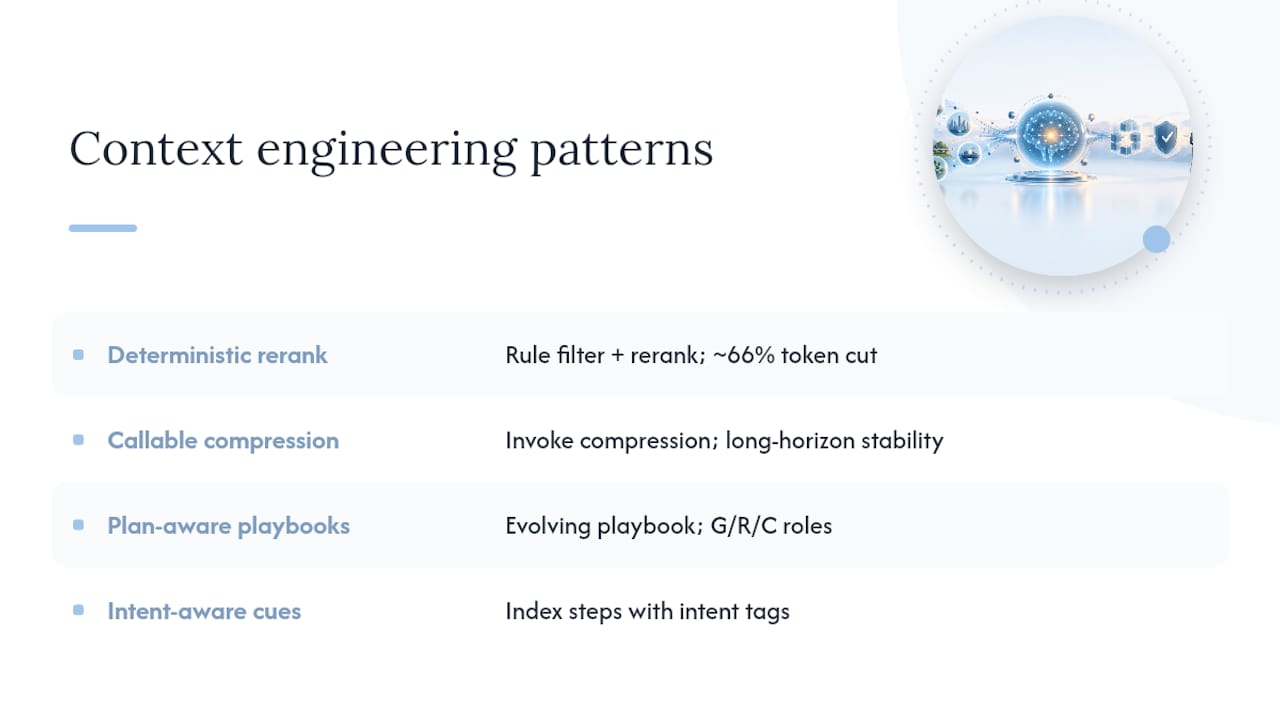
Once the architecture is in place, the harder problem is deciding, call by call, what to include. Four patterns cover most production needs.
Deterministic preselect plus LLM rerank. A cheap, rule-based filter narrows candidates first, then a single lightweight reranking pass orders what remains. IBM’s evaluation found this combination can approach the quality of far more expensive hierarchical retrievers while cutting average input tokens by roughly 66%, according to IBM Research.
2. Callable, stage-wise compression. Instead of appending every step to an ever-growing log, the agent treats context management itself as a tool it can invoke, compressing earlier stages proactively as a task progresses. The Cat paradigm formalizes this as a structured context workspace and reports better long-horizon stability than append-only baselines, per the Cat research paper.
3. Plan-aware, evolving playbooks. Rather than treating context as a static prompt, agentic context engineering frameworks maintain it as an evolving playbook with separate Generator, Reflector, and Curator roles, updating it through incremental deltas so earlier domain detail is not overwritten wholesale, as described in the ACE and PAACE framework.
4. Intent-aware retrieval cues. Indexing each step of an agent’s history with a contextual-intent tag, thematic scope, event type, and key entity type, and retrieving by intent compatibility rather than raw similarity reduces the odds of pulling evidence that matches on keywords but not on purpose. The STITCH paper shows this improves recall specifically under high contextual interference, where many similar-looking but irrelevant memories compete for attention.
Pro Tip: Start with pattern one. Deterministic preselect plus a single rerank pass is the cheapest to implement and fixes the majority of “irrelevant context” complaints before you need anything more elaborate.
Anthropic frames the underlying discipline plainly: context engineering treats the token budget available to a model as a finite, optimizable resource, distinct from prompt engineering, and favors curated, structured inputs like playbooks and memory systems over ad hoc prompt tweaks, as laid out in Anthropic’s engineering guidance. None of these four patterns is universally correct. Retrieval reranking suits information-dense lookup tasks. Callable compression suits long-running agentic workflows like software engineering. Playbook-style updates suit agents that need to retain nuanced domain knowledge across many sessions.
Memory tiers and multi-agent scaling without context explosion
Long-horizon agents fail in a specific, predictable way: context grows faster than relevance does, until the model is reasoning over mostly noise. Controlling that growth requires tiered memory and disciplined scoping.
A practical tiered setup loads working context on every call, pulls session state when a task spans multiple turns, and reaches into long-term memory only when a query explicitly needs history beyond the current session. Loading every tier on every call is the default failure mode: it is simple to build and expensive to run.
- Compaction and incremental deltas update stored context in small pieces rather than rewriting or re-summarizing everything, preserving detail that a full resummarization would blur.
- Proactive recall pulls relevant memory before it is needed, based on task type; reactive recall waits for an explicit signal, such as a direct question about past events.
- Next-step relevance conditioning compresses history based on what the agent is about to do next, keeping only what upcoming reasoning steps will actually use.
- Multi-agent scoping knobs, such as an
include_contentsparameter that limits what a sub-agent receives, prevent handoffs from silently ballooning into full-transcript transfers.
Architecting agentic memory is fundamentally a structure-boundary problem: entity-centric graph memory helps with multi-hop reasoning across many facts, but building that structure for tasks that never need multi-hop lookups wastes token budget on structure nobody queries, per IBM Research’s analysis of graph memory. Every one of these choices trades against the others. More retrieval improves fidelity but adds latency. More compaction saves tokens but risks losing detail a later step needed. There is no configuration that maximizes all four at once, and teams that claim otherwise usually have not stress-tested a long enough task.
Governance, testing, and risk management for context-aware agents
Context-aware agents carry a specific risk profile: the system’s behavior depends on data assembled dynamically at runtime, which makes it harder to predict, log, and audit than a static prompt. The NIST AI Risk Management Framework gives a structure for managing that risk across four functions, MAP, MEASURE, MANAGE, and GOVERN, and explicitly recommends documenting context and integrating testing, evaluation, verification, and validation, known as TEVV, throughout the system’s lifecycle, according to the NIST AI RMF.
Applied to a context-aware agent, that maps roughly like this:
- MAP: document what kinds of context the agent uses, where each type originates, and what decisions depend on it.
- MEASURE: define concrete metrics, retrieval recall, compression fidelity, drift between compiled context and source data, and track them over time.
- MANAGE: set operational controls, including human review checkpoints for high-stakes outputs and a process for disclosing incidents.
- GOVERN: maintain an inventory of every agent system in production and who owns its risk posture.
One figure worth internalizing: a modular retrieval pipeline can cut average input tokens by roughly 66% while approaching hierarchical retriever quality, which means governance overhead does not have to come at the cost of runtime efficiency.
Provenance and lineage records, where a piece of context came from, when it was retrieved, and what transformed it before it reached the model, are what turn TEVV from a paperwork exercise into something an auditor can actually check. A system that cannot answer “why did the agent see this fact” has no real provenance, regardless of what its documentation claims.
How to evaluate a system that claims to be context-aware
Vendors and internal teams alike will call a system context-aware without much scrutiny attached to the label. A short, staged test plan separates the systems that earn it from the ones that do not.
- Check the separation of storage and presentation. Ask to see the durable session or memory store and the compiled working context for the same call, side by side. If there is no visible distinction, the system is context-connected at best.
- Run a retrieval test. Feed a task where the correct answer depends on one fact buried among many similar-looking distractors, and measure whether the right one surfaces.
- Run a long-horizon test. Extend a task past the point where naive systems typically degrade and check whether the agent’s accuracy holds or collapses.
- Request TEVV and provenance artifacts. Ask for lineage records showing where context originated and how it was transformed before reaching the model.
Pro Tip: Ask specifically for a semantic drift test, one where the compiled context has been compressed several times, and check whether the agent’s answer still matches the original source. Compression fidelity failures are the most common hidden defect in systems marketed as context-aware.
Red flags include an inability to show a compiled working context on demand, no distinct handling for artifacts versus text, and vague answers about how memory is pruned over time. A credible three-step test plan moves from functional correctness, does retrieval work at all, to long-horizon stability, does it hold up over many steps, to governance readiness, can the vendor produce provenance and TEVV documentation on request. A system that passes step one but stumbles on steps two or three is context-connected wearing context-aware branding.
Production patterns and where they tend to break
A few recurring vignettes illustrate how these patterns play out once systems leave the whiteboard.
- Analytics agents that answer questions over large tabular datasets do best with compact metadata retrieval, pulling schema and summary statistics rather than raw rows, and loading full artifacts only when a specific query demands them.
- Long-horizon software engineering agents rely heavily on callable compression, periodically condensing earlier steps into trajectory-conditioned summaries so the model retains what mattered without replaying every diff and log line.
- Document automation pipelines need provenance-first design from the start: every extracted field should trace back to a page, a paragraph, and a confidence score, with TEVV checkpoints at ingestion and before any downstream action.
- Common failures in production tend to cluster around unbounded context growth, stale memory that contradicts newer facts, and compression steps that quietly drop the one detail a later step needed. Mitigating them usually means adding an explicit compaction step and a drift check, not adding more raw context.
Practitioner notes on building these systems
Building context-aware agents in production is a discipline of small, testable decisions repeated consistently, not a single architectural choice. That is the frame applied to client engagements here.
- We separate durable state from working context as a first design step, before any model selection or prompt work begins.
- Provenance and TEVV checkpoints are built into artifact-heavy pipelines from day one, most visibly in DocuPOW, a product for document reading and validation.
- Engagements are typically scoped in three stages: discovery to map the client’s context sources, a pilot to validate retrieval and compression choices against real data, and a production handoff with monitoring in place.
- Client-specific metrics and deployment case studies are documented per engagement and shared under the client’s own terms rather than published as generic benchmarks.
Frameworks and platforms worth knowing
No single framework owns the context-aware agent category yet, and the landscape splits roughly into three groups. Agent orchestration toolkits, such as Google’s Agent Development Kit, provide the tiered working-context, session, memory, and artifact model described earlier, along with processor pipelines that make context transforms testable, per Google’s ADK writeup. Research-stage systems, including the Cat paradigm for callable compression and the ACE and PAACE playbook frameworks, are not packaged products but demonstrate techniques that commercial frameworks are beginning to absorb. Retrieval and memory infrastructure, covering vector stores, graph memory systems, and metadata-driven retrieval pipelines like the one IBM Research evaluated, forms the third layer that most agent frameworks sit on top of rather than replace.
Choosing among them depends on the task shape more than brand preference. A team building a long-horizon coding agent benefits most from orchestration tooling with strong session and artifact separation. A team building a knowledge-retrieval agent over heterogeneous documents gets more mileage from investing in the retrieval and metadata layer first. Few teams need to adopt all three groups at once, and trying to standardize on one framework for every agent in a portfolio usually produces worse results than matching the tool to the task.
Where context-aware agents are headed
Three priorities matter more than any framework choice heading into 2026: separating storage from presentation before adding any retrieval sophistication, building provenance into artifact pipelines from day one rather than retrofitting it, and treating compression fidelity as a metric to track, not an assumption to trust. Expect benchmarks to shift from raw retrieval accuracy toward long-horizon stability and drift detection, since that is where most production failures actually occur. Leaders should invest first in observability of the compiled working context. Everything else, retrieval quality, memory tiering, playbook design, is easier to fix once you can see what the model is actually receiving.
Context-awareness is an engineering discipline applied continuously, not a feature you switch on once and forget.
— Syed Naveed Abbas
Getting help building a context-aware agent
Designing the layers described above, working context, session state, memory, artifacts, and the provenance records that make them auditable, is exactly the engineering work POW IT UP does for clients moving from scripted automation to genuine autonomous agents.
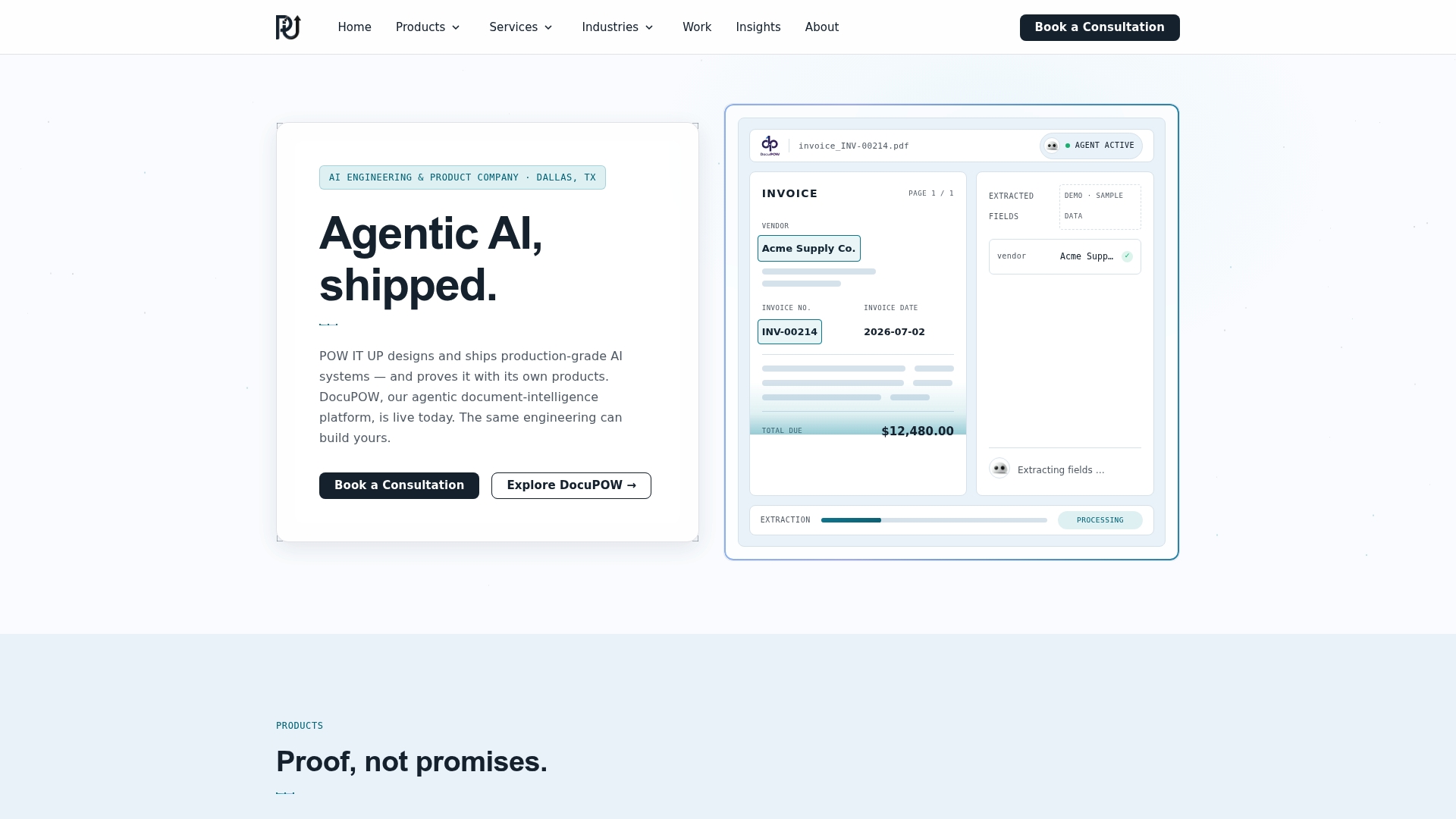
Our AI Agents Development service covers custom agent design from discovery through production handoff, and DocuPOW is a live example of the provenance-first, artifact-backed pattern described in this article, built for document reading and validation with a demo available on request.
| Engagement stage | What it delivers |
|---|---|
| Discovery | Mapping of the client’s context sources, data flows, and compliance needs |
| Pilot | Working retrieval and compression choices validated against real client data |
| Production handoff | Monitoring, TEVV checkpoints, and documented ownership for the client team |
If your team is deciding whether to build a context-aware agent in house or bring in engineering support, request a DocuPOW demo or reach out through AI Agents Development to scope a discovery conversation.
Sources
- NIST AI RMF and guidance for Generative AI
- Efficient Context Retrieval for Data-Centric Agents over Heterogeneous Sources (IBM Research)
- Context as a Tool: Context Management for Long-Horizon SWE-Agents (Cat)
FAQ
What does context-aware mean for AI agents?
A context-aware AI agent actively manages what data reaches its model at runtime, filtering, compressing, and tracking the origin of that data, rather than simply having access to a data source. This is distinct from a context-connected agent, which can query a database or API but does not curate or trace what it retrieves.
Who are the big four AI agents?
There is no single, universally recognized list of “big four” AI agents, since the category spans orchestration frameworks, research systems, and commercial products with different scopes. Definitions vary by use case; a more useful comparison looks at whether a given framework separates storage from presentation and supports provenance tracking, as described earlier in this article.
What are the seven types of AI agents?
Common taxonomies group agents by capability, including simple reflex agents, model-based reflex agents, goal-based agents, utility-based agents, learning agents, hierarchical or multi-agent systems, and autonomous long-horizon agents, though the exact count and labels vary across sources. Context-awareness is not tied to any one type; it is an architectural property that can be layered onto most of these categories.
What are the top five AI agents?
There is no single authoritative ranking of the top five AI agents, since performance depends heavily on task type, data environment, and evaluation method. A more reliable approach for technical teams is to run the staged evaluation described earlier, checking storage and presentation separation, retrieval accuracy, long-horizon stability, and provenance documentation, rather than relying on a generic list.
How do context-aware AIs work in production?
In production, a context-aware agent compiles a working context for each model call from durable session and memory stores, applying retrieval, filtering, and compression steps in a defined order. IBM Research’s evaluation found this kind of modular pipeline can cut average input tokens by roughly 66% while approaching the quality of more expensive hierarchical retrievers.