
Business systems modernization now means one thing: redesigning outcome-focused value streams and deploying autonomous AI agents inside an architected control plane, with governance built in from day one. Leaders who succeed start by picking one measurable process to fix, run an integration audit before writing a single line of automation, and codify human-oversight rules using frameworks like READY and the Agentic Operating Model, POW IT UP’s own engagements included.
TL;DR:
- Choosing high-volume, low-variance value streams with measurable KPIs ensures faster and more reliable AI pilot results, such as claims or invoice workflows.
- Conducting an Integration Surface Audit upfront identifies API, authentication, and ownership gaps that could delay or block scaled deployment.
- Success relies on a strong team structure, including an executive sponsor, platform team, and system owners, to support scaling and governance.
- Implementing governance as an integrated architecture with clear provenance logs, escalation protocols, and confidence thresholds prevents unmanaged risks at scale.
- Building or buying depends on process complexity, volume, and integration needs, with a plug-and-play architecture being crucial to avoid costly vendor lock-in.
Table of Contents
- What Does Business Operations Modernization Actually Look Like When Done Right?
- Why Does the Integration Surface Decide Whether Modernization Works?
- How Do You Take a Pilot From Launch to Full Production?
- How Do You Keep Autonomous Agents Accountable at Scale?
- Should You Build Custom Agents or Buy a Platform?
- What ROI and Timeline Should You Actually Expect?
- What Leaders Get Wrong About Modernizing First
- Ready to Modernize? Here’s Where to Start With POW IT UP
- Where This Guide Draws Its Framework
- Sources
- FAQ
What Does Business Operations Modernization Actually Look Like When Done Right?
Most companies still confuse modernization with automation. Automating a task, say, auto-filling a form, saves minutes. Redesigning the entire process around agentic AI, from intake to exception handling to reporting, saves headcount and compounds over time. That distinction between task-level automation and process-level (what practitioners call L3) redesign is the whole game.

Companies that redesign end-to-end processes rather than bolt AI onto isolated steps see materially better returns, with Capgemini’s survey of 1,607 organizations putting average ROI on AI-driven operations investments at 1.7x. The gap between that number and the disappointing pilots most executives have seen almost always traces back to scope: automating a task instead of rebuilding a workflow.
Before picking a pilot, screen candidate value streams against a short list:
- High transaction volume with repeatable structure (claims intake, invoice matching, KYC checks)
- Measurable baseline KPIs already tracked (cycle time, error rate, cost per transaction)
- Enough process variability to prove the agent generalizes, but not so much it can’t be scoped
- A visible customer or employee pain point tied to the metric, not just an internal inefficiency.
Throughput, error reduction, and cost per transaction are the outcomes that justify the investment. Customer experience gains follow once those three move.
Why Does the Integration Surface Decide Whether Modernization Works?
Enterprise system upgrade projects rarely fail because the AI model is weak. They fail because nobody mapped the legacy APIs, authentication models, and system ownership before committing to a delivery date. Integration with production systems is consistently the top blocker to scaled agent deployments, and reports from the field suggest the overwhelming majority of rollouts hit serious production failures rooted in exactly this kind of gap, according to Traversaal’s analysis of enterprise deployment blockers.
Two architectural layers determine whether an agent program scales past its first pilot. The shared context layer, built from ontologies, retrieval-augmented generation, and knowledge graphs, gives every agent a consistent, current picture of the business instead of siloed snapshots. The control plane handles routing requests to the right agent, monitoring performance, enforcing policy, and giving humans observability into what agents are doing in real time. Practitioner research on agent architecture points to message-based coordination, service registries, and protocol standards like MCP as the patterns that hold up at scale, per an arXiv survey of agentic architecture practices.
Run an Integration Surface Audit (ISA) before scoping any build. It follows four steps:
- Tier every system the agent will touch (Tier 1 core systems of record, Tier 4 peripheral tools) by criticality and access difficulty.
- Map authentication gaps, service accounts, and rate limits system by system.
- Identify the human system owners who must approve access, not just the IT team.
- Flag timeline risks tied to each tier before committing to a launch date.
Pro Tip: Run the ISA before you sell the project internally. A four-week audit that surfaces a six-month auth approval process is far cheaper than discovering it mid-build.
How Do You Take a Pilot From Launch to Full Production?
Pick a pilot that is genuinely end-to-end: a full subprocess, not a single task, with high volume and low variance so results are statistically visible within weeks. Claims triage, vendor invoice reconciliation, and policy renewal workflows tend to qualify.
Before promoting any agent past the pilot stage, qualify it the way READY frames the problem: measure reliability under real conditions, quantify the human-oversight burden it still requires, calculate the operating cost per transaction, and only then select the minimum oversight policy that still hits your reliability target. That framing matters because a highly “accurate” agent that needs a human to check every third output is not actually cheaper to run than the manual process it replaces.
Team structure needs to exist before scale, not after:
- Executive sponsor who owns the outcome metric and removes organizational blockers
- Platform team that owns the control plane, shared context layer, and reusable agent components
- Product teams embedded in the business unit who own individual workflows
- Security and compliance reviewing access, auditability, and data handling
- System owners from each Tier 1 or 2 system on the ISA, with a standing seat at rollout reviews
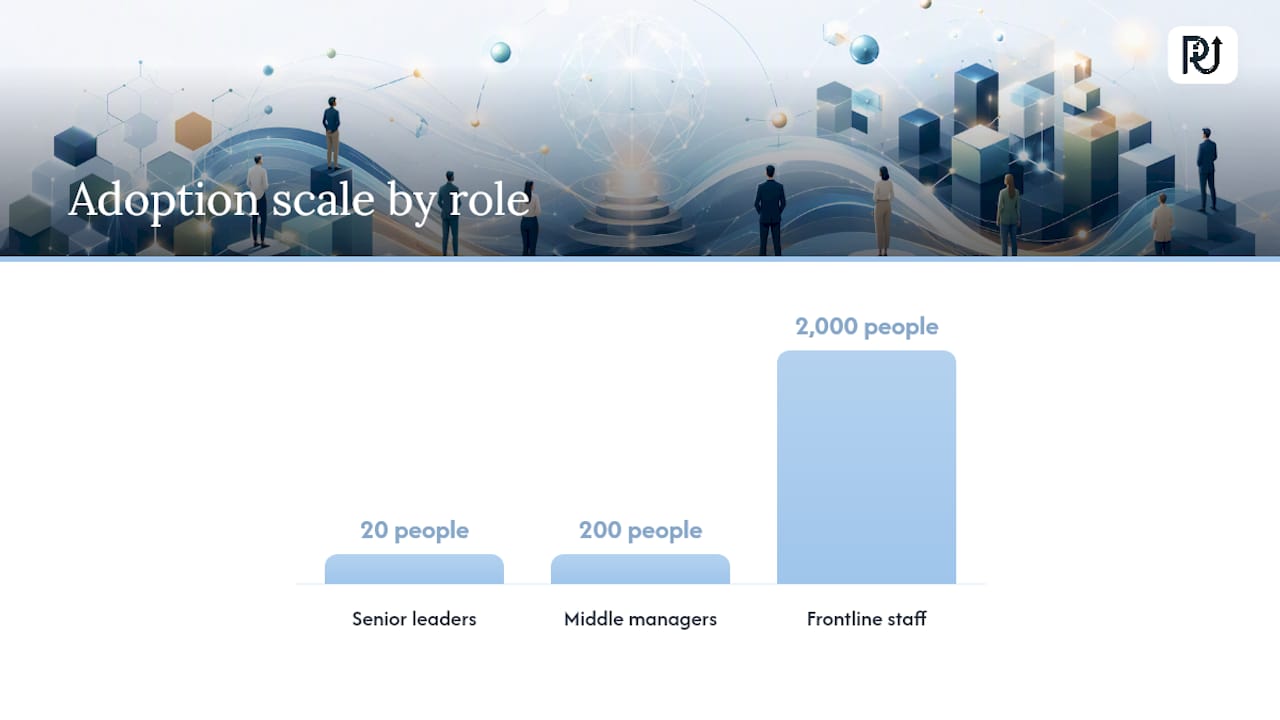
Run monthly OKR reviews tied to the outcome metric, not to agent count or usage volume. Bain’s research on operational scaling describes a “20/200/2,000” pattern, where senior leaders, middle managers, and frontline staff all need to move together for adoption to stick, a detail leaders scoping team structure should not skip.
How Do You Keep Autonomous Agents Accountable at Scale?
Governance has to be architecture, not policy documents nobody reads. The Agentic Operating Model lays out four layers that need to work together: cognitive (how agents reason), coordination (how they hand off work), control (how the system enforces limits), and governance (how humans stay accountable), according to Berkeley’s research on governing the agentic enterprise.
The oversight model you choose depends on stakes and confidence. Human-in-the-loop (HITL) requires a person to approve each action before it executes, appropriate for high-risk, low-volume decisions like large claims payouts. Human-on-the-loop (HOTL) lets agents act autonomously within set confidence thresholds while a human monitors a dashboard and intervenes on exceptions, the right model once an agent has proven reliable on high-volume, lower-risk work.
Guardrail agents enforce boundaries in real time rather than relying on after-the-fact review. A well-designed system also builds safe-action pipelines that automatically block or escalate any action exceeding a predefined blast radius, a control pattern Berkeley’s research flags as essential for catching problems at machine speed rather than after damage is done.
Auditors will expect three things from any agentic system: a provenance trail showing what data an agent used, logged model and version history for every decision, and a clear record of which confidence threshold triggered escalation. Build that logging into the platform layer from the start.
- Set explicit confidence thresholds per action type, not one blanket number
- Log every model version and prompt template tied to production decisions
- Require guardrail agents to escalate, never silently override, ambiguous cases
Pro Tip: Treat the audit trail as a product feature, not compliance overhead. Insurers and healthcare operators asking for SOC 2 or HIPAA evidence will ask for exactly this trail.
Should You Build Custom Agents or Buy a Platform?
The honest answer depends on where the cost actually sits. Buying a platform accelerates time-to-value for common, well-defined workflows where a vendor has already solved the integration patterns. Building custom agents pays off once volume is high enough that per-transaction licensing costs exceed the engineering investment, or when the workflow is specific enough that no off-the-shelf product fits.
Weigh these cost drivers before deciding:
- Upfront engineering: custom builds cost more to start; platforms cost more to run at volume
- Integration effort: a platform’s connectors may not cover your Tier 1 legacy systems
- Ongoing maintenance: who owns model updates, prompt drift, and retraining over time
- License and run costs: per-seat or per-transaction pricing compounds fast at enterprise volume
BCG’s research on scaling agentic AI frames this as a platform-versus-product decision that shapes team structure, not just a procurement choice. Whichever path you choose, insist on a plug-and-replace architecture, where models and vendors can be swapped without rewriting the workflow logic around them. Vendor lock-in at the model layer is the most expensive mistake to unwind later.
What ROI and Timeline Should You Actually Expect?
Set expectations using real numbers, not vendor promises. Capgemini’s survey found average ROI on AI investment in business operations at 1.7x, with agent adoption climbing meaningfully year over year. That is a solid return, not a moonshot, and any pitch promising 10x in a single quarter deserves scrutiny.
The pattern behind stalled programs is consistent: integration blockers surface late, governance approval lags behind the technical build, teams redesign for activity instead of outcomes, and middle managers never get bought in before rollout.
Mitigate each one directly. Run the Integration Surface Audit before scoping. Get compliance and security into governance design at week one, not week twelve. Anchor every pilot to an outcome metric, not an activity count. And loop middle management into the rollout plan before frontline teams see the tool, since Bain’s operational scaling research shows adoption stalls exactly at that layer.
What Leaders Get Wrong About Modernizing First
Most modernization failures I have studied trace back to one avoidable mistake: leaders chase a flashy pilot instead of a boring, high-volume, well-instrumented process. Boring wins. A claims-intake workflow with three years of clean baseline data will outperform a “reimagine everything” initiative every time, because you can prove the number moved.
The second mistake is treating governance as a phase two problem. By the time an agent is handling real transactions, retrofitting audit trails and confidence thresholds costs multiples of what it would have cost to design them in from the start. Build the control plane and the guardrails alongside the first pilot, not after it.
If you take one thing from this guide: run the Integration Surface Audit before you promise a delivery date to anyone, and pick a single outcome metric before you write a line of automation logic.
— Syed Naveed Abbas
Ready to Modernize? Here’s Where to Start With POW IT UP
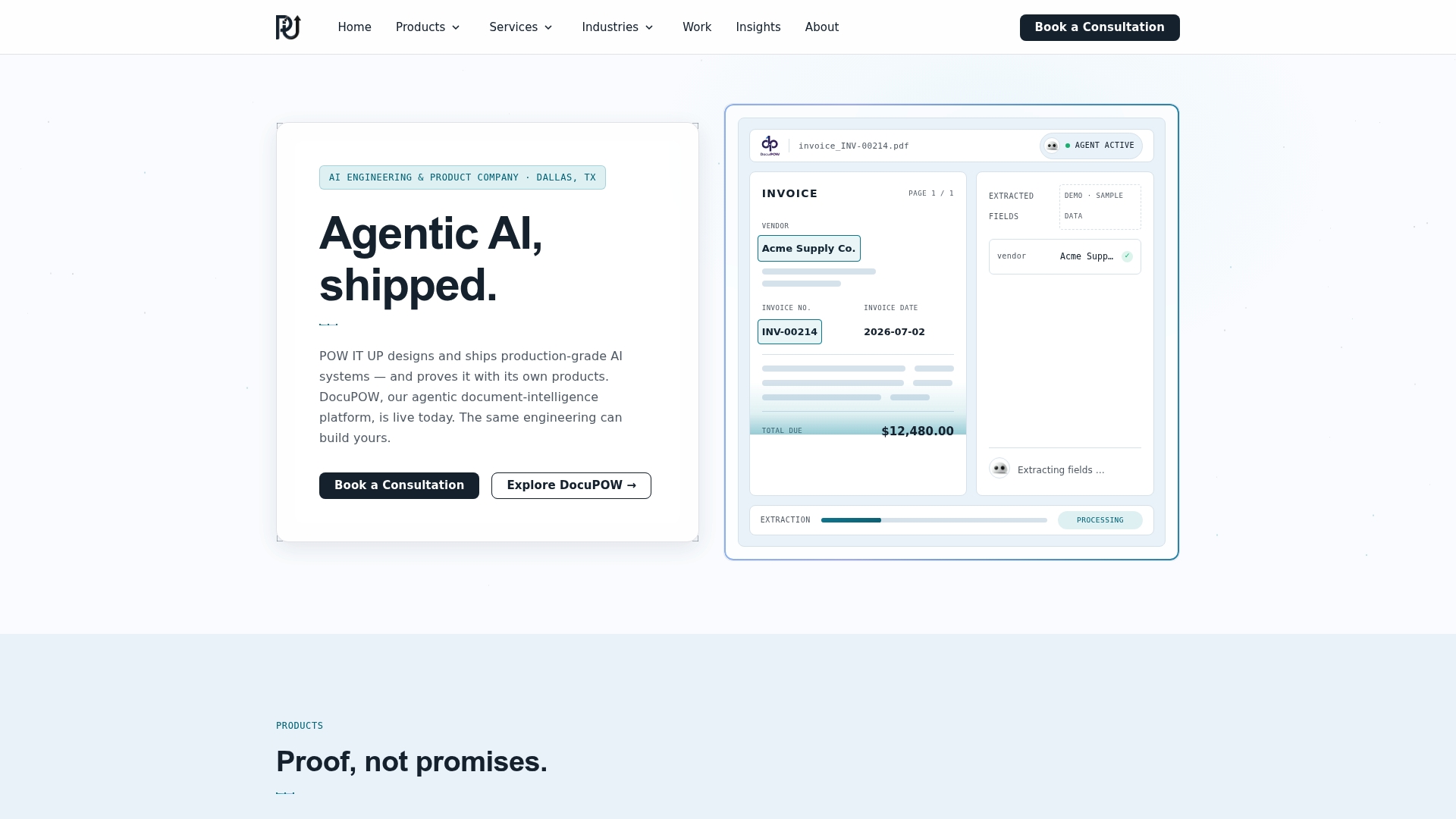
This kind of work involves custom AI agents designed around your actual integration surface, not a generic script layered on top of it. If document-heavy workflows, like claims intake, invoice matching, or KYC review, are your bottleneck, DocuPOW is a live product you can see in action rather than take on faith.
The fastest way to know if your organization is ready to modernize is to stop guessing at the architecture and start with a scoped audit. POW IT UP’s AI Integration team can run an Integration Surface Audit against your Tier 1 and Tier 2 systems, and its AI Agents Development group builds the custom digital workforce once you know exactly what you’re integrating against. For teams weighing secure deployment patterns alongside a build, partner resources like MARFI’s work on governance-by-design are worth a look too. Request a DocuPOW demo or book an Integration Surface Audit conversation to see what a scoped roadmap looks like for your business.
Where This Guide Draws Its Framework
The qualification approach referenced throughout comes from READY, which measures reliability, oversight burden, and cost together rather than accuracy alone. BCG’s scaling research informs the process-redesign and platform-versus-product framing. The governance layers described come from Berkeley’s Agentic Operating Model, and adoption figures cite Capgemini’s operations research.
Sources
- Scaling AI requires new processes, not just new tools (BCG)
- Governing the agentic enterprise: a new operating model (Berkeley CMR)
- AI agent integration challenges: enterprise deployment blocker (Traversaal blog)
FAQ
How Long Does Business Systems Modernization Typically Take?
A single well-scoped pilot can show measurable results within weeks, but full production scale across multiple workflows varies depending on integration complexity and governance approval cycles.
What Should the First Modernization Pilot Look Like?
Pick one end-to-end, high-volume subprocess with low variance and existing baseline metrics, such as invoice matching or claims triage, rather than a broad, multi-department initiative.
What’s the Difference Between HITL and HOTL Oversight?
Human-in-the-loop (HITL) requires approval before every agent action, while human-on-the-loop (HOTL) lets agents act autonomously within set confidence thresholds while a human monitors for exceptions.
What Does POW IT UP Charge for AI Integration or Agent Development?
POW IT UP’s pricing for AI Integration and AI Agents Development is available on request through the AI Integration and AI Agents Development pages.