

Automation-first business operations means treating automation as the default way to handle repeatable work, not a last resort when teams get overwhelmed. The core payoff is capacity: leaders who adopt this mindset can scale output without adding headcount at the same rate, while keeping quality consistent and throughput faster than manual processes allow.
TL;DR:
- Automating long processes requires clean data, standardized workflows, and clear KPIs to avoid scaling failures from fragmented systems.
- Pilot programs should target high-volume, rule-based tasks with straightforward exceptions and measurable success criteria before scaling.
- Building a reliable automation infrastructure involves API-based integrations, consistent data models, and thorough observability through audit trails and dashboards.
- Governance practices must include clear ownership, periodic performance measurement, and incident management, following frameworks like NIST AI RMF.
- Most successful automation initiatives focus on high-impact areas such as reporting, onboarding, and invoice processing to achieve faster cycle times and capacity expansion.
Table of Contents
- The core principles of an automation-first approach
- Why agentic AI makes automation-first urgent now
- A sequenced roadmap for implementing automation-first operations
- What to measure before you automate anything
- The technical foundation that makes automation reliable
- Governance and risk management for automation-first systems
- High-impact use cases and what ROI actually looks like
- Common pitfalls in scaling automation, and how to avoid them
- How POW IT UP approaches automation-first transformations
- Where POW IT UP fits if you are ready to build
- Sources
- FAQ
The core principles of an automation-first approach
An automation-first operation starts with a simple rule: if a task is repeatable, automation is the first option considered, not the fallback after a team is drowning. This is shift-left thinking applied to operations, catching process design decisions before inefficiency becomes embedded habit.
Three pillars make this work in practice.
- Default to automation: new processes are designed for automation from day one, rather than automated after they become manual bottlenecks.
- Build for scale: workflows are designed so volume can grow tenfold without a proportional increase in staff or errors.
- Measure continuously: straight-through processing rate, cycle time, and error rate are tracked as ongoing signals, not one-time audit metrics.
None of this depends on a specific vendor or platform. It is a way of designing work: process-centric, measured, and built so that once something is automated, it stays observable and adjustable rather than becoming another black box nobody wants to touch.
Why agentic AI makes automation-first urgent now
Task automation used to mean scripting one step: extract a field, populate a form. Agentic AI changes the scope. Systems can now chain multiple steps, make decisions between them, and hand off work across departments without a person stitching each stage together.
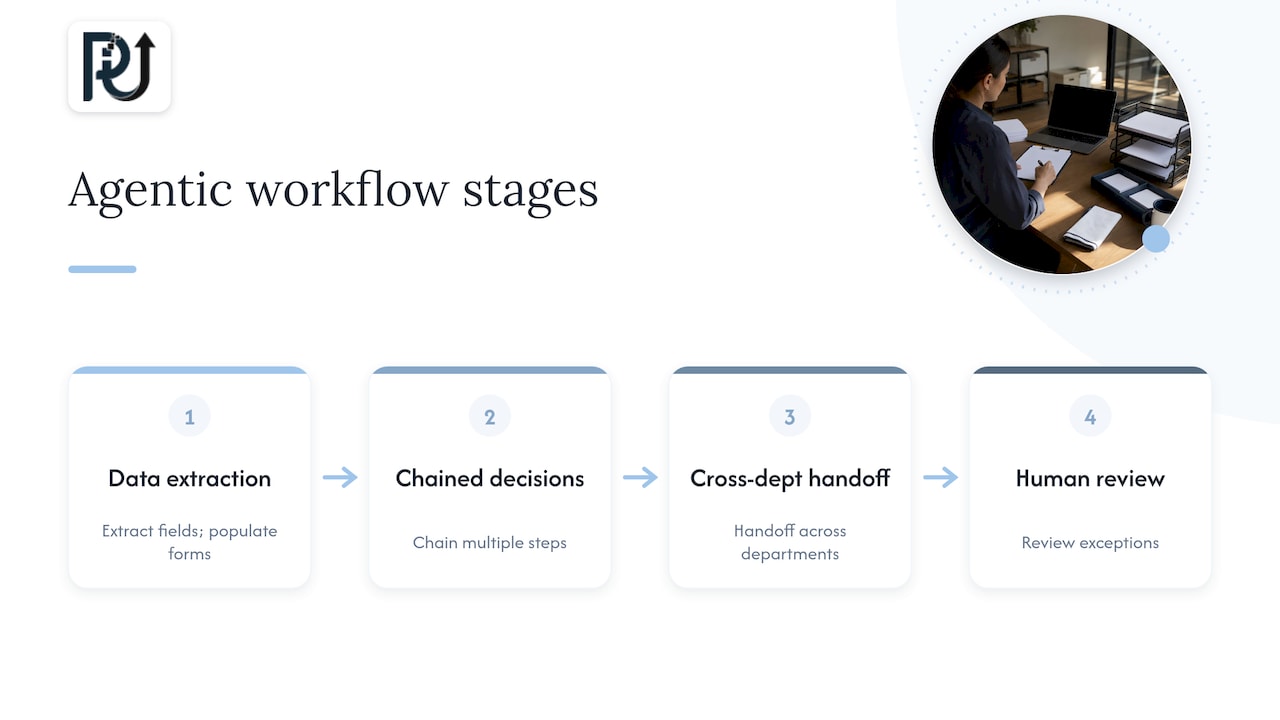
Many organizations now deploy AI agents for multi-stage workflows, and the shift from pilots to production is well underway, with a smaller share already running agents across functions and most planning more complex use cases in 2026. That is a shift from augmentation, where AI assists a person, to task handoff, where AI completes the task and a person reviews exceptions.
The catch is readiness. Agentic systems only work as well as the data and integrations they can reach. Companies with fragmented systems and undocumented handoffs see slower time-to-value than those with clean data access and modern APIs, regardless of how capable the underlying models are.
A sequenced roadmap for implementing automation-first operations
Automation-first programs succeed or stall based on sequencing. Layering automation onto a messy process just automates the mess faster. The order below reduces that risk.
- Diagnose: map current workload, cycle times, and error rates to size the addressable opportunity before touching any tooling.
- Design: standardize the process itself, removing exceptions and undocumented workarounds so automation has a clean target.
- Pilot: automate a single bounded workflow with clear success criteria, safety guards, and a defined exception path.
- Scale: once the pilot clears its KPIs, build reusable components and centralize the pattern across similar processes.
Each stage needs a go or no-go gate. A pilot that misses its cycle-time or error-rate target should be remediated, not pushed into production at scale. This sequencing mirrors what BCG’s Zero Ops research found: centralizing and simplifying operations before layering on automation or agentic AI can capture significant cost savings in the first program cycle, while skipping straight to automation on fragmented processes tends to produce scaling failures instead.
Pro Tip: Run the pilot on a process with clear volume and a bounded set of exceptions, never on the messiest process in the building.
What to measure before you automate anything
Before any automation project starts, leaders need a current-state map: transaction volume, average cycle time, exception rate, and where handoffs between systems or teams actually happen. Without this, it is impossible to estimate the size of the opportunity or where automation will pay off fastest.
- Volume and cycle time: how many transactions move through the process monthly and how long each one takes end to end.
- Exception rate: what share of cases deviate from the standard path and why.
- FTE-equivalent estimate: how many hours of manual work the process consumes, translated into a rough headcount equivalent.
- Straight-through processing uplift: the percentage of cases that could bypass human touch entirely once standardized.
Common blockers show up quickly: fragmented data sitting in disconnected systems, technical debt in legacy tools, and handoffs nobody wrote down because “everyone just knows how it works.” Quick-win candidates tend to be processes like lead response, employee onboarding, or invoice processing, all high-volume, rule-based, and painful enough that the payoff is obvious within a quarter.
The technical foundation that makes automation reliable
Automation that survives contact with real operations needs infrastructure behind it, not just a script that works in a demo. A programmable back office built on API-first integrations lets systems exchange data without brittle, one-off connections.
- Canonical data models: a single, consistent structure for core records prevents automations from disagreeing about what a “customer” or “invoice” actually looks like.
- Secure credential management: automated systems touching sensitive data need the same access controls a person would, not shared logins.
- Observability: audit trails, exception queues, and real-time dashboards let a team see what an automation did and why, not just that it ran.
- CI/CD and testing: agents and automations need version control and testing pipelines the same way software does, because untested changes break production quietly.
Skipping observability can cause loss of trust when something goes wrong, as it becomes hard to explain the failure.
Governance and risk management for automation-first systems
Automation without governance eventually creates a mess nobody can trace back to its source. The NIST AI Risk Management Framework organizes this work into four functions: GOVERN, MAP, MEASURE, and MANAGE, and it maps cleanly onto an automation-first program.
- Govern: assign clear ownership for AI-enabled automation, including who approves new use cases and who owns the human-in-the-loop configuration.
- Map: document acceptable use cases per workflow and flag where automation should not run unsupervised, such as decisions with legal or financial consequences.
- Measure: periodically check accuracy, bias, and performance drift rather than assuming a system that worked at launch still works six months later.
- Manage: build incident playbooks before something breaks, and vet third-party components the same way you would vet a new hire’s access.
Partner resources like Collett Systems’ risk assessment framework offer a practical starting point for the MAP and MEASURE stages if a team needs a structured way to begin.
Pro Tip: Write the incident playbook before the first agent goes live, not after the first failure.
High-impact use cases and what ROI actually looks like
Not every process is worth automating first. The highest-leverage candidates share three traits: high volume, repeatable structure, and a clear, measurable outcome.
- Data analysis and reporting: recurring reports that once took analysts days can run on a schedule with exception review only.
- Customer onboarding: document collection and verification steps move from manual chasing to automated intake and validation.
- Claims or invoice intake: high-volume, rule-based decisions are strong candidates for straight-through processing gains.
Realistic outcomes include higher straight-through processing rates, shorter cycle times, fewer manual errors, and capacity redeployed to higher-value work rather than headcount cuts. A conservative pilot-sizing check: estimate monthly volume, multiply by average manual handling time, and compare that redeployed time against the cost of building and maintaining the automation before committing to scale.
Common pitfalls in scaling automation, and how to avoid them
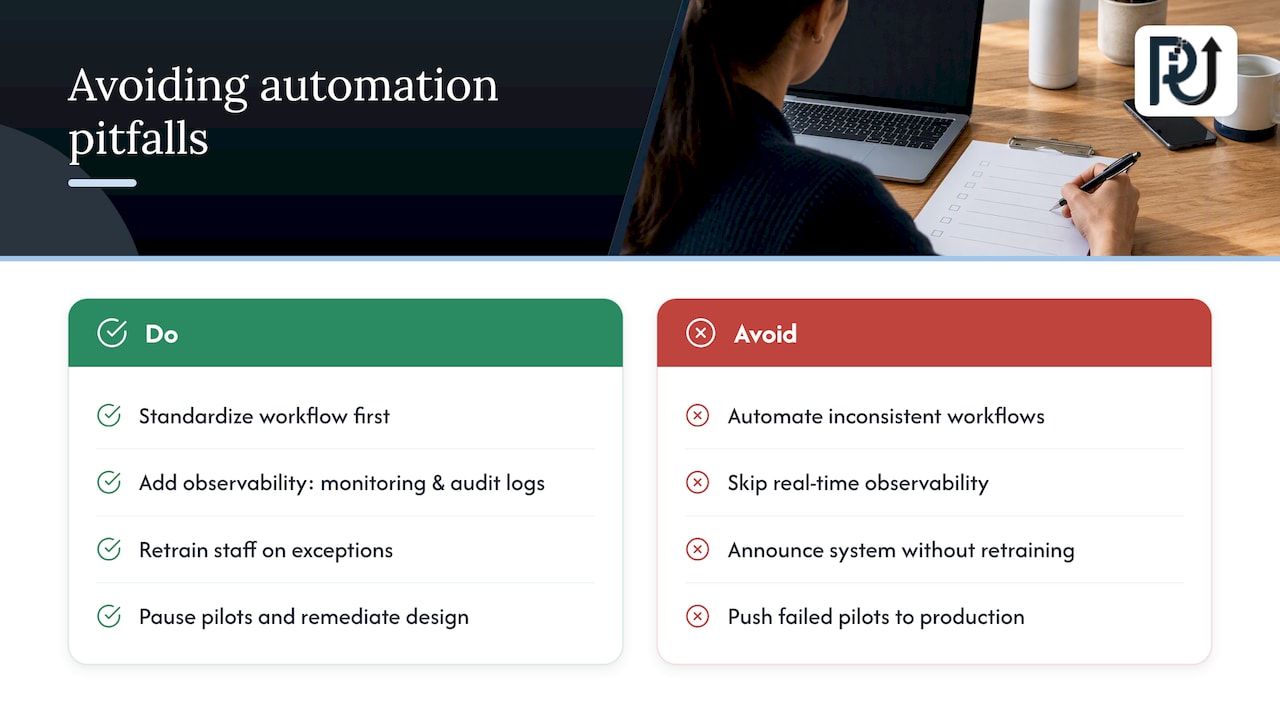
The most common failure is sequencing: layering agents onto a workflow that was never standardized, which tends to automate inconsistency at higher speed. The second is skipping observability. Real-time monitoring and audit logs are not optional extras, because the first production failure of an autonomous system is close to inevitable, and teams without visibility into what happened tend to abandon the effort rather than fix it.
Change management gets underestimated too. Staff need retraining on exception handling, not just a memo announcing the new system. When a pilot misses its KPIs, the right move is to pause and remediate the underlying process, not push it into production and hope volume fixes it.
Pro Tip: Treat a missed pilot KPI as a design signal, not a rollout delay.
How POW IT UP approaches automation-first transformations
Our starting point is always the same: map the workflow before designing anything. A diagnostic should tell you where the volume sits, where exceptions cluster, and whether the data is clean enough to automate against. From there, we design bounded agents around a single process, prove the pilot against clear KPIs, then scale the pattern once it holds.
— Syed Naveed Abbas
Where POW IT UP fits if you are ready to build
Reading a roadmap is one thing. Building a bounded pilot that survives production is another, and that gap is where most automation-first plans stall. A company like POW IT UP can serve as a technical architect for that gap: designing, building, and deploying custom AI agents rather than handing over generic scripts and calling it done.
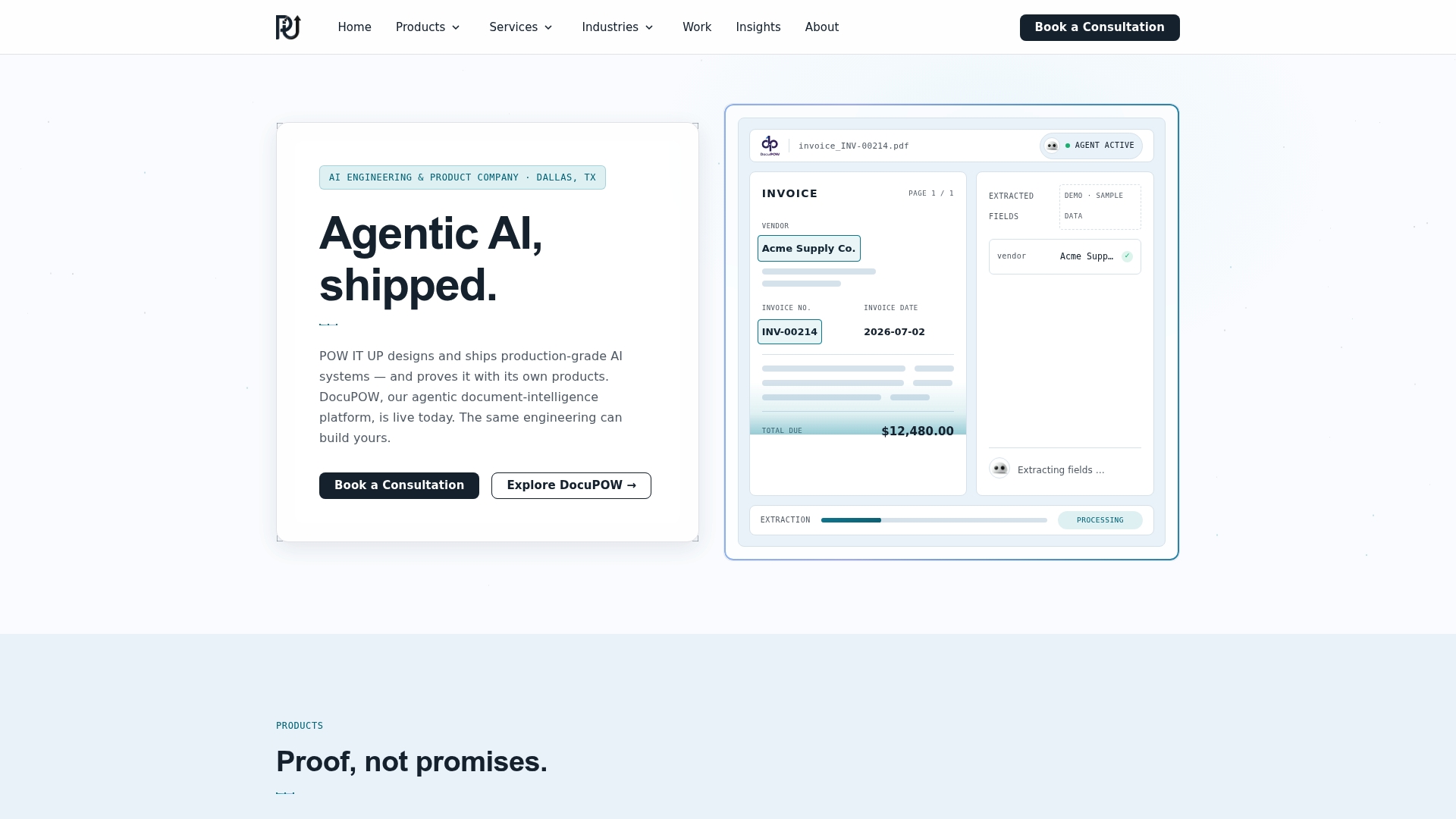
- DocuPOW: reads and validates documents automatically, built for teams drowning in intake and verification work. Details and a live demo are on the DocuPOW product page.
- AI Agents Development: custom, context-aware agents engineered for a specific workflow rather than a one-size-fits-all bot, detailed on the AI Agents Development page.
- AI Integration: connects automation into existing enterprise systems without ripping out what already works, described on the AI Integration page.
The typical engagement follows the same sequencing this article recommends: a diagnostic to size the opportunity, a bounded pilot with clear success criteria, then a scale phase once the pilot proves out. If you are weighing where to start, request a demo through the DocuPOW page or reach out through AI Agents Development to scope a pilot.
Sources
For governance, the NIST AI Risk Management Framework is the standard reference for building GOVERN, MAP, MEASURE, and MANAGE practices into automation programs. For adoption data, the 2026 State of AI Agents Report and McKinsey’s research on AI value capture show where organizations are gaining ground. For sequencing, BCG’s Zero Ops paper lays out the centralize-then-automate framework referenced throughout this piece.
- The 2026 State of AI Agents Report
- Artificial Intelligence Risk Management Framework (AI RMF 1.0)
- Zero Ops in practice
- Streamlining business operations at Microsoft with an AI toolkit
FAQ
How do you automate business operations?
Start by mapping the current process to find volume, cycle time, and exception rates, then standardize the workflow before introducing automation. Pilot on a bounded process with clear success criteria, then scale the pattern once it clears its KPIs, following the sequencing outlined by BCG’s Zero Ops research.
What are the top automation tools to consider?
The right tools depend on the workflow: document processing, workflow orchestration platforms, and custom AI agents each serve different needs. Rather than picking a single tool first, size the process and its data requirements, then match tooling to the specific bottleneck you are solving.
Can you learn automation basics in two months?
You can learn the fundamentals of process mapping, workflow design, and basic automation tools within a couple of months with consistent practice. Building production-grade, agentic systems that handle real business volume typically requires deeper engineering expertise and testing practices beyond that timeframe.
Is automation difficult to learn and implement?
Learning basic automation concepts is accessible to most operations professionals, but implementing reliable, production-grade automation is harder because it requires clean data, governance, and observability. Programs that skip standardization or monitoring tend to struggle regardless of how simple the initial tooling seemed.
What results should leaders expect from automation-first operations?
Expect faster cycle times, fewer manual errors, and higher straight-through processing rates on the automated workflow, with capacity redeployed to higher-value work rather than immediate headcount cuts. Properly sequenced programs, centralizing and standardizing before automating, can capture measurable cost savings in the first cycle according to BCG’s findings.